Impurity model for mixed-valent Mn
31/Mn
41ions
P. Schlottmann
Department of Physics, Florida State University, Tallahassee, Florida 32306
Kong-Ju-Bock Lee
Department of Physics, Ewha Womans University, Seoul 120-750, South Korea ~Received 14 May 1997!
Intermediate valent tri- and tetravalent manganese ions play an important role in LaMnO3-based systems. We consider a Mn impurity with five orbitals in cubic symmetry which hybridize with conduction electrons. The exchange interaction in the d shell maximizes the impurity spin. We study the valence of the Mn impurity as a function of the splitting of the egto t2gorbitals in zero magnetic field and for the totally spin-polarized state. The lifting of the degeneracy of the eglevels due to a small quadrupolar field, related to the Mn-O bond length or a Jahn-Teller effect, is also investigated. Possible implications on the magnetoresistance are dis-cussed.@S0163-1829~97!02346-1#
I. INTRODUCTION
Recently, Jin et al.1discovered a 1000-fold change in the resistivity in La0.67Ca0.33MnO3 films when a magnetic field
is applied close to the Curie temperature. In view of potential applications the study of this effect, now known as colossal magnetoresistance, has quickly spread to other compounds of the LaMnO3 family.2 Most attempts to theoretically
ex-plain the phenomenon invoke the double-exchange mechanism.3The large magnetoresistance occurs close to the metal-insulator and paramagnetic-ferromagnetic transitions of the compounds and a recent study on O18 substitution4
strongly suggests that the coupling to the lattice, either in the form of polarons or the Jahn-Teller effect, plays an important role.5,6The coupling to the lattice distortions manifests itself in changes of the Mn-O bond lengths, i.e., in local quadru-polar distortions in an otherwise cubic environment.
The manganese ions exist in a mixed trivalent-tetravalent state in which each of the three t2gorbitals is singly occupied
with their spin coupled to a total spin S53/2. The eg
orbit-als, on the other hand, are empty for Mn41and occupied by one 3d electron in Mn31, which is ferromagnetically corre-lated with the t2g electrons. The intermediate valence char-acter of the Mn ions arises from the eg electron, which may
be localized at the Mn ion or become an itinerant electron either via hopping or hybridization.7 Lifting the degeneracy of the two eg levels corresponds to a local change in the
Mn-O bond lengths.
Colossal magnetoresistance is a collective phenomenon of a lattice of Mn and O atoms, as clearly manifested by the nearby metal-insulator and paramagnetic-ferromagnetic tran-sitions. We study here the partial aspect of an isolated Mn impurity embedded in a crystal represented by a band of conduction electrons. As in the physics of heavy fermions, the solution of the single-impurity problem is believed to be an important step toward the understanding of the full lattice problem. The model under consideration is the multichannel generalization of the Anderson impurity model introduced and solved by means of Bethe’s ansatz by Tsvelik and Wiegmann,8now with the additional crystalline field terms.
The ground state of the impurity is then no longer the orbital singlet, but has a more complex structure since the t2gand eg
orbitals are not equally populated.
The Hamiltonian H5H01Hcf is given by8,9
H05
(
kms vF~k2kF!ckms † c kms1e(
ms dm†sdms 1V(
kms ~ckms † dms1dms † ckms! 21 2Umm(
8ss8 dms † d m8s8 † dm8sdms8 ~1! and Hcf5 1 5Dc(
sS
3m(
Peg nms22(
mPt2g nmsD
11 2Dq(
s ~neg1s2neg2s! . ~2!Here ckm† s creates a conduction electron with momentum k in the orbital channel m and spins, and dm†s creates a local-ized electron with orbital symmetry m and spin s. The ki-netic energy is linearized about the Fermi level (vF is the Fermi velocity, to be equated to one below!, V is the hybrid-ization matrix element,e is the one-particle energy of the d electrons, and U is the exchange coupling strength, which for
U.0 favors aligned spins. A strong U then maximizes the
spin of the d shell of the Mn ion as required by the first Hund rule. In the absence of crystalline fields the maximum spin is then n/2, where n is the number of orbital channels. The two terms in Eq.~2! represent the cubic and quadrupolar crystal-line fields, splitting the d orbitals into t2gand eg, and lifting
the degeneracy of the two eglevels, respectively.~The
split-ting of the t2g levels by the quadrupolar field can be ne-glected because they are filled shells for the Mn ions.!
Tsvelik and Wiegmann8 diagonalized model ~1! in the limit U@e2U(n21)/2@nV2/2 where the configuration 56
with n localized electrons hybridizes with states of the con-figuration with (n21) localized electrons. In the integer va-lent limit the Bethe ansatz solution corresponds to the ex-actly spin-compensated multichannel Kondo problem with a singlet ground state. This situation is experimentally realized in dilute alloys of Fe and Cr in simple metallic hosts, such as Cu and Ag.9Excellent agreement between theory and experi-ment for the susceptibility, the specific heat, the magnetiza-tion, and the low-temperature resistivity was obtained for the dilute FeCu system in terms of only one fitting parameter ~the Kondo temperature!.10A similar comparison for the
al-loys FeAg and CrCu was also successful.11
In this paper we use Tsvelik and Wiegmann’s8exact so-lution to study effects of the crystalline field splittings on the orbital manifold. The manganese ions are in a cubic environ-ment, so that the t2g and eg levels have different energy.
Each of the t2g orbitals is simply occupied, giving rise to a
total spin S53/2, while the occupation of the eg levels
de-pends on the cubic crystalline field strengthDc. The
quadru-polar splitting of the eg orbitals, which arises from the
cou-pling to the lattice, is believed to be small and is studied in linear response. The integral equations of the exact solution become very complicated when the orbital singlet condition is lifted. Therefore we limit ourselves to investigate two lim-iting cases, namely, the zero-magnetic-field situation and the fully-spin-polarized Mn impurity. The latter case is impor-tant because colossal magnetoresistance takes place close to the Curie temperature of the paramagnetic-ferromagnetic transition, and due to strong short-range correlations, the spin of the Mn impurity is expected to be at least partially oriented. Note that in the present model all localized elec-trons are ferromagnetically correlated maximizing the spin.
The rest of the paper is organized as follows. The scatter-ing matrix and the Bethe ansatz integral equations for the ground state8are restated in Sec. II. In Sec. III the integral equations are solved as a function of cubic crystalline field in zero magnetic field and for the spin-polarized state with
n55 and n54. The n54 situation simulates the situation of
an infinite Coulomb repulsion among the eg orbitals~simple
occupation!. For the cases with n55 we also obtain the lin-ear response to a quadrupolar field~Jahn-Teller or polaronic effect!. The magnetoresistance is also briefly discussed. Con-cluding remarks follow in Sec. IV.
II. BETHE ANSATZ EQUATIONS
Since the Hamiltonians ~1! and ~2! commute, the eigen-states of H0 are also the eigenstates of the total Hamiltonian
and only the energy eigenvalues change. The scattering ma-trix for the two-electron problem factorizes into the scatter-ing matrices within the spin and orbital sectors,
Sˆ(k)5Sˆs(k)^Sˆm(k), where8
Sˆs~k!5~kIˆs2iV2Pˆs!/~k2iV2!,
Sˆm~k!5~kIˆm1iV2Pˆm!/~k1iV2!. ~3!
Here k is the momentum transfer and Iˆs, Iˆm, Pˆs, and Pˆm
are the identity and permutation operators for the spin and orbital indices, respectively. Each of the scattering matrices ~3! separately satisfies the triangular Yang-Baxter relation.
Hence, their product also does, which is the necessary con-dition for the integrability of the model.
The Bethe ansatz solution is now straightforwardly con-structed in terms of (n11) sets of rapidities, namely, one set for the charges $kj%, one set of spin rapidities $la%, and
(n21) sets of orbital rapidities$ma(l)%, l51, . . . ,n21. Each eigenstate of the system is specified by its rapidities, which satisfy the discrete Bethe ansatz equations. The rapidities have in general complex values and for the ground state in the thermodynamic limit they can be classified according to8 ~i! real charge rapidities k corresponding to unpaired propa-gating electrons, ~ii! complex-conjugated charge rapidities related to the spin rapidities via k65l6i12V
2~all l are real!
representing pairs of electrons with opposite spin, ~iii! real orbital rapidities m(l)for spin-unpaired electrons in specific orbital channels, and ~iv! complex conjugated orbital rapidi-ties m(l)65L(l)6i1
2V
2 ~all L(l) are real! corresponding to
spin-paired electrons in the different orbital channels. This general structure simplifies with the orbital singlet condition, where all the orbital channels are equally populated. In the presence of crystalline fields, however, the orbital levels are occupied differently, breaking in this way the orbital singlet.12
The actual occupation of the states depends on the mag-netic field, the chemical potential, and the crystalline fields, and is best studied in terms of the distribution functions for the rapidities and their holes, i.e.,r(k) andrh(k) for the real
charge rapidities, s(l) and sh(l) for the spin rapidities,
zl(m) and zlh(m) for the real orbital rapidities, and kl(L)
and klh(L) for spin paired orbital rapidities. The
ground-state Bethe ansatz equations then take the form13
rh1r1a1!s2s!A11!z12s!A12!k1 5~1/2p!1~1/L!a1~k21/J!, ~4! sh1s1a2!s1a1!r2s!A21!z12s!A22!k1 5~1/p!1~1/L!a2~l21/J!, ~5! zjh1A11!Cjk!zk1A12!Cj k!kk 5dj1s!~A11!r1A12!s!, ~6! kjh1A22!Cjk!kk1A21!Cjk!zk 5dj1 s!~A21!r1A22!s!, ~7!
where! denotes convolution, V has been equated to one, and
J5V2/p(e2eF) is the Kondo exchange with eF being the
Fermi energy. The integration kernels are the Fourier trans-forms of
an~v!5exp~2nuvu/2!, s~v!51/@2cosh~v/2!#, Anm~v!5coth~uvu/2!$exp~2uvuun2mu/2!
2exp@2uvu~n1m!/2#%,
Cj k~v!5djk2s~v!~djk211dj k11!. ~8!
The right-hand sides of Eqs. ~4! and ~5! represent the driving terms of the integral equations. The distribution func-tions can be separated into a host~electron gas! contribution
~independent of L) and an impurity part, which arises from the 1/L driving terms. In Sec. III we only study the impurity contributions. The energy, the total number of electrons, the magnetization, and the population of the orbitals are given by E/L5
E
dkkr~k!12E
dlls~l!, N/L5E
dkr~k!12E
dls~l!, Sz/L5 1 2E
dkr~k!, m~l!5(
j5l11 n nj5E
dm zl~m!12E
dLkl~L!, ~9!where nj is the population of the j th orbital level arranged
such that n1>n2>•••>nn.
III. RESULTS
In this section we solve the Bethe ansatz integral equa-tions for the impurity in three limiting cases to study the effects of the crystalline field splitting.
A. Zero magnetic field
In zero magnetic field the magnetization vanishes and all the electrons are spin paired. Hence, necessarilyr(k)[0 and
zj(m)[0 for all j. We consider n55 ~five d orbitals! split
into a lower-lying t2g triplet and an excited eg doublet. Hence n15n25n3 and n45n5~no quadrupolar splitting!, so
that the rapidities L(l) for l51, 2, and 4 fill the entire real without leaving holes, i.e., k1h(L)5k2h(L)5k4h(L)[0.
Fourier transforming Eq.~7! we expressk1(L),k2(L), and k4(L) as a function of the remaining densities and eliminate
them from the system of equations. The remaining two equa-tions involves(l),sh(l),k3(L), andk3h(L).
Boths(l) andk3(L) give rise to valence fluctuations of the impurity. The fluctuations induced by s are global charge fluctuations, which in the Kondo limit are less inter-esting than the fluctuations between the t2gand eglevels. We consider here t2g orbitals that are integer valent, i.e., no
glo-bal charge fluctuations. The energy scales are also very dif-ferent: On the one hand, the fluctuations in the charge sector are of the order of the hybridization width V2, while on the other hand the fluctuations in the orbital sector are of the order of the Kondo temperature and the crystalline field split-ting. The former can be suppressed by choosing sh(l)[0
or, equivalently, by placing the impurity t2g levels well
be-low the Fermi level. The problem is in this way reduced to a single equation, namely,
k3h~L!1k3~L!5a5~L21/J!. ~10!
Here k3 is nonzero in the interval @2`,Q# and zero
else-where, whilek3h is nonzero in the interval@Q,`# and zero
elsewhere. Hence the population of the eg levels is given by
neg11neg2511
2
parctan
S
Q21/J
2.5
D
, ~11!and each of the t2glevels contains exactly one electron. This
follows from the last of the equations ~9!. Following the usual notation we parametrize Q21/J5(1/p)ln(TK/Dc), where TK is the Kondo temperature. With increasing cubic
crystalline field Dc the population of each of the eg levels monotonically decreases from 1 for zero splitting to 0 for very large splitting, as displayed in Fig. 1~a!. The character-istic energy is the Kondo temperature. For small and large splitting the dependence on Dc is logarithmic, i.e., 5/uln(TK/Dc)u, which is characteristic of the asymptotic
free-dom of the respective spins, S55/2 and S53/2, respectively. Assuming that the quadrupolar splitting is much smaller than the cubic splitting, we can treat the splitting of the eg
levels in perturbation theory. The splitting is determined by the k4h(L) density. There are now two coupled integral
equations yieldingk3(L),k3h(L),k4(L), andk4h(L). The
integral equation determining the splitting of the eg levels is
k4h~L!1k4~L!1
E
2` B dL8
a2~L2L8
!k4~L8
! 5E
2` Q dL8
a1~L2L8
!k3~L8
!, ~12!wherek4 is nonzero in the interval @2`,B# and zero
else-where, while k4h is the complementary function, and we
parametrize B21/J5(1/p)ln(TK/Dq). The function k3(L)
on the right-hand side of Eq.~12! plays the role of the driv-FIG. 1. ~a! Occupation of one eg orbital and ~b! the response function I2 as a function of TK/Dc for n55 in the absence of a magnetic field. The splitting of the eg levels due to a quadrupolar field is proportional to the function I2.
ing term for the splitting of the eg levels. The second
equa-tion is again Eq. ~10!, but with an additional driving term involving an integral over k4h. Sincek4h is small, we can
neglect this term in the integral equation fork3, and use the
solution of Eq. ~10! in Eq. ~12!. This approximation only changesk4in higher order than linear inDq@the corrections are of order (Dq/Dc)3#. Equation ~12! can now be solved
with the Wiener-Hopf method, and the leading contribution for B→` is
E
B ` dLk4h~L!5exp@2p~B2Q!#I2~Q21/J!, I2~Q21/J!5S
2 peD
1/2E
2` 0 dxepxa5~x1Q21/J!, ne g15neg2exp@2p~B2Q!#I2~Q21/J!, neg25neg1exp@2p~B2Q!#I2~Q21/J!, neg5 1 21 1 parctanS
Q21/J 2.5D
. ~13!Since B2Q5(1/p)ln(Dq/Dc), the splitting of the eglevels is
indeed proportional to Dq. The function I2(Q21/J) is dis-played in Fig. 1~b! and shows features characteristic of a charge susceptibility, namely, a maximum forDc'TK. Note
that the main assumption in this calculation isDq!Dc.
B. Spin-polarized ground state
Equations ~4!–~7! again simplify in the spin-polarized limit, where all electrons are unpaired and hence the densi-tiess(l) andkl(L) for l51, . . . ,4 are all identically zero. If we consider only the cubic crystalline field splitting be-tween the t2gand eg, then them(l)for l51, 2, and 4 fill the
entire real axis without leaving holes so that zlh(m)[0 for l51, 2, and 4. Fourier transforming Eqs. ~4! and ~6! the
system of equations can be reduced to two coupled integral equations forr(k),rh(k),z3(m), andz3h(m). Both densities r andz3give rise to charge fluctuations, the former between the impurity and the conduction band, while the latter in-duces transitions between the two crystalline field multiplets. As for the zero-magnetic-field case we suppress the global charge fluctuations by equating rh(k) identically to zero.
The remaining integral equation only involves z3 andz3h z3~m!1z3h~m!1
E
Q `
dm
8
a2~m2m8
!z3h~m8
!5a4~m21/J!1a6~m21/J!, ~14!
where the function z3(m) is nontrivial only in the interval
@2`,Q# and the hole distribution is the complementary function. The integration limit parametrizes the cubic field strength Q21/J5(1/p)ln(TK/Dc). This equation can be
solved either numerically or with the Wiener-Hopf method. The population of the t2g levels is one electron per orbital
~sincerh[0) and the occupation of each egorbital is one for
Dc→0 and tends to zero for Dc@TK. Here
1
2(neg11neg2) as
a function of ln(Dc/TK) is shown in Fig. 2~a!.
In order to study the splitting of the eg doublet as a con-sequence of the quadrupolar crystalline field we also have to considerz4(m). IfDq!Dc, the feedback of the holes in the
m(4) band on the distribution ofm(3) rapidities is small and
can be neglected for the purpose of studying the splitting in linear response. The integral equation satisfied byz4andz4h
is then
z4h~m!1z4~m!5s!z3~m!, ~15!
where z4(m) is nontrivial in the interval @2`,B# and z4h(m) is the complementary function. The crystalline field
is parametrized as B21/J5(1/p)ln(TK/Dq), so that a small
splitting corresponds to a large B. To leading order in Dq/Dc5exp@2p(B2Q)# we obtain
E
B ` dmz4h~m!5exp@2p~B2Q!#I1~Q21/J!, I1~Q21/J!5 1 pE
2` 0 dx epxz3~x1Q!, neg15neg2exp@2p~B2Q!#I1~Q21/J!, neg25neg1exp@2p~B2Q!#I1~Q21/J!, ~16! where neg is the occupation per orbital in the absence of
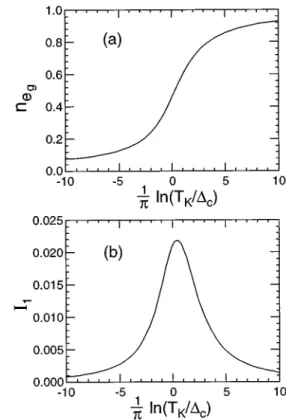
quadrupolar splitting. The function I1(Q21/J) is displayed in Fig. 2~b!, showing a maximum when Dc'TK. Note that
in this calculation it is assumed that Dq!Dc.
FIG. 2. ~a! Occupation of one eg orbital and ~b! the response function I1as a function of TK/Dcfor n55 for the spin-polarized impurity. The splitting of the eglevels due to a quadrupolar field is proportional to the function I1.
Comparing Figs. 1 and 2 we see that the occupations of the eg orbitals and the response to the quadrupolar splitting
in zero field are very similar to those of the spin-polarized state. Assuming that these quantities have a similar behavior at intermediate magnetic fields, we may conclude that the single-Mn-impurity model does not suggest a change in the Mn-O bond length as a function of magnetic field; i.e., the Jahn-Teller or polaron distortion is not very magnetic field dependent.
C. Magnetoresistance
The impurity model, of course, only gives limited insight into the transport properties. Within the framework of impu-rity scattering the zero-temperature resistivity is given by Friedel’s sum rule; i.e., an electron in the partial wave of orbital symmetry m and spin components acquires a phase shiftdms5pnms.14,15In zero field the ground state is a
sin-glet, so that the occupation of the t2g levels is 1/2 per spin
component and for the egorbitals it is a fraction smaller than
1/2. This situation is dramatically different in a large mag-netic field~compared to TK). For the spin-polarized state the
phase shifts of the partial waves with t2gsymmetry are either
0 or p, giving rise to no resistivity. The same holds for the
egphase shifts for spin components opposite to the magnetic field. Hence, only conduction electrons with the symmetry of the eg orbitals and spin component parallel to the magnetic
field scatter~assuming that the eg levels are not empty!
non-trivially. The contributions of the different spin components and orbitals add in parallel. Hence, the impurity model pre-dicts a dramatic drop of the zero-temperature resistivity as a function of magnetic field. Note that the polarization of the impurity occurs on the energy scale TK, while the
polariza-tion of the conducpolariza-tion band takes place on a scale of the order of the bandwidth. Hence, a spin-polarized impurity does not mean that all itinerant electrons have to have the same spin component; i.e., there are also down-spin conduc-tion electrons.
D. Coulomb repulsion among the egorbitals
In the impurity model ~1! both of the eg orbitals can be
occupied by one electron, since there is no Coulomb repul-sion among the electrons, other than the exchange maximiz-ing the total spin of the impurity. With increasmaximiz-ing Dc the number of localized d electrons increases from 3 ~the t2g
orbitals! to 5 ~all d orbitals are singly occupied!. An infinite Coulomb repulsion among the eg electrons would prevent
the population of the eg levels by more than one electron.
This additional Coulomb repulsion, however, destroys the integrability of the model.
This repulsion can be introduced in an approximate way by considering n54 instead of n55. There are then effec-tively only four orbitals, three t2g levels, and one eg state.
This approach, however, neglects the twofold degeneracy of the egorbitals. In this subsection we briefly discuss the effect of the cubic crystalline field on the n54 manifold for the two limiting situations of zero magnetic field and the spin-polarized impurity. The procedure is similar to the one fol-lowed previously.
In the absence of a magnetic field all electrons are spin paired so thatr[0 andzl[0 for all l. If we consider a cubic
crystalline field, we have thatk1h[k2h[0, and if the charge
fluctuations with the conduction band are suppressed, we have in addition sh[0. Fourier transforming Eqs. ~4!–~6! can be reduced to one integral equation for k3,
k3h~L!1k3~L!1
E
2` Q
dL
8
a2~L2L8
!k3~L8
!5a5~L21/J!, ~17!
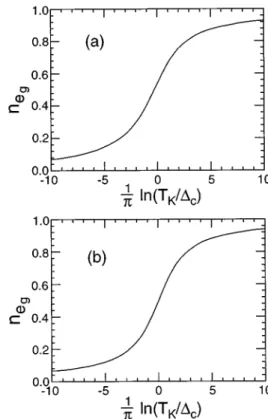
where the notation is the same as before. This integral equa-tion can either be solved numerically or via the Wiener-Hopf method. The result for the population of the eg level, neg52*2`Q dLk3(L), is shown in Fig. 3~a! as a function of
ln(TK/Dc) and is qualitatively similar to the per orbital
occu-pation in the absence of the additional Coulomb repulsion. For the spin-polarized situation we have only unpaired electrons so thats[0 andkl[0 for all l, and if we consider
a cubic crystalline field, we have in addition that
z1h[z2h[0. The charge fluctuations with the conduction
band are suppressed if rh[0 and Eqs. ~4!–~6! are straight-forwardly reduced to a single integral equation forz3:
z3h~m!1z3~m!5a4~m21/J!. ~18!
Using the same notation, Q21/J5(1/p)ln(TK/Dc), we have
neg5
E
2` Q dmz3~m!5 1 21 1 parctanS
Q21/J 2D
, ~19! which is displayed in Fig. 3~b!. The dependence of negonDcfor the spin-polarized impurity is again very similar to the zero-field case.
FIG. 3. Occupation of the egorbital as a function of TK/Dcfor
The arguments presented above for the magnetoresistance and their limitations remain valid if the occupation of the eg
levels is restricted to one.
IV. CONCLUDING REMARKS
We considered an isolated Mn impurity in an intermediate-valence state. The hybridization of the d elec-trons with the conduction band leads to a ground-state wave function that is a linear superposition of the Mn31 and Mn41 configurations. The spins of the localized d electrons are all aligned maximizing the total spin in accordance with the first Hund rule. This is accomplished by the large ex-change interaction U in the Hamiltonian ~1!. A cubic crys-talline field lifts the degeneracy of the d orbitals and splits them into a lower-lying t2gtriplet and the excited egdoublet.
The occupation of the t2g states is one electron per orbital,
while the population of the eg states depends on the
crystal-line field splitting.
Except for the crystalline field splitting the impurity is the variant of Anderson’s model introduced by Tsvelick and Wiegmann8 which for the orbital singlet and in the limit of integer valence reduces to the spin-compensated multichan-nel Kondo problem.16,17 The multichannel model is inte-grable and its Bethe ansatz solution8 can be taken over for the present situation since H0 and Hcf commute. The
crys-talline fields break the orbital singlet condition and consid-erably complicate the structure of the ground state. Crystal-line fields for the integer-valent multichannel Kondo model have been considered in Ref. 12 and give rise to new critical behavior in the overcompensated case.
Due to the additional complications arising from the crys-talline field, we confined ourselves to investigate two limit-ing situations, namely, the zero-magnetic-field case and the totally-spin-polarized impurity. The characteristic energy scale is the Kondo temperature which for the multichannel impurity is independent of the number of channels and their occupation. As a function of the cubic crystalline field we studied the occupation of the eg levels and the linear
re-sponse to a splitting of the eg levels due to a small
quadru-polar crystalline field. Both quantities are essentially the same in the two limiting cases of zero magnetic field and total spin polarization. The response to the quadrupolar split-ting is related to the coupling of the ion to the lattice ~polar-on or Jahn-Teller! and hence to the effective Mn-O bond length. Within the limitations of an impurity model, this re-sult suggests that the Mn-O bond length does not play a
fundamental role in the magnetic properties of the LaMnO3
compounds and possibly neither in colossal magnetoresis-tance. In contrast, the double-exchange mechanism involves correlated hopping between the sites. This aspect is, of course, not contained in the isolated-impurity model. Hence, the two-impurity model ~contains the simplest form of double exchange! will ultimately determine the importance of local quadrupolar distortions.
We also discussed the negative magnetoresistance arising from the impurity. On the one hand, in the absence of a magnetic field, all scattering phase shifts are different from 0 or p, so that there is significant scattering. On the other hand, for the spin-polarized impurity all down-spin phase shifts are zero and the t2gphase shift for up-spin electrons is p. Hence, only up-spin electrons in the eg channels are ac-tually scattered and the total resistivity due to the impurity is zero. In other words, we expect a very large negative mag-netoresistance.
Although perhaps too simplistic, it is useful at this point to speculate on the consequences of the impurity model on the magnetoresistance of the lattice. The orbital channels are only good quantum numbers locally but not conserved glo-bally, in contrast to the spin. But since down-spin electrons are not scattered in the spin-polarized case independently of the orbital channel, they give rise to no resistivity. Hence, neglecting potential scattering due to doping centers, the magnetoresistance of the compound in large magnetic fields is expected to be very small.
One drawback of the multichannel Anderson model is that it allows the single occupation of both eg orbitals. A large
Coulomb repulsion should prevent this in a realistic Mn31/Mn41 ion. This situation cannot be dealt with
satis-factorily within the present model. We considered n54 in-stead of the usual five orbitals. This simplistic approach ne-glects the orbital degeneracy of the egorbitals, but may give
an indication of what occurs for the full problem. Also in this case the egoccupation in zero magnetic field is similar to the
spin-polarized state, confirming in this way our results and conjectures. If the orbital degeneracy of the eg levels is kept
~without double occupancy!, we expect an orbital singlet to form via the quadrupolar Kondo effect.
We acknowledge the support by the U.S. Department of Energy under Grant No. DE-FG05-91ER45443, the Ministry of Education of the Republic of Korea under Contract No. BSRI-95-2428, and the Center of Theoretical Physics of Seoul National University.
1S. Jin, M. McCormack, T. H. Tiefel, R. M. Fleming, J. Phillips, and R. Ramesh, Science 264, 413~1994!.
2R. von Helmolt, J. Wecker, B. Holtzapfel, L. Schultz, and K. Samwer, Phys. Rev. Lett. 71, 2331 ~1993!; K. Chahara, T. Ohuo, M. Kasai, and Y. Kozono, Appl. Phys. Lett. 63, 1990
~1993!; G. C. Xiong et al., ibid. 66, 1427 ~1995!; Y. Tokura et al., J. Phys. Soc. Jpn. 63, 3931~1994!.
3A. J. Millis, P. B. Littlewood, and B. I. Shraiman, Phys. Rev. Lett. 74, 5144~1995!; N. Furukawa, J. Phys. Soc. Jpn. 64, 2734
~1995!.
4G. Zhao, K. Conder, H. Keller, and K. A. Mu¨ller, Nature ~Lon-don! 381, 676 ~1996!.
5A. C. Millis, B. I. Shraiman, and R. Mueller, Phys. Rev. Lett. 77, 175~1996!.
6G. J. Snyder, R. Hiskes, S. DiCarolis, M. R. Beasley, and T. H. Geballe, Phys. Rev. B 53, 14 434~1996!.
7J. Goodenough, Phys. Rev. 100, 564~1955!.
8P. B. Wiegmann and A. M. Tsvelick, JETP Lett. 38, 591~1983!; A. M. Tsvelick and P. B. Wiegmann, Z. Phys. B 54, 201~1984!; J. Stat. Phys. 38, 125~1985!.
9P. Schlottmann and P. D. Sacramento, Adv. Phys. 42, 641~1993!. 10P. D. Sacramento and P. Schlottmann, Solid State Commun. 73,
747~1990!. 11
P. D. Sacramento and P. Schlottmann, Phys. Rev. B 42, 743
~1990!; Physica B 171, 122 ~1991!.
12P. Schlottmann and K. Lee, Phys. Rev. B 52, 6489 ~1995!; Physica B 223&224, 458~1996!.
13A. M. Tsvelick, J. Phys. C 18, 159~1985!.
14N. Andrei, Phys. Lett. 87A, 299~1982!; P. Schlottmann, J. Magn. Magn. Mater. 47&48, 367~1985!.
15P. Schlottmann, Phys. Rep. 181, 1~1989!.
16P. Nozie`res and A. Blandin, J. Phys.~Paris! 41, 193 ~1980!. 17N. Andrei and C. Destri, Phys. Rev. Lett. 52, 364~1984!.