Received March 18, 2021; Revised March 25, 2021; Accepted March 25, 2021
*Corresponding author: Hun Park e-mail [email protected]
https://orcid.org/ 0000-0001-6367-238X Hun Park1 , Sunggoo Kang2
A Study on Inclusive Green Growth of South Korea:
Focusing on Sustainable Development Goals,
Climate Change, and Ecosystem Services
ABSTRACT
Introduction
Current international negotiation and cooperation for sustainable development are focused on three main themes. The first theme is implementation of Sustainable Development Goals (SDGs). The second theme is development of measures for climate change. The third theme is sustainable management of biodiversity and ecosystem services. In South Korea, responses of government policies and academic studies have been predominantly to one of these three themes. There have not been many integrated efforts to develop countermeasures considering all three international themes. In addition, while “green growth” policies have been setting national agendas for Korea’s sustainable development, they must be scrutinized such as why they have not dealt with some parts of these three themes and whether they have ignored one of these themes due to lack of integrated responses. This study finds critical issues in South Korea on how to harmoniously respond to the three themes of international efforts and improve green growth policies. First, to achieve SDGs, the domestic statistical system must be reorganized to track the achievement of “inclusiveness” and “green growth”. Second, the climate change response policy should seek inclusion between countries and between social groups. Third, in the field of biodiversity and ecosystem services, it is necessary to establish Korea’s identity in global geopolitics and enhance its own traditional ecological knowledge. Fourth, it is necessary to consider how to solve discrepancy between climate change response pol-icies and biodiversity-ecosystem service management polpol-icies. Finally, proactive improvement of laws and institutions must occur to promote inclusive green growth.
Keywords: Biodiversity, Climate change, Ecosystem services, Inclusive green growth, Sustainable development goals
1
OJEong Resilience Institute, Korea University, Seoul, Korea
2
Ministry of Environment, Sejong, Korea
The ‘sustainable development’ concept stems from the awareness of the issue that sustainable economic growth is difficult to achieve without environmental or resource supports, or a breakdown of its foundation (Daly, 1993; Meadows et al., 1972). With recent stable management of traditional environmental issues such as water, air, and waste, especially in developed countries, the international community has proposed a concept of ‘green growth’ as a theoretical framework in which the community can respond
to problems such as climate change risks and biodiversity losses while simultaneously achieving economic growth. In addition to the emphasis on green growth, there has been another trend focusing on ‘inclusiveness,’ recogniz-ing that sustainability should be discussed while takrecogniz-ing into account starvation, basic human rights, social justice, and solicitude.
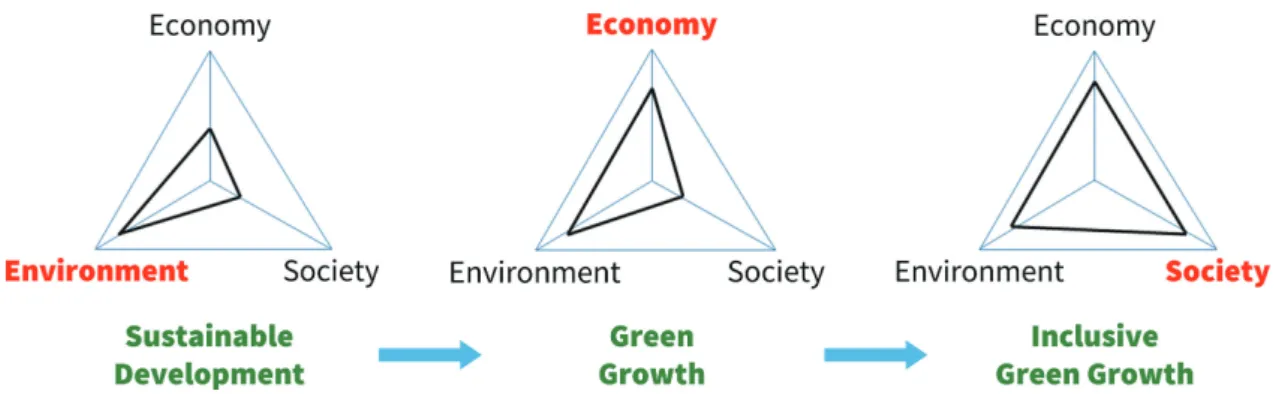
This relationship between green growth and inclusive-ness is schematically illustrated in Fig. 1. It shows how the concept of ‘sustainable development’ has evolved over time into other concepts such as green growth and in-clusive green growth. Considering that sustainability can be achieved when economic, environmental, and social elements are fundamentally balanced, concepts have been developed focusing on different aspects. Discussions on sustainability started with an emphasis on the environ-ment at the early stage. After environenviron-mental issues were
PNIE 2021;2(2):82-95 https://doi.org/10.22920/PNIE.2021.2.2.82 pISSN 2765-2203, eISSN 2765-2211
83
handled to some extent, the demand for economic growth was reflected in discussions. The current trend has more emphasis on social inclusiveness. The concept of ‘green growth’ focuses on ‘economic growth’ considering envi-ronmental impacts. ‘Inclusive green growth’ is a strength-ened concept retaining the former concept and social factor.
In fact, since all concepts argue the balance of economy, environment, and society, it is difficult to see that there is a particular pillar of emphasis. This paper inevitably showed pillars of emphasis for the convenience of analysis and understanding.
Fig. 1. Changes in pillars of emphasis in sustainability. Red text indicates pillars of emphasis.
PNIE 2021;2(2):82-95 defined. It was used only as a synonym for environmen-tally sustainable economic growth.
Given that the concept of ‘green growth’ was first introduced at the international conference held in South Korea, Seoul led the conceptual discussion earlier than other countries. ‘Low Carbon Green Growth’ was first advocated by former President Lee Myung-bak at the Liberation Day ceremony in 2008. It is a mixed term of low carbon and green growth. Low carbon refers to “low-ering dependence on fossil fuels, expanding the use and distribution of clean energy, and reducing greenhouse gases to an appropriate or lower level by expanding car-bon sinks”. Green growth means “growth achieved by sav-ing and ussav-ing energy and resources efficiently to reduce climate change and damage to the environment, securing new growth engines through research and development of green technology, creating new job opportunities, and achieving harmony between the economy and environ-ment” (Article 2 of the Framework Act on Low Carbon, Green Growth). The announcement became the basis for the Framework Act on Low Carbon, Green Growth which came into force in early 2010.
Meanwhile, the global economic downturn began with the 2008 U.S. financial crisis. Several countries embarked on revitalizing their economies through investments in green industries to overcome the crisis. The most rep-resentative cases were the 2009 enactments of the Framework Act on Low Carbon, Green Growth in South Korea and the American Recovery and Reinvestment Act in the United States. As most developed countries introduced similar policies, the Organization for Economic Co-operation In line with this international discussion trend, this paper
first examined the theoretical background of concepts of ‘green growth’ and ‘inclusiveness.’ It then analyzed how these concepts were reflected in international agendas such as the Sustainable Development Goals (SDGs) and reviews what kinds of approaches South Korea should take to han-dle these agendas. Lastly, based on such new understanding, we proposed new principles that could be helpful for poli-cy-making processes in the country.
Materials and Methods
This paper examined the theoretical background of green growth and inclusiveness based on the history of discussions in the international community. It also examined how South Korean and international laws and institutions supported these theoretical developments.
Theoretical background: ‘Green Growth’ and ‘Inclusiveness’
The term and concept of ‘green growth’ were first known in the international community through the Fifth Ministerial Conference on Environment and Development in Asia and the Pacific held in Seoul in 2005. In the con-ference, the term ‘green growth’ could be found in ‘the Seoul Initiative on Environmentally Sustainable Economic Growth’ (Green Growth) announced by the United Nations Economic and Social Commission for Asia and the Pacific (UN ESCAP, 2005a) as well as in ‘the Ministerial Declaration on Environment and Development for Asia and the Pacific’ (UN ESCAP, 2005b). However, in the then-relevant documents, green growth was not yet officially
and Development (OECD) came to redefine the concept of green growth in 2011.
The OECD, a group of advanced economies, defined ‘green growth’ as “fostering economic growth and devel-opment while ensuring that natural assets continue to provide the resources and environmental services on which our well-being relies” and suggested it as one of common development goals for all in 2011 (OECD, 2011) The organization defined it based on previous discus-sions. It can be regarded that South Korea has led the international community’s full-scale discussions on green growth.
However, there were criticisms that the green growth theory in advanced economies did not sufficiently consider unfavorable economic, social, and environmental condition-sin developing countries. It was necessary for the United Nations to re-define the concept of sustainable develop-ment corresponding to the green growth concept. In this sense, the United Nations Environment Programme (UNEP) announced ‘green economy’ as a unified concept in 2010. It refers to “one that results in improved human well-be-ing and social equity, while significantly reducwell-be-ing envi-ronmental risks and ecological scarcities” (UNEP, 2010). This concept did not intend to replace the Sustainable Development concept of the World Commission on Environment and Development (UN Secretary-General, World Commission on Environment and Development (WCED), 1987), but was presented as its sub-concept. Compared to the OECD’s concept of green growth, social equity was added and denoted in the concept.
Fig. 2 indicates the development and context of green growth-related concepts. ‘Green growth’ is a concept emphasizing economic growth. The OECD, an interna-tional ‘economic organization,’ adopted this concept to replace the sustainable development concept. The inter-national ‘environment organization’ UNEP defined green economy as a sub-concept of sustainable development with an emphasis on the economy.
Second, it can be broadly seen that ‘inclusiveness’ is in line with ‘social’ sustainability, one of three pillars of ‘sus-tainable development’ (e.g., economic, social, and envi-ronmental). The term ‘inclusive growth’ was first denot-ed internationally after it was presentdenot-ed as one of three long-term complementary strategic agendas (i.e., inclusive growth, environmentally sustainable growth, and regional integration) by the Asian Development Bank (ADB) (2008). As aforementioned, considering that concepts of ‘green growth’ and ‘green economy’ adopted such words as well-being and social equity, it seemed that social dimen-sion or inclusiveness was considered even if they were less explicated. The concept of ‘inclusiveness’ has continued to be specified since then. A paper of the United Nations Research Institute for Social Development (UNRISD) has stated that “an inclusive society that entails respect for human rights, cultural diversity and democratic gover-nance, and upholds. principles of equality and equity” (Dugarova, 2015).
WCED report in 1987 — Our Common Future, also known as the Brundtland Report - summarized the most widely known concept of sustainable development. It has also pointed out that the intra-generational equity in devel-oping and developed countries is an essential factor for sustainable development (UN Secretary-General, WCED, 1987). ‘The inter-generational equity’ was highlighted in the report, meaning that “it meets the needs of the present without compromising the ability of future gen-erations to meet their own needs.” It plays a key role in achieving the inclusiveness of national development (UN Secretary-General, WCED, 1987). In South Korea, the 2006 ‘National Strategy for Sustainable Development’ and the 2007 ‘Sustainable Development Act’ were also greatly influenced by WCED’s concept of sustainable development.
In the 2012 United Nations Conference on Sustainable Development (UN CSD), world leaders and representa-tives agreed on the concept and role of ‘green econ-omy’ and ‘inclusiveness,’ culminating in finalizing the non-binding document The Future We Want . It also decided to set SDGs by 2015, which had the greatest impact on the hierarchical establishment and adjustment of the green growth concept in South Korea. Millennium Development Goals (MDGs) targeted for delivery by 2015 focused on supporting developing countries to eradi-cate poverty. Its follow-up program, SDGs was expected to present a common direction for development for all countries from 2016 to 2030.
In the 2015 United Nations Sustainable Development Summit, leaders and representatives of its member states adopted the ‘2030 Agenda for Sustainable Development,’ which included ‘SDGs consisting of 17 goals and 169 targets (Fig. 3). Eight indicators, including poverty eradication among
Fig. 2. Conceptual diagram of green growth and green
85
Fig. 4. Integration of inclusiveness into green economy.
Fig. 3. Seventeen Sustainable Development Goals (UN, 2016) and inclusiveness-related goals.
these 17 goals, are directly or indirectly related to inclusive-ness. Accordingly, existing concepts of green economy or sustainable development need to be revised or differently
em-phasized. For example, UNEP has revised the existing green economy concept to the ‘inclusive green economy’ concept by reflecting the setting of SDGs (Fulai et al., 2015).
Theoretical conflicts and legal progress
There might be conceptual and theoretical conflicts of green growth between developing and developed countries. Developing and less developed countries have criticized that the green growth concept in South Korea and the OECD is dominated by the development logic of rich countries. In other words, developed countries can achieve such econom-ic growth or ‘green growth’ via low-carbon-intensity meth-ods based on their accumulated capital and technology, whereas developing countries still need to pursue economic expansion using fossil fuels. If developing countries pursue
green growth, they can hardly catch up with developed countries.
Considering that sustainable development concepts have been historically established through ‘consensus and coordi-nation’ among UN member states, it is necessary to consider the stance of developing countries as well. From this per-spective, the necessity to establish and adjust the existing concept of green growth and its hierarchy has been high-lighted, while considering changes in the international com-munity’s consensus and reorganization of its academic con-cepts since 2008.
The emphasis on inclusiveness is becoming increasingly evident in the international community’s understanding of ecosystems. Ecological understanding of the Earth based on indigenous and local knowledge (ILK) has led to legislation. In South America, for example, as an alternative to exist-ing ecological theories suggested in the debate on the the-oretical framework of the Intergovernmental Science-Policy Platform on Biodiversity and Ecosystem Services (IPBES), the concept of ‘Living-Well in balance and harmony with Mother Earth’ learned from thoughts of indigenous peoples (the words are expressed as “Buen Vivir” in Ecuador and “Vivir Bien” in Bolivia) has been suggested as an alternative development path that promotes economic inclusiveness. This concept has already influenced biodiversity and ecosys-tem policies as well as climate change response policies. The 2015 Paris Agreement, which was adopted after the IPBES introduced this concept in 2013, stated and highlighted Fig. 4 illustrates that the inclusiveness concept is
intro-duced to emphasize social sustainability, evolving into the ‘inclusive green economy’ concept after its combination with the green growth or green economy concept.
that some cultures recognized the natural environment as “Mother Earth.” Several South American countries have begun to grant Mother Earth ‘the basic rights.’
Basic rights of Mother Earth were included in Ecuador’s 2008 constitution (i.e., Constitución de la República del Ecuador) and Bolivian law in 2010 (i.e., Ley de Derechos de la Madre Tierra; its 2012 amendment La Ley Marco de la Madre Tierra y Desarrollo Integral para Vivir Bien) (Espinosa, 2014). Such legislative trends have expanded to other countries with U.N. support (Harmony with Nature, 2020). Meanwhile, the New Zealand Parliament has granted nature a legal personality for the first time in the world by passing a bill that recognizes the Whanganui River as a living entity with legal personality (BBC, 2017).
‘Inclusiveness’ in South Korea
How has the South Korean government handled SDGs? It has been pointed out that South Korea’s green growth and green economic system have hindered inclusive growth by focusing on economic growth rather than on poverty alleviation and enhancement of social equity (Bell, 2016). However, considering that former President Park Geun-hye pledged to “democratize the economy” during her 2012 election campaign, Seoul has shown more interest in inclu-siveness. In addition, ‘the 3rd Basic Plan for Sustainable Development (2016 – 2035)’ released in 2016 highlight-ed that there should be more political interest in achieving goals such as gender equality (SDG 5), reduced inequalities (SDG 10), and decent work and economic growth (SDG 8) among 17 SDGs (Government of South Korea, 2016). South Korea partially reflected inclusiveness-related SDGs in the the 4th Basic Plan for Sustainable Development (2021–2040) (Government of South Korea, 2021). However, the current level of concept application or administrative slogans does not guarantee inclusive development, especial-ly for environment-focused SDGs such as SDG13, SDG14, and SDG15. Deeper theoretical research of inclusive devel-opment would secure policy consistency and allow the country to negotiate more efficiently in the international community with operational theoretical concepts (Gupta et al., 2015). Therefore, it is necessary to introduce various indicators related to inclusive development suggested by the ADB (2014) at the government level or develop customized indicators for South Korea to timely evaluate and improve merits and demerits of an inclusive development policy (Anand et al., 2013; OECD, 2016).
Results
Based on conceptual and theoretical understanding of inclusive green growth as aforementioned, applications of
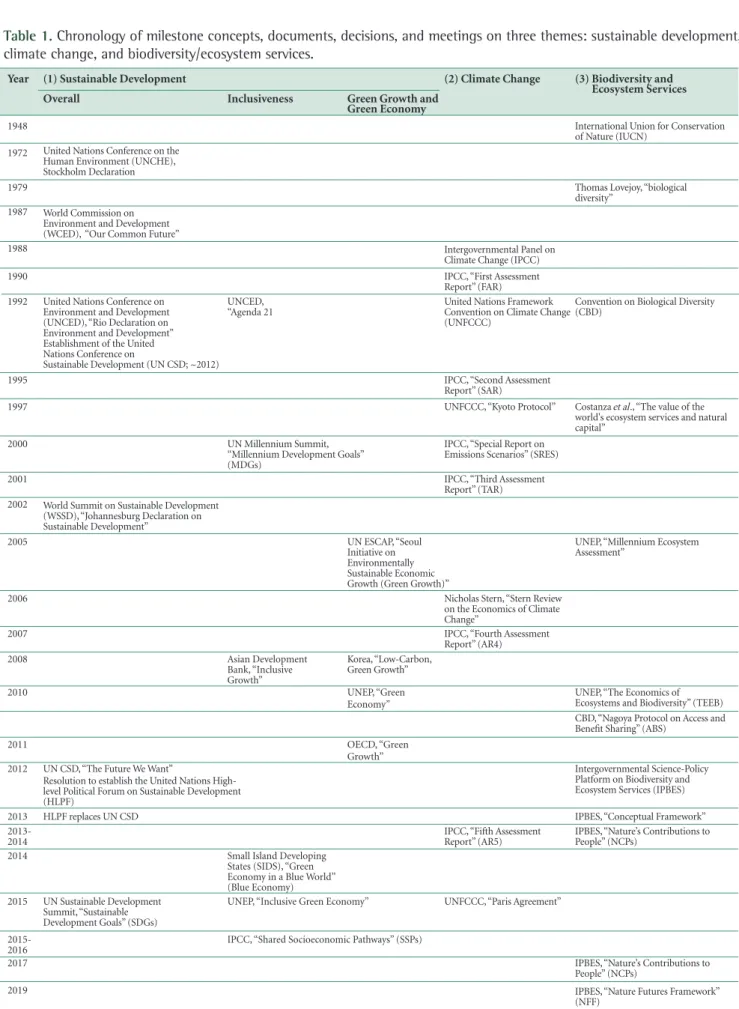
relevant concepts were analyzed about SDGs, responses to climate change impacts, and biosphere conservation as key agendas in South Korea and other countries. As a result, discussions about sustainable development and green growth in the international community are in prog-ress with a focus on the following three themes (Table 1). The first theme is about SDGs implemented in 2016 and mainly led by the UN. The second theme is about responses to climate change with an international gover-nance through the United Nations Framework Convention on Climate Change (UNFCCC) and scientific analysis pro-vided by the Intergovernmental Panel on Climate Chante (IPCC) as the center of the discussion. In response to cli-mate change impacts, since the 2015 Paris Agreement, countries have been in hurry to reduce greenhouse gas emissions and develop climate change adaptation poli-cies. The third theme is about the management of biodi-versity and ecosystem services. There have been interna-tional cooperations through the Convention on Biological Diversity (CBD). IPBES established in 2012 started themat-ic and regional evaluations in earnest.matthemat-ic and regional evaluations in earnest.
In particular, the second and third themes are notice-able. Among nine changes (i.e., climate change, bio-sphere integrity [genetic diversity and functional diversi-ty], land-system change, freshwater use, and biochemical flows [phosphorus and nitrogen], ocean acidification, atmospheric aerosol loading, stratospheric ozone deple-tion, and novel entities) that have the greatest impact on the survival of the modern human society, scientists have cited climate change and deterioration of biosphere integ-rity as the two most important “core” changes (Steffen et al., 2015).
There have been government policies and academic the-ories regarding countermeasures for these three themes. However, there have been few discussions on how South Korea should set sustainability policies while simultane-ously considering these themes. Furthermore, South Korea has suggested a ‘green growth’ policy within the sustain-able development framework. It is necessary to figure out whether green growth policy has failed to address these three themes in an integrated approach or whether it is cov-ering one theme but neglecting another. In particular, it is inevitable to face a sharp conflict of interest between devel-oping and developed countries due to the nature of the international community. South Korea should alter its SDGs depending on the direction in which the country establish-es its identity when dealing with thestablish-ese three themestablish-es. In this regard, this paper analyzed issues and principles necessary to improve the existing green growth policy and policies addressing the three themes in South Korea.
PNIE 2021;2(2):82-95 87
Table 1. Chronology of milestone concepts, documents, decisions, and meetings on three themes: sustainable development,
climate change, and biodiversity/ecosystem services. Year (1) Sustainable Development
Overall Inclusiveness Green Growth and
Green Economy 1948 1972 1979 1987 1990 2000 2006 2007 2008 2010 2011 2012 2013-2014 2013 2014 2015 2017 2019 2015-2016 2001 2002 2005 1997 1995 1992 1988 UN Millennium Summit, “Millennium Development Goals” (MDGs)
Asian Development Bank, “Inclusive Growth”
Small Island Developing States (SIDS), “Green Economy in a Blue World” (Blue Economy)
UNEP, “Inclusive Green Economy”
IPCC, “Shared Socioeconomic Pathways” (SSPs) UNCED, “Agenda 21 (3) Biodiversity and Ecosystem Services (2) Climate Change Korea, “Low-Carbon, Green Growth” UNEP, “Green Economy” OECD, “Green Growth”
UNEP, “The Economics of Ecosystems and Biodiversity” (TEEB) CBD, “Nagoya Protocol on Access and Benefit Sharing” (ABS)
Intergovernmental Science-Policy Platform on Biodiversity and Ecosystem Services (IPBES)
IPBES, “Nature’s Contributions to People” (NCPs)
IPBES, “Nature’s Contributions to People” (NCPs)
IPBES, “Conceptual Framework”
IPBES, “Nature Futures Framework” (NFF)
International Union for Conservation of Nature (IUCN)
Thomas Lovejoy, “biological diversity”
UNEP, “Millennium Ecosystem Assessment”
Costanza et al., “The value of the world's ecosystem services and natural capital”
Convention on Biological Diversity (CBD)
United Nations Conference on the Human Environment (UNCHE), Stockholm Declaration
World Commission on Environment and Development (WCED), “Our Common Future”
World Summit on Sustainable Development (WSSD), “Johannesburg Declaration on Sustainable Development”
UN CSD, “The Future We Want”
Resolution to establish the United Nations High-level Political Forum on Sustainable Development (HLPF)
HLPF replaces UN CSD
UN Sustainable Development Summit, “Sustainable Development Goals” (SDGs) United Nations Conference on Environment and Development (UNCED), “Rio Declaration on Environment and Development” Establishment of the United Nations Conference on
Sustainable Development (UN CSD; ~2012)
IPCC, “First Assessment Report” (FAR)
IPCC, “Special Report on Emissions Scenarios” (SRES)
Nicholas Stern, “Stern Review on the Economics of Climate Change”
IPCC, “Fifth Assessment Report” (AR5)
UNFCCC, “Paris Agreement” IPCC, “Fourth Assessment Report” (AR4) IPCC, “Third Assessment Report” (TAR)
UNFCCC, “Kyoto Protocol” IPCC, “Second Assessment Report” (SAR)
United Nations Framework Convention on Climate Change (UNFCCC)
Intergovernmental Panel on Climate Change (IPCC)
UN ESCAP, “Seoul Initiative on Environmentally Sustainable Economic Growth (Green Growth)”
Setting policy directions to implement SDGs
SDGs are international development goals that are high-ly related to the inclusive green growth concept. Among 17 SDGs, ten indicators are directly related to inclusive-ness. This means that inclusiveness is emphasized relatively. In this sense, the South Korean government can set inclu-siveness and green growth-related policies based on these 17 goals and 169 targets. However, as reaffirmed in the national specificity, that is, “the principle of common but differentiated responsibilities” of states in the 2012 UN CSD agreement (i.e., The Future We Want), international environ-mental agreements have been negotiated over a long peri-od and significant compromises have been made. However, final outcomes are often not legally binding or their binding force is weak (Rühs & Jones, 2016).
SDGs are not that different. However, it may not be appropriate for South Korea to respond loosely due to the absence of legally binding force. Although those Goals are currently not legally binding, it is possible to become an international agreement with a legally binding force if achievement levels of the Goals can be measured quanti-tatively (like the compulsory performance evaluation index for climate change mitigation such as GHG emissions) in the future and verified with each other (i.e., Measuring, Reporting and Verification [MRV]).
The European Union has implemented the Emissions Trading System (EU ETS) and the Europe 2020 Strategy (the aim of reducing GHGs by 20%, from 1990 levels, supplying 20% of energy from renewables, and improving 20% in energy efficiency by year 2020). Through this, it has led climate change policies in the international com-munity, gaining a greater say during the Paris Agreement negotiations than other developed countries. Likewise, if South Korea raises its performance levels of SDGs, it is possible for South Korea to take a leading position in future international negotiations. States that play a responsible role in the international community can lead international negotiations.
In order for South Korea to increase its performance levels, first of all, it is necessary to make efforts to reor-ganize survey items to find inclusiveness in the nation-al statistics. In other words, it should be possible to monitor performances for the 17 SDGs (or 169 targets), especially those related to inclusiveness. The United Nations Statistical Commission presented the Sustainable Development Goal indicators established in 2016 recom-mends reporting indicators as subdivided as possible based on income, gender, age, race, ethnic group, immigration status, disability, and geographic location (Statistical Commission, 2016). Among subdivisions, South Korea is urgently required to segment statistical data related to race, ethnic group, and immigration status. The country is no longer a single-ethnic nation due to an increase of
multicultural families through international marriage and the influx of foreign workers. However, national statistics still do not fully reflect such diversity except for several items related to household population (Korean Women’s Development Institute (KWDI), 2015), showing that there is a lack of inclusiveness. It is necessary to come up with measures that can numerically embrace inclusiveness related to SDG indicators such as ethnic minority, race, immigration status, and disability in South Korean statis-tical data. As the UN also recognizes that there are sev-eral difficulties in statistical segmentation and indicator development at a practical level, joint research is active-ly in progress (Inter-agency and Expert Group on SDG Indicators (IAEG-SDGs), 2016).
Setting climate change adaptation policy direction
As South Korea belonged to the ‘Non-Annex I’ Parties to the UNFCCC, it is a ‘Non-Annex B’ country that has no obligation to reduce greenhouse gas emissions under the Kyoto Protocol. This was because the country was not an OECD member state in 1997 and defined itself as a developing country. It did not have the obligation to reduce emissions under the Kyoto Protocol. However, the international community has raised its interest in cli-mate change impacts and risks, along with the 2006 Stern Report warning of economic impacts of global warm-ing and the IPCC’s 4th Assessment Report in 2007. Under such situation, in line with levels of economic power and GHG emissions and reductions after the commitment period of the Kyoto Protocol in 2012, there would be more inter-national pressure on South Korea to fulfill its responsibili-ties corresponding to advanced countries. Therefore, gov-ernment response policies (e.g., the 1st–4th Comprehensive Measures on Climate Change [1999, 2001, 2004, and 2007], Comprehensive Basic Plan for Climate Change [2008], etc.) were established and implemented. At the 2009 Copenhagen Conference of Parties (COP 15), the interna-tional community failed to reach an agreement, which gave some time for South Korea to prepare for climate change responses. At the 2015 Climate Summit (COP 21) in Paris, a legally binding treaty on climate change was adopted. South Korea also had voluntary obligations to achieve its emission reduction targets (i.e., Nationally Determined Contribution [NDC]). South Korea’s NDC aims to reduce greenhouse gas emissions by 24.4% by 2030 compared to 2017 (709.1 MtCO2eq) (Government of South Korea, 2020).
However, the Paris Agreement stipulated different obli-gations for developing and developed countries. Unlike the Kyoto Protocol, it did not specify which country belonged to which category. The positive aspect is that South Korea can submit/update its NDC document with its GHG reduc-tion targets and climate change adaptareduc-tion policies that best suit national interests without defining whether it is a
89 PNIE 2021;2(2):82-95 developed or developing country. On the other hand, it is
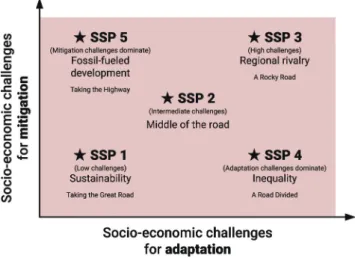
also burdensome. In the long run, it is necessary to clari-fy its national identity for sustainable development. As a responsible member of the international community, the country is required. to fulfill its obligations. In addition, its climate change response policies must be consistent with strategies for other sectors (e.g., implementation of SDGs or management of biodiversity and ecosystem services). In a similar context, South Korea needs to determine its future development pathway, that is, setting its national identity. The IPCC’s Fifth Assessment Report introduced new development pathways not only considering GHG emissions (as adopted by Representative Concentration Pathways [RCPs] in proceeding reports), but also empha-sizing socioeconomic aspects of development termed as Shared Socioeconomic Pathways (SSPs) (IPCC, 2014). After first mentioning SSPs in the Fifth Assessment Report, the IPCC modeling consortium officially published path-way-related academic papers in 2017. TheSE pathways have a total of five scenarios. These categorized scenar-ios based on relative burdens of climate change adapta-tion and mitigaadapta-tion are predicted to have different con-sequences in relation to inclusiveness and green growth. For example, as shown in Fig. 5, SSP 1, the most sustain-able development pathway, is desirsustain-able as it reduces social inequality (inclusiveness) and lowers carbon intensity (green growth). However, since it can hinder optimization of economic growth in some countries, policies favorable for this pathway might be difficult to gain public support. On the other hand, the SSP 5 pathway, which is expect-ed to bring strong economic growth, can be regardexpect-ed as an inclusive pathway because it resolves inequality issues among countries. However, this pathway is far from green growth in that it neglects environmental issues (O’Neill et al., 2017).
Setting the direction of biodiversity and ecosystem ser-vice management Policy
The term ‘biodiversity’ was first described in an academ-ic journal in 1979 (Lovejoy, 1979). It refers to a diversity of organisms and their genetic resources (Lovejoy, 1979). Ecosystem service is a concept that literally understands what kinds of service an ecosystem renders to human beings. Its economic values were noted in 1997 (Costanza et al., 1997). Since then, it has received worldwide atten-tion. This field also requires policy directions to consider inclusiveness.
What does it mean to consider ‘inclusiveness’ in a sub-ject that appears to belong to natural science? First, it is necessary to ‘fit’ recent international discussions about the ‘ecosystem service’ concept into South Korean policies while accepting or reflecting diverse approaches of other countries ‘inclusively.’ South Korea has not yet fully imple-mented the concept of ecosystem services into its environ-mental policies while focusing more on biodiversity conser-vation. For example, the government translated IPBES into ‘Biodiversity Science Organization’ in Korean, neglecting the importance of ‘ecosystem services’ (ES). There are various opinions as to what services mean and how to evaluate ser-vices quantitatively and qualitatively because the knowledge about eco system services is still low. If such services are fully understood,policymakers can easily interlink or understand the correlation between science and society or policy rath-er than mrath-erely focusing on biodivrath-ersity research (Jax et al., 2013). In other words, less attention to ecosystem services is highly likely to weaken the link between science and policy as a result.
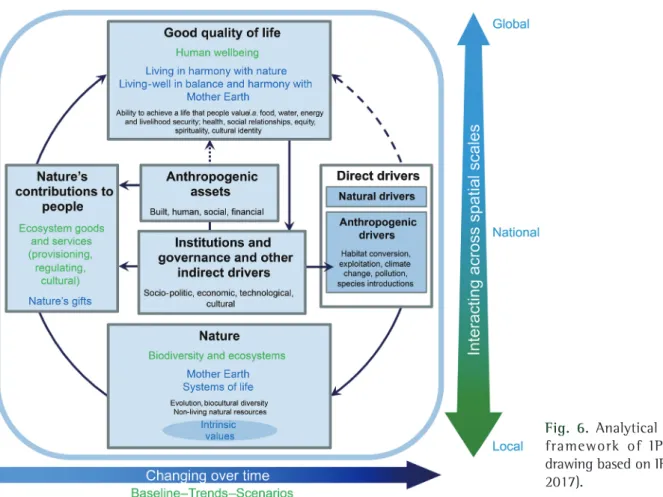
What do ecosystem services mean in South Korea? How to measure their deterioration or improvement levels? If South Korean academia and policymakers who have prior-itized Anglo-American theories are willing to accept oth-er poth-erspectives in the future, thoth-ere is room for improve-ment in inclusiveness. As for the conceptual framework to analyze biodiversity and ecosystem services (IPBES, 2013) confirmed in 2013, some scholars have focused on ‘scien-tific thinking’ of developed countries while other research-ers have prioritized indigenous and ILK from developing countries. They have not reached agreements on a unified conceptual framework. Thus, there are different concep-tual opinions in the framework. As shown in the analytical conceptual framework of IPBES (Fig. 6), concepts from the West are indicated in green and ILK concepts are pre-sented in blue (Borie & Hulme, 2015). The seemingly val-ue-neutral concept ‘ecosystem services’ is also a result of conflicts and negotiations between developing and devel-oped countries.
Fig. 5. Shared Socioeconomic Pathways (SSPs). (O’Neill et
South Korea must decide how to understand ecosystem services and manage the ecosystem. If it does not just fol-low established or familiar scientific theories of the West, but actively understands and introduces new theories from developing countries, it is possible to develop inclusive bio-diversity and ecosystem services-related policies. However, it is encouraging because several Korean scholars have already begun to study the ecological significance of traditional Korean thoughts (Lee, 2003; 2004; 2008; Lee et al., 2007; 2012).
Second, it is necessary to establish South Korea’s iden-tity in order to accept and reflect ‘inclusiveness’ in ecosys-tem services-related policies. ‘Inclusiveness’ levels can vary depending on national identity and its position towards ecosystem services evaluation. IPBES published a report evaluating global biodiversity and ecosystem services in 2019 (IPBES, 2019). This report was expected to be equiv-alent to the IPCC’s Climate Change Assessment Report in that it attempted to predict ecosystem changes by 2050 in the
short term and 2100 in the long term, along with a reas-sessment of the current global ecosystem state using the latest knowledge and data (IPBES, 2016). However, since this report laid greater emphasis on inclusiveness than the IPCC report, it would be more helpful to re-define the con-cept of inclusive green growth. Regarding the question of how South Korea will pursue inclusive green growth, it is necessary to re-examine scenarios at the time in that the IPBES report is a successor of the Millennium Ecosystem Assessment published in 2005.
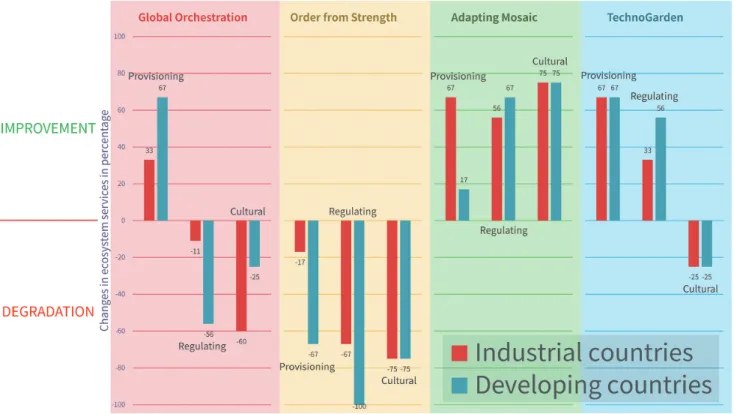
Fig. 7 shows that two scenarios (i.e., Adapting Mosaic and TechnoGarden) are expected to improve ecosystem services compared to the other two scenarios (i.e., Global Orchestration and Order from Strength). Then, is it possible to realize these two scenarios if countries around the world make efforts in collaboration? Unfortunately, it is hard to achieve that if we look into other aspects as summarized in the following table (Table 2).
Fig. 6. Analytical conceptual
framework of IPBES. Own drawing based on IPBES (2013; 2017).
91
As shown in Table 2, rich and poor countries each have different sectoral impacts under ecosystem services scenarios. Under the Adapting Mosaic scenario, there is a general improvement of human welfare. If the material welfare in developed countries is stagnant, it is likely for them to avoid the scenario. The TechnoGarden scenario can
be regarded as a scenario with insufficient ‘inclusiveness’ as it predicts that social relationships would deteriorate regardless of national income levels. Such difference trig-gers two problems. First, if differences in expectations fol-low predictions of the model, it reveals that SDGs based on compromises and agreements between richer and poorer
Fig. 7. Change of ecosystem services in 2050 (relative to 2000) according to different scenarios.
Source: Millennium Ecosystem Assessment (2005, p. 80).
Table 2. Change of human wellbeing in 2050 (relative to 2000) according to different scenarios.
Note: = increase, = remains the same as in 2000, = decrease Source: Millennium Ecosystem Assessment (2005, p. 78).
Services Global Orchestration Order from Strength Adapting Mosaic TechnoGarden
Industrial countries Developing countries Industrial countries Developing countries Industrial countries Developing countries Industrial countries Developing countries Material well-being Health Security Social relations Freedom and choice
or between developed and developing countries are not common goals for all countries. Second, South Korea should define itself as an advanced/rich country or a developing/poor country before setting policy targets related to biodiversity and ecosystem services. Depending on whether South Korea adopts development/environ-mental policies favored by developed coutries or policies preferred by developing countries such as South America, resultant national welfare levels and social and ecological indicators will be different. Scenarios of the Millennium Ecosystem Assessment explicitly show differences.
However, according to scenarios of the Millennium Ecosystem Assessment (MEA), it does not seem easy to respond to climate change impacts. As for global GHG emissions in 2050, according to the IPCC, it cannot reach the RCP 2.6 emissions scenario satisfying the target level of climate change agreed in the Paris Agreement. Yet the
Conflicts between policies and legislation
Conflicts between climate change response policy and biodiversity-ecosystem services policy
Climate change response policies could conflict with biodiversity and ecosystem services policies. In oth-er words, policies whoth-ere thoth-ere are improved biodivoth-ersity and ecosystem services with better inclusiveness may fail to prevent climate change. Table 3 shows estimates of greenhouse gas emissions for a sustainable future agreed in the Paris Agreement. They were compiled by the UNEP.
TechnoGarden scenario of the MEA predicts that emis-sions satisfying the scenario with temperature rise limit-ed to 2°C have a probability of 50–66 percent (Table 4). Under other scenarios, it is difficult to expect a sustainable climate system. Yet, the TechnoGarden scenario is highly likely to have insufficient inclusiveness as shown earlier.
Table 3. Future global greenhouse gas emissions according to scenarios of the 5th Assessment Report of IPCC and later
studies
Source: UNEP (2015). Limiting warming in 2100
Annual emissions of global total greenhouse gases [GtCO2e/yr]
2020 2025 2030 2050 2100 1.5 °C (>50% in 2100) 2 °C (>66% in 2100) 2 °C (50-66% in 2100) 56 52 53 47 48 50 39 42 47 8 23 28 -5 -3 -1
Table 4. Global greenhouse gas emissions in 2050 according to scenarios (Gt CO2 equivalent)
(1) IPCC 5th Assessment Report
Scenario RCP 2.6 RCP 4.5 RCP 6.0 RCP 8.5 Scenarios TechnoGarden Adapting Mosaic Order from Strength Global Orchestration CO2 12.4 41.4 46.1 76.2 CO2 17.2 48.8 56.5 73.7 CH4 4.0 7.0 7.5 14.2 CH4 5.9 11.7 12.1 13.6 N2O 1.9 2.7 3.3 4.0 N2O 2.2 3.3 4.0 4.0 Others 1.0 0.8 0.8 1.7 Others 0.7 2.2 1.8 2.6 Total 19.3 51.8 57.6 96.1 Total 26.0 66.0 74.4 93.9 (2) Millennium Ecosystem Assessment
93 PNIE 2021;2(2):82-95 If there is no development pathway that satisfies
cli-mate change mitigation and biosphere conservation at the same time, South Korea should clarify its own iden-tity, promoting consistent inclusive green growth poli-cies in the long term. For instance, inclusiveness can be improved by considering measures such as enhancing cli-mate change adaptive capacity for all social classes and their settlement areas rather than technology develop-ment. On the contrary, if South Korea chooses optimal GHG mitigation policies to alleviate climate change in line with the international community’s expectation, there should be inclusive policies considering developing coun-tries while preparing countermeasures against advocates that prioritize economic growth and competitiveness. Legal issues
Considering such international community’s discus-sions, it is necessary to take into account of legal issues of inclusive green growth policies from a long-term per-spective. For example, when defining ecosystem ser-vices, its value judgment of human beings is inevitable. It is difficult to give a definition that all society members or all countries agree on. Thus, a complicated process is required to confirm the definition between researchers in biodiversity and ecosystem services (Borie & Hulme, 2015). In addition, even though a particular organization defines some terms, there is another difficulty in diffusing the knowledge about such terms into diverse sectors of the society. In this regard, the creation or revision of laws and systems regarding ecosystem services is inevitably more difficult than handling environmental issues with clear characteristics and scopes such as ‘climate change’ (Maczka et al., 2016).
In response to these issues, as seen in the above-men-tioned theoretical background, if South Korean constitu-tion or law guarantees basic rights of Mother Earth, it would have a stronger say in the international communi-ty and help implement inclusive policies. It will also help institution support proactive environmental policy mea-sures classified as desirable by IPCC’s modeling scientists among pathways to green growth (van Vuuren & Carter, 2014) while gaining less attention than reactive measures (Vanhulst & Beling, 2014).
Discussion
The Republic of Korea has led green growth agenda in the international community and received a good repu-tation at early stages. As developing countries have criti-cized that green growth policies in richer countries have insufficient ‘inclusiveness,’ the UN advocated ‘inclusive green economy’ and confirmed SDGs in 2015. Under such circumstances, South Korea has adopted ‘inclusive green growth’ (Government of South Korea, 2016).
When South Korea joined the Kyoto Protocol in 1997, no country reacted against Seoul’s categorization as a devel-oping country. However, in the last two decades, South Korea has economically grown, leading to higher expecta-tion from the internaexpecta-tional community. In this sense, South Korea is bound to face limitations if it responds to interna-tional agendas and establishes domestic policies from a developing country’s perspective.
In particular, South Korea should revise or reset the direction of its ‘inclusive green growth policy’ if it con-siders three agendas of sustainable development such as SDGs, Response to Climate Change, and Management of Biodiversity and Ecosystem Services.
International discussions on sustainable development of the Earth system began with the concept of ‘sustainable development’ which emphasized environmental impor-tance. These discussions have evolved into ‘green growth’ in which environmental issues (e.g., climate change respons-es) and economic growth are simultaneously considered in South Korea and OECD member states. Furthermore, these discussion have led to the ‘inclusive green growth’ concept, while developing countries have claimed that developed countries have historic responsibilities of causing climate change and their duties.
In response to international discussion trends, South Korea must determine policy responses. That is, whether it will take a position as a developed country or a developing country. Based on results of this paper, the following princi-ples or directions of several countermeasures are suggested. First of all, in order to preemptively achieve SDGs, the South Korean statistical system must be reorganized so that performance levels of ‘inclusiveness’ and ‘green growth’ in main government policies and implementations could be tracked. Second, climate change response policies should encompass (cross-sectoral) inclusiveness at levels of coun-tries and social classes. Third, in fields of biodiversity and ecosystem services, the country must clarify its national identity, particularly regarding the concept ecosystem ser-vices, while conducting systematic research on tradition-al ecologictradition-al knowledge. Fourth, it is necessary to consider how to solve conflicts between climate change policies and biodiversity/ecosystem services management policies. Finally, it seems that legal discussions should be initiated to pro-mote inclusive green growth proactively and preventively. This study is expected to contribute to discussions on how to improve sustainability in the formulation and implemen-tation of main South Korean policies and on how to set the national status in the international community as a devel-oped or developing country or an intermediate position.
Conflict of Interest
The authors declare that they have no competing interests.
References
ADB. (2008). Strategy 2020: The long-term strategic framework of the Asian Development Bank 2008–2020.
Metro Manila, Philippines: Asian Development Bank.
Retrieved August 18, 2016 from http://hdl.handle. net/11540/2980
ADB. (2014). Framework of Inclusive Growth Indicators 2014: Key Indicators for Asia and the Pacific Special Supplement. Metro Manila, Philippines: Asian Develop-ment Bank. Retrieved June 5, 2016 from https://www. adb.org/publications/framework-inclusive-growth-indi-cators-2014-key-indicators-asia-and-pacific
Anand, R., Mishra, S., and Peiris, S.J. (2013). Inclusive Growth: Measurement and Determinants. Washington, D.C.: International Monetary Fund. Retrieved August 19, 2016 from https://www.imf.org/en/Publications/ WP/Issues/2016/12/31/Inclusive-Growth-Measure-ment-and-Determinants-40613
BBC. (2017). New Zealand river first in the world to be
given legal human status. BBC News, London, 15 March.
Retrieved March 3, 2021 from https://www.bbc.com/ news/world-asia-39282918
Bell, K. (2016). Green economy or living well? Assessing divergent paradigms for equitable eco-social transition in South Korea and Bolivia. Journal of Political Ecology, 23, 71-92. doi:10.2458/jpe.v23i1
Borie, M., and Hulme, M. (2015). Framing global biodi-versity: IPBES between mother earth and ecosystem services. Environmental Science & Policy, 54, 487-496. doi:10.1016/j.envsci.2015.05.009
Costanza, R., d’Arge, R., de Groot, R., Farber, S., Grasso, M., Hannon, B., et al. (1997). The value of the world’s ecosystem services and natural capital. Nature, 387, 253-260. doi:10.1038/387253a0
Daly, H.E. (1993). Sustainable Growth: An Impossibility Theorem. In H.E. Daly and K.E. Townsend (Eds.), Valuing the Earth: Economics, Ecology, Ethics (pp. 267-273). Cambridge: MIT Press.
Dugarova, E. (2015). Social Inclusion, Poverty Eradication and the 2030 Agenda for Sustainable Development. Geneva: United Nations Research Institute for Social Development (UNRISD). Retrieved August 17, 2016 from https://www.unrisd.org/80256B3C005BCCF9/(httpAux-Pages)/0E9547327B7941D6C1257EDF003E74EB/$file/ Dugarova.pdf
Espinosa, C. (2014). The advocacy of the previously incon-ceivable: A discourse analysis of the universal decla-ration of the rights of mother earth at Rio+20. The Journal of Environment & Development, 23, 391-416. doi:10.1177/1070496514536049
Fulai, S., Kempf, I., Kumar, P., Noronha, L., Stone, S., and Sukhdev, P. (2015). Uncovering Pathways Towards an Inclusive Green Economy: A Summary for Leaders. United
Nations Environment Programme. Retrieved May 5, 2010 from https://www.unep.org/resources/report/uncover- ing-pathways-towards-inclusive-green-economy-sum-mary-leaders
Government of South Korea. (2016). The 3rd Basic Plan for Sustainable Development (2016–2035). Seoul:
Government of South Korea.
Government of South Korea. (2020). The Republic of Korea’s Update of its First Nationally Determined Contri-bution. Seoul: Government of South Korea.
Government of South Korea. (2021). The 4th Basic Plan for Sustainable Development (2021–2040) . Seoul:
Government of South Korea.
Gupta, J., Pouw, M.N.R., and Ros-Tonen, F.M.A. (2015). Towards an elaborated theory of inclusive development. The European Journal of Development Research, 27,
541-559. doi:10.1057/ejdr.2015.30
Harmony with Nature. (2020). Rights of Nature Law, Policy and Education. United Nations. Retrieved March 3, 2021 from http://www.harmonywithnatureun.org/rightsOfNa-ture/
IAEG-SDGs. (2016). Tier Classification for Global SDG Indicators. New York: United Nations Statistics Division. Retrieved from March 16, 2017 from https://unstats. un.org/sdgs/iaeg-sdgs/tier-classification/
IPBES. (2013). Decision IPBES-2/4: Conceptual framework for the Intergovernmental Science-Policy Platform on Biodiversity and Ecosystem Services. Bonn, Germany: Intergovernmental Science-Policy Platform on Biodi-versity and Ecosystem Services. Retrieved May 20, 2014 from https://ipbes.net/sites/default/files/downloads/ Decision%20IPBES_2_4.pdf
IPBES. (2016). Decision and scoping report for the IPBES global assessment on biodiversity and ecosystem services. Bonn, Germany: Intergovernmental Science-Poli-cy Platform on Biodiversity and Ecosystem Services. Retrieved August 18, 2016 from https://www.ipbes.net/ sites/default/files/downloads/pdf/Scoping_Global%20 assessment.pdf
IPBES. (2017). Update on the classification of nature’s contributions to people by the Intergovernmental Science-Policy Platform on Biodiversity and Ecosystem Services, IPBES/5/INF/24. Bonn, Germany:
Intergov-ernmental Science-Policy Platform on Biodiversity and Ecosystem Services. Retrieved February 9, 2017 from https://ipbes.net/sites/default/files/downloads/pdf/ipbes-5-inf-24.pdf
IPBES. (2019). The Global Assessment report on biodiver-sity and ecosystem services. Bonn, Germany: Intergov-ernmental Science-Policy Platform on Biodiversity and Ecosystem Services. Retrieved October 9, 2020 from https://www.ipbes.net/sites/default/files/202002/ipbes_ Iglobal_assessment_report_summary_for_policymakers_en.pdf
95 PNIE 2021;2(2):82-95 IPCC. (Ed.). (2014). Climate Change 2014: Impacts,
Adaptation, and Vulnerability. Cambridge: Cambridge University Press. doi: 10.1017/CBO9781107415379 Jax, K., Barton, D.N., Chan, K.M.A., de Groot, R., Doyle,
U., Eser, U., et al. (2013). Ecosystem services and ethics. Ecological Economics, 93, 260-268.
doi:10.1016/j.ecol-econ.2013.06.008
KWDI. (2015). The 2015 Study on Multicultural Accept-ability in Korea. Seoul: Ministry of Gender Equality
and Family. Retrieved June 17, 2016 from https:// scienceon.kisti.re.kr/srch/selectPORSrchReport. do?cn=TRKO201600013336
Lee, D. (2003). Ecological knowledge embedded in tradi-tional Korean landscapes. Seoul: Seoul Natradi-tional
Univer-sity Press.
Lee, D. (2004). Korean Traditional Ecology. Seoul: Science Books.
Lee, D. (2008). Korean Traditional Ecology 2: Reading Landscapes and Living Space. Seoul: Science Books. Lee, D., Ko, I., and Pak, C. (2007). Ecosystem services of
traditional village groves in Korea. Seoul: Seoul National University Press.
Lee, D., Park, S.-J., Yoon, H.-G., and Choi, W.-S. (2012). Traditional Ecology and Geomancy in Korea. Seoul: Geobook.
Lovejoy, T.E. (1979). The epoch of biotic impoverishment. Great Basin Naturalist Memoirs, 3, 5-10.
Maczka, K., Matczak, P., Pietrzyk-Kaszy-ska, A., Rechci-ski, M., Olsza-ska, A., Cent, J., et al. (2016). Application of the ecosystem services concept in environmental policy – A systematic empirical analysis of national level policy documents in Poland. Ecological Economics, 128, 169-176. doi:10.1016/j.ecolecon.2016.04.023
Meadows, D.H., Meadows, D.L., Randers, J., and Behrens, W.W.III. (1972). The Limits to Growth , New York: Universe Books.
Millennium Ecosystem Assessment. (2005). Ecosystems and
human well-being: Synthesis. Washington D.C.: Island Press.
OECD. (2011). Towards Green Growth. Paris : OECD
Publishing. doi:10.1787/9789264111318-en
OECD. (2016). The Governance of Inclusive Growth. Paris: OECD Publishing. doi:10.1787/9789264257993-en O’Neill, B.C., Kriegler, E., Ebi, K.L., Kemp-Benedict, E.,
Riahi, K., Rothman, D.S., et al. (2017). The roads ahead: Narratives for shared socioeconomic pathways describ ing world futures in the 21st century. Global Environ-mental Change, 42, 169–180.
doi:10.1016/j.gloenv-cha.2015.01.004
Rühs, N., and Jones, A. (2016). The implementation of earth jurisprudence through substantive constitutional
rights of nature. Sustainability, 8, 174. doi:10.3390/ su8020174
Statistical Commission. (2016). Report of the inter-agen-cy and expert group on sustainable development goal indicators. (E/CN.3/2016/2/Rev.1). New York: United Nations Statistics Division (UNSD).
Steffen, W., Richardson, K., Rockström, J., Cornell, S.E., Fetzer, I., Bennett, E.M., et al. (2015). Plane-tary boundaries: Guiding human development on a changing planet. Science, 347, 1259855. doi:10.1126/ science.1259855
UN. (2016). Communications materials—Sustainable Development Goals (SDGs). New York: United Nations. Retrieved February 12, 2020 from http://www.un.org/ sustainabledevelopment/news/communications-materi-al/
UNEP. (2010). Green economy: Driving a green economy
through public finance and fiscal policy. Paris: UNEP Division of Technology, Industry and Economics (DTIE). UNEP. (2015). The emissions gap report 2015. Nairobi,
Kenya: United Nations Environment Programme (UNEP). Retrieved November 25, 2015 from https://uneplive. unep.org/media/docs/theme/13/EGR_2015_301115_ lores.pdf
UN ESCAP. (2005a). The Seoul initiative on environmen-tally sustainable economic growth (Green Growth). Fifth Ministerial Conference on Environment and Develop-ment in Asia and the Pacific (MCED 2005). 23-29 March 2005. Seoul, Korea.
UN ESCAP. (2005b). Report of Ministerial declaration on environment and development in Asia and the Pacif-ic, 2005. Ministerial Conference on Environment and Development in Asia and the Pacific. 28-29 March 2005. Seoul, Korea. Retrieved July 27, 2016 from https://
digitallibrary.un.org/record/552192
UN Secretary-General, WCED. (1987). Report of the World Commission on Environment and Develop-ment: Ourcommon future. (A/42/427). New York: UN. Retrieved January 15, 2004 from https://digitallibrary. un.org/record/139811
van Vuuren, D.P., and Carter, T.R. (2014). Climate and socio-economic scenarios for climate change research and assessment: reconciling the new with the old. Climatic Change, 122, 415-429. doi:10.1007/s10584-013-0974-2
Vanhulst, J., and Beling, A.E. (2014). Buen vivir: Emergent discourse within or beyond sustainable development? Ecological Economics, 101, 54-63. doi:10.1016/j.ecole-con.2014.02.017