PROCEEDINGS OF SPIE
SPIEDigitalLibrary.org/conference-proceedings-of-spie
Resolution enhancement in Brillouin
optical correlation domain analysis by
differential lock-in detection
Ji Ho Jeong, Kwanil Lee, Kwang Yong Song, Je-Myung
Jeong, Sang Bae Lee
Ji Ho Jeong, Kwanil Lee, Kwang Yong Song, Je-Myung Jeong, Sang Bae
Lee, "Resolution enhancement in Brillouin optical correlation domain analysis
by differential lock-in detection," Proc. SPIE 8421, OFS2012 22nd
International Conference on Optical Fiber Sensors, 8421BB (7 November
2012); doi: 10.1117/12.974973
Event: OFS2012 22nd International Conference on Optical Fiber Sensor,
2012, Beijing, China
Resolution Enhancement in Brillouin Optical Correlation Domain
Analysis by Differential Lock-in Detection
Ji Ho Jeong
a,b, Kwanil Lee
a, Kwang Yong Song
c, Je-Myung Jeong
b, and Sang Bae Lee
aa
Center for Opto-Electronic Convergence Systems, Korea Institute of Science and Technology
(KIST), Seoul 136-791, Korea
b
Dept. of Electrical and Computer Engineering, Hanyang University, Seoul 133-791, Korea
cDept. of Physics, Chung-Ang University, Seoul 156-756, Korea
ABSTRACT
We newly propose and experimentally demonstrate a differential lock-in detection scheme for the enhancement of Brillouin optical correlation domain analysis (BOCDA), where additional phase modulation is applied to the Brillouin pump wave and the on-off control on which is used for data acquisition. The theoretical model and the experimental results show that at least three-fold improvement is obtained in the spatial resolution of the distributed measurements and the Brillouin gain spectrum (BGS) with much narrower 3dB bandwidth than that of conventional BOCDA systems is acquired by the differential lock-in detection.
Keywords: Fiber optics sensors, Fiber optics, Brillouin scattering.
1. INTRODUCTION
Distributed fiber sensors based on Brillouin scattering have been regarded as a useful tool for either temperature or stain measurement in structural health monitoring [1-4]. In particular, the Brillouin optical correlation domain analysis (BOCDA) is based on the frequency modulation of pump and probe waves under continuous wave operation, and has shown unique advantages of a high spatial resolution (~ cm order) and a high sampling rate (~kHz) with random access of sensing position. The number of effective sensing points, i.e. the measurement range divided by the spatial resolution, of the BOCDA is determined solely by the amplitude of the frequency modulation, which leads to the trade-off relation between the spatial resolution and the measurement range. Optical time-gating or double frequency modulation has been implemented to circumvent this limitation with additional complexity of the system.
In this paper, we newly propose a differential lock-in detection scheme for data acquisition of the BOCDA, which effectively leads to at least three-fold enhancement in the spatial resolution under the same measurement range. Additionally, the measured BGS is observed to be much narrower than that of the ordinary BOCDA, similar to the intrinsic BGS in optical fibers. The operation principle is theoretically explained with experimental confirmation in which a spatial resolution less that 2 cm is obtained by the differential lock-in detection under the modulation parameters corresponding to a spatial resolution of 7 cm in ordinary BOCDA systems.
2. PRINCIPLE
In the BOCDA, the measurement range is defined as the interval of correlation peaks to locate only a single measurement position within a fiber under test (FUT), and the spatial resolution is defined as double of the span from a correlation peak to a specific position where the width of the beat spectrum is twice the width of intrinsic BGS as expressed by the following equation:
f f V z m B g Δ Δ = Δ π ν 2 (1)
where Vg, ΔvB, fm and Δf are the group velocity of light, the intrinsic linewidth of BGS, the modulation frequency of the
light source and the modulation amplitude, respectively [3]. Although the definition of Δz by Eq. (1) has been widely
accepted and applied in many former works, the capability to properly detect local Brillouin frequency (νB) of a specific
OFS2012 22nd International Conference on Optical Fiber Sensors, edited by
Yanbiao Liao, Wei Jin, David D. Sampson, Ryozo Yamauchi, Youngjoo Chung, Kentaro Nakamura, Yunjiang Rao, Proc. of SPIE Vol. 8421, 8421BB · © 2012 SPIE · CCC code: 0277-786/12/$18 · doi: 10.1117/12.974973
Proc. of SPIE Vol. 8421 8421BB-1
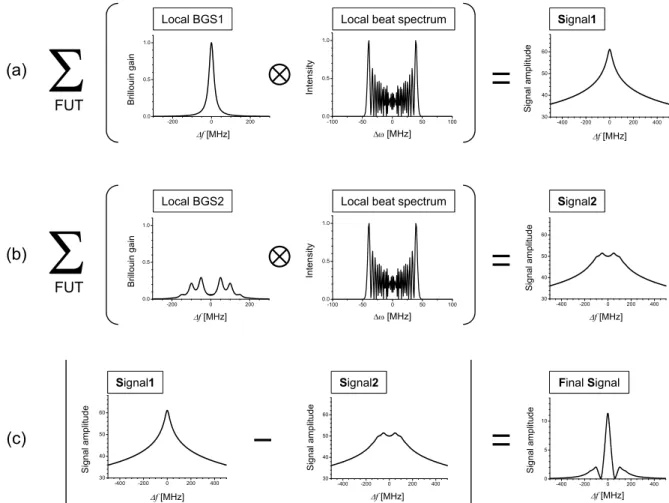
position is also related to the shape of the measured BGS and the amount of the shift of νB [5]. Fig. 1(a) schematically
shows the principle of the signal construction in ordinary BOCDA system. The intrinsic local BGS with Lorentzian shape is convoluted with the local beat spectrum of the pump and the probe to be summed up in the entire FUT to provide the BOCDA signal. Therefore, the spectral width of the measured BGS is always larger than intrinsic gain
bandwidth ΔvB and a specific substructure is composed as a background noise which limits the dynamic range and the
spatial resolution of the measurement. In former works, there have been feasibility studies on the removal of the noise structure by applying additional intensity modulation [5, 6].
Fig. 1. (a) Construction of BOCDA signal with an un-modulated pump wave. (b) Construction of BOCDA signal with frequency-modulated pump wave. (c) Construction of the final BOCDA signal by calculating the difference between the results of (a) and (b) based on differential lock-in detection.
In this work, we introduce differential lock-in detection where additional phase modulation (PM) is applied to the pump wave and the on-off control on the PM is used for data acquisition by a lock-in amplifier, which leads to effective removal of the noise substructure from the BOCDA signal and retrieval of the narrowband local BGS. The operation principle is depicted in Fig. 1(a) ~ (c). When the PM is not applied to the pump wave (like the case of ordinary BOCDA), one obtains ‘Signal1’ by the BOCDA as shown in Fig. 1(a). If the PM is additionally applied to the level of the carrier suppression, the local BGS is modified due to the sidebands of the pump wave (local BGS2) which results in ‘Signal2’ by the BOCDA as depicted in Fig. 1(b). If the difference between Signal1 and Signal2 is received as the final signal, one can obtain both the suppression of the noise substructure and the construction of the narrowband Brillouin gain spectrum as shown in Fig. 1(c). This process can be easily implemented by replacing an intensity chopper used in ordinary
BOCDA system with a phase modulator, where the PM of the pump wave is on-off switched at a frequency fL, and the
difference between Signal1 and Signal2 is acquired as the final signal by a lock-in amplifier with a reference frequency
of fL. In our experimental confirmation, it is shown that the removal of the noise structure effectively enhances both the
spatial resolution and the dynamic range of the BOCDA.
-200 0 200 0.0 0.5 1.0 B ril loui n gai n Δf [MHz]
Local BGS1 Local beat spectrum
-100 -50 0 50 100 0.0 0.5 1.0 Inte nsity Δω [MHz] -400 -200 0 200 400 30 40 50 60 Si gnal a m plit ud e Δf [MHz] Signal1
Σ
FUTLocal BGS2 Local beat spectrum Signal2
Σ
FUT -100 -50 0 50 100 0.0 0.5 1.0 Int ensit y Δω [MHz] -200 0 200 0.0 0.5 1.0 Br ill o ui n gai n Δf [MHz] -400 -200 0 200 400 30 40 50 60 Si gn al amp lit ude Δf [MHz](a)
(b)
(c)
-400 -200 0 200 400 30 40 50 60 Signa l ampl itude Δf [MHz] Signal1 Signal2 -400 -200 0 200 400 30 40 50 60 Si gna l am pl itude Δf [MHz] -400 -200 0 200 400 0 5 10 Δf [MHz] S igna l am pl itu d e Final SignalProc. of SPIE Vol. 8421 8421BB-2
wICLOMBN 2äU9íesustslo iu swbp p0i8pL ciLcnisroL 21U6 MSAE DLB FD 3. EXPERIMENTAL RESULTS
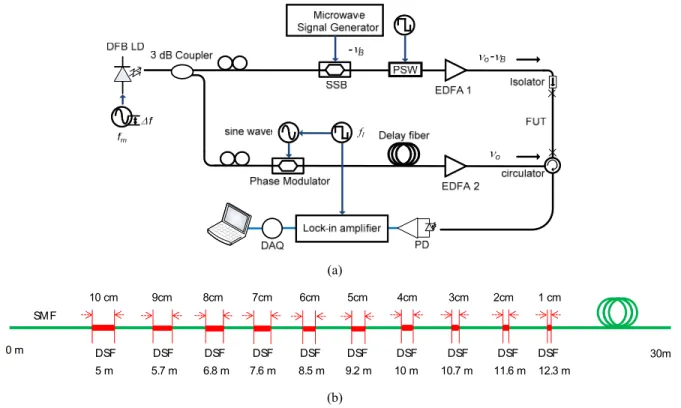
Fig. 2(a) shows the proposed BOCDA system with differential lock in detection. A 1550-nm distributed feedback laser
diode (DFB-LD) with the frequency modulated (Δf ~ 4 GHz, fm = 3.4 MHz) by a sine wave is used as a light source.
These modulation parameters correspond to Δz =7.3 cm by Eq. (1). The output of the LD was divided into two beams by a 3-dB coupler. One beam was injected into a single sideband modulator (SSBM) which was driven by microwave signal
generator and the lower sideband output (v0 - Δv) was utilized as a probe wave. The other beam was amplified by an
erbium-doped fiber amplifier (EDFA) after passing through delay fiber, to be used as the pump. In order to apply the differential lock-in detection, the pump beam was modulated by a phase modulator and the driving voltage of the modulator was periodically on and off at the lock in frequency. The pump and the probe were launched into an FUT through a circulator in opposite direction to each other. Finally the amplified probe signal due to SBS was detected by a photo detector (PD), and the output was processed by the lock-in amplifier. The BGS of single position was obtained by sweeping the frequency of the microwave generator in the vicinity of the Brillouin frequency, and the distributed BGS
along the FUT was obtained by repeating the BGS measurement while varying fm. The FUT was prepared to measure the
enhancement of the spatial resolution by concatenating SMF and ten pieces of DSF, as shown in Fig. 2(b). The Brillouin frequencies were about 10.87 and 10.51 GHz, for SMF and DSF, respectively.
(a)
(b)
Fig. 2. (a) Experimental setup for the BOCDA with differential lock-in detection. (b) Structure of the FUT.
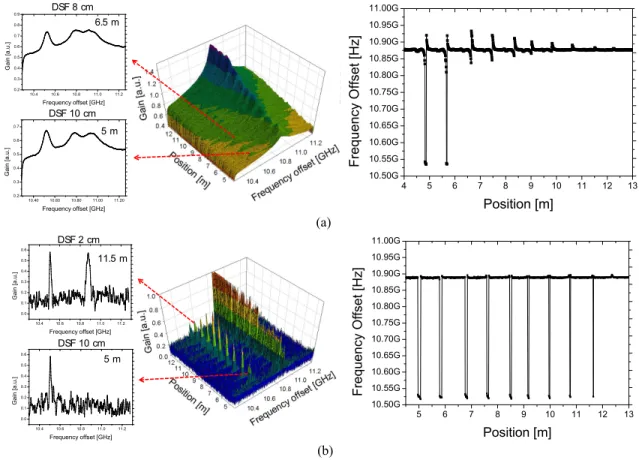
For the confirmation of the effect of the differential lock in detection, we carried out the distributed measurements two times: one with ordinary BOCDA setup and the other with the proposed setup for comparison. As shown in Fig. 3(a), one cannot get correct BFS information if the strained applied section is shorter than 8 cm in ordinary BOCDA setup mainly due to the large noise substructure as appeared in the inset, which matches well with the theoretical spatial resolution by Eq. (1). Meanwhile, as plotted in Fig. 3(b), it is seen that the detection of BFS was successful down to 2 cm strain-applied section. As shown in the inset of Fig. 3(b), the constructed BGS is observed to be much narrower than the signal of ordinary BOCDA system with the noise substructure almost disappeared, which leads to the enhancement of both the spatial resolution and the dynamic range. According the result, the spatial resolution was improved at least three times by the application of differential lock-in detection; however, we believe further enhancement might be possible by optimizing the parameters of the applied phase modulation.
10 cm 9cm 8cm 7cm 6cm 5cm 4cm 3cm 2cm 1 cm SMF DSF DSF 30m 0 m 5 m 5.7 m 6.8 m 7.6 m 8.5 m 9.2 m 10 m 10.7 m 11.6 m 12.3 m DSF DSF DSF DSF DSF DSF DSF DSF
Proc. of SPIE Vol. 8421 8421BB-3
(a)
(b)
Fig. 3. Distributed BGS (left) and BFS (right) measured by (a) ordinary BOCDA system and, (b) the BOCDA system with differential lock-in detection.
4. CONCLUSION
We have proposed and experimentally demonstrated the BOCDA system based on differential lock in detection, in
which the spatial resolution and the dynamic range was improved with the acquisition of the narrow Brillouin gain spectrum. It
was shown that the spatial resolution was improved by more than three times compared to the ordinary BOCDA system.
REFERENCES
[1] X. Bao, D. J. Webb and D. A. Jackson “32-km distributed temperature sensor using Brillouin loss in optical fiber,” Opt. Lett. 18, 1561-1563 (1993).
[2] M. Nikles, L. Thevenaz, and P. Robert, “Simple distributed fiber sensor based on Brillouin gain spectrum analysis,” Opt. Lett. 21, 758-760 (1996).
[3] K. Hotate and T. Hasegawa, “Measurement of Brillouin gain spectrum distribution along an optical fiber using a correlation-based technique—proposal, experiment and simulation,” IEICE Trans. Electron.E83-C, 405–412 (2000). [4] J. H. Jeong, K. Lee, K. Y. Song, J.-M. Jeong, and S. B. Lee, “Variable-frequency lock-in detection for the suppression of beat noise in Brillouin optical correlation domain analysis” Opt. Express 19, pp.18721-18728 (2011). [5] K. Y. Song, Z. He, and K. Hotate, “Optimization of Brillouin optical correlation domain analysis system using
intensity modulation scheme,” Opt. Express 14, 4256-4263 (2006).
[6] K. Y. Song, Z. He, and K. Hotate, “Effects of intensity modulation of light source on Brillouin optical correlation domain analysis,” J. Lightwave Technol. 25, 1238-1246 (2007).
10.4 10.6 10.8 11.0 11.2 0.2 0.3 0.4 0.5 0.6 0.7 0.8 0.9 Frequency offset [GHz] Gain [ a .u.] 10.40 10.60 10.80 11.00 11.20 0.2 0.3 0.4 0.5 0.6 0.7 Frequency offset [GHz] Gai n [a.u.] 5 m 6.5 m DSF 10 cm DSF 8 cm 4 5 6 7 8 9 10 11 12 13 10.50G 10.55G 10.60G 10.65G 10.70G 10.75G 10.80G 10.85G 10.90G 10.95G 11.00G Position [m] Frequ ency Off set [Hz] 10.4 10.6 10.8 11.0 11.2 0.0 0.1 0.2 0.3 0.4 0.5 0.6 Frequency offset [GHz] Ga in [a .u .] 5 m 11.5 m DSF 10 cm DSF 2 cm 10.4 10.6 10.8 11.0 11.2 0.0 0.1 0.2 0.3 0.4 0.5 0.6 Frequency offset [GHz] G ain [a .u .] 5 6 7 8 9 10 11 12 13 10.50G 10.55G 10.60G 10.65G 10.70G 10.75G 10.80G 10.85G 10.90G 10.95G 11.00G Position [m] F re quen cy Of fset [Hz]
Proc. of SPIE Vol. 8421 8421BB-4