산업폐기물을 이용한 인공 경량골재 제조에 관한
실험적 연구
Experimental Study of Manufacturing Artificial Lightweight
Aggregates using Industrial Wastes
윤 섭
*김 정 빈
**정 용
***Yoon, Seob Kim, Jung Bin Jeong, Yong
ABSTRACT
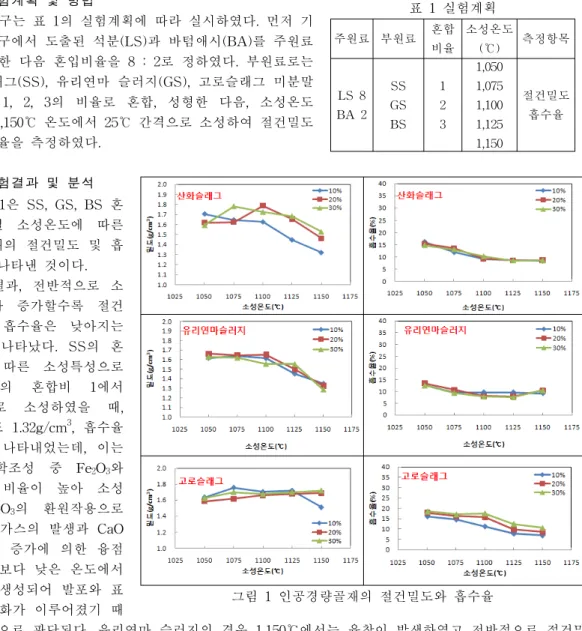
This study is of manufacturing artificial lightweight aggregates using industrial wastes. The ingredients for manufacturing lightweight aggregate were stone sludge and bottom ash for main materials, and steel slag(SS), glass abrasive sludge(GS) and blast furnace slag(BS) respectively for accessory material. Their precursors were sintered in the range of 1,050~1,150℃ for 5 min. The sintered results show that the lightweight aggregate with SS had low water absorption ratio and density at 1,150℃. There's a possibility that if GS is used more than the range of this study, GS can be manufactured lightweight aggregate. But it is judged that BS are incongruent to be used for a raw material of lightweight aggregate.
요 약
본 연구는 산업폐기물을 이용한 인공경량골재의 제조에 관한 실험적 연구이다. 실험결과, 산화슬래그 를 부원료로 사용한 경우, 소성온도 1,150℃에서 낮은 절건밀도와 낮은 흡수율을 나타내었고 유리연마 슬러지의 경우는 본 연구에서 사용한 범위 이상을 사용하여야 경량화가 가능할 것으로 판단된다. 그러 나 고로슬래그 미분말은 경량골재 원료로 사용하기에는 부적합한 것으로 판단된다. 1. 서 론 미국, 유럽 등 선진국에서는 이미 100여년전부터 지속되어 온 연구로 인하여 인공경량골재에 대한 제조 기술을 축적해 왔다. 가까운 일본의 경우에도 40년전부터 그에 대한 연구를 진행하여 실무현장에 활용하고 있다. 이러한 연구는 팽창혈암, 팽창점토 등의 천연자원을 이용한 경량골재에 대한 연구뿐만 아니라 산업폐기물인 플라이애시, 하수오니 등 다양한 재료에 대하여 점차 확대되고 있다. 국내의 경우 는 경량골재용 천연자원의 빈약으로 제조에 대한 연구 데이터뿐만 아니라 시장 자체도 미미하고 그 시 장도 비구조용 시장이 주류를 이루고 있다. 그러나 내진 및 내구성에 대한 규제가 엄격해짐에 따라 국 내에서도 경량골재의 수요가 증가할 것으로 예상되어 이에 대비한 경량골재 제조 기술의 개발이 시급 할 것으로 판단된다. 그러므로 본 연구에서는 산업폐기물인 석분슬러지, 바텀애시, 산화슬래그, 유리연마 슬러지, 고로슬래 그 미분말을 이용하여 배합비, 소성온도를 변화시켜 산업폐기물을 이용한 인공경량골재 제조에 관한 기초적 자료를 마련하고자 한다. * 정회원, (주)삼표 기술연구소 전임연구원 ** 정회원, (주)삼표 기술연구소 수석연구원 *** 정회원, (주)삼표 기술연구소 소장 한국콘크리트학회 2010년 봄 학술대회 논문집그림 1 인공경량골재의 절건밀도와 흡수율 주원료 부원료 혼합 비율 소성온도 (℃) 측정항목 LS 8 BA 2 SS GS BS 1 2 3 1,050 1,075 1,100 1,125 1,150 절건밀도 흡수율 표 1 실험계획 2. 실험계획 및 방법 본 연구는 표 1의 실험계획에 따라 실시하였다. 먼저 기 존의 연구에서 도출된 석분(LS)과 바텀애시(BA)를 주원료 로 선택한 다음 혼입비율을 8 : 2로 정하였다. 부원료로는 산화슬래그(SS), 유리연마 슬러지(GS), 고로슬래그 미분말 (BS)를 1, 2, 3의 비율로 혼합, 성형한 다음, 소성온도 1,050~1,150℃ 온도에서 25℃ 간격으로 소성하여 절건밀도 와 흡수율을 측정하였다. 3. 실험결과 및 분석 그림 1은 SS, GS, BS 혼 입비율별 소성온도에 따른 경량골재의 절건밀도 및 흡 수율을 나타낸 것이다. 실험결과, 전반적으로 소 성온도가 증가할수록 절건 밀도와 흡수율은 낮아지는 것으로 나타났다. SS의 혼 입비에 따른 소성특성으로 는 SS의 혼합비 1에서 1,150℃로 소성하였을 때, 절건밀도 1.32g/cm3, 흡수율 7.2%를 나타내었는데, 이는 SS 화학조성 중 Fe2O3와 CaO의 비율이 높아 소성 시, Fe2O3의 환원작용으로 인한 O2가스의 발생과 CaO 의 성분 증가에 의한 융점 저하로 보다 낮은 온도에서 액상이 생성되어 발포와 표 면 치밀화가 이루어졌기 때 문인 것으로 판단된다. 유리연마 슬러지의 경우 1,150℃에서는 융착이 발생하였고 전반적으로 절건밀 도 1.45~1.55g/cm3, 흡수율 9~12%로 다소 높게 나타났으나 유리연마 슬러지의 사용량이 많아지면 경량화 가능성이 있을 것으로 판단된다. 고로슬래그 미분말은 전반적인 실험결과 절건밀도 1.60~ 1.80g/cm3로 경량골재 원료로 사용하기에는 부적합한 것으로 판단된다. 4. 결 론 본 연구는 산업폐기물을 이용한 인공경량골재의 제조에 관한 연구로써, SS의 혼입비가 증가할수록 혼합체 내의 Fe2O3 성분과 CaO 성분의 비율이 증가하여 소성 시 발생하는 발포현상과 액상생성에 의 한 경량화를 만족하는 것으로 나타났고, GS의 경우, 혼입비율이 본 연구범위보다 더 많이 사용한다면 경량화 가능성이 있을 것으로 판단된다. 하지만 BS의 경우는 경량골재의 원료로 사용하기에는 부적합 것으로 판단된다.