Effect of Peanut Seed Orientation on Germination,
Seedling Biomass, and Morphology in an Oak Tree
Sawdust Cultivation System
Junsik Ahn1, Ilchan Song1, Dongjae Kim1,2, Joon Chul Lee3, Sungkwon Moon4, Sooncheol Myoung5, and Kisung Ko1*
1
Department of Medicine, College of Medicine, Chung-Ang University, Seoul 06974, Korea
2
Department of Biological Chemistry, University of California, Los Angeles, CA 90095, USA
3Agricultural Corporation Co. Resvera, Cheongju 28644, Korea
4Department of Food Science, College of Biotechnology and Natural Resource, Chung-Ang University,
Anseong 17546, Korea
5
Department of Urology, College of Medicine, Chung-Ang University, Seoul 06974, Korea *Corresponding author: [email protected]
We performed seed germination tests to investigate the effects of seed sowing orientation on germination viability on peanut (Arachis hypogaea L.) sprouts. Specifically, we assessed the influence of seed sowing orientation on germination rate, seedling weight, and seedling length, as well as the seedling vigor index. The seeds were sown in oak tree sawdust at 3.0 cm depth. Four seed orientations were tested: vertical with the hypocotyl end down, vertical with the hypocotyl end up, horizontal with the hypocotyl end down, and horizontal with the hypocotyl end up. The mean seed germination percentages of the four seed orientations were significantly different (p < 0.01) and ranged from 25 to 91.7%. The vertical orientation with hypocotyl-end-down and hypocotyl-end-up orientations showed the highest (91.7%) and lowest (25%) germination rates, respectively. The vertical orientation with the hypocotyl end down produced the heaviest (4.9 g) seedlings and the longest hypocotyls (4.65 cm). This orientation also produced the longest true leaf + epycotyl (2.15 cm) and had the highest seedling vigor index (197.1). The seedlings had a straight growth pattern, whereas seedlings from seeds sown with the hypocotyl up had an awkward plumular hook shape. Taken together, to produce peanut sprouts, we recommend placing the seeds vertically with the hypocotyl end down because this orientation leads to a high germination rate, high biomass production, and high overall seedling quality.
This work was supported by the “Food Functionality Evaluation Program (2016)” under the Ministry of Agriculture, Food and Rural Affairs and partially by the Korea Food Research Institute, a grant (Code# PJ011110) from the Korean Rural Development Administration, and National Research Foundation of Korea Grant funded by the Korean Government (MEST) (NRF-2014R1A2A1A11052922).
HORTICULTURAL SCIENCE and TECHNOLOGY 35(4):402-409, 2017
URL: http://www.kjhst.org
pISSN : 1226-8763 eISSN : 2465-8588
This is an Open-Access article distributed under the terms of the Creative Commons Attribution NonCommercial License which permits unrestricted non-commercial use, distribution, and reproduction in any medium, provided the original work is properly cited.
Copyrightⓒ2017 Korean Society for Horticultural Science. OPEN ACCESS Received: Revised: Accepted: December 20, 2016 December 20, 2016 December 27, 2016
Abstract
Additional key words: Arachis hypogaea, cotyledon, hypocotyl, morphology, sowing direction, vigor index
Introduction
Early sprout development dependson successful seed germination, hypocotylgrowth, and root emergenceinthedirectionofgravity (MaandHasenstein, 2006). Seedshaveaphysiologicalabilityto
germinateandcorrectlyorientthemselvesaccordingtogravity, aprocessknownasgravitropism (Takakuraetal., 1996). Seed orientationduringsowingcanaffecttheseedgerminationrate, seedlingphysiology, andseedlingmorphology (Kevinetal.,
2015). Theseediscomposedofacotyledon, aplumule (embryonicshootwithfirstleaves), andaradicle (embryonicroot). The seedshouldbeproperlyorientatedwhensownsothattheradiclepointsdownwards, sincetheseedsofsomeplantspecies exhibitgravitropism (BlancaflorandMasson, 2003). Iftheradiclepointsupwards, theembryonicrootandstememergeinthe wrongdirectionandhavetochangeorientation, whichrequiresenergyandsubsequentlyreducesplantgrowth (Jhaetal., 2012).
Peanut sprouts have recently become popular as a functional food material because they contain resveratrol
(3,4’,5-trihydroxystilbene), apotentbioactivephytochemicalthathelpspreventcardiovasculardiseasesandcancer (Sanderset al., 2000). Theoaktreesawdustcultivationsystemhasbeendevelopedtoincreaseresveratrolcontentsinpeanutsprouts (Lee,
2016). However, thissystemiscostlyandtimeconsumingcomparedtowatercultivationofpeanutsprouts. Therefore, high germinationratesandgoodmorphologicalgrowthwithhighbiomassareessentialforsuccessfulsproutcultivationandthe commercializationofpeanutsprouts. Ingeneral, germinationrate, seedlinggrowth, andmorphologyoftenvaryduetoseed sowingorientationinsimilarenvironmentsandforthesamevarieties (BosyandAarssen, 1995; Leeetal., 2016). Inthisstudy,
weinvestigatedtheeffectsofseedsowingorientationongerminationrate, growth, andmorphologyinpeanutunderoaktree sawdustcultivationconditionsinordertodeterminetheoptimalseedorientationforseedgerminationand toimprove germinationratesandseedlingvigor.
Materials and Methods
Oak Tree Sawdust Cultivation System for Seed Germination
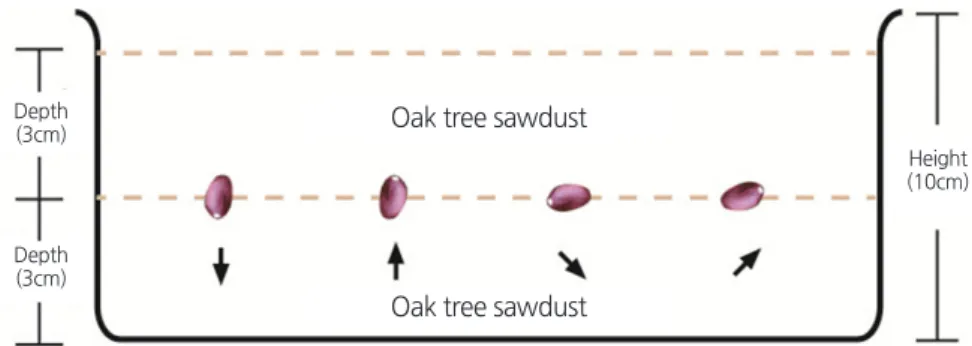
Peanut (Arachis hypogaea L.) seedsweresownintrays (50 × 30 × 10cm; NamyoungChemical, Hanam, Korea) containing oaktreesawdustandwereplantedinrows. Thespacingbetweenseedswas5cm, rowspacingwas9cm, andthesowingdepth was3cm. Allsevenseedsperrowhadthesameorientation. Fourteenseedsweresowninfourdifferentorientationsasfollows:
verticalwiththehypocotylenddown (No. 1), verticalwiththehypocotylendup (No. 2), horizontalwiththehypocotylenddown
(No. 3), andhorizontalwiththehypocotylendup (No. 4) (Fig. 1). Oaksawdusttoadepthof3cmwasplacedinatray, andafter sowing, theseedswerecoveredwitha3cmlayerofsawdust. Thetraysweretransferredtoadarkroomandwateredwithatotal
Fig. 1. Illustration of the seed orientations used in this study (from left to right: vertical with hypocotyl end down [No. 1], vertical with hypocotyl end up [No. 2], horizontal with hypocotyl end down [No. 3], and horizontal with hypocotyl end up [No. 4]). Seeds were placed in a 50 × 30 × 10 cm tray in one of the four different orientations on 3 cm of oak tree sawdust and covered with an additional 3 cm of oak tree sawdust.
Oak tree sawdust Oak tree sawdust Depth (3cm) Depth (3cm) Height (10cm)
of3Lwatereverydayinthemorningandevening. Seedgerminationwasrecordedeachdaybeginningatthreedaysafter sowing. Ninedaysaftersowing, allseedlingsineachorientationgroupwereobservedandtheirseedgerminationrate, hypocotyl,
trueleaf + epicotyl, root, andcotyledonlengthweremeasured, aswellasthegerminatedseedlingweight. Theseedling morphologywasalsorecorded.
Seedling Weight and Tissue Length Measurements
Thepeanutseedlingswereremovedfromeachtrayafter9daysofculture. Allseedlingswerewashedwithtapwaterand blotteddryonpapertowels (YuhanKimberly, Seoul, Korea). Thefreshofthewholeseedlingandthelengthsofthetrueleaf +
epicotyl, hypocotyl, root, andcotyledonweremeasured.
Vigor Index
Tooptimizetheconditionsforpeanutseedlingcultivation, thefourgroupsofpeanuts (categorizedbyseedlingorientation)
wereevaluatedusingtwocriteria: germinationrateandthelengthsofthefourtissuepartsmentionedabove. Thevigorindex wascalculatedasfollows: Germinationrateofeachseedlingorientationgroup × lengthofeachtissuepart.
Morphological Observation
Freshlyharvestedpeanutseedlingsampleswereplacedonapieceofblackcottonflannel. Fiveindividualsfromeachseedling orientationgroupwereselectedandphotographedusingaDigitalGrossSystemcamera (Humintec, Suwon, Korea). .
Results
Effect of Seed Orientation on Germination Rate
Theseedlingemergencetimeandseedgerminationratesweredifferentamongtheseedsowingorientationgroups. Inthe verticalwithhypocotyl-end-downorientationgroup (No. 1), theradicalbegantoemergeat4daysaftersowing, whereasit startedtoemergeafter7daysintheverticalwithhypocotyl-end-uporientationgroup (No. 2). Inthehorizontalwithhypocotyl endupanddownorientationgroups (Nos. 3and4, respectively), thehypocotylbegantoappearafter8and6days, respectively.
Seedssownverticallywiththehypocotylenddownward (No. 1) emergedsignificantlymorequicklythantheothers (Nos. 2, 3,
and4; datanotshown). Bycontrast, seedssownverticallywiththehypocotylendup (No. 2) emergedsignificantlylaterthanthe others (Nos. 1, 3, 4). SeedorientationgroupNo. 1hadthehighest (91.7%) germinationrate, whereasseedorientationgroupNo.
2hadthelowestgerminationrate (25%). Number3and4orientationshadsimilargerminationrates (41.7and41.7%, respectively)
(Table1andFig. 2).Theseresultsindicatethatsowingseedsverticallywiththehypocotylenddownwardenhancesseed emergenceandthegerminationratecomparedtosowingseedswiththehypocotylendupand/orhorizontally.
Effect of Seed Orientation on Seedling Weight
Ninedaysaftersowing, allseedlingswereuprootedandweighed. Seedssownverticallywiththehypocotylenddown (No. 1)
weightsofNo. 3and4seedorientationswere4.4gand4.7g, respectively(Fig. 3).
Effect of Seed Orientation on True Leaf + Epycotyl (TLE), Hypocotyl, Root, and Cotyledon Length
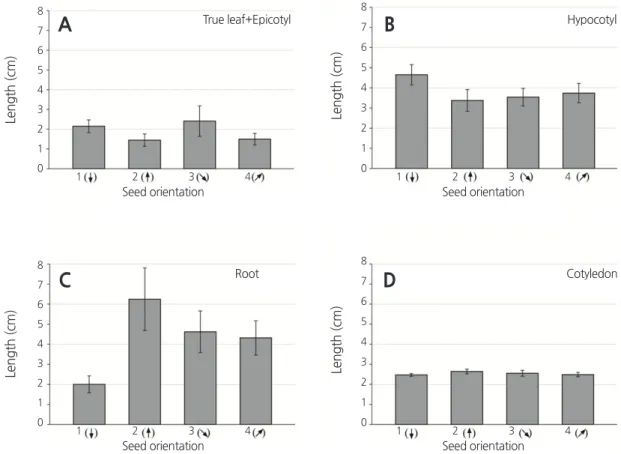
Thetrueleaf + epycotyl (TLE) inseedlingsfromgroupNo. 1 (verticalwiththehypocotylenddown) (2.15cm) andgroupNo.
3 (horizontalwiththehypocotylenddown) (2.41cm) werelongerthanthosefromgroupsNo. 2 (verticalwiththehypocotylend up) (1.45cm) andNo. 4 (horizontalwiththehypocotylendup) (1.49cm) (Fig. 4A). TheaveragehypocotyllengthofgroupNo. 1 seedswassignificantlygreater (4.65cm) thanthatproducedbytheotherseedorientations (No. 2, 3.37cm; No. 3, 3.54cm; and No. 4, 3.74cm) (Fig. 4B). TherootsofseedlingsingroupNo. 2 (6.25cm) weresignificantlylongerthanthoseoftheothergroups
Fig. 2. Effect of seed sowing orientation (from left to right: vertical with hypocotyl end down [No. 1], vertical with hypocotyl end up [No. 2], horizontal with hypocotyl end down [No. 3], and horizontal with hypocotyl end up [No. 4]) on seed germination rate. Germination rate (% ) 0 20 40 60 80 100 Seed orientation 1 2 3 4
Fig. 3. Effect of seed sowing orientation (from left to right: vertical with hypocotyl end down [No. 1], vertical with hypocotyl end up [No. 2], horizontal with hypocotyl end down [No. 3], and horizontal with hypocotyl end up [No. 4]) on fresh.
Fresh (g) Seed orientation 1 2 3 4 0 2 3 4 5 6 1 Orientationz Germination rate (%)
Length (cm) Vigor index (VI)y
True leaf+
Epicotyl Hypocotyl Root Cotyledon True leaf+Epicotyl Hypocotyl Root Cotyledon #1 91.7 2.15 4.65 2.00 2.47 197.1 ± 12.7 426.3 ± 38.8 183.3 ± 16.7 226.1 ± 20.6
#2 25.0 1.45 3.37 6.25 2.64 36.1 ± 8.5 84.3 ± 28.1 156.1 ± 52.0 65.9 ± 22.0
#3 41.7 2.41 3.54 4.62 2.55 100.4 ± 14.2 147.5 ± 29.5 192.5 ± 38.5 106.3 ± 21.3 #4 41.7 1.49 3.74 4.32 2.48 62.2 ± 8.8 155.9 ± 31.2 179.9 ± 36.0 103.5 ± 20.7
z#1: ↓, #2: ↑, #3:↘, #4:↗.
yGermination Rate (%) ×Length (cm).
(Fig. 4C). SeedlingsingroupNo. 1hadtheshortestroots (2.0cm) (Fig. 4C). Allorientationsproducedcotyledonsthatwere similarinlength (No. 1, 2.47cm; No. 2, 2.64cm; No. 3, 2.55cm; andNo. 4, 2.48cm) (Fig. 4D).
Effect of Seed Orientation on Vigor Index
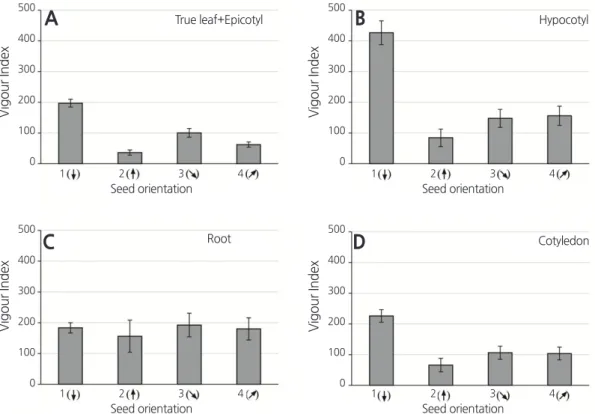
Wecalculatedthevigorindexofeachgerminatedseedlingtodeterminewhichorientationledtothemostefficientbiomass production(Table1andFig. 5). Accordingtothecalculation, theorder (fromhighesttolowest) wasNo. 1 > No. 3 > No. 4 > No. 2.
Ingeneral, seedsorientedwiththehypocotylenddownproducedseedlingswithbettervigorindexvaluesthanthosegrown fromseedsorientedwiththehypocotylendup. Whentheseedswereplacedhorizontally, theorientationdidnotappeartohave asignificanteffectonseedlingvigor. However, intheverticalorientation, thehypocotyl-end-uppositionhadasignificantly adverseeffectonthevigorindex(Fig. 5).
Effect of Seed Orientation on Seedling Morphology
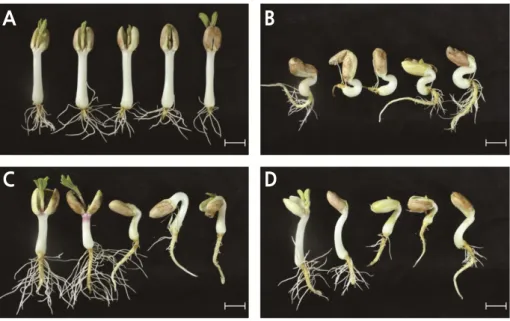
TheNo. 1orientatedseedsproducedanuprightseedlingform (Fig. 6A). Theverticalhypocotyl-end-uporientation (No. 2) led toseedlingswithanawkward, plumularhookshapeandlongroots(Fig. 6B). TheNo. 3andNo. 4seedorientationsproduced seedlingswithsimilarshapes (Figs. 6CandD, respectively). However, seedlingsgrownfromhorizontalseedswiththehypocotyl enddownwardshowedslightlybetteremergenceoftrueleavesthantheothergroup.
Fig. 4. Effect of seed sowing orientation (from left to right: vertical with hypocotyl end down [No. 1], vertical with hypocotyl end up [No. 2], horizontal with hypocotyl end down [No. 3], and horizontal with hypocotyl end up [No. 4]) on seedling length. A: True leaf + Epicotyl; B: Hypocotyl; C: Root; D: Cotyledon.
A
B
C
D
Length (cm) Length (cm) Length (cm) Length (cm) Seed orientation Seed orientation Seed orientation Seed orientation True leaf+Epicotyl Root Hypocotyl Cotyledon 1 2 3 4 1 2 3 4 1 2 3 4 1 2 3 4 0 2 3 4 5 6 1 7 8 0 2 3 4 5 6 1 7 8 0 2 3 4 5 6 1 7 8 0 2 3 4 5 6 1 7 8Discussion
Weinvestigatedtheeffectsofseedorientationonthegerminationrate, seedlingweight, lengthofeachseedlingtissue, and morphologyofpeanutsprouts. Theverticalwithhypocotylenddownwardorientationproducedthehighestgerminationrate comparedtotheotherorientations, whichindicatesthatthereisacloserelationshipbetweenseedorientationandgermination
(BowersandHayen, 1972). Indeed, thebestseedgerminationandseedlinggrowthinAnjan (Hardwickia binata Roxb) were achievedwhentheseedwasplantedinahorizontalposition (Masilamanietal., 1999), whereasbeanseedsplantedhypocotyl endupledtosignificantlyhighergerminationratesthanhypocotylenddownandthehorizontalposition (BowersandHayden,
1972). Previousreportshavesuggestedthatitisessentialtodeterminetheoptimalseedorientationsfordifferentplantspeciesif efficientgerminationandseedlinggrowtharetobeachieved. Inthecurrentstudy, thehypocotyl-end-uporientationsproduced thelowestseedlingweightcomparedtotheverticalorientations. Bycontrast, Anjan (H. binata Roxb) seedlingsgrownfrom seedsplacedinahorizontalorientationhadahigherbiomassthanthosefromseedsplantedinthehypocotylendupwardand downwardorientations (Masilamanietal., 1999). Inaddition, thehypocotyl-end-uporientationledtoreducedgerminationand seedlinggrowthinAnjan (Masilamanietal., 1999).
Inthecurrentstudy, thetrueleaf, cotyledon, hypocotyl, androotlengthwereaffectedbyseedorientation. Thehypocotyl
-downwarddirection, regardlessofwhethertheseedpositionwashorizontalorvertical, producedbettertrueleafgrowth, andthe hypocotylenddownwardwithverticalorientationproducedthelongestleaves. However, thehypocotylenddownwardwith verticalorientationproducedtheshortestroots, whereasthehypocotylendupwardwithverticalorientationproducedthe
Fig. 5. Effect of seed sowing orientation (from left to right: vertical with hypocotyl end down [No. 1], vertical with hypocotyl end up [No. 2], horizontal with hypocotyl end down [No. 3], and horizontal with hypocotyl end up [No. 4]) on vigor index (VI). A: True leaf + Epicotyl; B: Hypocotyl; C: Root; D: Cotyledon.
A
B
C
D
Vigour Index Vigour Index Vigour Index Vigour Index Seed orientation Seed orientation Seed orientation Seed orientation True leaf+Epicotyl Root Hypocotyl Cotyledon 1 2 3 4 1 2 3 4 1 2 3 4 1 2 3 4 0 100 200 300 400 500 0 100 200 300 400 500 0 100 200 300 400 500 0 100 200 300 400 500longestroots. TherootlengthwasshorteringroupNo. 1seedlingsthanintheothersbecausethetraydepthwaslimitedto3cm.
Seedorientationhadnosignificanteffectoncotyledonlength. Overall, properseedorientationoptimizesseedlinggrowthin manyplantspecies (BosyandAarssen, 1995; SharmaandPurohit, 1980).
Peanutsproutshavebecomeapopularfreshvegetable. Therefore, morphologicalqualityaswellasweightareimportant factors. Therelationshipbetweenseedsowingorientationandseedgerminationphysiologyandmorphologycanbeexplained bythepreviousfindingthattheinversionoftheseedlingsometimesproducesabnormalchemicalorphysiologicalconditions,
resultinginanabnormalmorphology (Bennetclarketal., 1959). However, thecurrentresultssuggestthatsowingpeanutseeds inaverticalhypocotylenddownwardorientationledtoahighergerminationrateanduniformseedlingshapecomparedtothe otherorientations. Inthisstudy, seedlingmorphologywassignificantlyinfluencedbyorientation. Thehypocotylupwardsseed positionadverselyaffectedseedlinggrowthandshape (Masilamanietal., 1999). Shapeabnormalitiesarecloselyrelatedto auxinallocationtospecifictissuepositions (Thapliyal, 1979). Inaddition, theseedgerminationratealsodecreasedandthe hypocotylgrowthofthegerminatedseedlingwassuppressedunderthisorientation. Thedeleteriouseffectofthevertical hypocotylendupwardorientationisduetotheextraenergyrequiredforgerminationandseedlinggrowth (Masilamanietal.,
1999). Thegreaterenergy requirementfor germination canreduce seedgermination, emergence, and seedling growth
(Thapliyal, 1979). Seedlinggermination, vigorindex, andshapeareinfluencedbyseedorientation, includingthedistributionof planthormones (Phatetal., 2015).
Thepresentstudydemonstratesthatseed-sowingorientationaffectsgerminationefficiencyandseedlinggrowthinpeanut sproutsinanoaktreesawdustcultivationsystem. Thus, itisessentialtoconsiderpropersowingorientationwhenattemptingto successfullygrowpeanutseedlingswithagoodshape. Thehypocotylendupwardseedorientationadverselyaffectedthe germinationrateandalteredtheseedlinggrowthpattern (BosyandAarssen, 1995). Inaddition, seedorientationhasvarying effects, whicharedependentonplantspecies, variety, andenvironmentalconditions. Therefore, allofthesefactorsshouldbe carefullyconsideredinordertoachievegoodseedlinggrowthandshape.
Fig. 6. Effect of seed sowing orientation on the phenotype of germinated seedlings. A: (↓, vertical with hypocotyl end down); B: (↑, vertical with hypocotyl end up); C(↘, horizontal with hypocotyl end down); D:(↗, horizontal with hypocotyl end up). Scale bar = 2 cm.
A
B
Literature Cited
Bennet-clark TA, Younis AF, Esnault R (1959) Geotropic behaviour of roots. J Exp Bot 10:69-86. doi:10.1093/jxb/10.1.69
Blancaflor EB, Masson PH (2003) Plant gravitropism. Unraveling the ups and downs of a complex process. Plant Physiol
133:1677-1690. doi:10.1104/pp.103.032169
Bosy J, Aarssen LW (1995) The effect of seed orientation on germination in a uniform environment: differential success without
genetic or environmental variation. J Ecol 83:769-773. doi:10.2307/2261413
Bowers SA, Hayden CW (1972) Influence of seed orientation on bean seedling emergence. Alliance of Crop, Soil, and Environmental
Science Societies doi:10.2134/agronj1972.00021962006400060008x. doi:10.2134/agronj1972.00021962006400060008x
Jha S, Sehgal VK, Subbarao YV (2012) Effect of direction of sowing and crop phenotype on radiation interception, use efficiency,
growth and productivity of mustard (Brassica juncea L.). J Agric Phys 12:37-43
Kevin KK, Bernard NK, Laurent KK, Ignace KK, Pierre BJ, Ars ne ZBI (2015) Effects of seed orientation and sowing depths on
germination, seedling vigor and yield in oleaginous type of bottle gourd, Lagenaria siceraria (Molina Standl). Int Res J Biol Sci 4(12):46-53
Lee, JC (2016) Method for cultivating peanut sprouts. WO 2016093423 A1
Lee SJ, Jeon H-J, Jeong J-H, Chung N-J (2016) Germination is enhanced by removal of the funiculus in the halophyte glasswort (Salicornia herbacea). Hortic Environ Biotechnol 57:323-329. doi:10.1007/s13580-016-0108-7
Masilamani P, Singh BG, Chinnusamy С, Annadurai K (1999) Short communication influence af seed orientation and depth of sowing
on germination and vigour of Anjan (Hardwickia binata Roxb). Trop Agric Res Ext 2(1):76-78
Ma Z, Hasenstein KH (2006) The onset of gravisensitivity in the embryonic root of flax. Plant Physiol 140:159–166. doi:10.1104/
pp.105.073296
Phat P, Sheikh S, Lim JH, Kim TB, Seong MH, Chon HG, Shin YK, Song YJ, Noh J (2015) Enhancement of seed germination and
uniformity in triploid watermelon (Citrullus lanatus (Thunb.) Matsum. and Nakai). Korean J Hortic Sci Technol 33:932-940. doi:10.7235/hort.2015.14193
Ranal MA, Santana DG (2006) How and why to measure the germination process? Rev Bras Bot 29:1-11 dx.doi:10.1590/S0100-
84042006000100002
Sanders TH, McMichael RW Jr, Hendrix KW (2000) Occurrence of resveratrol in edible peanuts. J Agric Food Chem 48:1243-1246.
doi:10.1021/jf990737b
Sharma MM, Purohit AN (1980) Seedling survival and seed germination under natural and laboratory conditions in Shorea robusta. Seed Sci Technol 8:283-287
Takakura T, Goto E, Tanaka M (1996) The effect of gravity on plant germination. Adv Space Res 18(4/5):255–258. doi:10.1016/
0273-1177(95)00886-J
Thapliyal RC (1979) Influence of seed orientation on seedling emergence in chir plant [Pinus roxburghii Sarg., pines, India]. Short communication. Indian J Exp Biol 17:119-120