P1-32 / C. G. Jhun
IMID 2009 DIGEST •
Abstract
In the bistable chiral splay nematic (BCSN) mode, the splay and π twist states are used for the two stable states. The switching property is strongly dependent on the amplitude of the electric field. In this paper, we investigated the gray scale capability of BCSN liquid crystal display (LCD) by the gradual horizontal electric field caused the interdigital electrode of by the inequality gap. We demonstrate the gray scale of the BCSN LCD during transition process under the horizontal electric field.
1. Introduction
The common feature of bistable liquid crystal displays (LCDs) is the existence of the two stable states without an external field. The two stable states have the memory effects which can reduce power consumption and make multiplexing capability in the passive matrices unlimited so that there has been increasing interest about bistable LCDs. A number of bistable modes have been proposed until now [1-6].
In the bistable chiral splay nematic (BCSN) mode, the splay and π twist states are used for the two stable states. While ideal bistable properties can be obtained with the d/p ratio of 0.25, we have chosen the d/p ratio of 0.2 for the effective horizontal switching [6]. When the d/p ratio is less than 0.25, the splay state is more stable than the twist state. Therefore, with the d/p ratio of 0.2, memory time of the twist state is limited. The twist state is replaced by the splay state accompanying a motion of the disclination line starting from the pixel boundaries.
Recently, we have proposed the double rubbing method [7, 8] and the double cell gap structure [9] for the two memory states to have infinite memory time with the d/p ratio of 0.2. The multi-domain structure
sustains memory time of the two states, because the disclination line is stranded at the domain boundary. However, only one of the two states is allowed in the pixel. This also limits the gray scale capability of BCSN LCD.
In this paper, with the d/p ratio of 0.25, we investigated the gray scale capability of BCSN LCD by the dwindling horizontal electric field caused by the interdigital electrodes of inequality gap. We demonstrate the gray scale of the BCSN LCD during transition process under the horizontal electric field.
2. Transition process of BCSN LCD
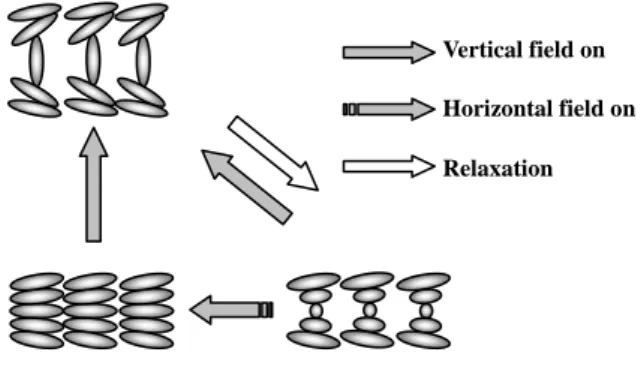
The splay and π twist states are used for the two stable states of the BCSN LCD. Figure 1 shows the transition process by applying a corresponding field to each texture of the BCSN device. By applying a vertical field, the splay state (bottom left) is changed into a bend state (top). Then, if we remove the applied voltage, the bend state relaxes into the π twist state (bottom right). Finally, by applying a horizontal field, the π twist state returns back to the initial splay state.
Fig. 1. Transition process of BCSN LCD by applied electric fields.
Vertical field on Horizontal field on Relaxation
Gray Scale of Bistable Chiral Splay Nematic Liquid Crystal
Device by Interdigital Electrodes of the Inequality Gap
Chul Gyu Jhun
1, Un-Sung Jung
1, Jin-hyouck Moon
1, Kyoungsun Kim
1,
Ji-Hoon Lee
2, Soon-Bum Kwon
1, 2, Joong Ha Lee
3, Jae Chang Kim
31
School of Display Eng., Hoseo University, Asan City, Chungnam, 336-795, Korea 2
NDIS Corporation, 165, Sechul, Baebang, Asan, Chungnam, 336-795, Korea 1
Dep. of Electronics Eng., Pusan National University, Busan, 609-735, Korea Tel.:82-41-540-5899, E-mail: [email protected]
P1-32 / C. G. Jhun
• IMID 2009 DIGEST
3. Simulation
To clarify the transition from the twist state to the splay state, we have firstly investigated the effects of the horizontal electric field on the bistability of the BCSN LCD. As the bistable curve represents the feature of bistable devices, we have calculated the bistable curve based on the continuum theory [10, 11]. The parameters used in the numerical calculation are as follows: liquid crystal MLC-6204-000; elastic constants K11 = 7.5 N, K22 = 6 pN, K33 = 14.8 pN; d/p
0.25; pretilt angle 5˚; cell gap 7.9 um. Both polar and azimuthal anchoring coefficients are 1×10⁻⁵ J/m2,
and the anchoring energy on the top and bottom substrates is assumed to be symmetrical.
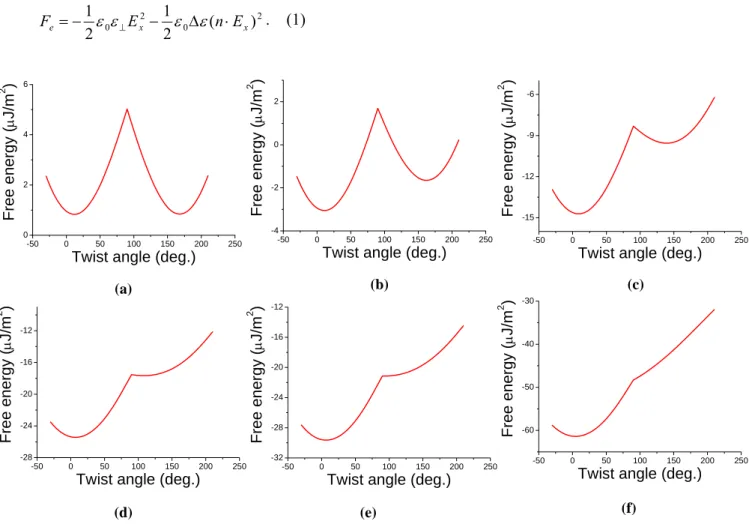
In the calculation, electric energy is considered for a horizontal field: 2 0 2 0 ( ) 2 1 2 1 x x e E n E F =− ε ε⊥ − ε Δε ⋅ . (1)
Calculated bistable curves with respect to the horizontal fields were shown in Fig. 2. Without a horizontal field, ideal bistable property is obtained and there is local minimum energy at the twist angle of 180°. When a horizontal electric field is applied to the BCSN LC device, the horizontal field dwindle the bistable curve to monostable. If the horizontal field is theoretically higher than 1.5×10⁵ V/m, the BCSN LC
cell has the monostable property.
From the simulation results, the transition from the twist to splay states is strongly coupled with the amplitude of the horizontal electric field. If a horizontal field higher than critical value is applied to the twist state, the twist-to-splay transition occurs accompanying a motion of the disclination line starting from defects.
-50 0 50 100 150 200 250 0 2 4 6 Fr ee ener gy ( μ J/m 2 )
Twist angle (deg.)
-50 0 50 100 150 200 250 -4 -2 0 2 Fr ee ener gy ( μ J/m 2 )
Twist angle (deg.)
-50 0 50 100 150 200 250 -15 -12 -9 -6 Fr ee ener gy ( μ J/m 2 )
Twist angle (deg.)
-50 0 50 100 150 200 250 -28 -24 -20 -16 -12 Fr ee ener gy ( μ J/m 2 )
Twist angle (deg.)
-50 0 50 100 150 200 250 -32 -28 -24 -20 -16 -12 Fr ee energy ( μ J/m 2 )
Twist angle (deg.)
Fig. 2. Energy curve of BCSN LC mode when the horizontal electric field of (a) 0, (b) 0.5×10⁵ V/m, (c) 1×10⁵ V/m, (d) 1.3×10⁵ V/m, (e) 1.4×10⁵ V/m, and (f) 2×10⁵ V/m is applied.
(a) (b) (d) (e) -50 0 50 100 150 200 250 -60 -50 -40 -30 Fr ee energy ( μ J/m 2 )
Twist angle (deg.) (c)
P1-32 / C. G. Jhun
IMID 2009 DIGEST •
4. Experimental
With the d/p ratio of 0.25, gray scale of BCSN mode can be achieved. Under no electric field, ideal bistable property is obtained as shown in Fig. 2 (a). As two memory states can simultaneously exist in the same pixel, multi-stable property of the BCSN LCD is obtained by controlling the texture ratio of splay and twist states.
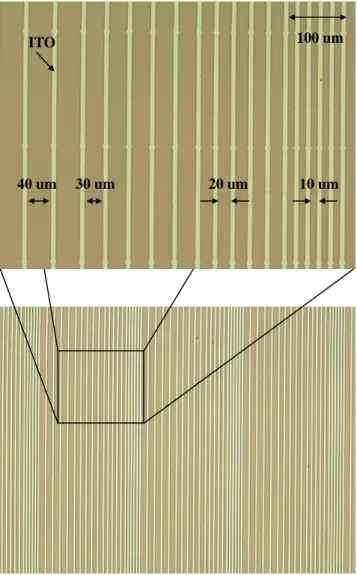
Since the bistability is strongly coupled with the amplitude of the horizontal electric field, we can selectively switch the twist state to the splay state. To realize gray scale simply, we propose an interdigital electrode structure of the inequality gap between electrodes. The fabricated electrode structure on the bottom substrate is shown in Fig. 3. While the width of the transparent electrode was 10 um, the electrode gap were 10 um, 20 um 30 um, and 40 um.
Fig. 3. Interdigital electrodes with the inequality gap
To verify the gray scale capability of the BCSN LCD, we fabricated test cells using the interdigital electrode structure of the inequality gap as shown in Fig. 3. The test cell was filled with MLC-6204-000 (Merck Co.). The d/p ratio and cell gap were 0.25 and 7.9 um, respectively.
5. Results and discussion
Figure 4 shows CCD pictures of the twist-to-splay transition with respect to various driving voltages applied for several seconds, the frequency of which was 1 kHz. When 8 V was applied to the twist state as shown in Fig. 4(2), we can confirm the gradual strength of the horizontal electric field. However, transition does not occur, because it is lower than the critical voltage. The higher voltage over than the critical voltage is applied to the twist state, the more the splay transition occurs.
(a) (b) (c) (d) (e) (f)
Fig. 4. Gray scale of BCSN mode: (a) twist state, (b) twist state with 8 V, (c), after splay transition with (c) 15 V, (d) 20 V, (e) 25 V, and (f) 30 V.
100 um ITO 40 um 30 um 20 um 10 um 100 um Twist state Splay state Twist state Splay state 100 um 100 um 100 um 100 um 100 um
P1-32 / C. G. Jhun
• IMID 2009 DIGEST
The splay transition from the twist state is not only coupled with the amplitude of the horizontal electric field, because the splay and twist states are topologically inequivalent. The splay transition always accompanies a motion of the disclination line starting from defects. The defects also plays crucial role in the splay transition. For the delicate control of the gray scale realization, the defect creation should be considered.
6. Summary
With the d/p ratio of 0.25, we demonstrated the gray scale of BCSN LCD. The splay transition from the twist state is strongly coupled with the amplitude of the horizontal electric field. Gray scale is achieved by gradual strength of the horizontal electric field, which is simply caused by the interdigital electrode structure of the inequality gap between electrodes.
Acknowledgement
This research was supported by a grant (F0004052-2009-32) from the Information Display R&D Center, one of the knowledge Economy Frontier R&D Program funded by the Ministry of Knowledge Economy of Korean Government.
7. References
1. G. D. Boyd, J. Cheng and P. D. T. Ngo, Appl. Phys. Lett., 36, p.556 (1980).
2. D. W. Berreman and W. R. Heffner, Appl. Phys. Lett., 37, p.109 (1980).
3. W. Greubel, U. Wolf, and H. Kruger, Mol. Cryst. Liq. Cryst., 24, p.103 (1973).
4.G. P. Bryan-Brown, C. V. Brown, J. C. Jones, E. L. Wood, I. C. Sage, P. Brett and J. Rudin, SID’97
Technical Digest, Vol. 28,p.37 (1997).
5. I. Dozov, M. Nobili, and G. Durand, Appl. Phys. Lett., 70, p.1179 (1997).
6. S. H. Lee, K.-H. Park, T.-H. Yoon, and J. C. Kim, Appl. Phys. Lett., 82, p.4215 (2003).
7. C. G. Jhun, C. P. Chen, T. – H. Yoon and J. C. Kim, Jpn. J. Appl. Phys., 45, p.5117 (2006).
8. C. G. Jhun, S. P. Chen, S. R. Lee, T.-H. Yoon and J. C. Kim, Mol. Cryst. Liq. Cryst., 476, p.85 (2007) 9. S.-H. Park, Y.-J. Kim, K.-S. Min. C. G. Jhun and
S.-B. Kwon, KLCC’07 Digest,Vol. 10, p. 9 (2007). 10. S. Saito, T. Takahashi, T. Chiba and S. Tsuchida,
Jpn. J. Appl. Phys. 41[6A], p.3841 (2002).
11. C. G. Jhun, C. P. Chen, S. L. Lee, J. I. Back, T.-H. Yoon and J. C. Kim, Jpn. J. Appl. Phys. 45[6A], p.5063 (2006).