RUBBER INCLUSION EFFECTS ON MECHANICAL PROPERTIES OF RUBBER–ADDED
COMPOSITE GEOMATERIAL
YUNTAE KIMi) and HYOSEB GANGii)
ABSTRACT
This paper investigates effects of rubber inclusion on the strength and physical characteristics of rubber–added composite geomaterial (CGM) in which dredged soils, crumb rubber, and bottom ash are reused for recycling. Several series of test specimens were prepared at 5 different percentages of rubber content (i.e. 0%, 25%, 50%, 75%, and 100% by weight of the dry dredged soil) and three different percentages of bottom ash content (i.e. 0%, 50% and 100% by weight of the dry dredged soil). The mixed soil specimens were subjected to unconfined compression test and elastic wave test to investigate their unconfined compressive strengths and small strain properties. The values of bulk unit weight of the CGM with bottom ash content of 0% and 100% decrease from 14kN/m3 to 11kN/m3 and
15kN/m3 to 12kN/m3, respectively, as rubber content increases, because the rubber had a specific gravity of 1.13. The test results indicated that the rubber content and bottom ash content were found to influence the strength and stress-strain behavior of CGM. Overall, the unconfined compressive strength, and shear modulus were found to decrease with increasing rubber content. Among the samples tested in this study, those with a lower rubber content exhibited sand-like behavior and a higher shear modulus. Samples with a higher rubber content exhibited rubber-like behavior and a lower shear modulus. The CGM with 100% bottom ash could be used as alternative backfill material better than CGM with 0% bottom ash. The results of elastic wave tests indicate that the higher rubber content, the lower shear modulus (G).
Key Words : Recycling, Bottom ash, Rubber, Mechanical property
1 INTRODUCTION
Bottom ash is by-product of the combustion of pulverized coal in power plants. Bottom ash is a coarse granular material, in contrast to the very fine structure of fly ash. In general, approximately 8-9% of the total coal ash generated is bottom ash (Sell et al., 1989). Bottom ash has been reused as a replacement for various construction materials, such as cement binder, aggregate, natural sand, and road construction materials, because of its particle size distribution characteristics (Churchill and Amirkhanian, 1999; Andrade et al., 2007). Kumar and Stewart (2003) conducted laboratory tests to investigate the geotechnical engineering characteristics of bottom ash-bentonite mixtures.
Due to the large number of vehicles being manufactured, discarded tires have become an ongoing environmental problem worldwide. More than 500 million tires are discarded in the United States every year. Some of these tires are left stockpiled in landfills or are illegally dumped, providing breeding grounds for harmful insects and rodents (Rubber Manufacturers Association, 2006). In Korea, approximately 20 million tires are discarded annually (Yoon et al., 2008). Discarded tires can be classified into several groups,
based on shape and size: whole tire, slit tire, shredded or chipped tire, ground rubber, or crumb rubber. Waste tires have been used in various applications in civil engineering, such as to reinforce soft soil in road construction, to stabilize slopes, and to backfill retaining structures with lightweight material (Masad et al., 1996; Bernal et al., 1996; Tweedie et al., 1998; Lee et al., 1999; Humphrey, 2004; 2007; Tanchaisawat et al., 2010). Pierce and Backwell (2003) mixed recycled crumb rubber and Class F fly ash to produce a rubber-based flowable fill. They obtained a range of measured strength similar to that typically achieved with standard flowable fill, and concluded that the material might be suitable for lightweight fill applications, such as bridge abutment and trench fills. Wu and Tsai (2009) conducted an experimental study using recycled crumb rubber and native silty sand to produce a lightweight, soil-based, rubberized controlled low strength material (CLSM) for bridge repair.
Despite the potential use of bottom ash as well as rubber for engineering applications, few studies have focused on reusing rubber by mixing it with bottom ash. This paper presents experimental results from a series of laboratory tests carried out on samples of rubber-added composite geomaterial (CGM) to i) Department of Ocean Engineering, Pukyong National University, Busan, 608-737, Republic of Korea.
investigate rubber inclusion effects on physical and mechanical properties of the CGMs. In this context, CGM refers to a controlled low-strength material comprised of dredged soil, bottom ash, cement, and rubber. The composition of such material provides a means to recycle waste materials and use natural dredged soils, once their mechanical properties have been rendered adequate for engineered fill applications. The samples used in this research were produced by adding bottom ash to dredged soil to increase the shear strength of the CGM. Rubber was also added with the goal of making the material lightweight. CGM test specimens were prepared with various contents of admixtures. Physical and mechanical properties of the CGM samples, including bulk unit weight, unconfined compressive strength and small strain property were investigated by conducting several sets of laboratory experiments, including unconfined compression testing and elastic wave testing.
2 EXPERIMENTAL PROGRAM
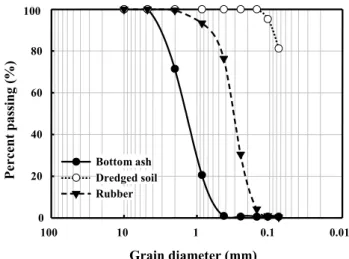
The dredged soil used in the testing program was obtained from a construction site at Busan New Port, Korea. Table 1 lists the geotechnical properties of the dredged soil: the natural water content was 57.5%, the plasticity index was 20.7%, and the grain size analysis revealed that approximately 81% passed through the No. 200 sieve, as shown in Figure 1. The dredged soft clay was classified mostly as low plasticity clay (CL), according to the Unified Soil Classification System. Ordinary Portland cement was used as the cementing material.
Table 1. Properties of dredged soil Initial water content (%) Liquid limit (%) Plastic limit (%) Specific gravity Percent passing no. 200 sieve (%) US CS 57.5 39.2 18.5 2.62 81.2 CL The bottom ash was taken from a power plant in Samchunpo, Korea, and was added to the CGM mixture to increase shear strength. The gravel-size particles were screened through a standard No. 4 sieve. Figure 1 also presents the particle-size distribution curve of the bottom ash: the effective size (D10), uniformity coefficient, and gradation coefficient of the bottom ash were calculated at 0.62 mm, 3.2, and 1.2, respectively. The particle-size distribution of the bottom ash appeared to have the characteristics of poorly-graded sand. The bottom ash had a specific gravity of approximately 2.0, and its chemical composition was 49.8% SiO2, 18.2% Al2O3, 10.4% Fe2O3, and 13.9% CaO (Kim et al., 2010b). Jaturapitakkul and Cheerarot (2003) showed experimentally that ground bottom ash
could be used as a good pozzolanic material. Kim et al. (2010b) also showed experimentally that the increase in shear strength due to addition of bottom ash into soil mixtures was caused not only by the development of friction at the interface of the mixture components, but also by the bond strength due to the pozzolanic reaction of the bottom ash.
Grain diameter (mm) 0.01 0.1 1 10 100 P erce nt pa ss ing (% ) 0 20 40 60 80 100 Bottom ash Dredged soil Rubber
Figure 1. The grain size distribution curves of admixtures.
Crumb rubber is made by cracking discarded tires at very low temperatures. It has a granular texture and ranges in size from very fine powder to sand-sized particles. Figure 1 presents the particle-size distribution curve of the rubber; most particles ranged from 0.1–2 mm and had an irregular shape due to the cracking process (Figure 2). The rubber had an effective size (D10), uniformity coefficient, and gradation coefficient
of 0.18 mm, 2.16, and 0.94, respectively, and its specific gravity was approximately 1.13, similar to previous results (Edil and Bosscher, 1994; Tanchaisawat et al., 2010). The unit weight was 5.39 kN/m3.
Figure 2. SEM image of rubber
Table 2 lists the mixing conditions of the test specimens. Mixing conditions are defined as the ratio of the weight of each admixture to the dry weight of
dredged soil and are expressed in terms of percentages. To observe the effects of the various contents of water and rubber on the characteristics of the CGM, the content of each admixture was modified to the percentage specified in Table 2 during mixing, whereas other admixture contents were maintained at reference values. Cement and water contents was 20% and 140% with respect to the dredged soil weight, respectively. Bottom ash content varied from 0-100% at 50% intervals to investigate rubber inclusion effect on the geotechnical properties of the CGM mixtures. To evaluate the effect of rubber on unit weight and strength of the CGM, rubber was uniformly mixed with the soil mixture at five different contents (0, 25, 50, 75, and 100%). To investigate bulk unit weight, stress-strain behavior, shear strength, and small strain property for each mix condition, each specimen was cured for 28 days and analyzed through laboratory testing including unconfined compression testing and elastic wave testing. Curing involved placing the slurried mixture into a mold with a diameter of 72 mm and a height of 148 mm and maintaining the mixture for the specified period at a temperature of 20±2°C.
Table 2. Mixing conditions
Component Mixing condition(%a)
Water content (Wi) 140 Cement content (Ci) 20 Bottom ash content (BAi) 0, 50, 100 Rubber content (Ri) 0, 25, 50, 75, 100 a: percentage by the weight of dredged soil
In this study, unconfined compression tests were conducted with a strain rate of approximately 1% per min. Primary and shear waves were measured to assess the small strain stiffness of CGM samples. Elastic wave velocities were calculated to consider the tip-to-tip distance between transducers and the travel time of signals through the specimen. Elastic waves were measured along the long axis of specimens in the transmission mode.
3 EXPERIMENTAL RESULTS AND DISCUSSION
3.1 Bulk unit weight
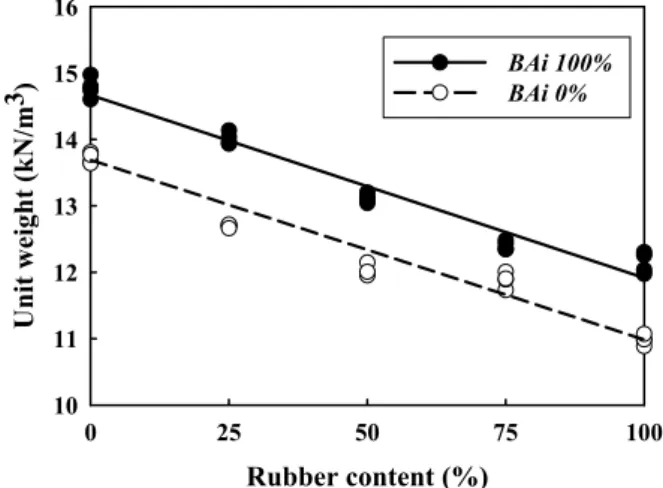
Bulk unit weight is also an important property in CGM. Based on experimental results of air foam-added lightweight soil, Kim et al. (2008; 2010b) found that bulk unit weight did not change significantly as a function of cement content, but strongly depended on the air foam content of the mixture. Water content had a relatively minor effect: bulk unit weight slightly decreased with increased water content. Figure 3 shows the bulk unit weight of CGM as a function of the percentage of rubber and bottom ash. The values of
bulk unit weight of the CGM with bottom ash content of 0% and 100% decrease from 14kN/m3 to 11kN/m3 and 15kN/m3 to 12kN/m3, respectively, as rubber content increases, because the rubber had a specific gravity of 1.13. It also indicates that the bulk unit weight of CGM is strongly dependent on the rubber content. For a given rubber content, the bulk unit weight of CGMs with 100% bottom ash content is 1kN/m3 greater than that with 0% bottom ash content.
Rubber content (%) 0 25 50 75 100 U n it we ight (kN/m 3 ) 10 11 12 13 14 15 16 BAi 100% BAi 0%
Figure 3. Variation of unit weight with rubber content. 3.2 Stress-strain behavior and unconfined compressive strength
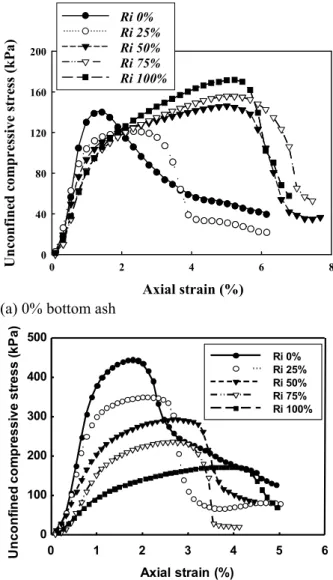
Figure 4 (a) and (b) presents the stress-strain curves of CGM with bottom ash content of 0% and 100%, respectively. These curves were obtained from unconfined compression tests for CGM after 28 days curing. The stress-strain curves of CGM strongly depend on inclusion of bottom ash as well as rubber. The compressive stress of CGM samples tended to increase with increased axial strain to a peak. After reaching peak stress, strain softening occurred and unconfined compressive stress decreased with increased axial strain. As shown in Figure 4 (a) and (b), the unconfined compressive strength of CGM with 100% bottom ash is much greater than that of CGM without bottom ash. For the case of CGM with 0% bottom ash in Figure 4 (a), with the exception of specimens with a relatively low rubber content(i.e., 0%, 25%), the unconfined compressive stress gradually increases with strain after yielding due to elastic compression of waste tire. For the case of CGM with 100% bottom ash in Figure 4 (b), an increase of rubber content contribute to decrease in peak stress. Inclusion of rubber to soil mixture produces more ductile behavior as shown in Figure 4 (b).
CGM with 0% rubber content has typical shear failure. As the rubber content increases, however, the failure shape of CGM shows bulging failure. Figure 4 indicates that the peak strain increases with increasing rubber content.
Figure 5 shows the variation of unconfined compressive strength of CGM with bottom ash and rubber contents. It is found that the unconfined compressive strength decreases with an increase in rubber content. However, in the case of CGM without bottom ash, the unconfined compressive strength slightly increases with increasing rubber content. This increase in the unconfined compressive strength results from the compression characteristics of crumb rubber as shown in Figure 4(a).
Axial strain (%) 0 2 4 6 8 Un co nf in ed c om p re ssi ve str ess (k P a) 0 40 80 120 160 200 Ri 0% Ri 25% Ri 50% Ri 75% Ri 100%
(a) 0% bottom ash
Axial strain (%) 0 1 2 3 4 5 6 U n co n fi n e d co m p ressi ve s tr ess (k P a ) 0 100 200 300 400 500 Ri 0% Ri 25% Ri 50% Ri 75% Ri 100% (b) 100% bottom ash
Figure 4. Stress-strain curves of CGM with varying rubber content
In the case of the low rubber content, inclusion of the bottom ash into mixture leads to an increase in strength. Kim et al. (2010) reported that the increase in shear strength is caused not only by the development of friction at the interface of the mixture components, but also by bond strength is due to the pozzolanic reaction of the bottom ash. On the other hand, as the rubber content increases, the unconfined compressive strength of CGM converges to a certain value regardless of bottom ash content (i.e., about 200kPa in this mixing ratio). This result indicates that rubber dominates the
mechanical behavior of CGM at the rubber content of 100%. The unconfined compressive strength of CGM is strongly influenced by the rubber content.
Unconfined compressive strength of CGM samples decreased with increased rubber content. The stiffness of CGM samples was slightly less than that of bottom ash-added lightweight soil due to the inclusion of rubber, which results in loss of friction and bonding in the mixture, thus providing less resistance against shear. Adding rubber to a soil mixture is advantageous in terms of light unit weight and ductile behavior. However, the addition of rubber also caused decreased strength and stiffness of CGM samples with increased rubber content, due to the fabric change and the negative effect of particle bonding.
Rubber content (%) 0 20 40 60 80 100 U n co nfine d c omp re ssi ve stre ngth (kP a) 0 100 200 300 400 500 BAi 0% BAi 50% BAi 100%
Figure 5. Variation of unconfined compressive strength with bottom ash and rubber contents.
3.3 Small strain properties
The small strain shear modulus Gmax can be
determined from the shear wave velocity and the corresponding mass density of the mixture, as follows:
2 max VS
G =ρ
(1)
Figure 6 shows the shear modulus as functions of rubber content and bottom ash content. The shear moduli of 100% bottom ash content are much greater than those of 0% bottom ash content at a given rubber content. As shown in Figure 6, in case of 100% bottom ash, the shear modulus of CGM decreased rapidly up to 50% rubber content and then converged to a certain value as rubber content increased. However, in case of 0% bottom ash, the shear modulus maintained constant value, regardless of rubber content. Two different mechanisms are involved in the increase of the elastic wave velocities and CGM stiffness with an increase in the bottom ash content: the fabric change and the particle bonding effect. As the bottom ash content
increases, the fabric of the CGM changes from fine to coarse material, and the packing density increases, despite the specific gravity of the bottom ash being lower than that of the dredged material.
It is also shown that the shear modulus decreases with an increase in rubber content. The trends are very similar to those of the elastic wave velocities and CGM stiffness, and in agreement with the stress–strain relationship shown in Figure 4.
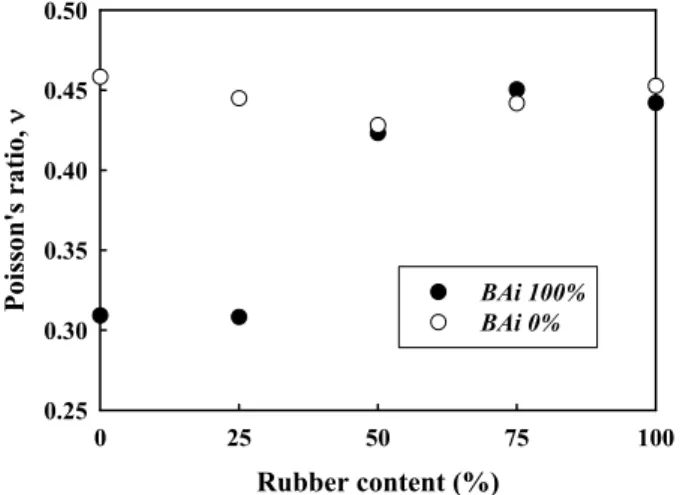
Figure 7 plots the Poisson’s ratio versus rubber content and bottom ash content. The small strain Poisson’s ratio can be calculated from elastic wave velocities in propagation modes (Santamarina et al., 2001), as follows: ν ν 2 1 ) 1 ( 2 − − = S P V V (2)
Poisson’s ratio for CGM samples with 0% bottom ash content is constant, regardless of rubber content. However, in case of 100% bottom ash content, Poisson’s ratio for CGM samples ranged from 0.31-0.45. Testing revealed that Poisson’s ratio abruptly changed near 25-50% rubber content. Kim et al. (2010b) found that Poisson’s ratio for bottom ash-added lightweight soil was independent of the bottom ash content, because P and S wave velocities increased proportionally as bottom ash content increased. CGM samples with rubber content from 0 25% had Poisson’s ratios similar to those obtained from bottom ash-added lightweight soil. These samples exhibited sand-like behavior and a higher shear modulus, as shown in Figure 6 and 12, respectively. However, samples with higher rubber content (50-100%) exhibited rubber-like behavior and a lower shear modulus.
Elastic wave testing revealed that higher rubber content resulted in lower elastic wave velocity and lower shear modulus, due to the compressible characteristic of rubber. Adding rubber to a soil mixture is advantageous in terms of light unit weight and ductile behavior. However, increased rubber content also results in decreased strength and stiffness due to the fabric change and the negative effect of particle bonding. As rubber content increases, CGM characteristics tend to change from sand-like to rubber-like behavior. Rubber content (%) 0 25 50 75 100 S h ear modulus, G (kPa) 0.0 5.0e+4 1.0e+5 1.5e+5 2.0e+5 2.5e+5 3.0e+5 3.5e+5 BAi 100% BAi 0%
Figure 6. Variation of shear modulus with rubber content. Rubber content (%) 0 25 50 75 100 Poi ss on' s ratio, ν 0.25 0.30 0.35 0.40 0.45 0.50 BAi 100% BAi 0%
Figure 7. Variation of Poisson’s ratio with rubber content.
4 CONCLUSIONS
Several series of laboratory tests were performed to evaluate the strength and physical characteristics of rubber–added composite geomaterial (CGM). The bulk unit weight of the CGM decreases as rubber content increases. The bulk unit weight strongly depends on the rubber content. Bottom ash inclusion improves the strength of CGM, but rubber contributes to decrease the strength. As the rubber content increases, the failure shape of CGM shows bulging failure. The results indicate that compression characteristics of CGM increase as the rubber content increase.
Higher rubber content resulted in lower elastic wave velocity and lower shear modulus, due to the compressible characteristic of rubber. Among the samples tested in this study, those with a lower rubber content exhibited sand-like behavior and a higher shear modulus. Samples with a higher rubber content exhibited rubber-like behavior and a lower shear modulus.
elastic wave velocities gradually decrease with an increase in rubber content. The shear moduli of 100% bottom ash content are much greater than those of 0% bottom ash content at a given rubber
ACKNOWLEDGMENT
This research was supported by Basic Science Research Program through the National Research Foundation of Korea (NFR) funded by the Ministry of Education, Science and Technology (2009-0086833). REFERENCES
1) Andrade, L.B., Rocha, J.C., and Cheriaf, M., 2007. Evaluation of concrete incorporating bottom ash as a natural aggregates replacement. Waste Management, 27 (9), 1190–1199.
2) Bernal, A., Salgado, R., and Lovell, C., 1996. Laboratory Study on the Use of Tire Shreds and Rubber–sand in Backfills and Reinforced Soil Applications. Final Report, Indiana Department of Transportation, Joint Highway Research Project Report No. FHWA/IN/JHRP-96, Purdue University, Indiana, U.S.A.
3) Churchill, E.V. and Amirkhanian, S.N., 1999. Coal ash utilization in asphalt concrete mixtures. J. Mat. in Civ. Engrg., 11(4), 295–301.
4) Dyvik, R. and Madshus, C., 1985. Lab measurements of Gmax using bender elements. Proc. ASCE Conference on Advances in the Art of Testing Soils under Cyclic Conditions, 186–196.
5) Edil, T. and Bosscher, P., 1994. Engineering properties of tire chips and soil mixtures, Geotechnical Testing Journal 17 (4), 453–464.
6) Humphrey, D.N., 2004, Effectiveness of Design Guidelines for Use of Tire Derived Aggregate as Lightweight Embankment Fill, Recycled Materials in Geotechnics, Virginia, USA, 61–74.
7) Humphrey, D.N., 2007. Tire Derived Aggregate as Lightweight Fill for Embankments and Retaining Walls. Proceedings International Workshop on Scrap Tire Derived Geomaterials, Yokosuka, Japan, 59–81.
8) Kim, Y.T., Ahn, J., Han, W.J., and Gabr, M.A., 2010a. Experimental study on mechanical characteristics of composite geomaterial using dredged soil and bottom ash, J. Mat. in Civ. Engrg., 22 (5), 539–544.
9) Kim, Y.T., Kim, H.J., and Lee, G.H., 2008. Mechanical behavior of lightweight soil reinforced with waste fishing net. Geotextiles and Geomembranes, 26, 512–518.
10) Kim, Y.T., Lee, C., and Park, H.I. 2010b. Experimental Study on Engineering Characteristics of Composite Geomaterial for Recycling Dredged Soil and Bottom Ash, Accepted to Marine Georesources & Geotechnology.
11) Kumar, S. and Stewart, J., 2003. Evaluation of Illinois pulverized coal combustion dry bottom ash for use in geotechnical engineering applications. J. of Energy Engineering, 129 (2), 42–55.
12) Masad, E., Taha, R., Ho, C., and Papagiannakis, T., 1996. Engineering properties of tire/soil mixtures as a lightweight fill material. Geotechnical Testing Journal, ASTM 19 3, 297–304.
13) Pierce, C.E. and Blackwell, M.C., 2003. Potential of scrap tire rubber as lightweight aggregate in flowable fill, Waste Management, 23, 197–208.
14) Rubber Manufacturers Association 2006. Scrap Tire Markets in the United States: 2005 Edition.
15) Santamarina, J.C., Klein, K.A., and Fam, M.A., 2001. Soils and Waves. J. Wiley and Sons, New York.
16) Sell, N., McIntosh, T., Severance, C., and Peterson, A., 1989. The agronomic landspreading of coal bottom ash: Using a regulated solid waste as a resource. Resources, Conservation and Recycling, 2 (2), 119–129.
17) Tanchaisawat, T., Bergado, D.T., Voottipruex, P., and Shehzad, K., 2010. Interaction between geogrid reinforcement and tire chip–sand lightweight backfill. Geotextiles and Geomembranes, 28 (1), 119–127
18) Tweedie, J.J., Humphrey, D.N., and Sandford, T.C., 1998. Full Scale Field Trials of Tire Shreds as Lightweight Retaining Wall Backfill, at-rest Conditions. Transportation Research Record No. 1619, Transportation Research Board, Washington DC, USA, 64–71.
19) Wu, J.Y. and Tsai, M., 2009. Feasibility study of a soil-based rubberized CLSM. Waste Management 29, 636–642. 20) Yoon, Y.W., Heo, S.B., and Kim, K.S. 2008. Geotechnical
performance of waste tires for soil reinforcement from chamber tests, Geotextiles and Geomembranes 26, 100–107.