© Korean Powder Metallurgy Institute 1266
-Effect of Powder Size of Mg-Zn-Y Alloy on the Consolidation
Taek-Soo Kim1, a, H.J.Chae1,2,b, J.K.Lee1,c, H.G.Jung1,d, Y.D.Kim2,e and J.C.Bae1,f 1 Division for Advanced Materials, Korea Institute of Industrial Technology
7-47 Techno-park Songdo, Incheon, 406-130, Korea
2 Division of Materials Science & Engineering, Hanyang Univ., Seoul 133-791, Korea a[email protected], b[email protected], c[email protected], d[email protected]
e[email protected] fjcbae@ kitech.re.kr
Abstract
MgZn4.3Y0.7 alloy powders were prepared using an industrial scale gas atomizer, followed by warm extrusion. The
powders were almost spherical in shape. The microstructure of powders as atomized and bars as extruded was examined as a function of initial powder size distribution using Scanning Electron Microscope (SEM), Energy Dispersive X-ray Spectroscope (EDS) and X-ray Diffractometer (XRD). The grain sizes were decreased with extruding as well as decreasing the initial powder sizes. Both the ultimate strength and elongation were enhanced as the initial powder sizes were decreased.
Keywords : Mg-Zn-Y alloy, Rapid solidification, Powder Metallurgy, Extrusion
1. Introduction
Mg alloys stand on the center of investigation due to their high potential of application to the structural area as well as the functional materials field, corresponding to the low density and abundance. The intrinsic low strength and corrosion resistance have been modified by a new composition Mg-Zn-Y, corresponding to the homogeneous distribution of metastable icosahedral phase (I-phase) in the Mg phases [1].
In addition, Mg-Zn-Y alloys prepared by the rapid solidification (RS) and powder metallurgy (PM) leads to the further enhancement in the materials properties as well as the modification of low workability of cast product [2]. However, the investigation on the PM Mg-Zn-Y alloys has been conducted using a laboratory scale gas atomizer. In the present work, materials properties of Mg85-Zn4.3-Y0.7 alloy
powders prepared using an industrial scale gas atomizer were investigated. In addition, the extrusion behavior of powders was also evaluated, depending on the initial powder sizes.
2. Experimental and Results
MgZn4.3Y0.7 alloy powders were prepared using the
industrial high-pressure gas atomizer in the condition of the gas pressure of 5 MPa and the melt flow rate of about 1.0 kg/min. The powders as atomized were divided into three groups, defined as follows ; group A - powders less than 33 µm, group B 46~63 µm and group C 64~90 µm. Each group of powders was degassed at 500K for 20min.,
280 MPa under an area reduction ratio of 10:1.
The structures were characterized using a X-ray diffractometry (XRD), while the microstructure was examined by optical microscopy (OM) and scanning electron microscopy (SEM). Tensile strength of extruded bar was measured at room temperature using Instron type machine.
The MgZn4.3Y0.7 powders as rapidly solidified presented
an average accumulated size distribution of about 55 µm in diameter. All the groups of powders observed to have near spherical shapes with the partial formed satelites. No change in the morphology was found with the powder sizes. The powders consisted of I-phases (Icosahedral, Mg3Zn6Y1)
and W-phases (Cubic, Mg3Zn3Y2) in the Mg matrix.
Embedding both the phases is an effective way to lower the coefficient of friction and interfacial energy, to enhance the corrosion resistance and thermal stability, and to improve the strength and hardness, simultaneously [1]. It also affects to increase the high temperature strength and to delay the onset of overaging [3].
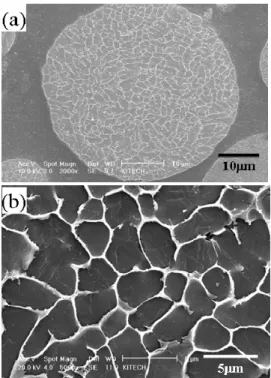
In order to identify the phase distribution in the powders as atomized, SEM photos were taken as seen in Fig. 1, in which (a) and (b) were taken from Group B and C, respectively. Group B (a) powders consist of grains of about 3 µm in diameter, while the powder in Group C contains the grains of about 4~5 µm. The grain size is about 2 µm for the Group A powders. The variation of grain size with the initial powder sizes is due to an effect of powder size on the cooling rate during the solidification, in which the finer the size of powders, the quicker the cooling rate.
However, the grains of rapidly solidified powders became much fine, regardless of the initial powder sizes,
C02-04-2
2006 POWDER METALLURGY World Congress
© Korean Powder Metallurgy Institute 1267
-compared with those of as cast sample which was reported to be about 30µm [4]. Energy Dispersive X-ray Spectroscopy (EDS) analysis of the grain and the grain boundary indicated that the elements of Zn and Y are rich in the grain boundaries rather than in the grains. This supported a report that the mechanical properties of Mg-Zn-Y alloys could be improved due to the secondary phases such as I and W phases which were mainly formed in the grain boundaries [5].
Fig. 1 SEM photos of MgZn4.3Y0.7 alloy powders tak
en from Group B (a) and C (b).
SEM micrograph and EDS trace of MgZn4.3Y0.7 alloy
bars extruded using the atomized powders (Group C) suggested that the grain size was reduced to be about 3 µm in diameter from about 4~5 µm due to the plastic deformation happened during the extrusion at the area reduction ratio of 10:1. The grain size was about 2~3µm in the Group A and B, which indicated a slight grain refinement in the extruded bars using the fine powder Groups.
Tensile strength of the extruded bar with the initial powder sizes was as sown in Fig. 2. The strength is about 260 MPa, 255 MPa and 246 MPa as the powder sizes are coarsened from Group A to C, respectively. The strain was also increased as the powder sizes increased, being 17%, 16% and 14%. The strength and elongation is higher than that of conventional Mg alloys, corresponding to the strengthening mechanism operated in the gas atomized and extruded alloys such as the grain size refinement and the homogeneous distribution of strong secondary particles.
Fig. 2 Tensile strength of the extruded bar with the initial powder sizes
3. Summary
MgZn4.3Y0.7 alloy powders atomized using an industrial
scale gas atomizer presented almost spherical morphology, and the mean powder sizes accumulated were about 55 µm in diameter. The grain size was about 2~5 µm with the powder Groups, and became fine after the extrusion being about 2~3µm. The grain size difference between the groups became narrow in the extruded bars, compared with in the as solidified powders. The powders as solidified consists of icosahedral (I-) phases and cubic W phases embedded in the α-Mg matrix. Concentration of Zn and Y elements are rich in the grain boundary. The highest UTS of 260 MPa and elongation of 17% were obtained from the bar extruded using the finest group of powders. Both the properties were increased as the powder sizes are decreased. Increasing the area reduction ratio will be an effective way for improving the strength further.
4. References
1. D.H.Bae, S.H.Kim, W.T.Kim and D.H.Kim, Mater. Trans., 42, 2144 (2001).
2. M. Nishida, Y.Kawamura and T.Yamamoto, Mater. Sci. Eng. A, 375-377, 1217 (2004).
3. A.Singh and A.P.Tasi : Scripta Mater., 49, 143 (2003). 4. I.J.Kim, D.H.Bae and D.H.Kim, Mater. Sci. Eng. A, 359,
313 (2003).
5. A.Singh, M.Watanabe, A.Kato and A.P.Tasi, Mater. Sci. Eng. A, 385, 382 (2004).