Definition and Prevalence of Salt Sensitivity and Salt-sensitive Hypertension SculIg-.Jac' .JOO
Depa끼menl 01InternalMedicine,Jeju Nali。때I Univer~싸y School이Medicine,Jeju,Korea (ReceivedDecember7,2012: Revised Decemb잉r 14:2012: AcceptedDecember21,2012)
Abstract
High salt intake is associated wilh significantly increased risk이stroke and lotal cardiovascular disease. Reduc1ionin habitual die!ary sal! intake o! 6 g/day decreases systolι and diastolic 8P,but not in all hyper1ensive subjec1s. Sall sensilivity is defined as the lendency lor BP 10 fall du끼ng dielary sall restriction and rise during sall supplementation. Salt sensitivity is diagnosed by
a low and 에gh salt die! pr이。col or a ra미d sodium,volume expansion and conlraclion protocol. Prevalence이앓11sensitivity ranged from 30 to 60% in hyper1ensive subjec1s and from 15 10 46% in narmotensive subjects. Sa11sensilivity is mo~e IreQuentty lound in hypertensive subjects,blacks,aged people,and women. (J Med니fe SCi 2012;9(2):123-127)
Key Words : Sal~ Sansitivilò',Hyper!ension,Prevalence
Introduction is associated with genetic fac1ors,race/et1micity, sex, age, and assocíateddisease such as hypert:ension
'"
1,Definilion 01 sall sensitivity
Figure 1.. Relationship between salt intake 1;U1dsySt이lC
blood pressure <BP)
π
,
e INTERSALT sω여1αb-O,Oπ
’‘。
OIS7(lnm’_
..
,
p‘"'"
!'o 100 I잉 '" '" U ~.9‘”’‘
1‘
j m 1.1ri=y1'<"‘-‘’&이
0‘
.1rlnMYN.a(p!(야, ,
'"
§
li 딩 g ξThe concept of heterogeneity of BP responsiveness to alterations in dietary s。이um intake was first suggested by Kaw앓aki et aL~)πey measured BP after a nonnal 009 mmollday),Iow (9 mmol/day),and then hi잉1 (249 mmollday) sodium intake in 19 hypertensive subjects. BP fell significant1y with dietary salt restriction and increased significant1y back ω baseline levels after the hígh salt iotake 까ley arbítrarily separated the subjects into two groups: salt sensitive (n=9; 47%). those who demonsσated at least a 10% increase in mean arterial press따e‘밍ld
000-salt sensitive (n=10; 53%),those having smaller increases in Addressfor correspondence: 8eung-JaeJ
∞
Department01InlernalMedicine,Jeju Na1ionalUnìversilyHosαlal,
15 Aran 13-gil,Jeju Cily,Jeψ Spec녀I Self멍overningProvince, Korea,690-767
E-mail: sejjoα@jejunu.8c.kr
Al1 guidelines for hypert:ension management recommends die떠ry 잃1t intake less than 5-6 g per day,Althou뱅 the criti.cism still exists,the causal relation between die떠Iγ salt intake and blood pressure (BP) has been established through experimentai,epidemiological,and intervention studíes 깨e INTERSALT study assessed the relationship between BP and sodium intake,whích was measured by 24-hour urin밍y
sodium excretion. in a very large sample (almost 11.α)이
。
r men and women aged 20-59 years from 52 centers in 39 coun며es (Fig, Jl ,""Within∞
nters, sodium excretion wassignificantiy related to BP in individual subjects. Cross cenrer analyses of sodium excretion and median BP showed a weak‘but significant positive relationship when all 52 centers were included. A meta-analysis of randomized conσ
。
lIed lrials of salt reduction 뻐d BP revealed thal a reduction in habitual dietary salt intake of 6 g a day would be associated with reductions in systolic/diastolic BP of 7/4 mmHg in people with hyper1:.cnsionand 4/2 mmHg in those without hypeπension.~ However. not all Índividuals have demonstrable changes in BP after high or low sodium intake. 80me individuals manifest large BP changes in response 10 acute or chronic salt depletion or repletion,없d are termed .s외t sens띠ve’8alt sensitivity is defmed as the tendency for BP ω fall during salt reduction and rise during salt repletion/supplementation. 8alt sensitivity or resistanceBP when the 10w and high salt pressures were compared
깐1Ís heterogeneous BP response in hypertensive subjects were also observed in the normotensive population. In a study of 16 normotensive young men,BP was measured after a 7-day period of 10 mmol/day sodium and then successive 3-day periods of 30α 6C
。
이 800,and 1200 or 1500 mmol/day. BP inclined significant1y from the lowest to the highest salt intake. However,야1e individual responses were variable and ranged from 밍1 increase of 1.5% to 34%잉 Weinberg et al야 arbitrarily defined salt sensitivity in normotensive subjects as a decrease in mean arterial pressme of at 1east 3 mmHg follovving the period of diet입γ salt restriction and defmed salt resistance as an increase of야1e same magnitude. Those demonstrating changes between
낭1ese leve1s were considered indeterminate with respect to classmcation. Using these criteria,they found that 42% of these normotensive subjects were salt sensitive and 18% were saIt resistant ,wi며 낭1e remainder indeterminate
Many investigators have rep
。
πBd the results of studies in normotensive and hypertensive su이ects using alterations in die떠1γ sodium content and classifying the subsequent BP responses. The criteria for the defmition of salt "sensitivity,""non-sensitivity," "resistance,"and "counter re밍띠ati
。
κ
。
f BP have varied markedly. To make the classification of salt sensitivity easier,an acute intravenous sa1ine challenge coup1ed with sa1t reduction plus diuretic treatment to acrueve vo1ume depletion has been deve10ped. Weinben:ter et al,7) utilized these techniques to characterize the sa1t sensitivity of BP in 378 normotensive and 198 hypertensive volunteers. Antihypertensive medications were discontinued 2 weeks before the study. The protocol began with the intravenous administration of 2 L normaI saline .(0.9%) over 4 hours in the morning. BP was measured at the completion。
f the infusion at noon. On the following day,sodium and volume depletion was induced by a 10 mmo1 sodium diet and three doses of oral furosemide (40 mg each). BP was again measured on the fol1owing morning η1e responses were heterogeneous and formed a norma1 distribution in both normotensive and hypertensive groups. They arbitrarily class미ied sa1t sensit:ivity as a decrease in mean arterial pressure ~ 10 mmHg and salt resist.ance as a decrease less than (5 mmHg when the two BP measurements were compared 만10se with a decrease in b100d pressure between 5 and 9 mmHg were considered indeterminate. The reproducibility of this' method was examined in the fo11subjects changed categories on restudy (1 from resist.ant on initial study to sensitive and 3 who were initia1ly defmed as salt-sensitive had resistant responses on repeat study). Six subjects changed to the indeterminate categorγ on restudy after initial classification as sait-sensitive (3) or salt resistant (3)
Comparison of two methods for defming salt sensitivity was a180 perfoπned in hypertensive subjects. Significant congruent BP responses between the rapid sodium,volume expanslon 밍1d contraction protoco1 밍1d a dietaη protocol
v.rith sodium intake ~200 rmnol/day for 5 days followed by 7 days of sodium intake ~ 15 rmnol/day was observed아η1e
Italian 80ciety of Hypertension a1so examined the reproducibility of BP responses of the most commonly used rapid technique and a carefu11y controlled manipulat:ion of dietarγ sodium intake in a large group of hypertensive subjects.t이 They showed the responses to repetit:ion of the techniques and the responses to. the two different approaches were significar띠y corre1ated ηley 외so found n
。
misclassification of subjects as salt-sensitive or salt resîst.ant on repeated testing2,Prevalence 01 salt sensitivity
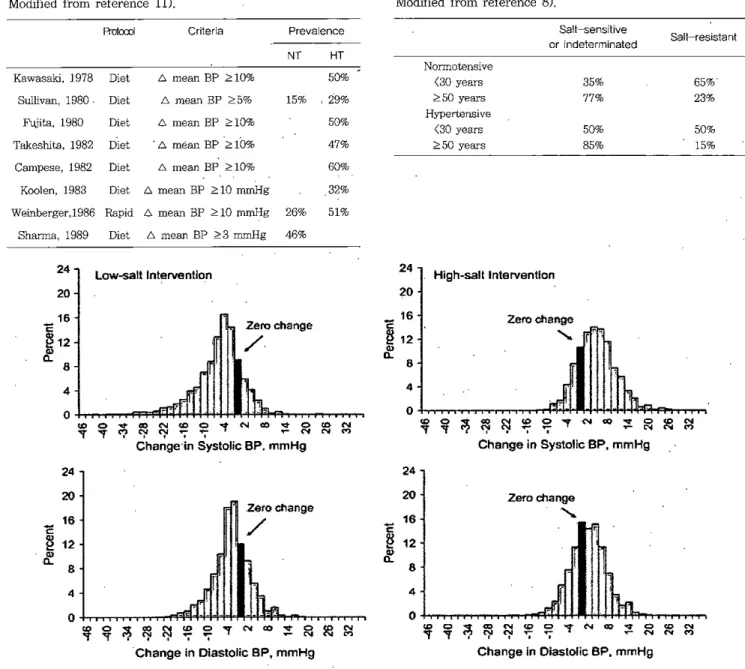
Prevalence of sa1t sensitivity depends on the methods and defmition used. It ranged from 30 to 60% in hypertensive subjects and from 15 to 46% in normotensive subjects (Table 1),11)
Hypertensive patients were significantly more salt sensitive than the normotensive individ니als 깐1e frrst study using the rapid sodium and vo1ume expansion and contraction pr야。co1 reported that 26% of the normotensive
subjects were salt sensitive and 58% were salt resis떠nt; in 1he hypeπ:ensive group,51% were sensit:ive밍1d 33% were resist.ant.71Despite differences in the methods and defmiti
。
πs used in the evaluation of sa1t sensit:ivity,several consistent demographic factors have emerged. Blacks have been consistent1y shown to have a greater frequency of salt sensitivity than whites. In one study , 73% of b1ack hypertensive pat:ients were 8alt sensitive compared with 56% of a white hypertensive group,but in the normotensive popu1ation,'the frequency of salt sensit:ivity among blacks (36%) was simi1ar to that seen among whites (29%).7) A similar finding of a greater frequency of salt sensit:ivity among 비acks in hypertensives (50% vs. 29% in white) and in normotensives (27% vs. 15% in wrute) has been reported in another study.l1l A large popu1ation-based study of salt sensitivity usmg a 1。、
V 밍1d high salt diet protoco1 was8eung-Jae Joo
Table 1. Defînition and prevalence of salt sensitivity Mαiified from reference 11)
penormed in 1,906 Chinese people.12)If an absolute change
。
f mean arterial pressure .:::::-.5 mmHg was used to defme sodium-sensîtivity ,33.9% during low-sa1t interγention and 32.4% during high-salt inteπention were sa1t-sensitive. If a proport1onal change of mean arterial pressure 으5% was used,38.7% during low-sa1t intervention and 39.2% during high-salt interγention were sa1t-sensitive (Fig. 2)Prevalence
Age was also found to be related to salt sensitivity of BP Increasing salt sensitivity has been noted with increasing age in several such studies. Tl꾀s relationship .appears to be stronger in hypertensîve than in normotensive individuals (Table 2).8) In a lO-year follow up study after 남1e initial classification of salt sensîtîvîty, BP of salt-sensitive individuals increased greater than salt resistant subjects.81
Table 2. Age and salt sensitivity of blood pressure M。이심ed from reference 8) S허t-sensitive Sait-resistant
。
r indeterminated 50% 15% 65% 23% 35% 77% 50% 85% Noπnotensîve <30 years ;;::':50years Hypertensive <30 years ;;::':50yeaι3 HT 47% 50% 50% 60% ,29% NT 15% D. mean BP ;;::.:5% D. mean BP .::::10% Criteria 6. me잉1 BP '::::10% D. méan BP .::::10% D. mean BP .::::10% Diet Dîet Dîet Díet Diet PrOIα:d Fωita,1980 Sullivan,198C Campese,1982 Kawasa띠.1978 Takeshîta,1982 K。이en,1983 Diet D. mean BP .::::10 mmHg 32% Weinberger,198E Rapid D. mean BP ;;::.:10 mrr퍼g 26% 51%Sh없ma,1989 Díet D. mean BP .2'::3 mmHg 46%
24
Low응alt lnterventlon 24 High-salt Interventlon
20 20
o
욱
Zero change、
~ 'PFJ용엉애얻우
"'fN∞
sg 영 Change in Systolic 'BP. mmHgg
8 4홉
'2~æ
N.,
@ N Zero change/
g
o
$
4 24 24 8 20 Zero change/
20홍
12 8 Zero change、
~ ~ 4~ lj!
카껴역격 ••••••’,1,,,•,0" •,•,•*업잉염우
γc‘∞
:t ~
æ
Change‘
n Dlastolic BP? mmHg 엄 4뚱 뚱
→••••.•..•••.
X∞
('\oj <Q 0 ~ Ñ∞,。
N N ←← ~ <‘ Change ln Diastolic BP,mmHgFigure 2. Dîstribution of systolic (upper panels) and diastolic (low panels) BP responses to low-salt intervention (left pane]s) and high-salt inteπention (right panels) in Chinese populations. The Genetic Epidemiology Network of Salt Sensitivity (GenS외t) study. BP response to low sodium=BP on 1
。、
N-SOd1um diet -BP at baseline and BP response to highsodium=BP on high-sodium diet - BP on low-sodîum diet.12J
8eung-Jae Joo
Populations. CWT Hyperrens Rep 2010;12:127-34
13)He J,Gu D,Chen J ,Jaquish CE,Rao DC,Hixson JE , Chen JC,Duan X,Huang JF ,Chen CS,Kelly TN, Bazzano LA,.Whelton Pκ GenSalt Collaborative Research
Group. Gender difference in blood pressure responses to dietary sodîum întervention in the GenSalt study. J Hyperreπs 2009;27:48-54
127
14)Shin SJ,Lim CY,Rhee MY,Oh SW,Na SH ,Park Y,Kim CI,Kim SY,Kim JW ,Park 많<:.Characteristics of sodium sensitivity in Korean pOP1니1ations. J Korean Med Sd 2011; 26:1061-7
15)Str잃뼈10 P,D'Elia L,Kandala NB,Cappuccio FP. Salt m떠ke,'stroke ,and cardiovasc 띠ardisease: me-æ-ar 녕1ysis