The Development of a Advanced Information management System
Seung Hwan KimKorea Atomic Energy Research Institute, P.O.Box 105, Yusong, Daejon, Korea, [email protected] 1. Introduction
Performing a PSA requires a lot of data to analyze, to evaluate the risk, to trace the process of results and to verify the results. KAERI is developing a PSA
information database system, AIMS (Advanced
Information Management System for PSA). The objective of AIMS development is to integrate and computerize all the distributed information of a PSA into a system and to enhance the accessibility to PSA information for all PSA related activities. We designed the PSA information database system for the following purposes:
- Integrated PSA information management software - Sensitivity analysis
- Quality Assurance
- Anchor to another reliability database.
Figure.1 is a system configuration of the AIMS. The AIMS consists of a PSA Information database, Information browsing (searching) modules, and PSA automatic quantification manager modules.
Figure 1. AIMS System Structure
2. DEVELOPMENT OF AIMS
To develop a PSA information database system, we collected and classified the PSA documents such as the PSA reports, PSA related documents, calculation sheets, drawings, etc. Next, we designed the database structure schema and inserted them into the database. Finally, we developed the database management and browsing software and the PSA manager.
2.1 PSA Information Database
In order to perform a PSA, various PSA related information is necessary. All the data for a PSA is obtained and computerized by storing it in an integrated
database. We collected the following data to build the AIMS database.
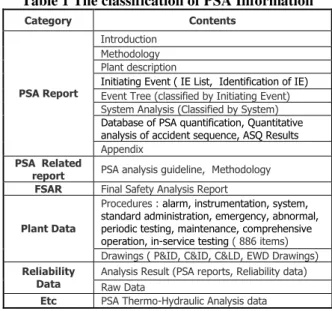
-System documents: design document, drawings -Plant manuals: Operation & Maintenance procedures -PSA Reports and PSA Supporting Documents Usually we obtained them from computer files but we got some data like drawings as a paper documents format. So we converted them into image files by an image scanning. We classified all the data by several categories. Table1 shows the classified and inserted data in the AIMS database.
Table 1 The classification of PSA Information
Category Contents
Introduction Methodology Plant description
Initiating Event ( IE List, Identification of IE)
Event Tree (classified by Initiating Event) System Analysis (Classified by System)
Database of PSA quantification, Quantitative analysis of accident sequence, ASQ Results PSA Report
Appendix PSA Related
report PSA analysis guideline, Methodology FSAR Final Safety Analysis Report
Procedures : alarm, instrumentation, system, standard administration, emergency, abnormal, periodic testing, maintenance, comprehensive operation, in-service testing ( 886 items) Plant Data
Drawings ( P&ID, C&ID, C&LD, EWD Drawings) Analysis Result (PSA reports, Reliability data) Reliability
Data Raw Data
Etc PSA Thermo-Hydraulic Analysis data
2.2. Information Browsing Software
The AIMS was developed for the UCN Units 3 & 4 PSA information management. It supports the document management and document search so that it can be used as a PSA analysis supporting tool. The AIMS is an advanced information browsing (search) tool to help the user to find a document easily and consists of four main modules by the difference of a document finding scheme.
-PSA InfoTree Browser
The AIMS generates the information tree structure from the database, and builds the PSA InfoTree automatically. The PSA InfoTree is a logical hierarchy tree of PSA information. We developed the PSA InfoTree browser to explore a logical structure of the PSA information. A user can find a document from the PSA InfoTree browser by expanding or collapsing the tree control of the window.
Transactions of the Korean Nuclear Society Autumn Meeting Busan, Korea, October 27-28, 2005
- Keyword Search Tool
The AIMS Database has a document property table which contains additional information for each document. The additional information consists of the document title, subject, author, category, keywords and a description of each document. The user can find a document from the property database using a keyword search tool.
- Text Search Engine
Usually the user can find a document from the PSA InfoTree or PSA document property database table of the AIMS system. But the PSA InfoTree and property database stores only essential data for a PSA document. So another searching tool is necessary to find any other text which the user wants to find. That is the Text search engine. When a user inputs a search string, the search engine returns the search results and displays the document list and the summary of each document which contains the search text. Finally the user can select the proper document and open it from the search results list.
- PSA model browser
The PSA model browser retrieves PSA models from the database and opens the proper application to review the model. The PSA model structure is stored in the database and the user can browse all kinds of PSA models such as a Fault Tree, Event Tree, Event Data, Cutsets and etc with this module.
Figure2. PSA Information Browser 2.3. PSA Model Manager
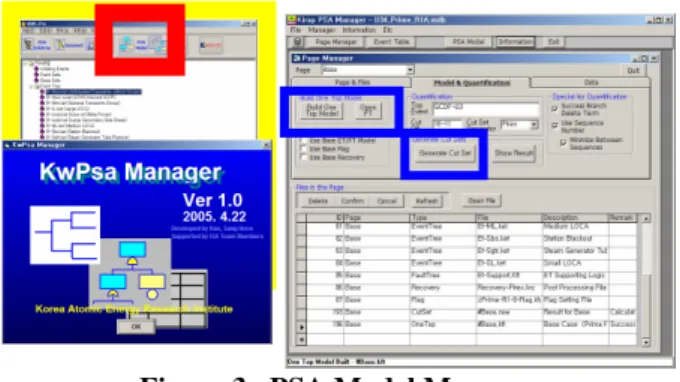
Another feature of AIMS is the PSA model Manager. The PSA model Manager is an integrated tool to manage the whole PSA process by creating and solving
the fault tree of a PSA model. The AIMS system enables the user to handle the PSA model and all sensitivity analysis easily with an automatic quantification.
The world’s fastest quantification engine, FTREX (Fault Tree Evaluation eXpert), which was developed by KAERI is implemented in the AIMS. The FTREX uses a coherent BDD algorithm to solve the large fault trees in a reasonable time and memory usage. With the FTREX, it takes around 30 seconds to solve the Korean Optimized Power Reactor Level #1 full power model (2843 gates, 2588 basic events) with a 3Ghz Pentium PC environment.
Figure 3. PSA Model Manager 3. Conclusion
In order to perform a PSA, it requires a large number of data for various fields. Therefore, an effective management of the data is essential to perform and review a PSA and to maintain the quality of a PSA. KAERI is developing the PSA Information Database System (AIMS: Advanced Information Management System for PSA) which enhances the accessibility to PSA information for all the PSA related activities. The key technology implemented in AIMS is a database that stores all the references and links to information used by the PSA. All the hyper links can be clicked to open the related documents, drawings, sheets and models. We expect the AIMS will be a good support tool for the all PSA activities
REFERENCES
[1] Seung Hwan Kim et al, “The development of PSA information database system”, ‘05 International Congress on Advances in Nuclear Power Plants, 2005 [2] Seung Hwan Kim et al, “A Study for the
development of PSA Automatic Sequence
Quantification System,” ‘03 Korea Nuclear Society, 2003
[3] Seung Hwan Kim et al, “A Study for the development of PSA Integrated Database”, ‘02 Korea Nuclear Society, 2002
[4] Sang-Hoon Han et al, “Development of PSA Workstation KIRAP”, KAERI/ TR-847/97, 1997.
Text Search Engine PSA Model Browser