─ 275 ─
ⓒ The Korean Society of Limnology. All rights reserved.
This is an open-access article distributed under the terms of the Creative Commons Attribution Non-Commercial License(http://creativecommons.org/licenses/by-nc/3.0/), which permits unrestricted non-commercial use, distribution, and reproduction in any medium, provide the original work is properly cited.
서 론
유전적으로 분화된 개체군 사이의 자손을 잡종이라
고 하며 자연에서는 드물게 나타나는 현상으로 다른 척 추동물군보다 어류에서 빈번하게 나타난다(Verspoor and Hammart, 1991; Abbott et al., 2013). 또한 잡종은 해수보다 담수에서 자주 나타나며, 특히 잉어과(family Cyprinidae) 어류들에서 속간잡종(intergeneric hybrid)과 종간잡종 (interspecific hybrid)이 다양하게 보고되고 있다(Hubbs,
한강수계 상천천에서 한강납줄개 Rhodeus pseudosericeus와
떡납줄갱이 R. notatus의 종간 자연잡종 출현
곽영호·김근용1·김근식2·송하윤*
국립수산과학원 중앙내수면연구소, 1아쿠아진텍, 2국립생태원 멸종위기종복원센터
Occurrence of a Natural Interspecific Hybrid between Rhodeus pseudosericeus and R. notatusin Sangcheon
Stream of the Han River, Korea. Yeong-Ho Kwak(0000-0003-2919-0808), Keun-Yong Kim1 (0000-0002-7647-3766),
Keun-Sik Kim2 (0000-0002-2081-2589) and Ha-Yun Song*(0000-0001-6902-6688) (Inland Fisheries Research Institute,
National Institute of Fisheries Science, Gapyeong 12453, Republic of Korea; 1AquaGenTech Co., Ltd, Busan 48300,
Republic of Korea; 2Research Center for Endangered species, National Institute of Ecology, Yeongyang 36531, Republic
of Korea)
Abstract Two specimens presumed to be hybrids of Rhodeus pseudosericeus and R. notatus were collected from the Sangcheon Stream of the Han River, Korea. The body color of natural hybrid individuals was yellowish brown, showing the intermediate characteristics of R. pseudosericeus and R. notatus, but overall, the characteristics of R. notatus were similar. Meristic and morphometric characters, the number of dorsal fin rays, anal fin rays and longitudinal row scales showed a hybrid index(HI) of 0, indicating the characters of
R. notatus. The hybrid index of predorsal length(HI=74.6), preanal length(HI=75.3), and preventral length (HI=77.6) were similar to the characters of the R. pseudosericeus. Also four characters were appeared to have intermediate characters between R. pseudosericeus and R. notatus; number of gill rakers(HI=55.3), body depth(HI=67.9), snout length(HI=43.4), and inter orbital width(HI=44.8). The rest of 14 characters deviated between 0 and 100, showing unique characteristics of hybrid individuals. Recombination activating gene 1(RAG1) analysis, hybrids were identified as natural hybrids due to the overlapping peaks of their parent species. Also, as a result of analysis using the cytochrome b gene(COB), one individual was derived from R.
pseudosericeus, while the other was derived from R. notatus.
Key words: hybrid index(HI), Rhodeus pseudosericeus, R. notatus, recombination activating gene 1(RAG1), cytochrome b gene(COB)
Manuscript received 31 August 2020, revised 22 September 2020, revision accepted 23 September 2020
* Corresponding author: Tel: +82-31-589-5180, Fax: +82-31-589-5151 E-mail: [email protected]
ISSN: 2288-1115(Print), 2288-1123(Online)
1955; Economidis and Sinis, 1988; Tang et al., 2012). 잉어 과 어류의 잡종을 야기하는 자연적 요인으로 제한된 서식 지와 동소종 간 경쟁이 대표적이며 인위적 요인은 서식지 의 훼손과 잡종을 유발하는 양식, 타 수계로의 도입 등이 있고 잡종형성의 원인 중 약 50%가 인위적 요인으로 인 해 나타난다고 보고된 바 있다(Scribner et al., 2001). 잡종 은 새로운 유전적 변이를 형성해 진화의 기회를 제공해 주 기도 하지만, 고유한 유전자의 훼손으로 토착종의 절멸이 라는 심각한 결과를 초래할 수도 있으며(Demarais et al., 1992; Vitule et al., 2009), 외래종의 이입과 서식처훼손 등 의 인위적인 영향으로 전 세계적으로 잡종현상이 증가하 고 있다(Kucinski et al., 2015). 어류의 외부 형태학적 특징은 종을 동정하는 데 있어 중 요한 형질로 사용하고 있으나(Begg and Waldman, 1999; Yi et al., 2017), 분류학적 키가 중복되거나 동일 종 내에서 서식하는 환경에 따라 서로 다르게 나타나는 형태 변이는 일부 종의 동정을 어렵게 만든다(McDonald et al., 1991; Nguyen et al., 2001; Kerschbaumer et al., 2011). 이러한 점 을 보완하고자 최근에는 형태학적 분석과 더불어 유전자 의 염기서열을 확보하여 비교 분석하는 분자계통학적 분 석이 상호보완적으로 활용되고 있다(Eyualem and Blaxter, 2003; Larsson Herrera et al., 2020).
핵 DNA와 미토콘드리아 DNA 염기서열에 기반한 유전 자분석은 대상종의 잡종유무를 판단하고 부계와 모계의 명 확한 추정을 위해 사용되고 있다(Sonnenberg et al., 2007; Kim et al., 2020). 핵 DNA 영역의 recombination activating
gene 1(RAG1)은 염기서열이 보존적이며 진화를 잘 반영하
기 때문에 종의 계통발생학적 위치를 명확히 하는데 사용되 고 있다(Šlechtová et al., 2007; Cebrat et al., 2008; Kim and Bang, 2010). 또한 잡종개체의 염기서열 분석 시 부모 종의 peak가 중복되는 double peak가 나타나 잡종판별에 효과적 인 분자마커로 사용되고 있다(Sonnenberg et al., 2007; Yun
et al., 2009; Song et al., 2017). 미토콘드리아 DNA 영역은
모계유전의 특징을 가지고 있어 잡종개체의 모계를 판단하 는 데 효과적으로 이용되고 있으며(Billington and Hebert, 1991; Jerry et al., 1999; Wirtz, 1999), 미토콘드리아 DNA 영역 중 cytochrome b gene(COB) 유전자는 납자루아과 (Acheilognathinae)를 포함한 다양한 잉어과 어류들의 종간 잡종을 구분하는 데 효과적으로 사용된 바 있다(Kim et al., 2014, 2015a, 2015b; Ramoejane et al., 2020).
납자루아과 어류는 석패과(Unionidae) 조개의 아가미에
산란을 하는 독특한 산란습성을 가지고 있으며, 전 세계에 3속 75종이 알려져 있고 국내에는 3속 16종이 분포하고 있다(Nelson et al., 2016; Chae et al., 2019). 이 중 한강납
줄개 Rhodeus pseudosericeus와 떡납줄갱이 R. notatus가
속한 납줄개속(genus Rhodeus) 어류 5종은 유속이 완만하 고 수초가 번성한 하천에 서식하며, 수 환경 변화에 취약 하기 때문에 보존이 필요한 분류군으로 알려져 있다(Kang et al., 2006). 특히 한강납줄개는 한강 일부 지류와 무한천, 대천천 상류에 제한적으로 분포하는 한국고유종으로 서식 지 감소와 수 환경 악화 등으로 개체군이 감소하여 2012 년부터 멸종위기 야생생물 II급으로 지정되어 보호받고 있 다(NIBR, 2019). 한강납줄개에 관한 연구는 자연잡종 동 정(Kim et al., 2014), 산란특성(Kim et al., 2017; Kim and Park, 2020), 난 발생 및 초기생활사(Kim et al., 2006), 서식 양상(Ko et al., 2019), 멸종위협등급 평가(Ko et al., 2018) 등이 있으며, 떡납줄갱이에 관한 연구는 잡종의 초기발생 특징(Kang et al., 2006), 잡종동정(Yun et al., 2009), 세포 유전학적 분석(Kim et al., 2012) 등이 있다. 본 연구는 북한강으로 합류되는 조종천의 지류인 상천 천에서 납줄개속 어류인 한강납줄개와 떡납줄갱이의 종 간 자연잡종으로 추정되는 개체가 채집되어 이를 대상으 로 유전자 분석과 외부형태 분석으로 자연잡종 개체를 확 인하고 형태 및 유전적 특징을 기재하고 자연잡종의 출현 이유를 논의하였다.
재료 및 방법
1. 표본의 확보 2020년 3월 18일 경기도 가평군 청평면 하천리 상천천 일대에서 납자루아과 자연잡종(Hybrid 01, Hybrid 02)으로 추정되는 2개체(체장 37.7, 44.3mm)를 채집하였다. 또한 부모종을 추정하기 위해 상천천 2개 지점의 어류상을 조 사하여 납자루아과 어류를 확인하였다(Table 1). 채집된 납 자루아과 어류 가운데 부모종으로 추정되는 떡납줄갱이와 한강납줄개는 자연잡종과의 체색비교를 위해 현장에서 사 진촬영을 한 뒤 방류하였고, 채집된 자연잡종(n=2)과 떡 납줄갱이(n=6)는 유전자 분석에 필요한 배지느러미 일부 를 절단하여 100% 에탄올에 넣어 고정하였다. 형태분석을 위한 표본은 10% 포르말린에 고정하였으며, 형태 및 유전 자 분석에 쓰인 한강납줄개(n=6)는 2012년 이전에 조종 천에서 채집되어 중앙내수면연구소의 수장고에 보관되어 있던 표본을 사용하였다. 2. 형태 분석개의 계수형질과 19개의 계측형질을 측정하였다. 측정 항 목으로 등지느러미와 뒷지느러미의 기조수, 종렬비늘수, 측선비늘수, 새파수를 계수하였고 체장에 대한 체고, 두장, 등지느러미 기점거리, 가슴지느러미 기점거리, 뒷지느러 미 기점거리, 배지느러미 기점거리, 미병장, 미병고, 등지느 러미 기저길이, 뒷지느러미 기저길이, 등지느러미 길이, 가 슴지느러미 길이, 배지느러미 길이, 뒷지느러미 길이와 두 장에 대한 문장, 안경, 양안간격, 미병장, 미병고를 계측하 였다. 각각의 지느러미 기조수와 비늘수를 포함한 계수형 질은 실체현미경(Olympus SZX16, Japan)으로 계수하였 으며, 계측형질은 Digital caliper(Mitutoyo, Japan)를 사용 하였다. 자연잡종과 부모종 간 외부형태를 비교하기 위해 Nikoljukin(1972)이 제안한 잡종지수(hybrid index, HI)로 환산하였다.
Hybrid index(HI)=100(H - M1)/(M2 - M1)
H: 잡종개체 특정 형질의 수치, M1: 제1 부모종 특정 형질 의 수치(Rhodeus notatus), M2: 제2 부모종 특정 형질의 수 치(R. pseudosericeus) 3. RAG1과 COB를 이용한 분석 잡종판별과 모계추정을 위해 채집된 자연잡종 개체와 부모종으로 추정되는 한강납줄개와 떡납줄갱이의 배지 느러미를 이용하여 genomic DNA(gDNA)를 추출하였다. RAG1영역은 RAG1-1495f3(5ʹ CAGTAYCAYAAGATG TACCG-3ʹ)와 RAG1-3067r(5ʹ TTGTGAGCYTCCAT RAACTT-3ʹ) primer를 사용하였고, COB 영역은 trnE-14317f(5ʹ-GAYTTGAAGAACCAYCGTTG-3ʹ), trnP-15601r(5ʹ-ATTHTGGCTTTGGGAGYCAG-3ʹ) primer를 사용하여 PCR하였다(Kim et al., 2015a). PCR 조건은 처 음 95℃에서 5분간 denaturation 1회 반응시킨 후 95℃에 서 20초간 denaturation, 55℃에서 20초간 annealing, 72℃ 에서 1분간 elongation을 순서로 35회 반복하여 반응시켰
으며 마지막으로 72℃에서 5분간 elongation을 실시하였
고 생성된 증폭산물은 AccuPrepⓇ PCR Purification Kit
(Bioneer, Korea)를 사용하여 정제하였다. PCR 증폭산물 은 Applied BiosystemsⓇ 3730xl DNA Analyzer(Thermo Fisher Scientific, USA)를 통해 DNA 염기서열을 해독하 였다. 자연잡종 개체의 모계추정은 납자루아과 근연종들 의 COB 서열을 GenBank에서 검색하여 자연잡종 2개체 와 부모종으로 추정되는 한강납줄개, 떡납줄갱이의 염기 서열을 함께 정렬하였다. 또한 out group은 모래무지아 과(Gobioninae)에 속하는 모샘치 Gobio gobio와 어름치
Hemibarbus mylodon 2종의 염기서열을 사용하였다. 정
렬된 서열은 RAxML 7.0.4(Stamatakis, 2006; Stamatakis
et al., 2008)을 사용하여 Maximum likelihood(ML) 분석
을 수행하였으며, 탐색 조건은 one single program(“-f a” option)으로 설정하였다. 최적의 ML tree는 GTRMIXI model에서 200회의 검증을 통해 제시되었으며, 각 분지의 지지도는 1,000회의 bootstrap을 통해 평가하였다.
결과 및 고찰
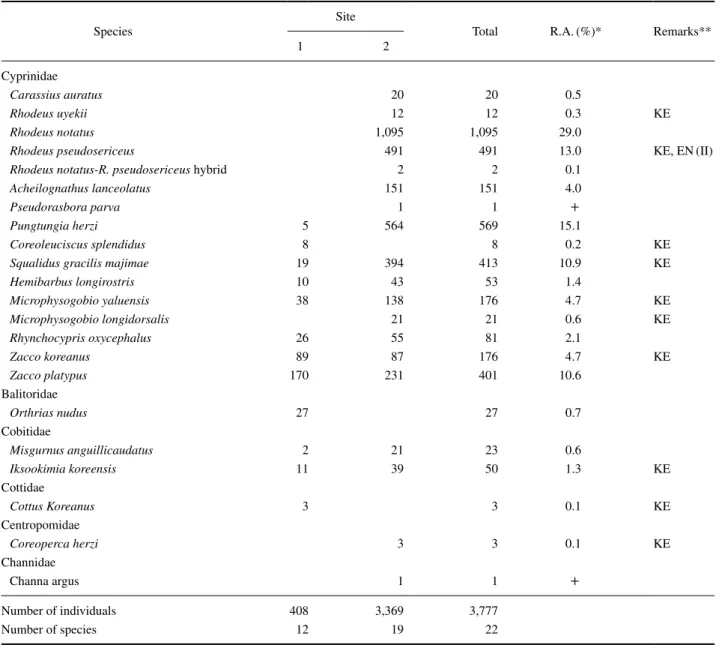
1. 동소출현종 상천천 조사지점(St. 1, St. 2)에서 총 6과 22종 3,777 개체의 담수어류가 채집되었으며, 잉어과 어류가 16종으 로 대부분을 차지하였다(Table 2). 전체 우점종은 떡납줄 갱이(29.0%)였으며, 아우점종은 돌고기 Pungtungia herzi (15.1%)로 나타났다. 고유종은 총 10종이 출현하여 국내 에 출현하는 담수어의 고유화 빈도인 28.8%(Kim et al., 2005)보다 높은 45.5%로 나타나 높은 고유화 빈도를 보였 다. 조사지점 중 유수역인 St. 1에서 출현한 둑중개 Cottus Koreanus는 2005년에 멸종위기 야생생물 II급으로 지정 되었다가 2012년에 해제된 고유종으로(ME, 2005, 2012), 주로 계곡에서 서식하는 냉수성 어종이다. 둑중개는 과거 조종천 상류일대에서 드물게 출현하였는데(Nam, 1997; Lee, 2013), 조종천의 지류인 상천천에서 출현은 매우 주 목되었다. 멸종위기 야생생물 II급인 한강납줄개는 St. 2 에서 13.0%의 높은 빈도로 출현하였다. 납자루아과 동소Table 1. Information of natural hybrids and sympatric species collecting site.
Site Sampling date GPS coordinate Localities Habitat characteristic 1 2020.04.06 127°26ʹ12.83ʺE37°45ʹ12.76ʺN 272 Hacheon-ri, Cheongpyeong-myeon,
Gapyeong-gun, Gyeonggi-do Lotic 2 2020.03.18 37°44ʹ48.10ʺN127°26ʹ3.35ʺE 217-11 Hacheon-ri, Cheongpyeong-myeon,
종은 각시붕어 R. uyekii, 떡납줄갱이, 한강납줄개, 납자루 Acheilognathus lanceolatus 등 총 4종으로 정수역인 St. 2 에서만 출현하여 납줄개속 어류들이 정수역에 서식한다는 Kim et al.(2010)의 결과와 일치하였다. 2. 외부형태적 특징 자연잡종 2개체 모두 전체적인 체색은 황갈색으로 한강 납줄개보다는 옅었고 떡납줄갱이보다는 진한 중간적인 특 성을 나타냈다(Fig. 1). 등지느러미 반문은 담황색으로 한 강납줄개와 유사하였으며, 뒷지느러미 반문의 형태는 떡 납줄갱이와 유사하였지만 반문의 색은 다소 옅은 주홍색 이였다. 또한 안경 상단의 붉은 띠, 아가미 상단에 위치한 암점과 등지느러미 기점 아래의 중간지점부터 미병부 후 단까지 이어지는 청색 세로줄은 기존에 보고된 떡납줄갱 이의 특징과 매우 유사한 특징을 보였다(Kim and Park, 2002; Chae et al., 2019).
잡종개체의 형태분석에 있어 잡종지수(HI)의 가장 이
상적인 수치는 50이지만, 보통 30~70의 수치를 부모종 의 중간형질로 여겨진다(Ross and Cavender, 1981; Šorić,
Table 2. List of Ichthyofauna in the Sangcheon Stream of Bukhan River, Korea.
Species
Site
Total R.A.(%)* Remarks** 1 2
Cyprinidae
Carassius auratus 20 20 0.5
Rhodeus uyekii 12 12 0.3 KE
Rhodeus notatus 1,095 1,095 29.0
Rhodeus pseudosericeus 491 491 13.0 KE, EN(II)
Rhodeus notatus-R. pseudosericeus hybrid 2 2 0.1
Acheilognathus lanceolatus 151 151 4.0
Pseudorasbora parva 1 1 +
Pungtungia herzi 5 564 569 15.1
Coreoleuciscus splendidus 8 8 0.2 KE
Squalidus gracilis majimae 19 394 413 10.9 KE
Hemibarbus longirostris 10 43 53 1.4 Microphysogobio yaluensis 38 138 176 4.7 KE Microphysogobio longidorsalis 21 21 0.6 KE Rhynchocypris oxycephalus 26 55 81 2.1 Zacco koreanus 89 87 176 4.7 KE Zacco platypus 170 231 401 10.6 Balitoridae Orthrias nudus 27 27 0.7 Cobitidae Misgurnus anguillicaudatus 2 21 23 0.6 Iksookimia koreensis 11 39 50 1.3 KE Cottidae Cottus Koreanus 3 3 0.1 KE Centropomidae Coreoperca herzi 3 3 0.1 KE Channidae Channa argus 1 1 + Number of individuals 408 3,369 3,777 Number of species 12 19 22
*R.A.: Relative abundance, **KE: Korean endemic species, EN (II): Endangered species (II). + : <0.1
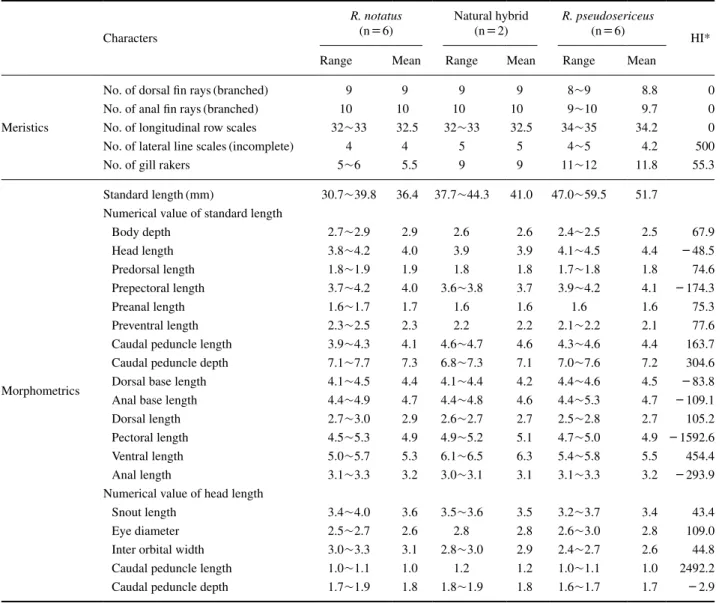
2004). 또한 잡종지수가 0에 근접할수록 제1 부모종인 떡 납줄갱이에 가깝고 100에 근접할수록 제2 부모종인 한강 납줄개의 형질에 가깝다는 것을 의미한다. 그러나 잡종 지수가 0보다 작거나 100보다 큰 값을 나타내면 잡종개 체의 고유한 특성이 발현된 것으로 간주된다(Witkowski et al., 2015). 자연잡종 개체의 24가지 형질을 분석한 결 과, 등지느러미 기조수(mean=9), 뒷지느러미 기조수 (mean=10), 종렬비늘수(mean=32.5)의 3가지 계수형 질에서 떡납줄갱이(mean=9, 10, 32.5)와 동일하게 나타 나 HI 값이 0으로 나타났다(Table 3). 측선비늘 수는 자연 잡종(mean=5)이 부모종인 떡납줄갱이(mean=4)와 한 강납줄개(mean=4.2) 간 큰 차이를 보여 HI 값이 500으 로 나타나 잡종개체의 고유특성을 나타냈다. 자연잡종의 새파수(mean=9)는 떡납줄갱이(mean=5.5)와 한강납줄 개(mean=11.8) 간 중간 값에 해당하였고 HI 값은 55.3 으로 나타나 부모종의 중간적인 특성을 보였다. 자연잡 종 개체의 계측형질 중 체장에 대한 등지느러미 기점 거 리(mean=1.8), 뒷지느러미 기점 거리(mean=1.6), 배지 느러미 기점 거리(mean=2.2)는 한강납줄개(mean=1.8, 1.6, 2.1)와 유사하게 나타났으며 HI 값은 각각 74.6, 75.3, 77.6으로 나타나 한강납줄개의 형질에 좀 더 가까운 것 으로 나타났다. 체장에 대한 두장(mean=3.9), 가슴지느 러미 기점 거리(mean=3.7), 미병장(mean=4.6), 미병고 (mean=7.1), 등지느러미 기저 길이(mean=4.2), 뒷지느 러미 기저 길이(mean=4.6), 동지느러미길이(mean=2.7), 가 슴 지 느 러 미 길 이( m e a n=5.1), 배지느러미 길이 (mean=6.3), 뒷지느러미 길이(mean=3.1)는 부모종인 떡 납줄갱이, 한강납줄개와 큰 차이를 보여 0~100 사이의 값 을 벗어나 잡종개체의 고유특성이 나타났다. 반면 체장 에 대한 체고(mean=2.6)는 떡납줄갱이(mean=2.9)와 한 강납줄개(mean=2.5) 간 중간 값을 보였고 HI 값은 67.9 로 나타나 부모종의 중간적인 특성을 나타냈다. 또한 두 장에 대한 안경(mean=2.8), 미병장(mena=1.2), 미병고 (mean=1.8)는 떡납줄갱이, 한강납줄개와 차이를 보여 HI 값이 각각 109.0, 2492.2, - 2.9로 나타나 잡종개체의 고유 특성을 나타냈다. 반면 두장에 대한 문장(mean=3.5)과 양 안간격(mean=2.9)은 떡납줄갱이(mean=3.6, 3.1)와 한강 납줄개(mean=3.4, 2.6) 간 중간 값을 보여 HI 값이 각각 43.4, 44.8로 나타나 부모종의 중간적인 특성을 나타냈다. 3. 유전학적 분석 RAG1 영역의 염기서열 분석결과 총 1,490 bp가 증폭되 었고 자연잡종 개체 간 DNA 염기서열은 100% 유사도를
Fig.1. Photographs of natural hybrid specimens(B, Hybrid 01: 44.3mm SL; C, Hybrid 02: 37.7mm SL) between Rhodeus pseudosericeus (A: 48.3mm SL) and R. notatus(D: 39.8 mm SL).
A B
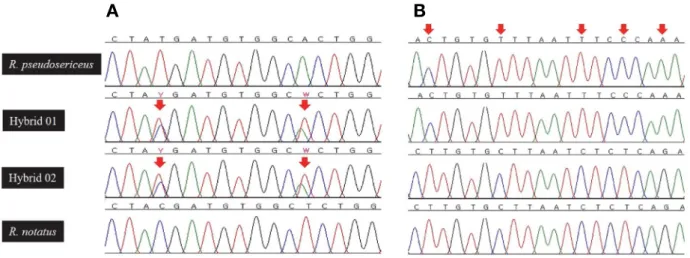
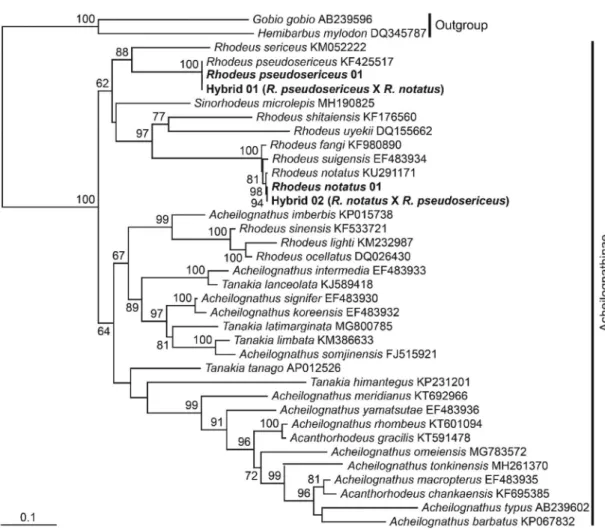
보였으나 29개 염기서열 위치에서 부모종의 염기서열이 치환되어 나타났다(Table 4). RAG1의 electropherogram 을 분석한 결과 부모종은 각 염기서열마다 명확한 single peak가 관찰되었지만, 자연잡종 2개체 모두 부모종인 한강 납줄개와 떡납줄갱이 두 종 간에서 차이 나는 29개의 염 기서열의 위치에서 부모종의 염기서열이 중복되어 double peak의 형태로 관찰되었다(Fig. 2A). 이것은 자연잡종 개 체가 부모종인 한강납줄개와 떡납줄갱이의 유전자를 모두 포함하고 있어 일어난 현상으로 국내에 보고된 납자루아 과 자연잡종에서 나타나는 염기서열의 결과들과 일치하였 다(Yun et al., 2009; Kim et al., 2014, 2015b). COB영역은 총 1,057bp가 증폭되어 나타났으며, electropherogram으로 염기서열을 분석한 결과 Hybrid 01은 한강납줄개와 100% 의 유사도를 보였고 Hybrid 02는 떡납줄갱이와 100%의 유사도를 나타내 자연잡종 간 상반된 염기서열의 차이를 나타냈다(Fig. 2B). 또한 자연잡종 개체와 납자루아과 근 연종들 간 분자계통수를 분석한 결과 Hybrid 01은 한강납 줄개 그룹과 연결되어 100%의 지지도를 나타냈고 Hybrid 02는 떡납줄갱이 그룹과 연결되어 98%, 94%의 지지도를 나타냈다(Fig. 3). 부모종이 교잡할 경우 모계 유전을 하 는 미토콘드리아 DNA 특성상 잡종 개체는 모계종과 동일 한 미토콘드리아 유전정보를 나타내기 때문에(Avise and Saunders, 1984; Lee et al., 2009), Hybrid 01은 한강납줄개, Hybrid 02는 떡납줄갱이가 모종임을 강하게 시사하였다.
Table 3. Comparison based on 5 meristic and 19 morphometric characters between natural hybrid specimens and parent species, Rhodeus
notatus and R. pseudosericeus.
Characters
R. notatus
(n=6) Natural hybrid (n=2) R. pseudosericeus(n=6) HI* Range Mean Range Mean Range Mean
Meristics
No. of dorsal fin rays(branched) 9 9 9 9 8~9 8.8 0 No. of anal fin rays(branched) 10 10 10 10 9~10 9.7 0 No. of longitudinal row scales 32~33 32.5 32~33 32.5 34~35 34.2 0 No. of lateral line scales(incomplete) 4 4 5 5 4~5 4.2 500 No. of gill rakers 5~6 5.5 9 9 11~12 11.8 55.3
Morphometrics
Standard length(mm) 30.7~39.8 36.4 37.7~44.3 41.0 47.0~59.5 51.7 Numerical value of standard length
Body depth 2.7~2.9 2.9 2.6 2.6 2.4~2.5 2.5 67.9 Head length 3.8~4.2 4.0 3.9 3.9 4.1~4.5 4.4 - 48.5 Predorsal length 1.8~1.9 1.9 1.8 1.8 1.7~1.8 1.8 74.6 Prepectoral length 3.7~4.2 4.0 3.6~3.8 3.7 3.9~4.2 4.1 - 174.3 Preanal length 1.6~1.7 1.7 1.6 1.6 1.6 1.6 75.3 Preventral length 2.3~2.5 2.3 2.2 2.2 2.1~2.2 2.1 77.6 Caudal peduncle length 3.9~4.3 4.1 4.6~4.7 4.6 4.3~4.6 4.4 163.7 Caudal peduncle depth 7.1~7.7 7.3 6.8~7.3 7.1 7.0~7.6 7.2 304.6 Dorsal base length 4.1~4.5 4.4 4.1~4.4 4.2 4.4~4.6 4.5 - 83.8 Anal base length 4.4~4.9 4.7 4.4~4.8 4.6 4.4~5.3 4.7 - 109.1 Dorsal length 2.7~3.0 2.9 2.6~2.7 2.7 2.5~2.8 2.7 105.2 Pectoral length 4.5~5.3 4.9 4.9~5.2 5.1 4.7~5.0 4.9 - 1592.6 Ventral length 5.0~5.7 5.3 6.1~6.5 6.3 5.4~5.8 5.5 454.4 Anal length 3.1~3.3 3.2 3.0~3.1 3.1 3.1~3.3 3.2 - 293.9 Numerical value of head length
Snout length 3.4~4.0 3.6 3.5~3.6 3.5 3.2~3.7 3.4 43.4 Eye diameter 2.5~2.7 2.6 2.8 2.8 2.6~3.0 2.8 109.0 Inter orbital width 3.0~3.3 3.1 2.8~3.0 2.9 2.4~2.7 2.6 44.8 Caudal peduncle length 1.0~1.1 1.0 1.2 1.2 1.0~1.1 1.0 2492.2 Caudal peduncle depth 1.7~1.9 1.8 1.8~1.9 1.8 1.6~1.7 1.7 - 2.9 *HI: hybrid index
4. 잡종형성 자연잡종은 중복되는 산란시기, 산란장의 감소, sneaker 행동 등의 현상에 의해 나타나며(Jansson et al., 1991), 잡 종개체가 채집된 상천천 일대는 하천의 효율적인 이용 과 관리를 위해 1989년 조종천 하천정비기본계획이 수립 된 이후 크고 작은 하천공사가 지속적으로 진행되어 왔 다(MOCT, 1989, 2003). Kim et al.(2010)은 서식처의 환 경 변화와 경쟁종 증가 등의 영향으로 종간잡종이 출현하 며 특히 북한강 수계 납자루아과 어류들은 수 환경의 변화 로 인해 잡종 출현의 가능성이 높아질 수 있음을 시사하 였는데, 북한강의 수계의 상천천은 지난 10년간 하천공사 로 인해 환경적 압박을 지속적으로 받아 납자루아과 어류 들의 서식처 및 산란장이 감소한 것으로 추정된다. 잡종이 출현한 조사시점에서 석패과인 조개류의 서식을 확인할 수 없었지만, 부모종인 한강납줄개는 석패과인 작은말조개 에 산란하는 것으로 알려져 있으며(Kim et al., 2017), 떡납 줄갱이도 석패과에 산란하기 때문에(Kim and Park, 2002) 두 종의 산란장 및 산란행동은 중복될 수 있다. 또한 두 종 의 산란시기는 4~6월로 중복되고 납자루아과 어류의 종 특성상 sneaker 행동이 빈번하게 나타난다(Kim and Park, 2002; Kim et al., 2014, 2015b). 따라서 한강납줄개와 떡 납줄갱이 간 자연잡종은 지속적인 하천공사로 인해 납줄 개속 어류의 서식처가 제한되었고 동소종 간 경쟁을 야기
Table 4. Difference in polymorphic base sequences of recombination activating gene 1(RAG1) between natural hybrids(Hybrid 01 and
Hybrid 02) and parent species, Rhodeus pseudosericeus and R. notatus. Polymorphic base positions are indicated according to the IUPAC codes. Species Base positions* 2 1 1 3 8 1 8 9 1 9 8 2 2 0 2 4 6 2 4 8 2 5 5 3 5 7 3 6 6 4 1 4 5 3 7 5 5 5 5 8 2 7 5 9 7 6 7 7 9 7 8 0 6 9 0 1 9 5 7 9 8 6 1 0 4 7 1 0 5 6 1 0 8 3 1 1 3 4 1 1 3 7 1 1 7 3 1 2 7 8 1 3 0 8 R. pseudosericeus A A T A C G G G G G T G G T C A C A C T G G A A C C T G C Hybrid 01 R M Y W M R R R R R Y R R Y Y R Y M Y Y S R W R Y Y K S Y Hybrid 02 R M Y W M R R R R R Y R R Y Y R Y M Y Y S R W R Y Y K S Y R. notatus G C C T A A A A A A C A A C T G T C T C C A T G T T G C T *R(A/G), M(A/C), W(A/T), Y(C/T), S(C/G), K(T/G)
Fig. 2. Electropherogram showing DNA sequence differences in the recombination activating gene 1(RAG1)(A) and mitochondrial
cyto-chrome b gene(COB)(B) region of natural hybrids(Hybrid 01 and Hybrid 02) of Rhodeus pseudosericeus and R. notatus. Arrow indicates in A show that the peaks of the parent species, R. pseudosericeus and R. notatus overlap in some regions of the natural hybrids recombina-tion activating gene 1(RAG1), B indicates that in the mitochondrial cytochrome b gene(COB) the some sequence between Hybrid 01 and R.
pseudosericeus and the between Hybrid 02 and R. notatus are similar.
한 결과 나타난 현상으로 추정된다. 그러나 잡종형성의 원 인은 다양하게 나타나기 때문에 한강납줄개와 떡납줄갱이 간 자연잡종 출현의 원인규명을 위한 추가적인 연구가 필 요할 것으로 보인다. 본 연구결과 한강납줄개와 떡납줄갱이 간 자연잡종 현 상이 단방향이 아닌 양방향으로 진행된 점은 매우 주목할 만한 것으로 향후 상천천 개체군에 대한 지속적인 모니터 링을 통해 서식지 내 잡종개체의 비율, 납자루아과 종간 경쟁 양상과 잡종개체의 임성검증 등의 추가적인 연구가 필요할 것으로 사료된다.
적 요
한강수계 상천천에서 한강납줄개 Rhodeus pseudoseri- ceus와 떡납줄갱이 R. notatus의 잡종으로 추정되는 2개체 를 채집하였다. 자연잡종 개체의 체색은 황갈색으로 한강 납줄개와 떡납줄갱이의 중간적인 특성을 나타냈지만, 전 반적으로 떡납줄갱이의 특징이 두드러졌다. 계수 및 계측 형질에서 등지느러미 기조수, 뒷지느러미 기조수, 종렬비 늘 수의 3가지 형질은 hybrid index(HI) 값이 0으로 나타 나 떡납줄갱이의 형질을 따랐다. 체장에 대한 등지느러미 기점 거리(HI=74.6), 뒷지느러미 기점 거리(HI=75.3), 배지느러미 기점 거리(HI=77.6)는 한강납줄개의 형질 을 따르는 것으로 나타났다. 새파수(HI=55.3), 체장에 대 한 체고(HI=67.9), 두장에 대한 문장(HI=43.4), 양안간 격(HI=44.8)의 4가지 형질은 한강납줄개와 떡납줄갱이의 중간형질을 나타내는 것으로 나타났다. 나머지 14가지 형 질은 0과 100 사이를 벗어나 잡종개체만의 고유한 특성을 나타냈다. Recombination activating gene 1(RAG1) 분석Fig. 3. Phylogenetic trees created based on the DNA sequence of the mitochondrial cytochrome b gene(COB) of natural hybrids(Hybrid 01
and Hybrid 02) and their parent species Rhodeus pseudosericeus and R. notatus. Bootstrap value below 50% are not included. Species ana-lyzed in this study are in bold type. Also, the GenBank numbers of each species are listed with their scientific names.
결과 잡종개체는 부모종의 유전자가 중복되어 나타나 자 연잡종으로 판별되었으며, cytochrome b gene(COB)를 분 석한 결과 한 개체는 한강납줄개를 모계로, 또 다른 한 개 체는 떡납줄갱이가 모계로 나타났다. 저자정보 곽영호(국립수산과학원 인턴연구원), 김근용(아 쿠아진텍 책임연구원), 김근식(국립생태원멸종위기종복원 센터 선임연구원), 송하윤(국립수산과학원 해양수산연구 사) 저자기여도 연구설계: 송하윤, 조사 및 채집: 송하윤, 곽영 호, 시료분석: 곽영호(외부형질), 김근용(염기서열), 김근식 (분자계통), 원고작성: 곽영호, 원고수정 및 검토: 송하윤, 김근식 이해관계 본 논문에는 이해관계 충돌의 여지가 없습니다. 연구비 본 연구는 2020년도 국립수산과학원 수산시험연 구사업(R2020030)의 지원으로 수행되었습니다.
REFERENCES
Abbott, R., D. Albach, S. Ansell, J.W. Arntzen, S.J.E. Baird, N. Bierne, J. Boughman, A. Brelsford, C.A. Buerkle, R. Buggs, R.K. Butlin, U. Dieckmann, F. Eroukhmanoff, A. Grill, S.H. Cahan, J.S. Hermansen, G. Hewitt, A.G. Hudson, C. jiggins, J. Jones, B. Keller, T. Marczewski, J. Mallet, P. Martinez-Rodriguez, M. Most, S. Mullen, R. Nichols, A.W. Nolte, C. Parisod, K. Pfennig, A.M. Rice, M.G. Ritchie, B. Seifert, C.M. Smadja, R. Stelkens, J.M. Szymura, R. Vainola, J.B.W. Wolf and D. Zinner. 2013. Hybridization and speciation. Journal of Evolutionary
Biology 26: 229-246.
Avise, J.C. and N.C. Saunders. 1984. Hybridization and intro-gression among species of sunfish(Lepomis): analysis by mitochondrial DNA and allozyme markers. Genetics 108: 237-255.
Begg, G.A. and J.R. Waldman. 1999. An holistic approach to fish stock identification. Fisheries Research 43: 35-44. Billington, N. and P.D. Hebert. 1991. Mitochondrial DNA
diver-sity in fishes and its implications for introductions.
Cana-dian Journal of Fisheries and Aquatic Sciences 48: 80-94. Chae, B.S., H.B. Song and J.Y. Park. 2019. A field guide to the freshwater fishes of Korea. LG evergreen foundation, Seoul, Korea.
Cebrat, M., A. Cebula, A. Laszkiewicz, M. Kasztura, A. Miazek and P. Kisielow. 2008. Mechanism of lymphocyte-specific inactivation of RAG-2 intragenic promoter of NWC: im-plications for epigenetic control of RAG locus. Molecular
Immunology 45: 2297-2306.
Demarais, B.D., T.E. Dowling, M.E. Douglas, W.L. Minckley and P.C. Marsh. 1992. Origin of Gila seminuda (Teleostei: Cyprinidae) through introgressive hybridization: implica-tions for evolution and conservation. Proceedings of the
National Academy of Sciences 89: 2747-2751.
Economidis, P.S. and A.I. Sinis. 1988. A natural hybrid of
Leu-ciscus cephalus macedonicus×Chalcalburnus chalcoides
macedonicus(Pisces, Cyprinidae) from Lake Volvi (Mace-donia, Greece). Journal of Fish Biology 32: 593-605. Eyualem, A. and M. Blaxter. 2003. Comparison of biological,
molecular, and morphological methods of species identifi-cation in a set of cultured Panagrolaimus isolates. Journal
of Nematology 35: 119-128.
Hubbs, C.L. 1955. Hybridization between fish species in nature.
Systematic Zoology 4: 1-20.
Hubbs, C.L. and K.F. Lagler. 2004. Fishes of the Great Lakes region, revised edition, revised edition. The Unversity of Michigan Press, USA.
Jansson, H., I. Holmgren, K. Wedin and T. Andersson. 1991. High frequency of natural hybrids between Atlantic salmon, Salmo salar L., and brown trout, S. trutta L., in a Swedish river. Journal of Fish Biology 39: 343-348.
Jerry, D.R., T.A. Raadik, S.C. Cairns and P.R. Baverstock. 1999. Evidence for natural interspecific hybridization between the Australian bass(Macquaria novemaculeata) and estuary perch(M. colonorum). Marine and Freshwater Research
50: 661-666.
Kang, E.J., C.H. Kim, I.S. Park, H. Yang and Y.C. Cho. 2006. Early developmental characteristics of induced hybrids between Rhodeus uyekii and R. notatus(Pisces: Cyprini-dae). Korean Journal of Ichthyology 18: 339-346. Kerschbaumer, M., L. Postl, M. Koch, T. Wiedl and C.
Sturm-bauer. 2011. Morphological distinctness despite large-scale phenotypic plasticity-analysis of wild and pond-bred juveniles of allopatric populations of Tropheus moorii.
Naturwissenschaften 98: 125-134.
Kim, B.S., E.J. Kang, H. Jang and I.S. Park. 2012. Morphomet-ric traits and cytogenetic analysis in induced cross and reciprocal hybrid between Rhodeus uyekii and R. notatus.
Korean Journal of Ichthyology 24: 151-159.
Kim, C.H., E.J. Kang and J.H. Kim, 2006. Development of eggs and early life history of Korean bitterling, Rhodeus
pseu-dosericeus(Acheilognathinae). Korean Journal of
Ichthy-ology 18: 266-272.
Kim, C.H., W.O. Lee, Y.J. Kang and J.M. Baek. 2010. Occurrence of a natural intergeneric hybrid, Rhodeus uyekii
×Achei-lognathus signifer(Pisces; Cyprinidae) from Jojongcheon Bukhan River, Korea. Korean Journal of Ichthyology 22: 225-229.
Kim, H.S. and J.Y. Park. 2020. Spawning characteristics of Han-gang bitterling, Rhodeus pseudosericeus(Pisces: Achei-lognathinae) in the host mussel with Glochidia. Korean
Journal of Ichthyology 32: 63-69.
Kim, H.S., J.D. Yoon, H. Yang, H.S. Choi and J.H. Lee. 2017. Reproductive characteristics of Rhodeus pseudosericeus (Pisces: Acheilognathinae) in the Heukcheon, Namhan-gang(River), Korea. Korean Journal of Ichthyology 29: 235-243.
Kim, H.S., S.W. Yun, H.T. Kim and J.Y. Park. 2015b. Occur-rence of a natural hybrid between Acheilognathus signifer and A. lanceolatus(Pisces: Cyprinidae). Korean Journal
of Ichthyology 27: 199-204.
Kim, H.S., S.W. Yun, J.G. Ko and J.Y. Park. 2014. Occurrence of a natural intergeneric hybrid between Rhodeus
pseudo-sericeus and Acheilognathus signifer(Pisces: Cyprinidae) from the Namhangang(river), Korea. Korean Journal of
Ichthyology 26: 153-158.
Kim, I.S. and J.Y. Park. 2002. Freshwater Fishes of Korea. Kyo-hak Publishing, Seoul, Korea.
Kim, I.S., Y. Choi, C.L. Lee, Y.J. Lee, B.J. Kim and J.H. Kim. 2005. Illustrated book of Korean fishes. Kyohak publish-ing, Seoul, Korea.
Kim, K.Y. and I.C. Bang. 2010. Molecular phylogenetic position of Abbottina springeri(Cypriniformes: Cyprinidae) based on nucleotide sequences of RAG1 gene. Korean Journal
of Ichthyology 22: 273-278.
Kim, K.Y., M.H. Ko, S.J. Cho, W.J. Kim, M.H. Son and I.C. Bang. 2015a. A natural hybrid of intergeneric mating be-tween a female Pungtungia herzi and a male
Pseudoras-bora parva(Cypriniformes: Cyprinidae). Fisheries and
Aquatic Sciences 18: 99-107.
Kim, P., J.H. Han and S.L. An. 2020. Genetic identification of species and natural hybridization determination based on mitochondrial DNA and nuclear DNA of genus Zacco in Korea. Mitochondrial DNA Part A 31: 221-227.
Ko, M.H., M.S. Han and S.M. Kwan. 2018. Distribution as-pect and extinction threat evaluation of the endangered species, Rhodeus pseudosericeus(Pisces: Cyprinidae) in Korea. Korean Journal of Ichthyology 30: 100-106. Ko, M.H., R.Y. Myung and H.S. Kim, 2019. Fish community
characteristics and habitat aspects of endangered species,
Rhodeus pseudosericeus in Heuk Stream, a tributary of the Han River drainage system. Korean Journal of
Envi-ronment and Ecology 33: 266-279.
Kucinski, M., K. Demska-Zakes, D. Zarski, T. Liszewski, D. Fopp-Bayat, M. Jankun and G. Furgala-Selezniow. 2015. The morphological, histological and cytogenetic charac-teristics of goldfish Carassius auratus(L.)×common carp
Cyprinus carpio(L.) hybrids. Caryologia 68: 77-83. Larsson Herrera, S., C. Tha, R.R. Vetukuri, A. Knight, L.J.
Grenville-Briggs and M. Tasin. 2020. Monitoring and discrimination of Pandemis moths in apple orchards using semiochemicals, wing pattern morphology and DNA bar-coding. Crop Protection 132: 105-110.
Lee, I.R., H. Yang, J.H. Kim, K.Y. Kim and I.C. Bang. 2009.
Identification of a natural hybrid between the striped spine loach Cobitis tetralineata and the king spine loach
Iksookimia longicorpa by analyzing mitochondrial COI and nuclear RAG1 sequences. Korean Journal of
Ichthy-ology 21: 287-290.
Lee, S.H. 2013. Impacts of weirs on fish community in the Jo-jong Stream. Master Dissertation, Seoul National Univer-sity.
McDonald, J.H., R. Seed and R.K. Koehn. 1991. Allozymes and morphometric characters of three species of Mytilus in the Northern and Southern Hemispheres. Marine Biology
111: 323-333.
ME(Ministry of Environment). 2005. Enforcement of Wildlife Laws(Law No. 7167).
ME(Ministry of Environment). 2012. Conservation and Man-agement Laws of wildlife(Law No. 10977).
MOCT(Ministry of Construction Transportation). 1989. River improvement master plan of Jojong Stream. Gyeonggi Province.
MOCT(Ministry of Construction Transportation). 2003. River improvement master plan of Jojong Stream. Gyeonggi Province.
Nam, M.M. 1997. The fish fauna and community structure in the Jojong Stream. Korean Journal of Limnology 30: 367-376.
Nelson, J.S., T.C. Grande and M.V.H. Wilson. 2016. Fishs of the World(Fifth edition). John Wiley & Sons, Hoboken, New Jersey, USA.
Nguyen, K.B., J. Maruniak and B.J. Adams, 2001. Diagnostic and phylogenetic utility of the rDNA internal transcribed spacer sequences of Steinernema. Journal of Nematology
33: 73-82.
NIBR(National Institute of Biological Resources). 2019. Red data book of republic of Korea(second edition), volume 3(Freshwater fishes). Ministry of Environment, Incheon, Korea.
Nikoljukin, M.J. 1972. Distant hybridization in Acipenseridae and Teleostei, theory and practice, Moscow.
Ramoejane, M., G. Gouws, E.R. Swartz, B.L. Sidlauskas and O.L. Weyl. 2020. Molecular and morphological evidence reveals hybridisation between two endemic cyprinid fish-es. Journal of Fish Biology 96: 1234-1250.
Ross, M.R. and T.M. Cavender. 1981. Morphological analyses of four experimental intergeneric cyprinid hybrid crosses.
Copeia 2: 377-387.
Scribner, K.T., K.S. Page and M.L. Bartron. 2001. Hybridization in freshwater fishes: a review of case studies and cyto-nuclear methods of biological inference. Reviews in Fish
Biology and Fisheries 10: 293-323.
Šlechtová, V., J. Bohlen and H.H. Tan. 2007. Families of Cobit-oidea(Teleostei; Cypriniformes) as revealed from nuclear genetic data and the position of the mysterious genera
Vaillan-tella. Molecular Phylogenetics and Evolution 44: 1358-1365.
Song, H.Y., J.H. Kim, I.Y. Seo and I.C. Bang. 2017. Species and hybrid identification of Genus Coreoleuciscus species in Hwnag-ji Stream, Nakdong River basin in Korea. Korean
Journal of Ichthyology 29: 1-12.
Sonnenberg, R., A. Nolte and D. Tautz. 2007. An evaluation of LSU rDNA D1-D2 sequences for their use in species identification. Frontiers in Zoology 4: 1-12.
Šorić, V.M. 2004. A natural hybrid of Leuciscus cephalus and
Alburnus alburnus(Pisces, Cyprinidae) from the Ibar Riv-er, Western Serbia. Archives of Biological Sciences 56: 23-32.
Stamatakis, A. 2006. RAxML-VI-HPC: maximum likeli-hood-based phylogenetic analyses with thousands of taxa and mixed models. Bioinformatics 22: 2688-2690. Stamatakis, A., P. Hoover and J. Rougemont. 2008. A rapid
bootstrap algorithm for the RAxML web servers.
System-atic Biology 57: 758-771.
Tang, Q.Y., S.Q. Liu, D. Yu, H.Z. Liu and P.D. Danley. 2012. Mitochondrial capture and incomplete lineage sorting in the diversification of balitorine loaches(Cypriniformes, Balitoridae) revealed by mitochondrial and nuclear genes.
Zoologica Scripta 41: 233-247.
Verspoor, E. and J. Hammart. 1991. Introgressive hybridization in fishes: the biochemical evidence. Journal of Fish
Biol-ogy 39: 309-334.
Vitule, J.R.S., C.A. Freire and D. Simberloff. 2009. Introduction of non-native freshwater fish can certainly be bad. Fish
and Fisheries 10: 98-108.
Wirtz, P. 1999. Mother species?father species: unidirectional hybridization in animals with female choice. Animal
Be-haviour 58: 1-12.
Witkowski, A., J. Kotusz, K. Wawer, J. Stefaniak, M. Popiołek and J. Błachuta. 2015. A natural hybrid of Leuciscus
leucis-cus(L.) and Alburnus alburnus(L.)(Osteichthyes: Cyprini-dae) from the Bystrzyca River(Poland). Annales Zoologici
65: 287-293.
Yi, S., J. Zhong, S. Huang, S. Wang and W. Wang. 2017. Mor-phological comparison and DNA barcoding of four closely related species in the genera Misgurnus and
Paramisgur-nus(Cypriniformes: Cobitidae). Biochemical Systematics
and Ecology 70: 50-59.
Yun, Y.E., I.R. Lee, S.Y. Park, E.J. Kang, E.O. Kim, S.K. Yang, Y.K. Nam and I.C. Bang. 2009. Genetic Identification of Hybrids between Rhodeus uyekii and R. notatus by Se-quence Analysis of RAG-1 Gene. Journal of Aquaculture