Korean J Radiol 7(2), June 2006 149
Sonographic Detection of Intrathyroidal
Branchial Cleft Cyst: A Case Report
We report here on an extremely rare case of an intrathyroidal branchial cleft cyst. Intrathyroidal branchial cleft cyst is rare disease entity and it has nonspecific findings on sonography, so the diagnosis of the lesion is very difficult. However, during aspiration, if pus-like materials are aspirated from a thyroid cyst, we should consider the possibility of intrathyroidal branchial cleft cyst in the differential diag-nosis.
ranchial cleft cysts are a well-described entity and branchial anomalies are derived from the branchial cleft apparatus that persists after fetal development (1). A branchial cleft cyst is usually located in the lateral areas of the head and neck, and an intrathyroidal branchial cleft cyst is extremely rare (2).
We report here on a case of intrathyroidal branchical cleft cyst presenting as a benign thyroid cystic lesion and its sonographic finding.
CASE REPORT
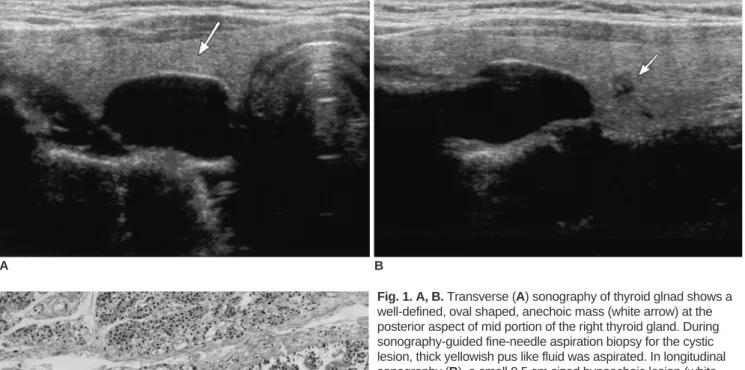
A 32-year-old female visited our hospital due to her nonspecific neck discomfort for several years. Sonography was performed on an Acuson unit with a 15-MHz linear transducer (Acuson, Mountain View, CA), and a 0.5 cm sized hypoechoic nodule with ill-defined margins and a taller shape was found in the right portion of the thyroid gland. It was suspected of malignant nodule. Another 1.8 cm sized anechoic cystic lesion with oval shape and well-defined margin was also noted at the posterior aspect of the mid-portion of the thyroid, and it was superior to the suspicious malignant nodule (Figs. 1A, B).
To rule out thyroid cancer, the patient underwent sonography-guided fine needle aspiration of the suspicious malignant nodule. At the same time, we also aspirated the cystic lesion in right portion of the thyroid gland. The aspirated fluid was measured as 1 cc and showed as a thick yellowish pus-like fluid material. The cystic lesion was thought of parathyroid cyst or other complicated cyst, so aspirated fluid was sent for cytology cultures for bacteria and a check of the parathyroid hormone (PTH) level. After aspiration, the cystic lesion collapsed. The cytology results of the suspicious malignant nodule were consistent with a papillary cancer; there were no follicular cells and a few squamous cells in the cytology results of the cystic lesion. The PTH level of cystic fluid showed to be normal and there were no bacteria on culture. The patient underwent right total thyroidectomy for removal of the cancer. Histopathologic examination about the suspicious malignant nodule on US revealed micropapillary carcinoma, the same as the preoperative cytology report. The 1.8 cm sized cystic Hye-Jeong Lee, MD1
Eun-Kyung Kim, MD1 SoonWon Hong, MD2
Index terms :
Thyroid cyst, Branchial cleft cyst, Branchial cleft anomaly, Neck mass, Ultrasound
Korean J Radiol 2006 ; 7 : 149-151 Received July 12, 2005; accepted after revision September 23, 2005.
1Department of Diagnostic Radiology,
Research Institute of Radiological Science, Severance Hospital, Yonsei University College of Medicine, Seoul 120-752, Korea; 2Department of
Pathology, Severance Hospital, Yonsei University College of Medicine, Seoul 120-752, Korea
Address reprint requests to : Eun-Kyung Kim, MD, Department of Diagnostic Radiology, Research Institute of Radiological Science, Severance Hospital, Yonsei University College of Medicine, 134, Shinchon-dong, Seodaemun-gu, Seoul 120-752, Korea. Tel. (822) 2228-7400
Fax. (822) 393-3035
e-mail: [email protected]
lesion superior to the cancer was lined by ciliated pseudos-tratified columnar epithelial cells, and its diagnosis was a branchial cleft cyst (Fig. 1C).
DISCUSSION
Branchial anomalies may result from the abnormal persistence of branchial apparatus remnants, and they present around each of the developed brachial derivates. Such anomalies have been traditionally classified as cysts, sinuses, or fistulas. A branchial cleft cyst is an epithelial-lined structure without an external opening, and it is usually located in the lateral areas of the head and neck (1, 2). First branchial cleft cysts are intimately associated with the external auditory canal and the parotid gland (1). Second branchial cleft cysts are found along the anterior border of the sternocleidomastoid muscle and most commonly present just lateral to the internal jugular vein at the level of the carotid bifurcation (3). Anomalies of the third and fourth branchial clefts are relatively uncommon
and the distinction between third and fourth branhcial anomalies remains controversial, primarily because both lesions similarly present around the piriform sinus (1).
A intrathyroidal branchial cleft cyst is extremely rare. The exact histogenesis of a intrathyroidal branchial cleft cyst is unclear, but probably the failure of the third or fourth branchial pouches to atrophy and dissipate in utero results in the cysts or the sinus tracts that lie in close proximity to, or inside, the thyroid gland (2, 5).
Whatever their origin, histologic analysis reveals that they are generally well-circumscribed cysts lined by straight squamous or pseudostratified columnar epithelium, and they have abundant lymphoid tissue and follicles beneath the epithelium. The cystic contents may be clear, watery to mucinous fluid, or the cyst may contain desqua-mated, granular cellular debris and if this becomes infected, it may be yellowish pus-like fluid (3, 4).
Generally, the diagnosis of branchial cleft cysts is relatively easy when it is located in its classical position, and
sonographically the cyst appears as an anechoic mass or a
Lee et al.
150 Korean J Radiol 7(2), June 2006
A B
Fig. 1. A, B. Transverse (A) sonography of thyroid glnad shows a
well-defined, oval shaped, anechoic mass (white arrow) at the posterior aspect of mid portion of the right thyroid gland. During sonography-guided fine-needle aspiration biopsy for the cystic lesion, thick yellowish pus like fluid was aspirated. In longitudinal sonography (B), a small 0.5 cm sized hypoechoic lesion (white arrow) inferior to the cystic lesion was confirmed as papillary carcinoma.
C. A cystic lesion is located on the thyroid surface, measuring
about 1 0.8 cm. The inner linings are ciliated pseudostratified columnar epithelium without smooth muscle or a cartilagenous component (H & E stain, 100).
Sonographic Detection of Intrathyroidal Branchial Cleft Cyst
Korean J Radiol 7(2), June 2006 151
predominantly hypoechoic, cystic mass with faint internal debris and posterior enhancement. Occasionally, it is hyperechoic and shows a pseudosolid appearance. However, on real-time images, after the application of transducer pressure on the cyst, the entire contents may shift, suggesting their true cystic nature (4).
Preoperatively, how can we arrive at the the diagnosis of intrathyroidal branchial cleft cyst? Although some prior reports have suggested that intrathyroidal branchial cleft cysts should be considered in the differential diagnosis of thyroid cystic lesions, and especially in the patients with Hashimoto’s thyroiditis, yet in view of the rarity of the lesion, the diagnosis can be suggested only by histopatho-logic confirmation, as was the case in all the previous case reports (2, 6). Generally, in clinical practice, when thyroid cysts are detected by sonography, we first suggest that it is a colloid cyst or a true epithelial thyroid cyst. If cysts are presented in the posterior portion of the superior or inferior pole of the thyroid, we also should consider the possibility of parathyroid cysts (7). But, fine-needle aspira-tion of yellowish, green viscous fluid or the sonographic appearances of a pseudosolid, cystic nodule in the thyroid should alert the sonographer to the possibility of a congeni-tal developmencongeni-tal cyst (6). Thyroglossal duct cysts, the one of congenital developmental cysts, also have been reported to present as thyroid masses. The distinguishing features between a thyroglossal duct cyst versus a branchial cleft cyst include presentation of the mass, with thyroglossal duct cysts more likely to be midline neck masses while branchial cleft cysts are typically lateral neck masses, and frequency of infection, branchial cleft cyst are more likely to be infected (8). Histology of the cellular components of the cyst wall and surrounding tissue is the most valuable method of differentiating the two (8). But, preexisting inflammation may cause metaplasia of the lining of a thyroglossal duct cyst, while may make histologic differen-tiation from a branchial cleft cyst difficult (8).
When we reviewed the previous case reports for
intrathyroidal branchial cleft cysts, there was no specific finding on the sonography studies. But in a few cases, there was creamy green or turbid yellowish fluid aspirated during fine needle aspiration cytology for intrathyroidal branchial cleft cyst, as like our case (4, 8).
In conclusion, the differential diagnosis for a cystic lesion that lies in close proximity to, or inside, the thyroid gland on sonography includes colloid cyst, true epithelial thyroid cyst and parathyroid cyst. The definite diagnosis of thyroidal branchial cleft cyst will be made postoperatively; yet if on fine-needle aspiration of the cyst a yellowish, pus-like viscous fluid is aspirated, branchial cleft cyst should be considered in the differential diagnosis of the thyroid cystic lesion.
References
1. Mandell DL. Head and neck anomalies related to the brachial apparatus. Otolaryngol Clin North Am 2000;33:1309-1332 2. Haba R, Miki H, Kobayashi S, Kushida Y, Saoo K, Hirakawa E,
et al. Intrathyroidal branchial cleft-like cyst in chronic thyroidi-tis. Pathol Int 2000;50:897-900
3. Randal SW, Dianne CD. Head and neck. In: Courtney MT, ed.
Sabiston textbook of surgery: the biological basis of morden surgical practice, 16th ed. Philadelphia: WB Saunders, 2000:546
4. Ahuja AT, King AD, Metreweli C. Second branchial cleft cysts : variability of sonographic appearances in adult cases. AJNR Am
J Neuroradiol 2000;21:315-319
5. Liberman M, Kay S, Emil S, Flageole H, Nguyen LT, Tewfik TL, et al. Ten years of experience with third and fourth branchial remnants. J Pediatr Surg 2002;37:685-690
6. Ahuja AT, Chang AR, To E, Pang P, Ching AS, King AD, et al. Intrathyroidal lymphoepithelial (branchial) cyst: sonographic features of a rare lesion. AJNR Am J Neuroradiol
2000;21:1340-1343
7. Smith MD, Serpell JW, Morgan JL, Cheng MS. Fine needle aspiration in the management of benign thyroid cysts. ANZ J
Surg 2003;73:477-479
8. Johnston R, Wei JL, Maddalozzo J. Intra-thyroid thyroglossal duct cyst as a differential diagnosis of thyroid nodule. Int J