Future Network & MobileSummit 2011 Conference Proceedings Paul Cunningham and Miriam Cunningham (Eds)
IIMC International Information Management Corporation, 2011 ISBN: 978-1-905824-23-6
HINLO: An ID/LOC Split Scheme for
Mobile Oriented Future Internet
Heeyoung JUNG1, Seok Joo KOH2
1
ETRI, 138 Gajeongno, Yuseong-Gu, Daejeon, 305-700, South Korea Tel: +82 42 860 4928, Fax: + 82 42 860 6104, Email: [email protected]
2
Kyungpook National Univ., Daegu, 702-700, South Korea Tel: +82 53 950 7356, Fax: +82 53 950 6093, Email: [email protected] Abstract: The future Internet would be evolved toward ‘mobile’ environment, but the current Internet was historically designed for ‘static’ environment and thus it is inevitably subject to architectural limitations in the viewpoint of mobile-oriented future Internet. In this paper, we identify a set of requirements for identifications in future mobile environments and propose a new Identifier/Locator split scheme to satisfy those requirements, named Host ID and Network Locator (HINLO). Based on the HINLO architecture, the binding of Host ID and Locator and the packet delivery operations are described. The proposed HINLO scheme is compared with the existing ID/LOC split schemes.
Keywords: Future Internet, Mobile Environments, Identifier-Locator split, Host Identifier, Network Locator
1. Introduction
With wide popularity of smart phones and emergence of various wireless/mobile networks, the environment for Internet services has rapidly changed from fixed-based to mobile-based. This mobile trend is going to be much dominant and very common in the future. It is reported that the number of mobile users will be more than 1.6 billion in around 2014 and thus exceed the number of desktop users [1]. With this trend, the mobile network environment is now a primary factor to be considered in the design of future Internet.
However, such mobile trend was not considered in the design of original Internet. That is, the current Internet has been designed for fixed hosts rather than for mobile ones. This has naturally incurred lots of inefficiencies. The most typical example is overloaded semantic of IP address. In Internet, an IP address is used as an identifier (ID) as well as a locator (LOC). Moreover, it is assigned to interface of a host rather than the host itself. It may make no problem in the fixed environment, because the location of host will not change. However, in mobile environments, the situation is quite different. For moving host, ID should be the same to keep session continuity, but the location should be changed to be routable. It is a big problem from the perspective of host mobility. Also, the IP address is allocated to node’s interface, it can’t support multi-homing environment in the effective manner. Scalability is also an issue, since mobility and multi-homing make the routing table aggregation more difficult.
Many protocols have so far been proposed to address the overloaded semantic issue of IP address. To deal with this issue, the Mobile IP (MIP) protocols [2, 3] use the two types of IP addresses: home address (HoA) as an ID and care-of-address (CoA) as a LOC, in which the mobility of a host will be supported with the help of mobility agents such as Home Agent (HA) and Local Mobility Anchor (LMA), even when a host is away from its home domain. On the other hand, HIP [4] and LISP [5] have been proposed as new scheme
for separation of ID and LOC. As a host-based scheme, HIP uses host identity tag for ID and IP address of host for LOC, whereas LISP is a network-based scheme that uses IP address of a host for Endpoint ID and IP address of a router for Routing LOC.
We note that the existing solutions focus on a specific problem, for instance, mobility, multi-homing and scalability and compatibility with the current Internet. Accordingly, they are like to be temporary solution rather than optimal one. Therefore, we argue that more mobile-oriented ID/LOC split scheme are highly required to effectively address the existing and future mobile environment. For this purpose, this paper proposes a mobile-oriented new ID/LOC split scheme, named HINLO (Host ID and Network Locator).
The remainder of this paper is organized as follows. First, we identify the requirements of ID for mobile oriented environment in Section 2. In Section 3, we describe the architecture of HINLO with relevant procedures. Comparisons with the existing ID/LOC separation protocols are given in Section 4. Finally, Section 5 concludes this paper.
2. ID Requirements for Mobile Environment
To effectively support mobile oriented environment, the host ID and/or LOC of future Internet should satisfies the following requirements.
2.1 – Mobile host is mandatory and fixed host is special
In current Internet, ‘static’ host is the basic assumption, whereas ‘mobile’ host is treated as a special case, as shown in MIP. It is quite reasonable approach in the fixed host dominant environment, but it should be completely opposite in the mobile dominant one.
2.2 – Host ID and LOC should be separated
As indicated in the existing ID/LOC split schemes [4-7], the attachment to network cannot be fixed for moving hosts. Therefore, host ID and LOC should be separated and a dynamic binding between them should be provided, e.g. in the form of (persistent host ID, temporary LOC).
2.3 – ID for host itself is necessary
An IP address in the current Internet represents an interface of the host. To effectively support the mobility and multi-homing, ID for host itself should be provided.
2.4 – Support of hosts with multiple interfaces
Current Internet implies a host with a single interface. Note that a host with multiple interfaces will be common in mobile environment, as shown in the wireless networks (e.g. wireless BAN, PAN, etc). Accordingly, the design of ID for future Internet shall be able to support the multi-homing and multiple interfaces effectively.
2.5 – LOC does not need to be allocated to host
The allocation of a fixed LOC to a moving node is meaningless, because its value is only temporary. Besides, as shown in the MIP, the dynamic configuration of LOC (e.g. IP address) in the host may degrade handover performance severely. Note that the cellular system, which is a typical mobile-oriented network, does not require such LOC allocation to mobile terminal, and only requires IDs for user and/or terminal [8].
2.6 – Light host and network based operation
A sensor network is a promising technology for future Internet. The ID/LOC scheme should effectively support these light hosts. In the sense, the host-based scheme needs to be changed to the network-based one. Moreover, the heterogeneous network environment is envisioned even in the network layer. To support such network diversity, the network-based operation is preferred [7].
2.7 – More secure ID structure
The ID in current Internet (IP address) is known to be vulnerable to security and privacy. In the mobile environment, such drawbacks will be more severe. Therefore, a more secure ID should be provided for mobile oriented environment.
3. HINLO Architecture
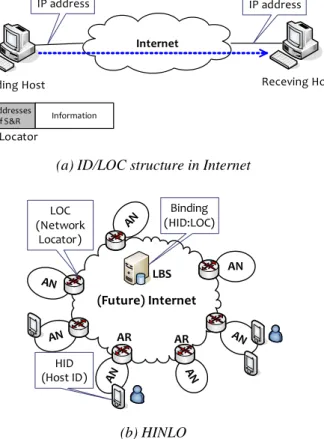
Based on the requirements identified in Section 2, we design the architecture of HINLO, in which the three types of IDs are employed: HID, LOC and Link ID (LID). HID is used to identify a host, which is a fixed-length secure format. We assume that a HID contains information on the domain that a host belongs to, and it will be used to find a proper location server. LOC is used to represent the location of a host in the network and also used for delivery of data packets. As a LOC, the current IP address still can be used, but it does not preclude the use of other LOCs. LID is an identifier of a host within the access network between host and router. A typical example of LID is a MAC address of Ethernet or connection ID of WiMAX. The format of LID depends on the underlying access technology.
Fig. 1 compares the ID/LOC structure of current Internet (a) and HINLO (b).
Internet IP Addresses of S&R Information ID&Locator Sending Host Receving Host IP address IP address
(a) ID/LOC structure in Internet
AN AN AN A N AN AN AN (Future) Internet HID (Host ID) LOC (Network Locator) LBS Binding (HID:LOC) AR AR (b) HINLO
In Internet, an IP address is used as host ID as well as LOC, and the LOC is allocated the interface of host rather than host itself. Accordingly, the binding between host ID and LOC is very static. This results in the inefficiency of current Internet in the mobile and multi-homing environment.
In the HINLO, an HID is allocated to host itself, not its interface. LOC is given only to Access Router (AR) of network. Note that a host does not have any LOC in the HINLO. That is, the LOC of a host is represented by LOC of AR which the host is currently attached to. Accordingly a single LOC represents more than one HID. This is a notable feature of HINLO, and the very similar ID/LOC structure in the conventional cellular system [7]. Also, an AR does not need to have another ID. It will have only a LOC. The dynamic binding between HID and LOC is given by the Location Binding Server (LBS), which is located within the network. We assume that such LBS is deployed in a distributed manner and multiple LBSs are interconnected each other to support global location trackings.
3.1 – HID and LOC binding
LBS is responsible for binding between HID and LOC. The binding can be achieved by registration to LBS by AR, when a host is attached to network or changes its attachment point by movement.
When a host is attached to the network, it informs its HID to AR. It can be done in the two ways: implicitly or explicitly. In the implicit case, it is assumed that HID information is delivered to AR through the underlying technology (e.g., with the MAC frame). If it is not supported, the information may be explicitly delivered by a newly defined protocol. Through this attachment procedure, a host cache is maintained and updated by each AR. If an AR realizes that a new host is attached, it registers the information (HID:LOC) to LBS by sending a specific message (LOC binding request), on behalf of the host. LBS confirms this binding by replying with a LOC binding ACK message. Note in the HINLO that the HID represents an ID of the host, but the LOC is represented by AR. When the host moves into another AR region, the same procedure will be repeated.
3.2 – HINLO-based packet delivery
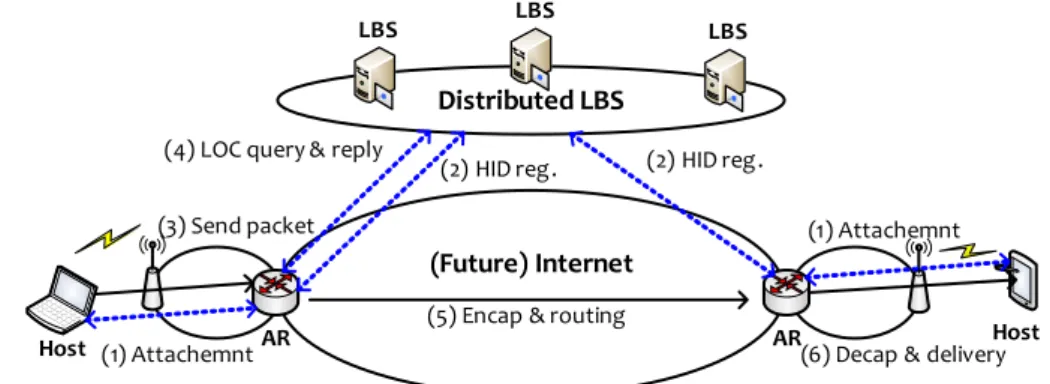
Fig. 2 shows how to deliver a packet in the HINLO-based network. The delivery is done by ID-based communication, and LOC-based encapsulation is used to route the packet within the Internet backbone. The packet delivery within an access network is accomplished by the underlying layer technology with (HID:LID) mapping.
Distributed LBS (Future) Internet AR AR Host Host LBS (3) Send packet (4) LOC query & reply (5) Encap & routing (6) Decap & delivery (1) Attachemnt (2) HID reg. (1) Attachemnt LBS LBS (2) HID reg.
Figure 2: HINLO-based packet delivery
When a mobile host is attached to AR, it firstly performs the network attachment which is specific to the access network (step 1). Through the attachment procedure, AR gets the information on HID of the host. The AR registers the HID with its LOC to LBS instead of the host (step 2). For enhancement of scalability, the distributed LBSs will be used, rather
than centralized ones. The LBS keeps the binding information between the host’s HID and the corresponding AR’s LOC. When a host sends a data packet to the destination host, the packet is first delivered to AR with the access network (step 3). Based on the destination HID information, AR queries the necessary LOC information to LBS (step 4). Note that the LOC is an IP address of AR that the receiving host is currently attached to. After AR gets the required LOC information, it encapsulates the packet with an outer header including LOC, and delivers the packets to the destination AR with the LOC-based routing (step 5). Finally, the destination AR eliminates the outer header, and the original packets are delivered to the destination host (step 6).
Fig. 3 shows an abstract packet format used in the packet delivery. The header of original packet in the host includes only source ID and destination ID, without LOCs. This HID-based packet is delivered to access router. At AR, the packet is encapsulated with an outer header containing source and destination LOCs, and then routed to the destination AR.
Source ID/ Dest. ID App. Data Source ID/ Dest. ID App. Data Source Loc/ Dest. Loc Host to Host Within Internet
Figure 3: Abstract packet formats
4. Analysis
4.1 – Characteristics comparison
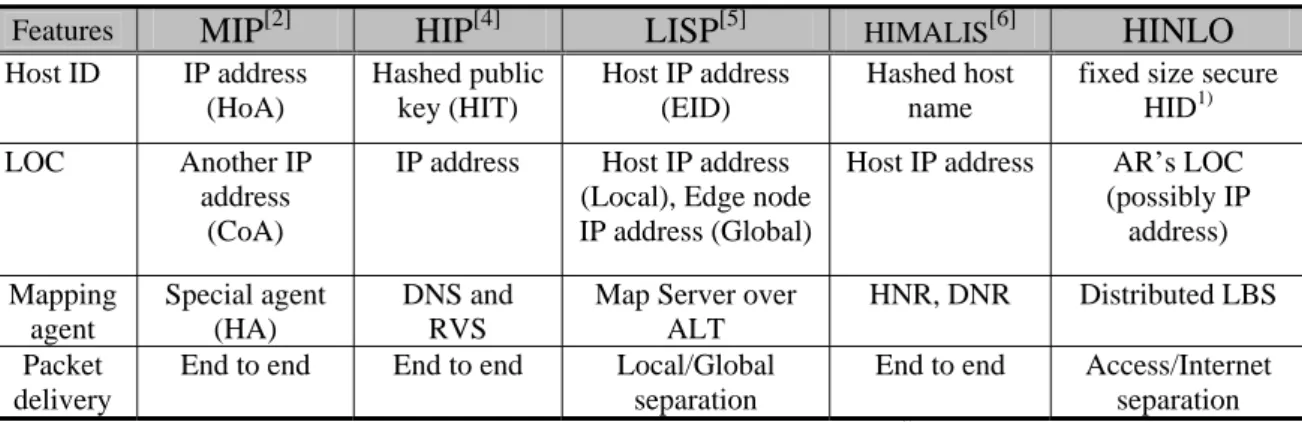
Table 1 summarizes the basic features of proposed HINLO and existing ID/LOC schemes. All of schemes provide ID for upper layer connection to support mobility. However, host ID is only supported in HIP, HIMALIS and HINLO. Regarding LOC, only LISP and HINLO support network LOC. Mapping agent for ID/LOC binding is essential for every ID/LOC split schemes. HINLO and LISP provide ID-based communication using network node, but others are host-based end-to-end communication.
Table 1: Characteristics comparison of existing ID/LOC schemes and HINLO
Features MIP[2] HIP[4] LISP[5] HIMALIS[6] HINLO
Host ID IP address (HoA) Hashed public key (HIT) Host IP address (EID) Hashed host name
fixed size secure HID1)
LOC Another IP
address (CoA)
IP address Host IP address (Local), Edge node IP address (Global)
Host IP address AR’s LOC (possibly IP address) Mapping agent Special agent (HA) DNS and RVS
Map Server over ALT
HNR, DNR Distributed LBS
Packet delivery
End to end End to end Local/Global separation
End to end Access/Internet separation Note: 1) Detail format is for further study
Fig. 4 shows comparison of ID/LOC allocation of each scheme. In conventional Internet, IP address is allocated to end host’s interface and used as both ID and LOC. In case of MIP, HIP and HIMALIS, host ID is separated from LOC, but both are still located at the host. LISP has a separated network LOC from host, but the IP address of host still means ID and LOC within local network. For mobile optimized ID/LOC split, a host in
HINLO does not have LOC anymore. A host has only ID, and LOC is only managed by network. (Future) Internet Host ID/LOC Conventional Internet ID LOC MIP, HIP, HIMALIS ID LOC LISP ID/LOC LOC HINLO
Figure 4: Comparison of ID/LOC allocations
Table 2 shows how each ID/LOC scheme satisfies the requirements specified in Section 2. Note that the existing schemes do not support some requirements, but the proposed HINLO meets all the requirements.
Table 2: Comparison of ID/LOC schemes in terms of requirements
Req. No.1) MIP HIP LISP HIMALIS HINLO
2.1 No No No No Yes 2.2 Yes Yes Yes Yes Yes 2.3 No Yes No Yes Yes 2.4 No Yes No Yes Yes 2.5 No No No No Yes 2.6 No No Yes No Yes 2.7 No Yes No Yes Yes
Note: 1) means the requirement number specified in Section 2
4.2 – Numeric cost analysis
For performance analysis, we compare the packet delivery cost for three candidate ID/LOC split schemes: HIP, LISP, and HINLO. HIMALIS can be considered as a similar approach with HIP.
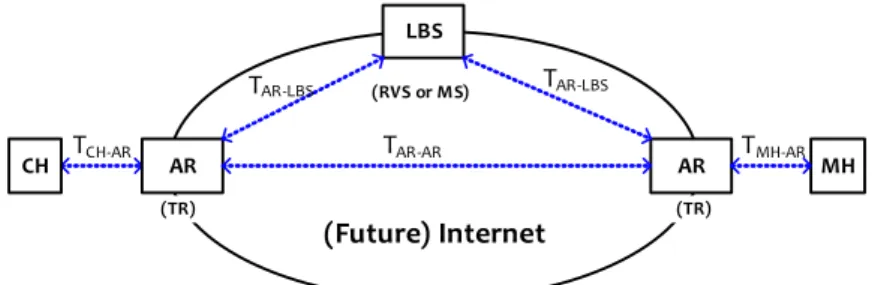
Let us consider a simplified network model in Fig. 5. In the figure, we consider two communicating hosts: correspondent host (CH) and mobile host (MH). AR represents an access router that a host is attached to, which is regarded as a Tunnel Router (TR) of LISP. Likewise, LBS of HINLO will represent a Rendezvous Server (RVS) of HIP or Map Server (MS) of LISP. For analysis, we define Ta-b as the transmission delay of a packet between
two nodes (a and b) in the network. This can apply to TCH-AR, TAR-LBS, TAR-AR, and TMH-AR.
It is assumed that CH sends N data packets to MH, and CH has already known the ID of MH (Future) Internet LBS AR (RVS or MS) (TR) AR CH MH TAR‐LBS (TR) TAR‐AR TAR‐LBS TCH‐AR TMH‐AR
In HIP, the packet delivery cost from CH to MH can be calculated as follows: 1) for initialization between CH and MH via RVS, we need TCH-AR+TAR-LBS+TAR-LBS+TMH-AR; 2)
the second HIP packet is delivered from MH directly to CH, which is TMH-AR+TAR-AR+T CH-AR. We ignore the third and fourth packets of HIP for equal comparison; 3) N data packets
are delivered directly from CH to MH, which is TMH-AR+TAR-AR+TCH-AR. Accordingly, the
overall packet delivery cost of HIP (CHIP) can be represented as
CHIP = (TCH-AR+2TAR-LBS+TMH-AR)+(TMH-AR+TAR-AR+TCH-AR)+N×(TMH-AR+TAR-AR+TCH-AR)
= 2(TCH-AR+TMH-AR + TAR-LBS)+TAR-AR+N×(TMH-AR+TAR-AR+TCH-AR). (Eq. 2)
In LISP, the ingress TR will contact with MS to obtain the RLOC of MH. Accordingly, the packet delivery cost from CH to MH can be calculated as follows: 1) the first packet is delivered from CH to AR (TR). TR sends a Map Request to MS, and MS forwards the Map Request to the egress TR of MH. These operations correspond to TCH-AR+TAR-LBS+TAR-LBS;
2) the egress TR responds with a Map Reply directly to the ingress TR. The ingress TR sends the first data packet to MH via egress TR. These operations require TAR-AR+T AR-AR+TMH-AR; 3) the subsequent N-1 data packets are delivered directly from CH to MH,
which results in TMH-AR+TAR-AR+TCH-AR for each of N-1 packets. The overall packet
delivery cost of LISP (CLISP) can be represented as
CLISP= (TCH-AR+2TAR-LBS)+(2TAR-AR+TMH-AR)+(N-1)×(TMH-AR+TAR-AR+TCH-AR)
= 2TAR-LBS+TAR-AR+N×(TMH-AR+TAR-AR+TCH-AR). (Eq. 2)
In HINLO, on the other hand, the Location Query (LQ) operation (at most only one) is performed with LBS by AR of CH before the packet delivery to MH. After that, all the N data packets are delivered directly to MH. So, the packet delivery cost of HINLO (PDCHINLO) from CH to MH can be calculated as follows: 1) the first packet is delivered
from CH to AR. AR sends a LOC Query to LBS, and then LBS responds with a LOC Query Reply directly to the AR. The ingress TR sends the first data packet directly to MH TR. These operations require TCH-AR+2TAR-LBS+TAR-AR+TMH-AR; 2) the subsequent N-1 data
packets are delivered directly from CH to MH, which results in TMH-AR+TAR-AR+TCH-AR for
each of N-1 packets. The overall packet delivery cost of HINLO (PDCHINLO) can be
represented as
CHINLO =(TCH-AR+2TAR-LBS+TAR-AR+TMH-AR)+(N-1)×(TMH-AR+TAR-AR+TCH-AR)
=2TAR-LBS+N×(TMH-AR+TAR-AR+TCH-AR). (Eq. 3)
For analysis, we set the parameter values used for numerical comparison, as follows: N = 5, TCH-AR = TMH-AR= 500ms, TAR-LBS = 300ms, and TAR-AR = 500 ms. Fig. 6 compares the
packet delivery costs of the candidate schemes for different transmission delays between AR and LBS (TAR-LBS) and between MH and AR (TMH-AR).
(a) Impact of TAR-LBS (b) Impact of TMH-AR Figure 6: Packet delivery costs
In Fig. 6(a), it is shown that the packet delivery costs linearly increase for all the schemes, as TAR-LBS gets larger. It is noted that the proposed HINLO scheme gives better
performance than the two existing schemes, HIP and LISP. This is because the data delivery operations of HIP and LISP quite depend on the transmission between AR and LBS, whereas the HINLO performs the direct delivery of data packets between ARs without using LBS. In Fig. 6(b), we see that HINLO also provides the best performance among the candidate schemes. This is because the proposed HINLO scheme can reduce the control operations over the wireless network region between MH and AR, compared to HIP and LISP.
5. Conclusions
In this paper, we identified a set of requirements for mobile oriented ID/LOC split scheme and proposed the architecture of HINLO that satisfies the requirements. To support the mobile-oriented future Internet environment, HINLO allocates LOC to a network agent (access router), not a host, whereas a host has only its ID. With the HINLO scheme, the ID based communication is naturally accomplished. The proposed HINLO architecture can be regarded as an incremental approach for future Internet architecture, which may be implemented and deployed over the current Internet, as discussed in [9]. For example, the IPv6 address can be used as a HID of HINLO with a slight modification of the current IPv6 address format, and the current IPv4/IPv6 addresses can be used as LOCs in the backbone network.
From the analysis, we can see that the proposed HINLO scheme satisfies the requirements for in mobile-oriented environment and also gives better performance than the existing schemes in terms of packet delivery cost. Moreover, HINLO is expected to show much better handover performance than existing ones because of its LOC-free feature in host. The issue of handover for in-session mobility support will be more specific in our future work.
HINLO is being developed as a part of a Korea government funded project on future Internet [9]. For future works, a detail HID format will be developed, which should be closely related to international standardization activity. Based on the HINLO scheme for ID/LOC split, a new mobility control mechanism will be developed, too.
Acknowledgments
This research was supported by the IT R&D program of KCA(10913-05004: Study on Architecture of Future Internet to Support Mobile Environments and Network Diversity).
References
[1] Morgan Stanley report, “Internet trends,” http://www.morganstanley.com/institutional/techresearch/ pdfs/Internet_Trends_041210.pdf, April 2010
[2] C. Perkins, “IP Mobility Support for IPv4,” IETF 3344, August 2002 [3] S. Gundavelli, et al., “Proxy Mobile IPv6,” IETF RFC 5213, August 2008
[4] Dave Thaler, “Why do we really want an ID/locator split anyway?,” ACM SIGCOMM 2008 workshop, Aug. 2008
[5] T. Henderson, “End-Host Mobility and Multihoming with the Host Identity Protocol,” IETF RFC 5206 [6] D. Farinacci, V. Fuller, D. Meyer, and D. Lewis, “Locator/ID Separation Protocol,” IETF I-D
draft-ietf-lisp-08.txt, August 2010
[7] Ved P. Kafle and Masugi Inoue, “HIMALIS: Heterogeneity Inclusion and Mobility Adaption through Locator ID separation in New Generation Network,” IEICE Trans. Comm., Vol. E93-B, No.3, March 2010 [8] Asha mehtota, “GSM System Engineering,” Artech House, 1997