서
론
국화는 꽃의 은은한 향과 아름다운 모양으로 세계 3 대 절화류로서 많은 사람들의 사랑을 받고 있다. 국내에 서도 2008년 기준으로 연간 1,030억원의 생산액으로 장 미 다음의 판매 우위를 점하고 있다. 하지만 우리나라는 네덜란드 등의 다국적 기업에서 만들어낸 외국 품종을 도입하여 재배하기 때문에 종묘비도 매년 계속해서 증가 하고 있어 경영에 압박을 받는 농가가 늘고 있다. 따라서 ─ ─ 171 ──스프레이 국화
‘Argus’
와 화색 돌연변이체간의
유전적 다형성 비교분석
성상엽1,2∙정성진1∙김상훈1∙김욱진1∙이지연1∙김동섭1 김진백1∙김홍기2∙강시용1,* 1한국원자력연구원 정읍방사선과학연구소, 2충남대학교 응용생물학전공Analysis of Genetic Diversity among Spray-Type
Chrysanthemum (Dendranthema grandiflorum) ‘Argus’ and
its Flower-Colored Mutants
Sang Yeop Sung1,2, Sung Jin Chung1, Sang Hoon Kim1, Wook-Jin Kim1, Ji Yeon Lee1, Dong Sub Kim1, Jin-Baek Kim1, Hong Gi Kim2and Si-Yong Kang1,*
1Advanced Radiation Technology Institute, Korea Atomic Energy Research Institute,
Jeongeup 580-185, Korea
2Department of Applied Biology, Chungnam National University, Daejeon 305-764, Korea
Abstract-- The original variety, chrysanthemum cv. ‘Argus’ and 4 mutant lines, AM1 to AM4 derived from that were used to analyze the relationship between morphological characters and genetic diversity. Morphological characteristics were investigated by using 29 parameters including flower, leaf, stem types, and so on. The genetic relationship was analyzed among the five lines using the AFLP fingerprinting method. A total of 28 EcoRI and MseI primer combinations were used to analyze the genetic relationship to among the five lines using the ABI3130 capillary electrophoresis system. In the morphological evaluation, euclidean distance values ranged from 1.20 to 1.52. In the AFLP analysis, a total of 2085 bands were detected by the 28 primer sets, and 956 (45.8%) of them were confirmed as polymorphic bands. Similarity coefficient values ranged between 0.40 and 0.72. The distribution by Euclidean distance and a similarity coefficient between the results of morpho-logical characters and AFLP analysis showed a difference.
Key words : Chrysanthemum, AFLP, UPGMA, Similarity coefficient, Euclidean distance, Mutation
* Corresponding authors: Si-Yong Kang, Tel. +82-63-570-3310, Fax. +82-63-570-3319, E-mail. [email protected]
왔으며, 최근에는 생명공학기법을 이용한 유전자 변형 육종 방법이 시도되고 있다. 또한 기존 품종의 형질개량, 중간모본용 육종 소재 확대 및 유전자풀 (Gene pool)의 확대를 위해 다양한 방법이 시도되고 있으며, 이 중 한 방법이 돌연변이 육종법이다. 연구 결과에 따르면 생물 의 종류나 유전자좌에 따라 다소 차이를 보이지만 보통 자연돌연변이의 경우 유전자좌당 10-5~10-7정도의 아
주 낮은 빈도로 나타난다 (Kimura and Ohta 1971). 인위 적으로 변이 발생빈도를 높이기 위하여 EMS (ethyl me-thanesulfonate) 등의 화학 돌연변이 유기원을 처리하기 도 하지만 쉽게 분해되며 처리 과정에서 인체에 질병 및 암을 유발하는 문제점이 제기되고 있다. 한편 지구상에는 우주 및 지각으로부터 나오는 자연 방사선이 존재하며 자연방사선에 의한 돌연변이 빈도는 극히 낮다. 이에 반해 감마선, 이온빔, 전자빔 등 방사능 잔류에 대한 안전성이 검증된 다양한 방사선을 이용한 방사선 돌연변이 육종법은 다양한 식물 종에 적정 선량 을 조사함으로써 더 안전하고 단기간에 돌연변이 품종 육성을 할 수 있게 하였다 (Sidrak and Suess 1973; Naga-tomi et al. 1991; Brenda et al. 1992; NagaNaga-tomi et al. 1993, 1997; Mandel et al. 2000a; Misra et al. 2003; Naito et al. 2005; Hiroyasu et al. 2008, 2009; Jia and Li 2008). FAO-IAEA 돌연변이 품종 데이터베이스(http://www.mvgs.iaea. org/MVD/Default.htm)에 의하면 돌연변이 육종에 의해 등록된 화훼류는 약 600여 품종으로, 그 중 254개가 국
화 품종이며 χ선과 γ선을 이용하여 50% 이상이 네덜란
드와 인도에서 개발되었다. 최근 일본에서도 ‘Imajin’, ‘Arajin’, ‘Emi-akari’, ‘Princess kagawa’, ‘Dreaming’, ‘Ray Sunrise’ 등 ion beam과 χ선 조사를 통한 품종개발이 보 고된 바 있으며 국내에서도 조직배양 기술과 감마선 돌 연변이 육종 기술을 접목하여 국화 신품종 개발을 위한 육종 연구가 보고되고 있다 (Park 2005; Park et al. 2007; Lee et al. 2008). 한편 돌연변이체간의 유연관계를 밝히고 다양한 정보 를 축척하여 돌연변이 유전자원의 지적재산권을 확보하 기 위해서는 변이체간의 명확한 구분 및 유연관계 분석 이나 유전표식을 확인하는 작업이 필요하다. 현재까지 연구되고 있는 유전표식으로 RFLP (Restriction Fragment Length Polymorphism), RAPD (Random Amplified morphic DNA), AFLP (Amplified Fragment Length Poly-morphism), SNP (Single Nucleotide Polymorphism) 및 EST (Expressed Sequence Tags) 등이 개발되어 이용되고 있으
표식이 나타내는 유전적 변이성의 정도 및 응용성은 차 이를 나타내고 있기 때문에 분석목적에 따라 적합한 유 전표식을 사용할 필요가 있다. DNA를 이용한 유전표식 에 있어 AFLP분석은 PCR 기반의 DNA 다형성 분석법 으로서 적용이 쉽고, 결과가 안정적이며 단시간 내에 전 체 유전체를 대상으로 다양한 유전자좌를 포함하는 다 량의 polymorphism을 획득할 수 있는 장점이 있어 널리 이용되고 있다 (Vos et al. 1995). 본 연구에서는 감마선 조사에 유도된 4개의 선발 화 색 돌연변이체와 원품종간의 형태적 특성 조사와 아울러 AFLP 분석을 통해 유전적 차이 및 유연관계를 명확히 파악하여 유전자원의 기초자료로 활용함과 동시에 방사 선 조사에 의한 신품종 육성의 유용성을 확인하는 것을 목적으로 하였다.
재료 및 방법
1. 실험재료Dendranthema grandiforum ‘Argus’를 2005년에 줄기 의 기내배양을 통해 대량 증식하였다. 증식된 유식물체 에 한국원자력연구원 저준위 감마선 조사시설 (60Co)에 서 40 Gy를 조사하여 3주간의 발근 후 방사선육종시험 장 온실에 정식하였다. 2006년에서 2007년 사이에 삽목 증식을 통해 MV3세대를 육성하였다 (박 2007). 이 중 유전적으로 고정된 4계통의 화색 변이 계통을 선발하여 원품종과 함께 실험재료로 사용하였다. 2. 형태적 분석 안정적인 특성 평가를 위해 각 계통별 총 40주로부터 특성조사를 실시하였으며, 정상적인 생육이 이루어지고 완전히 개화가 되어진 식물체를 이용하였다. 형태적 특 성 조사는 생장유형, 꽃의 형태, 화반의 형태, 설상화 및 관상화의 주된 색 등을 세분화 하여 조사를 진행하였다. 형태적 분석 데이터를 통계적으로 수치화하기 위하여 각 조사 특성에 따른 차이를 5단계로 나누어 원품종 ‘Argus’의 특성을 ‘3’으로 기준하고 각 계통의 수치에 따라 1~5 단위로 표시하여 matrix code를 작성하였다. NTSYS 프로그램 (Rohlf 1992)을 사용하여 각 개체간의 Euclidean distance를 구하고 UPGMA (Unweighted Pair-Group Method using Arithmetic)로 연관관계를 분석하였
도를 확인하였다.
3. Genomic DNA의 분리 및 AFLP 분석
실험에 이용되어진 Genomic DNA는 Doyle and Doyle (1990)의 방법에 따라 10 g의 어린 식물체의 잎과 줄기 로부터 분리되었다. 분리되어진 Genomic DNA는 흡광광 도계 측정 (Jenway 6505, Essex, U.K.)과 0.7% agarose gel 전기영동을 통해서 DNA의 양과 질을 확인한 후 실험에 이용하였다. AFLP 분석은 Vos et al. (1995)와 Meudt and Clarke (2007)의 방법을 일부 변형하여 사용하였다. Geno-mic DNA 250 ng을 EcoRI/MseI (Promega,USA) 제한효소 를 이용하여 절단시켰다. 절단 산물에 EcoRI/MseI adaptor 를 첨가하여 ligation 반응을 실시하고 preamplification 반응을 수행하였다. 반응액을 TE buffer를 이용하여 50 배 희석하여 5가지의 fluorescent dyes (FAM, HEX, NED, ROX and LIZ)로 라벨되어진 EcoRI/MseI selective primer 를 이용하여 selective amplification을 수행하였다. 최종 PCR product를 ABI 3130xl genetic analyzer (Applied Bio-systems, CA, USA)를 이용하여 capillary electrophoresis 를 통해 AFLP분석을 수행하였다 (Applied Biosystems, CA, USA). PCR 증폭을 포함한 모든 반응 조건은 Analy-sis system I (Invitrogen, Carlsbad, California)을 참조하여 실행하였다. 유전적 다형성 분석은 100~500 bp에서의
trix code를 작성한 후, NTSYS 프로그램을 사용하여 각 개체간의 유사도 matrix를 UPGMA (Unweighted Pair-Group Method using Arithmetic)로 분석하였고 이를 토대 로 덴드로그램을 작성하고 유전적 유사도를 확인하였다.
결과 및 논의
1. 형태적 특성 조사 본 연구에서의 국화 원품종 ‘Argus’는 스프레이 타입 아네모네형으로 연분홍 빛을 띄는 흰색 계열의 설상화와 자주색을 띄는 통상화로 크게 2가지 색상을 띈다 (Table 1). ‘Argus’와 변이체의 줄기와 잎의 특성을 조사한 결과 화서의 형태는 산방화서 (corymbiform)로 감마선에 의한 변화가 없었으며, 잎의 형태 (rounded)나 기부의 주된 모 양 (rounded), 잎자루의 형태 (moderately upwards), 잎의 색깔 또한 조사 결과 방사선에 의한 큰 변화가 없었다. 줄기의 색깔에서는 ‘Argus’와 변이체 ‘AM3’, ‘AM5’에 서 진한 녹색을 띠었으며, ‘AM1’은 청녹색, ‘AM2’는 연 한녹색으로 약간의 차이가 나타났다 (Table 2). 잎의 가장 자리 톱니수 (indentations)에서 ‘Argus’의 경우 48개로 ‘AM2’ 45개와 비슷하였으나 ‘AM1’, ‘AM3’, ‘AM5’는72~74개로 상당한 수의 차이를 나타냈다. 잎의 넓이는
Table 1. Morphological characteristics of stem and leaf parts among ‘Argus’ and its derived 4 mutant lines
Inflorescence
Leaf Petiole Stem
Lines Plant type
form Color of Shape Number of Predominant Attitude Color upper side indentations shape of base
Wild-type ‘Argus’ Non bushy Corymbiform Green 137A† Rounded 48 Rounded Moderately upwards Green N199B†
AM1 Non bushy Corymbiform Green 137C Rounded 72 Rounded Moderately upwards Green 165C AM2 Non bushy Corymbiform Green 137A Rounded 45 Rounded Moderately upwards Green 137D AM3 Non bushy Corymbiform Green 137A Rounded 72 Rounded Moderately upwards Green 199A AM5 Non bushy Corymbiform Green 137B Rounded 74 Rounded Moderately upwards Green 199A
†Royal Horticultural Society color chart (RHS chart)
Table 2. Characteristics of floral parts in ‘Argus’ and its derived 4 mutant lines
Natural
Flower color Flower bud Color before Color at Lines
flowering period Ray floret Tubular floret Color of outer side anther anther
Flower head just before opening dehiscence dehiscence type Wild-type ‘Argus’ Oct E-Nov M† Light pink 69C‡ Ruby red 9B 69B 61A 65C Single
AM1 Oct E-Nov M Heather violet 72C Raspberry red 77C 72C 59A 72A Single
AM2 Oct E-Nov M White pink 69D Ruby red 9B 69C 59A 65D Single
AM3 Oct E-Nov M White pink 69D Sulfur yellow 75B 69C 71A 7B Single
AM5 Oct E-Nov M Light pink 69C Traffic red N74C 69C N79A 84C Single
†E, M and L: early, mid and late of a month, respectively ‡Royal Horticultural Society color chart (RHS chart)
‘Argus’, ‘AM1’, ‘AM3’이 4.2~4.6 cm로 유사하였으며, ‘AM2’가 5.1로 가장 크고 ‘AM5’가 3.5로 가장 작았다.
식물체 초장의 길이는 ‘AM5’가 62.3±10.7 cm로 가장 컸으며, ‘Argus’, ‘AM1’, ‘AM2’는 대부분 50~51 cm로
Plant height Stipule Ray floret Length of
Lines
(cm) Width including size (mm) Diameter Height
floret
peduncle
(cm) petiole (cm) (mm) Length Width Length
(mm) (cm) (mm) (mm) (mm) Wild-type ‘Argus’ 51.0±3.62 4.6 10.5 11 7 4.2 14 20 8 14 54 AM1 49.2±3.75 4.3 7.3 10 3 3.8 14 18 7 14 40 AM2 51.0±4.23 5.1 7.3 12 4 4.8 17 22 7 17 45 AM3 46.5±6.51 4.2 11.0 10 2 3.7 15 16 8 8 53 AM5 62.3±10.75 3.5 9.1 12.5 3 3.9 13 16 7 14 54
Fig. 1. The flower features of chrysanthemum [Dendranthema grandiforum (Ramat) Kitam] ‘Argus’ and mutants. A, Argus; B, AM1; C,
AM2; D, AM3; E, AM5.
A
B
C
D
E
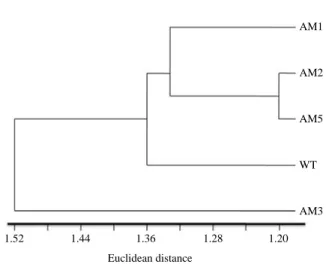
width at widest point (cm)유사하고, ‘AM3’은 46.5±6.4 cm로 가장 작게 나타났다 (Tables 1, 3). 개화특성은 차이가 없었으며, 꽃의 형태에 서도 큰 차이가 없었다. 화색에 있어서는 설상화 (ray floret)와 통상화 (tubular floret) 모두에서 변화가 있었는 데 ‘AM1’의 경우 설상화에서 heather violet으로, ‘AM3’ 은 통상화가 sulfur yellow로 가장 확연한 차이가 있었 다. ‘AM2’와 ‘AM3’의 통상화에서는 분홍빛이 또렷해 지는 것을 관찰할 수 있었다. 그 외에도 전반적인 화색 의 변화가 있었다 (Table 2, Fig. 1). 형태적 특성 조사의 결과를 정도에 따라 ‘1’~‘5’로 표시하여 matrix code를 작성한 후, NTSYS 프로그램을 사용하여 각 개체간의 Euclidean distance를 이용하여 덴드로그램을 작성하고 형태적 유사도를 확인한 결과, ‘AM2’, ‘AM5’가 Eucli-dean distance에서 1.20로 높았으며, ‘AM3’은 가장 낮은 것을 확인할 수 있었다 (Fig. 2). 그리고 ‘Argus’를 기준 으로 ‘AM1’, ‘AM2’, ‘AM5’가 한 그룹을 이루고, ‘AM3’ 은 형태적으로 동떨어져 있음을 확인할 수 있었으며, Euclidean distance는 1.52에서 1.20으로 분포됨을 확인 할 수 있었다 (Fig. 2). 2. AFLP 분석 형태적 특성 조사를 통해서 원품종 ‘Argus’와 변이체 는 잎, 줄기와 꽃에서 변이가 확인되었다. 생물의 형태적 차이는 그 종이 보유하고 있는 염색체 DNA 염기서열의 차이와 밀접한 관련이 있으며, 따라서 DNA상의 차이를 확인하는 AFLP분석은 돌연변이체간의 유연관계를 밝히 는데 중요한 수단이라 할 수 있다(Lee et al. 2002). AFLP 분석은 총 28개의 primer 조합이 사용되었다 (Table 4). 분석 결과 4개의 변이체와 원품종 ‘Argus’간의 28개의 primer조합에서 전체 2,085개의 밴드가 확인되었고, pri-mer당 평균 밴드 수는 74.5개였다. 다형성 밴드는 총 956 개, 평균 34.1개의 특이적 밴드가 확인되었다. Primer E-ACA/M-CAA조합에서 최대 179개의 전체 밴드와 126 개의 다형성 밴드가 확인되었으며, E-AAC/M-CCA조합 에서 17개의 전체 밴드와 6개의 다형성 밴드가 확인되 어 최소값을 보여주었다. Polymorphism은 E-ACA/ M-CAA조합에서 70.4%로 최대값을 보였으며, E-ACA/ M-CGA조합에서 13.6%로 최소값, 평균 40.8%의 polymor-phism을 보였다. 그리고 또한 NTSYS-pc program을 이 용하여 similarity coefficient를 확인하였는데 ‘AM2’와 ‘AM3’이 0.72정도의 유연계수가 나타나 ‘Argus’보다 유 전적으로 더 가까웠다. 또한 전체적인 유사도는 0.40~ 0.72의 범위였는데, Kim et al. (2009)의 무궁화 품종 구 분에서 0.66~0.98의 유사도 보고와 Lee et al. (2002)의 카네이션 근연 야생종에서 0.52~0.71의 유사도 보고가 본 실험의 결과와 유사함을 확인하였다 (Fig. 3). 형태적 특성 조사와 AFLP분석 결과를 바탕으로 한
Fig. 2. Phylogenetic tree between original variety, ‘Argus’ and its
derived four mutants from the UPGMA clustering analysis based on the morphological data.
AFLP primer combinations among chrysanthemum ‘Argus’ and its derived 4 mutants lines
No. of No. of
Polymorphism Primer set total bands polymorphic
(EA) bands (EA) (%)
E-ACA/M-CAA 179 126 70.4 E-ACA/M-CCA 87 29 33.3 E-ACA/M-CGA 44 6 13.6 E-ACC/M-CAA 204 158 77.5 E-ACC/M-CCA 109 35 32.1 E-ACC/M-CGA 93 27 29 E-ACC/M-CTA 36 13 36.1 E-AGC/M-CAA 163 107 65.6 E-AGC/M-CCA 55 25 45.5 E-AGC/M-CGA 80 20 25 E-AAC/M-CAA 50 9 18 E-AAC/M-CAT 40 10 25 E-AAC/M-CAC 79 24 30.4 E-AAC/M-CCA 17 6 35.3 E-AAC/M-CGA 58 26 44.8 E-AAC/M-CTA 44 11 25 E-AGG/M-CAA 54 36 66.7 E-AGG/M-CAT 78 39 50 E-AGG/M-CAC 78 47 60.3 E-AGG/M-CCA 105 32 30.5 E-AGG/M-CGA 102 35 34.3 E-AGG/M-CTA 36 11 30.6 E-ACG/M-CAA 37 12 32.4 E-ACG/M-CAT 53 20 37.7 E-ACG/M-CAC 44 24 54.5 E-ACG/M-CAA 58 24 41.4 E-ACG/M-CGA 38 27 71.1 E-ACG/M-CTA 64 17 26.6 Total 2085 956 -Mean 74.5 34.1 40.8 AM2 AM5 WT AM3 1.52 1.44 1.36 1.28 1.20 Euclidean distance
덴드로그램은 다른 양상를 보였다. 그리고 AFLP결과 0.4의 유연계수를 보였던 ‘AM1’은 유전적 유사도가 가 장 낮게 확인되었는데 이는 가시적으로 확인할 수 있었 던 화색의 변화가 가장 높았던 변이체로서 화색의 변화 와 유전적 변이율이 일치하는 결과를 보여주었다.
결
론
AFLP분석은 genomic DNA를 제한효소로 절단하여
단편의 양쪽에 primer와 상보적인 adaptor배열을 접합하 여 임의의 염기배열을 추가한 primer를 이용하여 DNA 를 증폭시켜 그 증폭단편의 길이의 다형을 검출하는 방 법으로 RFLP분석의 신뢰성 및 PCR의 간편성을 조합한 기술이다. 따라서 본 연구에서는 돌연변이체간의 형태적 으로 명확히 구분되는 4개의 돌연변이체와 원품종을 대 상으로 AFLP분석을 수행하였으며 그 결과 유전적 차이 및 유연관계를 명확히 파악할 수 있었다. 한편 AFLP분 석에 대한 similarity coefficient와 형태적 분석을 통한 Euclidean distance 결과가 일치하지 않았으며, 환경에 영 향을 많이 받는 표현형을 기반으로한 결과보다는 환경 에 거의 영향을 받지 않는 유전형에 가산한 결과가 더욱 신뢰도가 높은 것으로 판단된다. 향후 얻어진 돌연변이 계통을 이용한 유전자 마커 및 특이적 발현 유전자에 대 한 심도 깊은 추가 연구가 필요할 것으로 판단된다.
사
사
본 연구는 2009년도 농촌진흥청(RDA) 바이오그린 21사참 고 문 헌
Doyle JJ and Doyle JL. 1990. Isolation of plant DNA from fresh tissue. Focus. 12:13-15.
Gagnaire PA, Albert V, Jonsson B and Bernatchez L. 2009. Natural selection influences AFLP intraspecific genetic variability and introgression patterns in Atlantic eels.
Mole-cular Ecology 18:1678-1691.
Hiroyasu Y, Akemi S, Konosuke D and Toshikazu M. 2008. Effects of dose and dose rate of gamma ray irradiation on mutation induction and nuclear DNA content in chrysan-themum. Breeding Sci. 58:331-335.
Hiroyasu Y, Akemi S, Yoshihiro H, Konosuke D, Atsushi T and Toshikazu M. 2009. Mutation induction with ion beam irradiation of lateral buds of chrysanthemum and analysis of chimeric structure of induced mutants. Euphytica 165: 97-103.
Jia CF and Li AL. 2008. Effect of gamma radiation on mutant in-duction of Fagopyrum dibotrys Hara. Photosynthetica 46(3): 363-369
Kim SH, Kim WJ, Lee WJ, Song HS, Kim DS, Kim JB and Kang SY. 2009. Genetic relationship of Hibiscus syriacus L. clarified by AFLP & morphological evaluation. J. Kor.
Soc. Hort. Sci. 50(6):555-565.
Kimura M and Ohta T. 1971. Protein polymorphism as a phase of molecular Evolution. Nature. 229:467-469.
Lee GJ, Chung SJ, Park IS, Lee JS, Kim JB, Kim DS and Kang SY. 2008. Variation in the phenotypic features and trans-cripts of color mutants of chrysanthemum (Dendranthema
grandiflorum) Derived from Gamma ray Mutagenesis. J Plant Biol. 51(6):418-423.
Lee SY, Kim KS and Joung HY. 2002. Genetic similarity and cross compatibility of interspecific hybridization in wild species of carnation. J. Kor. Soc. Hort. Sci. 43:355-358. Mandal AKA, Chakrabarty D and Datta SK. 2000a. In vitro
isolation of solid novel flower colour mutants from induced chimeric ray florets of chrysanthemum. Euphytica 114:9-12. Meudt HM and Clarke AC. 2007. Almost forgotten or latest
practice? AFLP applications, analyses and advances. Trends
Plant Sci. 12:106-117.
Misra P, Datta SK and Chakrabarty D. 2003. Mutation in flower colour and shape of chrysanthemum morifolium induced by γ-radiation. Biol. Plantarum. 47:153-156.
Mueller UG and LaReesa Wolfenbarger L. 1999. AFLP geno-typing and fingerprinting. TREE 14:389-394.
Nagatomi S. 1991. Flower color mutants derived from floral
Fig. 3. Phylogenetic tree between original variety, ‘Argus’ and its
derived four mutants induced by gamma-ray from the UPGMA clustering analysis using the AFLP data.
0.40 0.48 0.56 0.64 0.72
Similarity coefficient
AM2
AM5
mum. Institute of radiation Breeding. No. 36 Technical News.
Nagatomi S, Degi K, Yamacuchi M, Miyahira E, Sakamoto M and Takaesu K. 1993. Six mutant varieties of flower colors induced by floral organ cultures of chronically irradiated plants in chrysanthemum. Institute of radiation Breeding. No. 43 Technical News.
Nagatomi S, Tanaka A, Watanabe H and Tano S. 1997. Chry-santhemum mutants regenerated from vitro explants irradiat-ed with 12C++5ion beam. Institute of radiation Breeding. No. 60 Technical News.
Naito K, Kusaba M, Shikazono N, Takano T, Tanaka A, Tanisa-ka T and Nishimura M. 2005. Transmissible and nontrans-missible mutations induced by irradiating arabidopsis thalia-na pollen with gamma-rays and carbon ions. Genetics 169: 881-889.
Park IS and Song HS. 2005. Current trends of mutation breeding by radiation technology at domestic and foreign ornamen-tals. J. Kor. Flower Res. Soc. 13(3):184-200.
Park IS, Lee GJ, Kim DS, Chung SJ, Kim JB, Somg HS, Goo DH and Kang SY. 2007. Mutation breeding of a spray
chry-culture. Flower Res. J. 15(1):52-57.
Rohlf FJ. 1992. NTSYS-pc numerical taxonomy and multivari-ate analysis system, version 1.70. Exeter Publications. New York, USA.
Shirley BW, Hanley S and Goodman HM. 1992. Effects of ionizing radiation on a plant genome: analysis of two arabi-dopsis transparent testa mutations. Plant Cell. 4:333-347. Sidrak GH and Suess A. 1973. Effects of low doses of gamma
radiation on the growth and yield of two varieties of tomato.
Radiation Botany. 13(6):309-314.
Vos P, Hogers R, Bleeker M, Reijans M, van de Lee T, Homes M, Frijters A, Pot J, Peleman J, Kupier M and Zabeau M. 1995. AFLP: A new technique for DNA fingerprinting.
Nucleic Acids Res. 23:4407-4414.
Yun MK and Choi YH. 2002. Biological Diversity and Benefit Sharing : WTO TRIPS discussions from the korean per-spective. [KIEP]policy analyses I. http://dbpia.co.kr/sKno-wledge/sKnowledge_detailview.asp?arid=124188.
Manuscript Received: June 7, 2010 Revision Accepted: June 14, 2010

![Fig. 1. The flower features of chrysanthemum [Dendranthema grandiforum (Ramat) Kitam] ‘Argus’ and mutants](https://thumb-ap.123doks.com/thumbv2/123dokinfo/4672151.796/4.892.82.808.160.339/flower-features-chrysanthemum-dendranthema-grandiforum-ramat-kitam-mutants.webp)