Food Sci. Biotechnol. Vol. 18, No. 6, pp. 1392 ~ 1397 (2009)
1392
ⓒ The Korean Society of Food Science and Technology
Thermal Storage and Thermodynamic Characteristics of Phase
Change Materials Slurries
Ki-Hyun Kwon1, Jin-Woong Jeong1, Jong-Hoon Kim1, Yong-Joo Kim2, and Chang-Hyun Choi* Department of Faculty of Life Science and Technology, Sungkyunkwan University, Suwon, Gyeonggi 440-746, Korea
1Department of Post-harvest Technology Research Center, Korea Food Research Institute, Seongnam, Gyeonggi 463-746, Korea 2Advanced R&D Center Machinery Technology Group, LS Mtron Ltd., Anyang, Gyeonggi 431-080, Korea
Abstract This study was aimed at developing a low cost cold storage system for agricultural products. Three kinds of
slurries: K1, K2, and K3 slurries were developed using phase change materials (PCMs) such as tetradecane, octadecane, and
sodium polyacrylate to maintain the desired temperature ranges. The slurries were manufactured by in-situ polymerization. Tetradecane and octadecane were capsulated in a core with melamine at the surface. The thermodynamic characteristics of the slurries were measured and analyzed. The latent heats of the K1, K2, and K3 slurries at the melting points were 206.41, 186.88,
and 147.91 kJ/kg, respectively. A transportable cold storage container was built to investigate the performance of the slurries as thermal storage media. The temperatures at the insides of the container could be maintained in the ranges of 0-5, 5-10, and 10-15oC for more than 23, 27, and 60 hr with the K
1, K2, and K3 slurries, respectively.
Keywords: latent heat, phase change material (PCM), slurry, thermal storage Introduction
Conventional cooling systems have long pipe lines to convey heat transfer fluid between heat exchangers. Thermal energy is transferred by the sensible heat of the fluid. Although sensible heat storage by means of water is simple and technically well developed, the efficiency of these systems is relatively low. Latent heat storage using phase change material (PCM) has advantages of high thermal storage capacity and heat retrieval at constant temperature during the phase change (1,2).
PCMs have been used for various thermal energy applications as a heat transfer and thermal storage medium (3). PCM particles suspended in a fluid provide additional thermal capacity from latent heat associated with the solid-liquid phase change. Because PCM particles can stick together to form large lumps, clogging often occurs in pipes, resulting in a failure to circulate the slurry in cooling systems. Several researches have shown that microencapsulated phase change materials (MPCMs) have no effect on their melting temperatures or latent heats.
Yamagishi et al. (4) studied the hydrodynamic and heat
transfer characteristics of slurries containing MPCMs as a heat transfer fluid. Slurries consisting of octadecane (C18H38) contained in 2-10µm diameter microcapsules and
pure water were used. Felsing and Jessen (5) and Patterson and Felsing (6) studied heat capacities of gaseous mono-and methylamines mono-and heats of solution of gaseous di-and tri-methylamine. They reported that MPCM slurries with larger latent heats, higher phase change rates, and no supercooling demonstrated promising heat transfer performance. Lee et al. (7) designed and tested a cooling
system using MPCM slurries to investigate the performance of the MPCM as a thermal storage medium. The MPCM slurries were manufactured by in-situ polymerization. The
surface of the MPCM was composed of melamine while tetradecane (C14H30) was in the center of the MPCM. The
discharge times of the 10 and 20 wt% MPCM slurries were up to 105 and 285 min longer, respectively, than a water cooling system.
In Korea, small amounts of various kinds of agricultural products are delivered from farmers to consumers every day by vehicle. Optimal temperature control is important to maintain the freshness of the agricultural products during transportation (8). The desired temperatures depend on the varieties and packing conditions of the agricultural products. Low cost and energy efficient cooling systems are needed to maintain the quality of agricultural products for distribution. Cooling systems using the latent heat of PCMs are particularly attractive with respect to thermal storage capacity and cost, and can be utilized to transport the agricultural products.
This study was carried out to develop a low cost cold storage system for agricultural products. Three kinds of slurries using MPCMs were developed, and their thermodynamic characteristics were analyzed. A transportable cold storage system using packs of MPCM slurries was designed and the performances of the MPCM slurries as thermal storage media were investigated.
Materials and Methods
Phase change materials Three kinds of slurries: K1, K2,
and K3 slurries were developed using MPCMs such as
tetradecane (C14H30), octadecane (C18H38), and sodium
polyacrylate (0.15 wt%) to maintain different temperature ranges of the cold storage system (9,10). The K1, K2, and
K3 slurries were designed to maintain the desired temperature
ranges of 0-5, 5-10, and 10-15oC, respectively. The K 1
slurry consisted of 2 components: 5% tetradecane and 95%
*Corresponding author: Tel: +82-31-290-7824; Fax: +82-31-290-7830 E-mail: [email protected]
Received May 15, 2009; Revised September 3, 2009; Accepted September 3, 2009
sodium polyacrylate (0.15 wt%). The K2 slurry consisted
of 3 components: 94% tetradecane, 4% octadecane, and 2% sodium polyacrylate (0.15 wt%). The K3 slurry
consisted of 64% tetradecane, 34% octadecane, and 2% sodium polyacrylate (0.15 wt%).
The K1, K2, and K3 slurries were manufactured by in-situ
polymerization as described by Lee et al. (7) and Kwon et al. (11). Tetradecane and octadecane were capsulated in a
core with melamine at the surface. Stealy meth acrylate (SMA) was used as an emulsifier. Sodium polyacrylate was added in the capsules as the nucleating agent to reduce the supercooling phenomena of tetradecane and octadecane. The concentration of the MPCM particles in the slurries was 25 wt%.
The capsule shape and the degree of aggregation of the MPCMs were observed with an optical microscope (Mw 200 Bi, Samsung SDI, Yongin, Gyeonggi, Korea). The surface of the MPCMs was analyzed by a scanning electron microscope (SEM, S-2380N; Hitachi, Ibaraki, Japan). The degree of aggregation changes of the K2 slurry with 15 and
20 min of homogenization are shown in Fig. 1. The diameters and specific gravities of the MPCM particles were in the range of 5-15µm and 0.87-0.91, respectively.
The thermal characteristics of the K1, K2, and K3 slurries
were analyzed by a differential scanning calorimeter (Unix DSC 7; PerkinElmer, Waltham, MA, USA) (12). The latent heats of the MPCM slurries at freezing and melting temperatures were analyzed initially and after 400 thermal
cycles, where 1 cycle included both melting and solidification processes. The degree of supercooling can be defined as the difference between the melting and solidification temperatures (13). The supercooling phenomena were analyzed by measuring the thermal energies of the MPCM slurries.
The viscosities of the slurries were measured by a viscometer (DV-II; Brookfield, Middleboro, MA, USA) at 3 different temperature levels: 0, 5, and 20oC for the K
1
slurry, 0, 10, and 20oC for the K
2 slurry, and 0, 15, and
20oC for the K
3 slurry. A 300 cm3 sample was taken at
each temperature and rotated at an angular velocity of 100 rpm for 30 sec. The viscosity measurements using a spindle that is used to measure low viscosity were repeated 3 times to obtain average values. The weights of the slurry samples were measured at 20oC, and the average values
were used to determine the densities of the slurries.
Experimental apparatus and method A transportable cold storage container, 700 (W)×800 (D)×1,450 mm (H),
was built to investigate the performance of the MPCM slurries as thermal storage media. The transportable cold storage container with a thermal capacity of 0.7 RT (1 RT =13.89 MJ) was designed to maintain temperatures in the range of −10-15oC for more than 12 hr when the ambient
temperature was 35oC. The experimental container included
a cold storage module at the bottom, a blower for air circulation at the top, an air mix duct, and a cooling air Fig. 1. Surface change of K2 slurry with 15 and 20 min of homogenization.
1394 K. -H. Kwon et al.
duct (14). The produced K1, K2, and K3 slurries were filled
in 700 mL polyethylene (PE) packs and sealed. A total of 22 PE packs were used as thermal storage media in the cold storage module.
Tests were conducted to analyze the temperature changes at the insides of the experimental container and the discharge times of the MPCM slurries. The PE packs filled with K1, K2, and K3 slurries were used to maintain the
temperature of the container at 3, 8, and 13oC, respectively.
The PE packs filled with slurries were left in a constant temperature bath at 20oC to remove the latent heats of the
MPCMs. The PE packs were put in the cold storage module and cooled at −10oC until the temperatures of the
slurries reached 0oC for the K
1 slurry, −3oC for the K2
slurry, and −5oC for the K
3 slurry. The temperatures were
measured at the insides (left, right, middle, and bottom positions) of the container and slurry filled PE packs every 30 sec. T-type thermocouples with diameters of 0.3 mm and a multi-junction data acquisition device (2625A; Fluke, Everett, WA, USA) were used for the temperature measurements.
Results and Discussion
Thermodynamic characteristics of K1, K2, and K3 slurries The thermal energy analysis showed that all slurries had more than 2 heat absorption peaks, due to the differences of the materials at the inner and outer parts of the capsules. The freezing and melting point temperatures were found to be −3.5 and 6.3oC for the K
1 slurry, −2.2 and
6.3oC for the K
2 slurry, and −2.0 and 5.6oC for the K3
slurry, respectively. As shown in Table 1, the latent heats of the K1, K2, and K3 slurries at the freezing points were
215.80, 189.16, and 137.84 kJ/kg, and the latent heats at the melting points were 206.41, 186.88, and 147.91 kJ/kg, respectively. The latent heats of tetradecane and octadecane at the melting points are 229.8 and 243.7 kJ/kg, respectively (15). The 25 wt% K1, K2, and K3 slurries were developed
to maintain the desired temperature ranges of 0-5, 5-10, and 10-15oC, respectively. The results show that the latent
heats of the slurries decreased as the desired temperature ranges increased due to the different MPCMs mixing ratios. The degrees of supercooling of the K1, K2, and K3
slurries were 3.43, 3.52, and 2.53oC, respectively. The
degree of supercooling of tetradecane (30 wt%) was found to be 6.16oC.
The DSC measurement results of the K1, K2, and K3
slurries are shown in Fig. 2. The latent heats of the slurries at freezing and melting points were analyzed after 400 thermal cycles. The freezing and the melting point temperatures were −2.93 and 5.23oC for the K
1 slurry,
−3.23 and 5.49oC for the K
2 slurry, and −2.43 and 4.90oC
for the K3 slurry, respectively. The latent heats at the
melting and the freezing points were 137.50 and 135.60 kJ/ kg for the K1 slurry, 132.97 and 131.95 kJ/kg for the K2
slurry, and 111.52 and 108.88 kJ/kg for the K3 slurry,
respectively, after 400 cycles. It was found that the phase change temperatures changed by less than 1.5. However, the latent heats of the slurries decreased as the number of thermal cycles increased. The latent heats of the K1, K2,
and K3 slurries at the melting points were decreased by
36.6, 29.6, and 16.2%, respectively, after 400 cycles. This indicates that the PE packs of the slurries may not be usable as thermal storage media after 400 cycles. A method to preserve the latent heats of the slurries over extended thermal cycles will be required for long term use.
The average viscosities of the K1 slurry were 9.86, 7.70,
and 7.23 cp at 1.66, 6.03, and 20.8oC, respectively. As
shown in Table 2, the viscosities of the K2 slurry were
44.06, 34.36, and 28.76 cp at 0.83, 9.93, and 21.3oC, and
the viscosities of the K3 slurry were 47.80, 30.36, and
29.76 cp at 0.16, 15.13, and 20.4oC, respectively. The
viscosity of sodium polyacrylate is much higher than the viscosities of tetradecane, octadecane, and water. The viscosities of the K1, K2, and K3 slurries were 7, 28, and 29
times greater, respectively, than that of water at 20oC due
to the addition of sodium polyacrylate. The results showed that the viscosities of the slurries decreased as the temperature increased. The densities of the K1, K2, and K3
slurries at 20oC were 0.99, 0.95, and 0.93g/cm3, respectively.
The density of sodium polyacrylate is greater than the densities of tetradecane and octadecane. The density of the K1 slurry was greater than the densities of the K2 and K3
slurries, because the K1 slurry included more sodium
polyacrylate than the other slurries. The viscosities and the densities of the slurries were affected by the mixing ratios of the phase change materials.
Performance of K1, K2, and K3 slurries A transportable
cold storage container was built and used to investigate the performance of the K1, K2, and K3 slurries as thermal
storage media. The slurries, filled in the PE packs, were cooled at −10oC to store thermal energy and the latent heats
of the slurries were then used to maintain the temperatures of the experimental container. Temperatures were measured at the insides of the container and in the slurries in the PE packs until the temperatures increased above the desired temperatures.
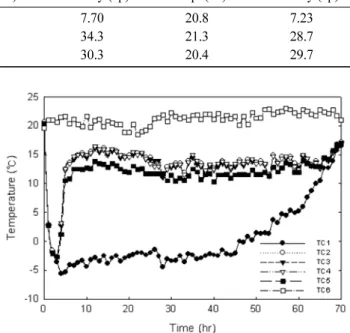
The temperature changes at the insides of the experimental container with the K1 slurry are shown in Fig. 3. The K1
slurry was designed to keep the temperature of the container at 3oC, and used to maintain the temperatures at 0-5oC. The
Table 1. Thermodynamic characteristics of microencapsulated phase change materials (MPCMs) slurries
MPCM
slurry1) Phase change temperature (
oC) Latent heat (kJ/kg)
Degree of
supercooling (oC) componentsNumber of
Freezing point Melting point Freezing point Melting point
K1 -3.5 6.3 215.80 206.41 3.4 2
K2 -2.6 6.3 189.16 186.88 3.5 3
K3 -2.0 5.6 137.84 147.91 2.5 3
1)K
1, slurry consisted of 5% tetradecane and 95% sodium polyacrylate (0.15 wt%); K2, slurry consisted of 94% tetradecane, 4% octadecane, and
ambient temperature was 22-24oC during this experiment.
The K1 slurry was cooled at −10oC until its temperature
reached 0oC. It took 2.5 hr to cool the slurry and the
temperature at the bottom position decreased to −2.5oC
during this time. After the slurry cooling process, the temperature of the slurry was kept at 0oC for 23 hr and then
increased rapidly. It was observed that the temperature of the slurry increased as the latent heat was discharged. The temperatures at the insides of the container were maintained at 3-4oC with small fluctuations before the
temperature of the slurry increased. The temperatures were maintained in the range of 0-5oC for 23 hr at the left side
and middle positions, and for 24 hr at the right side and bottom positions of the container. The results show that the
temperatures of the container insides were maintained in the range of 0-5oC for more than 23 hr with the K
1 slurry.
The K2 slurry was designed to keep the temperature of
the container at 8oC, and used to maintain the temperatures
at 5-10oC. The temperature changes at the insides of the
experimental container with the K2 slurry are shown in Fig.
4. During these experiments, the ambient temperature was 21-24oC. The K
2 slurry was cooled at −10oC until the
temperature of the slurry reached −3oC. The cooling process
took 3 hr, during which the temperature at the bottom position of the container decreased to −3oC. After cooling
the slurry, the temperature of the slurry remained at −3oC
for 19 hr, slowly increased until it reached 3oC, and then
rapidly increased. The latent heat started to discharge after Fig. 2. Thermal characteristics of slurries after 400 thermal cycles.
1396 K. -H. Kwon et al.
the temperature of the slurry was maintained constantly at
−3oC. The temperatures at the insides of the container were
maintained at 7-8oC until the temperature of the slurry
reached 3oC. The temperatures were maintained in the
range of 5-10oC for 27 hr at the left side and bottom
positions, and for 28 hr at the right side and middle positions of the container. The results show that the temperatures of the container insides were maintained in the range of 5-10oC for more than 21 hr with the K
2 slurry.
The temperature changes at the insides of the experimental container with the K3 slurry are shown in Fig. 5. The K3
slurry was designed to keep the temperature of the container at 13oC, and used to maintain the temperatures at 10-15oC.
During this experiment, the ambient temperature was 19-23oC. The K
3 slurry was cooled at −10oC until the temperature
of the slurry reached −5oC. The cooling process took 4 hr,
during which the temperature at the bottom position of the container decreased to −6oC. After the cooling process of
the slurry, the temperature of the slurry was kept at −3oC
for 40 hr and then slowly increased. The temperature increase resulted from the discharging of the latent heat of the slurry. The temperatures at the insides of the container were maintained at 10-15oC until the temperature of the
slurry reached 9oC. The temperatures were maintained in
the range of 10-15oC for 60 hr at the left side and bottom
positions, and for 61 hr at the right side and middle positions of the container. The temperature at the bottom was 2-3oC lower than that at the center position. The
results show that the temperatures of the container insides were maintained in the range of 10-15oC for more than 60
hr with the K3 slurry. References
1. Song HK, Ro JG, Moon YM. Thermal characteristics of H2O-NaOH
mixtures type PCM for low temperature storage of food and medical products. J. Korean Solar Energy Soc. 24: 7-12 (2004) 2. Sung JH, Choi JK, Lee JG, Kim YG, Hong JC, Lee HJ. Study on
characteristics of microencapsulated phase change materials having latent heat. pp. 877-882. In: Proceedings of the SAREK 2000 Summer Conference. Jun 22-24, Yongpyong Resort, Pyeongchang, Korea. The Society of Air-Conditioning and Refrigerating Engineers of Korea, Seoul, Korea (2000)
3. Lee HJ, Lee JG. Experimental study on the microencapsulated PCM
Table 2. Viscosities of the K1, K2, and K3 slurries at different temperatures
MPCM slurry Temp. (oC) Viscosity (cp) Temp. (oC) Viscosity (cp) Temp. (oC) Viscosity (cp)
K1 1.6 9.86 6.0 7.70 20.8 7.23
K2 0.8 44.0 9.9 34.3 21.3 28.7
K3 0.1 47.8 15.1 30.3 20.4 29.7
Fig. 3. Temperature changes of the cold storage system using the K1 slurry for a desired temperature of 3oC. TC1, K1 slurry
in PE pack; TC2, left side of container; TC3, right side of container; TC4, middle of container; TC5, bottom of container; and TC6, ambient temperature.
Fig. 4. Temperature changes of the cold storage system using the K2 slurry for a desired temperature of 8oC. TC1, K1 slurry
in PE pack; TC2, left side of container; TC3, right side of container; TC4, middle of container; TC5, bottom of container; and TC6, ambient temperature.
Fig. 5. Temperature changes of the cold storage system using the K3 slurry for a desired temperature of 13oC. TC1, K1 slurry
in PE pack; TC2, left side of container; TC3, right side of container; TC4, middle of container; TC5, bottom of container; and TC6, ambient temperature.
as a thermal storage medium. Korean J. Air-Conditioning Refrigeration Eng. 13: 80-88 (2001)
4. Yamagishi Y, Takeuchi H, Pyatenko AT, Kayukawa N. Characteristics of microencapsulated PCM slurry as a heat-transfer fluid. AICHE J. 45: 696-707 (1999)
5. Felsing WA, Jessen FW. The heat capacities of gaseous mono- and dimethylamine. J. Am. Chem. Soc. 55: 4418-4422 (1933) 6. Patterson A, Felsing WA. The heats of solution of gaseous di- and
trimethylamine. J. Am. Chem. Soc. 60: 2693-2695 (1938) 7. Lee HJ, Choi JK, Lee JG. An experimental study for manufacturing
MPCM slurry and its application to a cooling system. Korean J. Air-Conditioning Refrigeration Eng. 15: 352-360 (2003)
8. Jeong JW, Kwon KH, Kim JH, Kim BS, Cha HS, Choi JH. Development of multipurpose cold chain system using thermal storage for freshness maintenance and energy conservation of domestic agricultural and livestock products. KFRI Report, E06200-060109. pp. 114-121. Korea Food Research Institute, Seongnam, Korea (2006)
9. Kwon KH, Jeong JW, Kim JH, Choi CH. Development of cold chain system using thermal storage with low-energy type. J. Biosystems Eng. 31: 161-167 (2006)
10. Lee YS, Kang CD, Hong HK. Effect by additives on latent heat storage materials based on sodium sulfate decahydrate. pp. 45-50. In: Proceedings of the SAREK 2004 Winter Conference. November
24, KOFST, Seoul, Korea. The Society of Air-Conditioning and Refrigerating Engineers of Korea, Seoul, Korea (2004)
11. Kwon KH, Jeong JW, Choi CH. Study on manufacturing and characteristics of phase change materials for having latent heat. J. Biosystems Eng. 31: 168-174 (2006)
12. Shin SY, Park HJ, Ryu HS, Moon SW. An experimental study for the thermodynamic characteristics of micro-capsuled PCM slurry. pp. 541-548. In: Proceedings of the SAREK 2004 Summer Conference. Jun 23-25, Phoenix Park, Pyeongchang, Korea. The Society of Air-Conditioning and Refrigerating Engineers of Korea, Seoul, Korea (2004)
13. Kim KI, Kim CO, Kim JH, Chung NK. A study on thermal properties of TMA clathrate by adding ethylene glycol. pp. 1291-1296. In: Proceedings of the SAREK 2003 Summer Conference. July 2-4, Muju Resort, Muju, Korea. The Society of Air-Conditioning and Refrigerating Engineers of Korea, Seoul, Korea (2003)
14. Kwon KH. Development of phase change materials by using thermal-storage type cold chain system. PhD thesis, Sungkyunkwan University, Suwon, Gyeonggi, Korea (2006)
15. Paik JH, Park SS, Kim YL, Kim SC, Lee HJ, Kim CJ. Development of PCM for the technical establishment in the field thermal storage. KIIT Report. 02-GO-1-0006. pp. 38-50. Korea Institute of Industrial Technology, Cheonan, Korea (2003)