P1-115 / S. -Y. Lee
IMID 2009 DIGEST •
Abstract
The magnesium fluoride (MgF2) has very higher optical transmission than oxide or nitride material applied for gas barrier, so we manufactured Mg-Zn-F films with Mg-Zn-F target mixed in the various ratio of MgF2 to Zn and characterized films’ properties. Zn is used to increase packing density of barrier film. Thickness and optical transmission of Mg-Zn-F are 200 nm and over 90 %, respectively. The result of water vapor transmission rate at 38 , RH 90 ~ 100% of the Mg-Zn-F film deposited with 4 : 6 (MgF2 : Zn) ratio target reached below 1 × 10⁻³ g/(m2·day), measuring limit of instrument.
1. Introduction
Organic light emitting diode (OLED) has positioned the future technology replacing for liquid crystal display (LCD). OLED has many merits such as brightness, response time, viewing angle, power consumption and potential of flexible display [REF]. For application of flexible display, OLED will be manufactured based on polymer substrates. The hurdle for introduction of flexible OLED (FOLED) into commercial application is degradation by moisture and oxygen [1, 2]. The most materials for OLED are very weak for moisture and oxygen. Additionally, polymer substrates have generally high transmission rate of water vapor and oxygen. Therefore, effective passivation to prevent penetration of moisture and oxygen into device layers is essential to improve lifetime of OLED.
This is already a challenge for preventing penetration moisture and oxygen through the top side of OLED on glass substrate. In this case, the rigid glass or metal cap is used to isolate the device from water vapor and oxygen, but for FOLED, thin film barriers are used in place of them. The various OLED structure and passivation techniques are considered for FOLED. Researchers attempted investigation of single- and multi-layered thin film with metal, metal oxide, metal nitride and polymer, such as Al, SiOx, SiNx, SiOxNy, polypropylene (PP), polyacrylate (PA), etc [3].
In this study, MgF2 and Zn were used for thin film passivation. MgF2 have higher optical transmission than other material used for passivation. Additionally Zn was used to increase packing density of films. We fabricated thin film including MgF2 and Zn for permeation barrier and characterized films’ properties and improvement of barrier performance as changing ratio of Zn in thin film.
2. Experimental
Targets for RF magnetron sputtering were fabricated with 5 : 5, 4 : 6 and 3 : 7 ratio of MgF2 to Zn for controlling the Zn contents in passivation film. Targets were 2 inches in radius and 0.125 inches in thickness. The passivation films were sputtered on Poly(ethylene naphthalate) (PEN, Q65 Teonex, Teijin Dupont) substrate at argon atmosphere. Sputtering conditions to fabricate passivation films are shown at table 1.
Characteristics and Gas Barrier Properties of Mg-Zn-F
Films in Various Ratio of MgF
2to Zn
Sung-Youp Lee
*,1, Do-Eok Kim
2, Byong-Wook Shin
3, Byoung-Ho Kang
2,
Seok-Min Hong
4, Shin-Won Kang
2, Hyeong-Rag Lee
†,1,31Dept. of Nano-Science and Technology, Kyungpook National University, Daegu
702-701, Korea
2School of Electrical Engineering and Computer Science, Dept. Kyungpook National
University, Daegu 702-701, Korea
3Dept. of Physics, Kyungpook National University, Daegu 702-701, Korea 4Dept. of Sensor an Display Engineering, Kyungpook National University, Daegu
702-701, Korea
TEL: 82-53-950-5321, e-mail: [email protected]
Keywords : flexible display, organic light emitting diode (OLED), thin film passivation
P1-115 / S. -Y. Lee
• IMID 2009 DIGEST TABLE 1. Sputtering conditions
Parameter Condition Distance of Target and
Substrate 11 cm
Pressure for sputtering 6.25 × 10⁻¹ Torr Flow rate of Ar 50 sccm
RF power 100 W
Deposition rate 0.1 nm/sec
The Thickness and optical transmission of passivation films were measured by field emission scanning electron microscopy (FE-SEM, S-4300, HITACHI) and UV-visible spectrometer (UV-1601, SHIMADZU). The refractive indexes were confirmed via a prism coupler by a METRICON 2010. The composition and stoichiometry of the passivation films were analyzed by energy dispersive X-ray spectroscopy (EDS, EDX-350, HITACHI). Water vapor transmission rate (WVTR) was measured by the L80-5000L (Lyssy Inc.)
3. Results and discussion
Passivation films show reduced gas permeation as the film thickness increases. However, for application of FOLED, the passivation films must be less than 200 nm thick to prevent film from cracking. Therefore, we fabricated passivation thin films that were approximately 200 nm thick.
Table 2 shows EDS analysis of passivation films sputtered with targets in 5 : 5, 6 : 4 and 3 : 7. EDS analysis verified that the Zn content of the film sputtered using a 4 : 6 ratio target was 9.84 wt%. Zn contents of thin films made by 5 : 5 and 3 : 7 ratio targets were 2.07 and 5.01 wt%, respectively.
TABLE 2. EDS analysis of passivation films Ratio of MgF2 to Zn Weight ratio (wt%) Mg Zn F 5:5 39.78 2.07 58.14 4:6 38.73 8.12 53.15 3:7 35.64 5.01 59.35
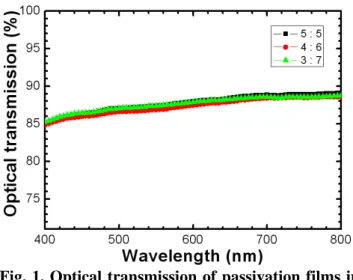
Figure 1 shows the optical transmission of all films. The optical transmission of passivation films is approximately over 85 % in visible light region. These results show that these passivation films are applicable to flat panel displays. In our previous study [4], we showed that the Mg-Zn-F film had amorphous phase from XRD analysis and that Zn physically formed between the gaps of the MgF2 without chemical bonding in the Mg-Zn-F film from XPS study.
Fig. 1. Optical transmission of passivation films in various ratio of MgF2 to Zn
To calculate packing density, the refractive index was measured via a prism coupler using a METRICON 2010. The packing density can be calculated using following equation.
nf = p·ns + (1-p)·nv (1)
In Equation (1), p, nf, ns, and nv are the packing density, the index of the film, the index of the solid part of the film (i.e., grain or columns), and the index of the pores in the film (nv=1), respectively [5]. The claulated results of packing density with refractive index of the film sputtered with 4 : 6, 5 : 5 and 3 : 7 ratio targets are 68.7, 71.5 and 69.7, respectively. The results of EDAX analysis and packing density are shown together in Figure 2. It shows that the packing density increases as Zn contents increase.
P1-115 / S. -Y. Lee
IMID 2009 DIGEST • Fig. 2. Packing density and Zn portion to target
Figure 2 shows the water vapor transmission rate (WVTR) at 38 , RH 90 ~ 100 % of Mg-Zn-F films with various Zn contents. It can be found that the 4 : 6 film has the WVTR equal to or less than 1 × 10⁻³ g/(m2·day), the measuring limit of the instrument [6]. The results of this study show that as Zn contents of Zn-F films increased, gas barrier property of Mg-Zn-F films enhanced. It means that Zn atoms block openings that can be served as permeation routes of moisture.
Fig. 3. WVTR results and Zn portion of Mg-Zn-F passivation films.
4. Conclusions
We fabricated passivation films by RF sputter with target which have 5 : 5, 4 : 6, 3 : 7 ratio of MgF2 to Zn. These films based MgF2 contained various contents of Zn. MgF2 have better transmittance than oxidized and nitrified materials. Moreover, the insertion of Zn improves packing density of passivation film. As Zn portion increases in Mg-Zn-F passivation films, it prevents effectively permeation by water vapor. WVTR of 4 : 6 passviation film reaches 1 × 10⁻³ g/(m2 ·day), the measuring limit of the instrument.
5. Acknowledgement
This research was financially supported by the Ministry of Education, Science Technology (MEST) and Korea Institute for Advancement of Technology (KIAT) through the Human Resource Training Project for Regional Innovation.
6. References
1. G. Gu, P.E. Burrows, S. Venkatesh, S.R. Forret, M.E. Thompson, Opt. Lett., 22[3], 172 (1997)
2. G. Gustaffson, G.M. Treacy, Y. Cao, F. Klavetter, N. Colaneri, A.J. Heeger, Synth. Met., 55[1], 4123 (1993)
3. J.S. Lewis, M.S. Weaver, IEEE J. Sel Top. Quant., 10[1], 45 (2004)
4. D.E. Kim, B.H. Kang, S.H. Kim, S.M. Hong, S.Y. Lee, B.W. Shin, H.R. Lee D.H. Kwon, J. Korean Phys. Soc., 54[1], 231 (2009)
5. Y. Shen, H. Yu, J. Yao, S. Shao, Z. Fan, H. He, J. Shao, Opt. Laser. Technol., 40[3], 550 (2008) 6. J.R. Sheats, H. Antoniadis, M. Hueschen, W.
Leonard, J. Miller, R. Moon, D. Roitman, A. Stocking, Science, 273[5277], 884 (1996)