A STUDY ON DATA INTERACTION AMONG DIFFERENT LEVELS OF
DETAIL IN PLANNING PHASES FOR MEGA PROJECTS
Hyeon-Jeong Choi, Min-Ji Kwon, Ju-Hyung Kim*, and Jae-Jun Kim
Department of Sustainable Architectural Engineering, Hanyang University, Seoul, Korea * Corresponding author ([email protected])
ABSTRACT: Urban renewals in an area or district consist of multiple facilities construction projects, and thus, should be
managed as a program. Successful program management is enabled by seamless information of subprojects during its whole lifecycle. In the aspect of data management, program is differentiated with project by its own management structure. Specified architectural design data of individual facilities become the source of program management as a project developed into architectural planning phase and even further, while the schematic data on program created in planning phase contain directions to plan individual facilities in the area. For this reason, the authors suggest schema of data interaction in the planning phase from the very initial planning phase to subsequent detailed planning phases. The data interacts based on product models of different management levels and different levels of detail (LOD), which is commonly introduced as BIM (Building Information Model) in architecture, engineering, and construction industry. Based on the advantages of BIM, the suggested data interaction schema is expected to bring managerial opportunities such as instant cost estimation on with its own management structure of megaproject and with data that are required for specific management activity.
Keywords: Web-based Planning, Multi-project Data Management, Data Interaction, Program Management, Planning Phase, Product Model, LOD (Level of Detail)
1. INTRODUCTION
A megaproject is defined as “extremely large-scale investment project” and thus have highly significant impact on overall society and communities, environment, and budget in them [1-2]. When it comes to a megaproject in construction area, it frequently consists of several subprojects with various purposes. Contrary to some megaprojects that have only a single facility, those megaprojects are required to be controlled under program management [3]. An instance of those megaprojects is found in Korea. New development or renewal projects for considerable extent of area are often implemented in Korea, which are large enough to require almost facilities for urban life [4]. Since the constituent projects are under limited budget and resources, they are not able to be controlled or coordinated individually [5].
Yamada and Sunaga [6] defined ‘program’ as “a group of projects managed in a coordinated way to obtain benefits
not available from managing them individually”, and program management as “a concept to deal with huge and complex business activities from social, economical, cultural and environmental points of view.” In brief, program management is not enabled just by summing the outcome of project management. Rather, the raw data from project management need to be connected and synthesized in order to support decision making in various perspectives.
For instance, PMIS (Project Management Information System) is a commonly used information system for construction management. Since a megaproject consists of several single subprojects that are executed often with a time gap, information summation from PMIS needs to reflect the time issue. This should be considered in advance of initiation of individual project. Otherwise, if any change in the relation of summation occurs, (e.g. change of the number of facility) the information from each PMIS may get mixed up.
Information System) is differentiated with PMIS [7]. As project management does, program management should be executed through the whole lifecycle of the program, from the planning and until every project is executed. The role of PgMIS is more complicated than management system just on multiple projects. Kim, et al [5] argued that an information system for program management is required to enables stakeholders management, benefit management, and decision making governance, which are soft aspects of program management.
It does not indicate, however, that information system for megaprojects ought to be a ‘mighty system’. As Kim et al. [5] described, the concept of ‘plug and play’ to assemble the functional module for program management can be applied; PgMIS can be tailored in accordance with the management point of a target program and its aim. In other word, the detailed functionality of PgMIS can vary.
What all PgMIS has to have in common is, instead, the capability to operate project information, not only program information [7]. This requirement implies that PgMIS should be operated on the management environment where seamless information utilization is enabled between the program level and the project level. This requirement is also, common for all the management where multiple management level and phases exists.
The goal of this research is to suggest a schema for data interaction to support the environment. The scope of data interaction is focused on the product model and planning phase for the following reason.
2. PLANNING PHASE IN TERMS OF DATA CREATION AND ITS INTERACTION
In the aspect of information created and managed in, program has a top-down process in the initial planning phase that the program is outlined in, and bottom-up process in the later phase that projects are identified and plan for facilities starts in [8]. The information created in
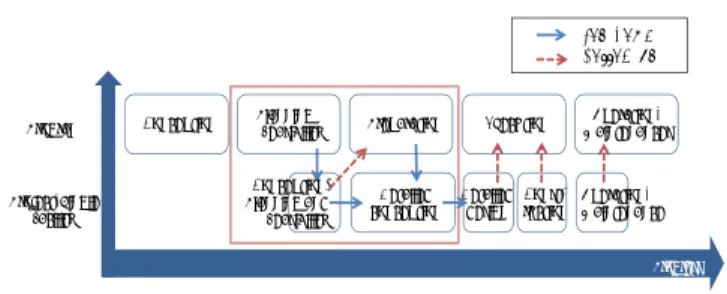
program management and specified information of individual subprojects (e.g. detailed building area, space use, etc) is generated at the project or facility level. Within the facility level, the plan is developed into detailed design of facility. At the same time, the information from the low levels for monitoring on progress in order to predict project outcomes is accomplished at the level of program management. The process of information intercommunication between both levels or between both phases continues through the life cycle of a program. The process is illustrated in Fig.1 below.
Program
Project/Single Facility
Conception Planning & Feasibility Preparation Execution MaintenancesOperation/
Conception, Planning and Feasibility
Detailed
conception Detaileddesign ructionConst- Operation/Maintenance
Progress
Top-down Bottom up
Fig. 1 The process and scope of program management and single facility management
Since each phase is implemented by different organization and with defined resource set, the process undergoes discrepancies in the view of information succession. At the same time, each of program planning and project planning become an outline for project planning, and detailed design for facility. Also, a discrepancy is located between two level of project and program at the very initial phase. Next, another discrepancy is found between phases within a level; between conception planning/feasibility analysis phase and detailed conception phase of project.
Then, information generated in the planning phase is given attention. Since program is defined in the program planning phase and project is defined in the project planning phase, the managerial structure for the subsequent phase at the lower level is decided in the planning phase at the higher level. Consequently, the information management plan in the planning phase would have more
For construction project, the basic unit of management is a building. Not only being referred in legislation as a minimal unit, but also a building can be a unit for general contracts related to construction projects. Also, a building is considered as a unit of production by construction.
Building product model is defined as “explicit description of the abstract systems, spaces (e.g., rooms and elevators) and physical elements (e.g., walls, columns, beams) of a physical facility.” [9] In this study, product model means physical model, which indicates geometrical model in the program planning phase or space model in the project planning phase. In consequences, information around a building product model is required to be managed as a unit for information management in construction or building industry.
For individual facility planning and management, the concept of BIM (Building Information Modeling), that is founded on object-oriented geographical modeling, has been initiated in AEC (Architecture, Engineering and Construction) industries [10]. As a “methodology to manage the essential building design and project data in digital format throughout the building's life-cycle.” [11], a building product model can have relational information within geometric information as well as non-geometric project information set corresponding to the process of AEC projects (e.g. IFC format)[12]. As well, the hierarchical data structure of object-oriented model has advantages on data management, for examples, arranging data when their applied use is required. Consequently, synthesized information from each model for facility can be managed under the hierarchy. Else, one of the benefits can be easiness to create product model and relevant information based on three-dimension.
For this reason, the authors planned data interaction enabling data succession in the planning phase of megaproject for program management, especially driven by BIM product model.
In the authors’ previous research was suggested a conceptual model for product-model-based information management system [13]. However, the concept was considered at the very high level of management and thus, with the low level of detail. In this paper, the authors propose the detailed schema for the information system, in terms of the data interaction in the web-based PgMIS.
4. SCHEMA OF THE DATA INTERACTION IN PLANNING PHASE FOR MEGA PROJECTS
We have described the aspect of data creation and interaction in planning phase for program management and the building model environment changing into object-oriented information model in AEC industry. In this section, authors illustrate interaction schema for the planning phase based on BIM, in other word, object-oriented product model.
Requirements on managerial activities
First of all, managerial activities for megaproject planning are required to be identified, to distinguish which data and how those data interact. Gibson [14] summarized the process of planning into four in large; preparation for planning, selection on project alternatives, detailed scope definition, and decision making on alternatives. Adopting Gibson’s four processes for planning [14], the authors identified possible managerial activities in the planning. According to PMI [15], at the planning are involved all the areas to be managed; program integration, scope, time, cost, quality, human resource, communication, risk, procurement, finance, stakeholder, and governance. Among the areas, project integration, scope, cost, and time are mainly affected area by product information change (e.g. volume of a building). Program integration is considered in the aspect of information integration. Other areas are associated to non-physical resources such as financial environment or human factor more.
The specific management process for each area was also suggested by PMI [15] as following: for the area of integration, developing management plan; for scope, defining scope and creating breakdown structure; for time, estimating duration; for cost, estimating cost.
‘Planning’ for megaproject goes through at least two times of planning, each for the whole megaproject and for at least one subproject. The basic managerial activities are applied the same regardless to management level. The authors allocated the activities into the four-steps of planning process as shown in Table 1. Firstly, as a preparation of plan, a structure for project integration and project scope are required to be set. Secondly, for selection on a project alternative, alternatives are needed to be generated, selected and evaluated. Each alternative can be evaluated in terms of cost and time: cost/duration estimation. Thirdly, the alternatives are required to undergo
planning. Activities were defined in the process of project planning either. At the facility management level, the activities are implemented for detailed design, rather than planning.
LOD (Level of Detail) of product model in phases: the case of urban renewal megaproject in Korea
LOD of product model in each phase follows the required detail of planning, which is changeable how programs or projects are defined. In this study was adopted the general level of detail on product information shown in three urban renewal megaprojects in Korea, of which planning processes have already completed. In the planning phase for program, a specific space zoning in a facility rarely happens. In consequence, product information at the level of program management is detailed in the extent of possible use and entire volume of a building. In the 1 2 3 4 Planning process · Preparation for planning · Selection on a project alternatives · Detailed project definition · Decision making on alternatives
Managerial activity for megaproject
planning level · Define integration structure/ scope
· Create megaproject alternatives · Select megaproject alternatives. · Estimate cost/ duration · Repeat activities in
process 2 · Finalize megaproject alternative LOD (Level of
Detail) of product model
High
· Building use (e.g. commercial building) · No space property
· Case-based reasoning Activity for project
planning level · Define integration structure/scope
· Create Project alt. · Select Project alt. · Estimate Cost/
Duration
· Repeat function of
process 2 · Finalize project alt. LOD (Level of
Detail) of product model
Middle
· Programming on space (e.g. floor zoning) · Space property (e.g. high-quality finishing) · Space and the property based estimation Activity for
planning of facility level
-
(Plan in the aspect of management is almost finished in the previous stage) LOD (Level of
Detail) of product model
Low
cases, it might be changed in accordance with how the scope of program is defined.
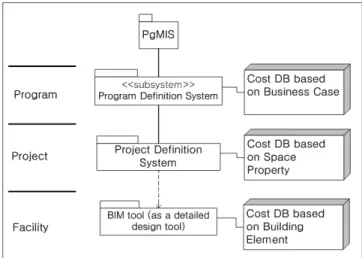
Fig. 2 System interaction schema
System and data interaction
Fig. 2 shows the conceptual structure of systems involving each management phase. For simplification, only one functional activity, cost estimation was considered as an instance among functional activities. Even though the activity for a planning phase is similar to each other, how to realize it in each phase is different. Hence, the system to support whole program management consists of three different parts, each for program, project and facility management. At the program management level, program definition system, and cost database based on business case are used. The word ‘definition’ includes the activity defining plan and the extent of information. At the project management level, project definition and cost database based on space property. Also, for facility management, BIM tool is employed as a detailed design tool and cost database based on building element is connected.
The interaction of among data and systems is described
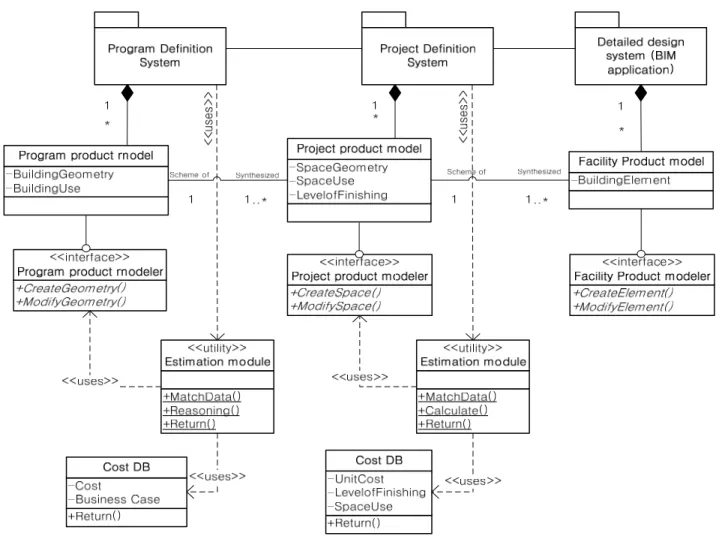
in Fig.3 with detail. In planning phase interact physical components of a definition system; system, product model, modeler, functional module, and database and data from them. For instance, program definition system behaves as an inclusive system that supports interaction in the described concept. Interacting with other component, it implements required activities defined.
The data interaction among different levels, in other words, among the level program, project, and detailed design management, occurs based on product models created in each phase. By the definition of program, a program product model can have several project product models and a project product model can have facility product models. Through the relation among program, project and facility product model, the data from components can be utilized to be a scheme for detailing in the next phase or to be synthesized for monitoring at the upper level. Product models can be created by modeler for each phase with low LOD for program product model, and with high LOD for facility product model. Functional modules works using cost database and product model that includes physical data such as volume of building. Even on the same purpose, how the modules work can be different because of LOD in a particular phase. For instance, the cost estimation module for project planning gets area of each space of buildings and the level of finishing in the space to estimate cost based on the information. Once they find the applicable unit cost for the features of space, the whole project cost will be estimated. Moreover, not only cost estimation function, any module that functions using interacted data can be added with proper data base can be utilized in the relation.
Fig. 3 Class diagram for Data Interaction Schema
Expected effects
The expected effects brought by the result of data interaction are listed here.
· For project managers, consistency of data from very high management level to low management level gives opportunities for reducing time and cost for data management. (e.g. quick cost estimation)
· Extended utilization: Because the building model and the module for managerial activity (in this case, cost or duration estimation module) are supposed to act separately, additional modules for other management area can be utilized in connection with the building product model and database.
· Strengths on change management: By reflecting
5. DISCUSSION
While the advantages of the data interaction suggested were emphasized, it is appropriate to discuss possible limitations. As already described, this research assumes that the use of PgMIS and BIM is facilitated each for program management and detailed design of facility. The most challengeable limitation may be originated from the limitation of BIM technology itself.
To reduce this limitation, technical problems need to be solved. Especially, the engine used to create building product model might affect the data interaction in a significant rate. The experimental study on examining the modeler engines would be required.
example, a managerial structure of a program has hierarchical structure in accordance with the rule for classifying space or facility, and also should be defined by a manager. It is evitable to link the hierarchical structure with the RDB to complete automated interaction. However, the hierarchy is supposed to change as project plan is changed by a need: the link is required to be dynamic.
ACKNOWLEDGMENTS
This research was supported by a grant (07Urban RenaissanceA03) from High-Tech Urban Development Program funded by the Ministry of Land, Transport and Maritime Affairs of Korean Government.
REFERENCE
[1] Flyvbjerg, B., et al., Megaprojects and risk: An
anatomy of ambition: Cambridge Univ Pr, 2003.
[2] Altshuler, A. A. and Luberoff, D.,
Mega-projects: The changing politics of urban public investment:
Brookings Inst Pr, 2003.
[3] Kim, D., et al., "The Strategic Approach Using SWOT Analysis to Develop an Intelligent Program Management Information System (iPMIS) for Urban Renewal Projects," 2009, pp. 320-324.
[4] Bae, W., et al., "The present conditions and tasks of urban renewal in Korea," City Information, 2008. [5] Kim, J., et al., "Conceptual Model of Intelligent Program Management Information Systems (iPMIS) for Urban Renewal Mega Projects," Journal of Asian
Architecture and Building Engineering, Vol. 8(1), pp.
57-64, 2009.
[6] Yamada, T. and Sunaga, N., "Research & Development of the Program Management Support System," Shimizu Corporation2005.
[7] Thompsen, C. E. and Thomsen, C., Program
management: Construction Management Association of
America, 2008.
[8] Sanghera, P., Fundamentals of effective program management : a process approach based on the global standard. Ft. Lauderdale, Fl.: J. Ross Pub., 2008.
[9] (2009, March 29). Glossary of VDC Concepts
and Terms. Available:
http://cife.stanford.edu/Courses/Certificate/courseOvervie w/Glossary.htm
[10] Eastman, C. M., et al., BIM handbook : a guide
to building information modeling for owners, managers, designers, engineers, and contractors. Hoboken, New
Jersey: Wiley, 2008.
[11] Penttilä, H., "Describing the Changes in Architectural Information Technology to Understand Design Complexity and Free-form Architectural Expression," ITcon, Vol. 11(Special Issue: The Effects of CAD on Building Form and Design Quality), pp. 395-408, 2006.
[12] Fu, C., et al., "IFC model viewer to support nD model application," Automation in Construction, Vol. 15(2), pp. 178-185, 2006.
[13] Choi, H., et al., "BIM-based Program Information Management System for Urban Renewal Mega Projects Planning," presented at the The First International Conference on Sustainable Urbanization, Hong Kong, 2010.
[14] Gibson Jr, G., et al., "Preproject-planning process for capital facilities," Journal of construction
engineering and management, Vol. 121(p. 312, 1995.
[15] PMI, The Standard for Program Management: