P2-48 / O. Kwon
• IMID 2009 DIGEST
Abstract
It is suggested that the light extraction efficiency of the display device can be improved by adoption of periodic array of sub-wavelength scale structures. The relief of the total reflection has been investigated using the rigorous coupled wave analysis (RCWA). Various shape of the sub-wavelength scale structure allowed to have non vanishing transmittance for the light rays with the incident angle bigger than the critical angle.
1. Introduction
Light leaving from display devices like LED enters the air from a substance having refractive index larger than 1, which results in the total internally reflection at the boundary of two materials and consequently decreases the luminance and finally the luminous efficiency. To increase the light extraction efficiency of LED, textured semiconductor surfaces were used [1, 2]. We designed the periodic sub-wavelength scale structures at the boundary and investigated the change of transmittance of the light from a substance to the air for the incident angle bigger than the critical angle by using rigorous coupled wave analysis (RCWA) [3].
2. Results and discussion
In order to find out the effect of sub-wavelength scale grating for the increase of light extraction efficiency, incident light having 560nm wavelength and azimuth angle of 0˚, s-polarization is used in this simulation. The transmittance of light is investigated as the incident angle is changed. In this work, all radiated light in display device travels outward and the reflection by metal electrode is not considered. The substance having the refractive index of 2 is used
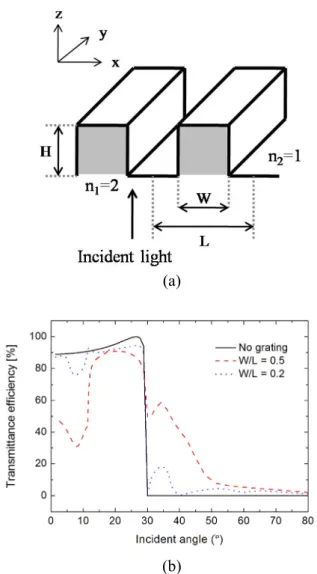
and thus, if there is no periodic grating on the boundary between the material and the air, total internally reflection occurs when the incident angle is over 30˚
Fig. 1(a) shows the one dimensional periodic grating with 400nm L and H. As shown in Fig. 1(b), as the width of grating decreases and W/L is 0.5, the transmittance diffraction efficiency under the incident angle of 10˚is decreased but the transmittance diffraction efficiency over the incident angle of 30˚ is increased. As the W/L decreases further to 0.2, the transmittance diffraction efficiency under the incident angle of 10˚ is increased but that over the incident angle of 30˚ is decreased.
Fig. 2(a) shows shapes of two dimensional periodic grating, the pyramid which consists of several stacks of rectangular pillars with W of 240nm and L of 400nm, H of 400nm. As shown in Fig. 2(b), for the incident angle smaller than 30˚, the transmittance of the pyramid is higher than that of a rectangular pillar, but for the angles bigger than 30˚, the transmittance of the rectangular pillar is higher.
The sub-wavelength scale grating is effective to increase the light extraction efficiency and the shape of grating also affects to increase the light extraction efficiency, but the simulated conditions are only azimuth angle of 0˚and s-polarized light. In order to find out the light extraction efficiency with other conditions, azimuth angle from 0˚to 359˚and not only s- polarized but also p-polarized light are concerned.
Total transmittance is derived to integrate transmittances for the incident angle from 0˚to 90˚ and azimuth angle from 0˚to 359˚. It is expressed below
Improvement of light extraction efficiency of display
devices by using sub-wavelength scale structure
Ohyung Kwon, and Ki-Woong Whang
Plasma laboratory, Display Technology Research Center, Department of Electrical Engineering and Computer Science, Seoul National University, Seoul 151-742, Korea Tel.:
82-2-880-9554, E-mail: [email protected]
P2-48 / O. Kwon
IMID 2009 DIGEST • (a)
(b)
Fig. 1 (a)Pattern of one dimensional periodic grating. (b)Transmittance efficiency as varying W/L.
T(θi,φi) means the transmittance at the incident angle
of θi and azimuth angle of φi. The total transmittance
for the flat surface is 0.114, but total transmittance for the pyramid-structured surface case and the rectangular pillar (W/L=0.5) structured surface case are 0.145 and 0.133. It is also concluded that the total transmittance for grating surface case is better than that for flat surface case.
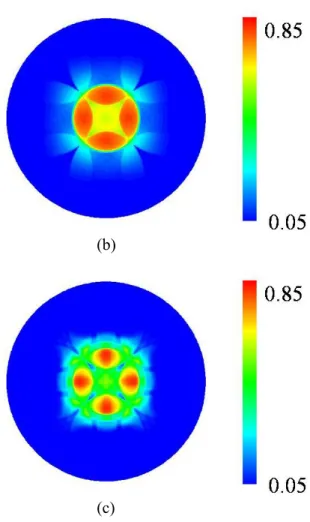
Fig. 3 shows the angular patterns of radiation for the incident angle and incident azimuth angle. The radius of angular pattern corresponds to the incident angle and the argument of angular pattern corresponds to the
(a)
(b)
Fig. 2 (a)Shapes of two dimensional periodic grating; pyramid and rectangular pillar.
(b) Transmittance efficiency as varying shape.
azimuth angle. The angular pattern for flat surface case is shown by Fig. 3(a). It can be seen that there is no radiation over critical angle. Fig. 3(b) and (c), however, show light is radiated over critical angle, 30˚. Fig. 3(b) and Fig. 3(c) are the angular patterns for the pyramid-structured surface case and the rectangular pillar (W/L=0.5) structured surface case respectively. Although the angular pattern for rectangular pillar structured surface shows transmittance efficiency from 30˚ to 40˚of the incident angle is larger than pyramid-structured case, the broad angular pattern for pyramid-structured surface for whole incident angle and azimuth angle results in the increase total transmittance.
The reason for the increase of total transmittance for structured surface case can be explained by the Effective Medium Theory (EMT) [4]. When light is incident to periodic structures which are sub-wavelength scale, light travels as if light is incident on multilevel flat surfaces which have intermediate refractive indexes as shown Fig. 4. In this work, effective medium have refractive indexes from 1 to 2, 1 < n3 < n2 < n1 < 2. Light is transmitted and reflected
P2-48 / O. Kwon
• IMID 2009 DIGEST
at multilevel flat surfaces and total internally reflection is decreased due to the smaller differences between two adjacent layers, so that transmittance efficiency is increased as compared to only two flat surfaces case without the sub-wavelength scale structure.
4. Summary
Periodic sub-wavelength scale structures at the material-air interface are effective to increase the transmittance efficiency of light rays leaving the display device. It has been shown that the total transmittance for pyramid-structured surface case is better than that for rectangular pillar structured surface case. The increase of total transmittance can be explained by give the effect of gradual change of refractive index change at the interface, the effective medium theory.
5. References
1. T. Fujii, Appl. Phys. Lett. 84, 855 (2004) 2. Y. Gao, Jpn. J. Appl. Phys. 43, L 637 (2004)
3. M. G. Moharam, J. Opt. Soc. Am. A 3, 1780-1787 (1986)
4. D. H. Raguin, Appl. Opt. 32, 7, 1154 (1993)
(a)
(b)
(c)
Fig. 3 Angular pattern for (a)flat surface,
(b) pyramid-structured surface, (c)rectangular pillar(W/L=0.5) structured surface. The radius of angular pattern is the incident angle and the argument is azimuth angle.
Fig. 4 Effective medium for the structured surface