Preliminary Analysis of Temperature Coefficients for a 600MWth
Block-type HTGR
Chang Keun Jo, Jae Man Noh, and Jongwha Chang
Korea Atomic Energy Research Institute, P.O.Box105, Yuseong, Daejeon, Korea 305-600
1. Introduction
This paper intends to provide the results of temperature coefficients analysis of a 600 MWth block-type high-temperature gas-cooled reactor (HTGR). The pre-conceptual design for a 600 MWth block-type core was performed by using the VSOP94 code system [1].
The core design originates from GT-MHR[2] which was developed to dispose of weapon-grade plutonium of Russia. GA (General Atomics) has developed a uranium-fueled core of GT-MHR by using a UCO fuel kernel in an attempt to achieve a high burnup of a low enriched fuel. The dimensions of fuel blocks and core are the same as in the original GT-MHR specification. In this
paper, an UO2 fuel is utilized instead of the
original plutonium or UCO fuels. Table 1 shows the main design specifications of the 600 MWth block-type HTGR core explored in this study.
Table 1. Main design specifications
Reactor power 600 MWth
Reactor inlet/outlet temperature 490/1000 oC
Active core height 793 cm Equivalent inner/outer radius of active core 147.62/241.32 Equivalent outer reflector thickness (cm) 91.68 U235 enrichment of initial/equilibrium core (%) 10.36/15.50
No. of block layers/no. of fuel columns 10 / 102 2. Results of Core Analysis
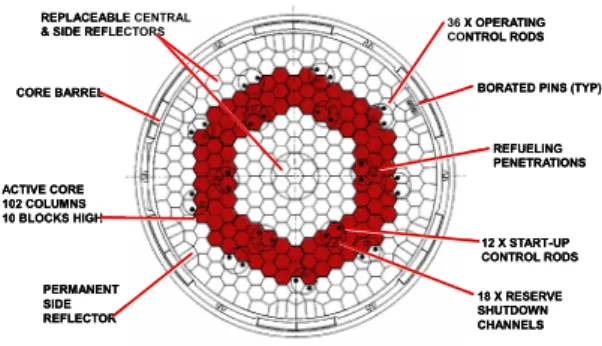
The configuration of GT-MHR core is schematically shown in Fig. 1. Four-group diffusion calculations were performed for the core in an r-z geometry. The core characteristic parameters including the power and temperature distributions, the temperature coefficients, the
effective delayed neutron fraction and neutron lifetime were evaluated for both the initial and equilibrium cycle conditions of the core. As for the fuel management, a typical 2-batch fuel reloading scheme was adopted here: fresh fuels are loaded in the middle ring of the active core and the once-burned blocks are moved to the inner and outer rings.
Fig. 1. Configuration of GT-MHR core
The cycle lengths were evaluated to be 450 and 480 days for the initial and equilibrium cycles, respectively. The neutron lifetime of the initial cycle was 2.74×10⁻⁴, 2.93×10⁻⁴ and 3.58×10⁻⁴ sec
at BOC, MOC and EOC, respectively. And, the neutron lifetime of the equilibrium cycle was 2.16e-4 sec, 2.53e-4 sec and 3.23e-4 sec at BOC, MOC and EOC, respectively. These values are similar to those of the typical pebble bed type HTGR.
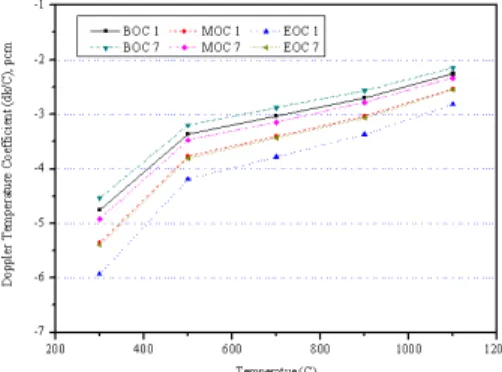
The Doppler coefficient ( δρ /℃) is the
reactivity change due to a change in the average fuel temperature. As shown in Fig. 2, the Doppler reactivity coefficients of initial and equilibrium cycles are negative for any operating conditions and range in magnitude from -6.0 pcm to -2.0 pcm. It is observed that the fuel temperature coefficients of initial and equilibrium cycles are also negative for any operating conditions and range in magnitude from -10.5 pcm to -4 pcm.
REPLACEABLE CENTRAL & SIDE REFLECTORS
CORE BARREL ACTIVE CORE 102 COLUMNS 10 BLOCKS HIGH PERMANENT SIDE REFLECTOR 36 X OPERATING CONTROL RODS
BORATED PINS (TYP)
REFUELING PENETRATIONS 12 X START-UP CONTROL RODS 18 X RESERVE SHUTDOWN CHANNELS REPLACEABLE CENTRAL
& SIDE REFLECTORS
CORE BARREL ACTIVE CORE 102 COLUMNS 10 BLOCKS HIGH PERMANENT SIDE REFLECTOR 36 X OPERATING CONTROL RODS
BORATED PINS (TYP)
REFUELING PENETRATIONS 12 X START-UP CONTROL RODS 18 X RESERVE SHUTDOWN CHANNELS
Transactions of the Korean Nuclear Society Autumn Meeting Busan, Korea, October 27-28, 2005
The isothermal temperature coefficient is the rate of reactivity change due to a change in the average temperature of the core including the reflectors. The isothermal reactivity coefficients of initial and equilibrium cycles were also calculated to be always negative for any operating conditions and range in magnitude from -9.0 pcm to -2.0 pcm, which are shown in Fig. 3.
Fig. 2. Doppler reactivity coefficients
Fig. 3. Isothermal temperature coefficients
3. Conclusion
For a 600 MWth block-type HTGR core, temperature coefficients analysis has been performed. It is shown that the Doppler coefficients, fuel and isothermal temperature coefficients of the core are all negative for any operating conditions at both initial and equilibrium cycles. In this study, the control rod movement and burnable absorbers were not accounted for in the evaluation of the core parameters. In a prismatic HTGR, the burnable absorbers and control rods should be used to compensate a relatively large excess reactivity. A more elaborate core analysis is required in the future.
ACKNOWLEDGEMENTS
This work was supported in part by Ministry of Science and Technology (MOST) of Korea through the Nuclear Hydrogen Development and Demonstration (NHDD) project coordinated by Korea Atomic Energy Research Institute.
REFERENCES
[1] E. Teuchert, et. al., “VSOP(’94) Computer Code System for Reactor Physics and Fuel Cycle Simulation,” FZJ Internal Report,
Jul-2897, 1994.
[2] W. S. Park, et. al., “A Study on the Design Concepts of the PBMR and the GT-MHR,” KAERI Internal Report, KAERI/AR-701/2004, 2004.