Characterization of carrier-envelope-offset
frequency of a femtosecond laser stabilized by
the direct CEP locking method
Tran Trung Luu1, Jae-hwan Lee1, Eok Bong Kim2, Chang Yong Park2, Tae Jun Yu3, and Chang Hee Nam1
1Dept. of Physics and Coherent X-ray Research Center, KAIST, Daejeon 305-701, Korea 2 Korea Research Institute of Standards and Science, Daejeon 305-340, Korea
3Advanced Photonics Research Institute, Gwangju Institute of Science and technology, Gwangju 500-712, Korea E-mail: [email protected]
Abstract: Characterics of carrier-envelope-offset frequency (fceo) of a femtosecond laser stabilized by the direct locking
method were investigated using two f-to-2f interferometers. The stability of fceo was comaparable to that achieved with a
conventional PLL method.
Keywords: Carrier-envelope phase, optical frequency comb, femtosecond Ti:sapphire laser 1.INTRODUCTION
Stabilization and control of the carrier-envelope phase (CEP) of femtosecond laser pulses have been intensively investigated for frequency metrology (frequency-domain applications) and ultrafast science (time-domain applications). Particularly, for precise measurement of an optical frequency, stable operation of an optical frequency comb (OFC) is critical. As the CEP fluctuation in the time domain yields the fluctuation of carrier-envelope offset frequency fceo in the frequency domain, good CEP stabilization is required for accurate measurements.
The CEP stabilization of a femtosecond oscillator can be realized in a couple of different ways. The conventional phase-locked
loop (PLL) method makes the carrier-envelope offset frequency (fceo), or the rate of CEP change, constant by locking fceo to a
well-defined external reference frequency. On the other hand, the direct locking (DL) method operated in the time domain elliminates pulse-to-pulse CEP slip by quenching the beating signal from an f-to-2f interferometer, generating pulses with an
identical CEP value, or equivalently zero fceo [1]. Due to simplicity in equipment and intuitiveness in data analysis the CEP
stabilization by the DL method is a powerful and practical method in CEP-sensitive investigations, especially in time-domain applications such as CEP sensitive high harmonic generation [2].
The DL method possesses a good potential also for frequency metrology with stabilized cavity length or equivalently repetition rate frep. Since fceo is locked naturally to zero by the DL method, the frequency of an optical source can be measured without
necessitating to measure fceo. However the characteristics in the frequency domain have not been analyzed due to difficulties of
characterizing zero fceo. In this work, we present experimental results of characterizing the DL method in the frequency domain.
The results confirm that the DL method is a powerful tool for applications in the frequency domain also. 2.EXPERIMENT SETUP AND RESULT
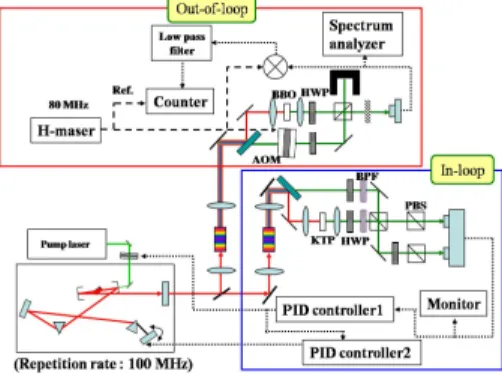
To analyze the characteristics of the DL method in the frequency domain, two f-to-2f interferometers were installed as shown in Fig. 1. The OFC of the femtosecond laser was stabilized by the DL method with double-feedback loops (blue section). The second interferometer (red section) was installed to characterize fceo. As fceo of the oscillator is stabilized to zero, it is difficult to directly characterize fceo in the in-loop. To generate a non-zero beating frequency, AOM was installed in the f2n arm, shifting the frequency comb by 80 MHz. For stable frequency maintenance the driving frequency of AOM was generated from a synthesizer
referenced to an H-maser. The frequency shifted f2n and frequency-doubled fn was then overlapped on a fast APD, generating a
nominal beating signal in the out-of-loop interferometer of 80 MHz. The beating signal was monitored by an RF spectrum analyzer and a frequency counter referenced to the H-maser with uncertainty of 1x10-13 at 1 s.
The frequency jitter was measured first using the frequency counter with a gate time of 1 s, as shown in Fig. 2. We subtracted the frequency shift of 80 MHz by AOM in the frequency measurement. During the measurement, any large fluctuation or drift was not observed. Measured standard deviation was 24 mHz, showing that the stability by the DL method is comparable to that
obtained by the conventional PLL method [3]. Also we estimated the avaerage of the measured frequency to check whether fceo is
truly locked to zero. The result was 0.2 mHz, which confirms that the stabilized fceo is truly zero.
0 200 400 600 800 1000 -0.16 -0.08 0.00 0.08 0.16 Frequenc y ( H z) Time (s)
1 10 100 10-4 10-3 10-2 10-1 All an dev ia tio n (Hz) Averaging time (τ)
The beating frequency was measured by a frequency counter with gate times of 1, 3, 10 and 30 s to estimate Allan deviation, showing fig. 3. Usually in order to estimate Allan deviation, the fractional frequency difference, y=(ν ν1− 0) /v0, is integrated
from 0 to observation time, namely t, where ν0 is the nominal frequency. As the oscillator stabilized by the DL method has zero
fceo, the nominal frequency of fceo is meaningless. Thus the Allan deviation was estimated with the fractional frequency difference of y = ν1. The slope of graph drawn in the log scale characterizes the noise type of a system. The graph shows the Allan deviation
with a slope of 1/τ, showing the characteristics of phase locking. Consequently, this verifies that the femtosecond laser stabilized by the DL method was indeed locked in phase.
3.CONCLUSION
We have analyzed the frequency-domain characteristics of a femtosecond laser stabilized by the DL method. To measure
non-zero fceo, one more interferometer was devised. The fceo jitter was 24 mHz, showing good stability comparable to that
obtained using the conventional PLL method. Also estimated average value confirms that the stabilized oscillator truly has zero
fceo. Measured Allan deviation has a slope of 1/τ in the log scale, proving that the femtosecond laser was locked in phase.
Consequently the results confirm that the direct locking method can be applied to frequency metrology well. REFERENCES
[1] Y. S. Lee, J. H. Sung, and C. H. Nam, T. J. Yu and K.-H. Hong, “Novel method for carrier-envelope-phase stabilization of femtosecond laser pulses,” Opt. Express 13, 2969-2976(2005).
[2] J.-H. Lee, Y.S. Lee, J. Park, J.J. Park, D.S. Kim, T.J. Yu, and C.H. Nam, “Implementation of the direct locking method for long-term carrier-envelope-phase stabilization of a grating-based kHz femtosecond laser,” Appl. Phys. B (Accepted)
[3] B. R. Washburn, S. A. Diddams, and N. R. Newbury, J. W. Nicholson and M. F. Yan, C. G. Jørgensen, “Phase-locked, erbium-fiber-laser- based frequency comb in the near infrared,” Opt. Lett. 29, 250-252 (2004).
Fig. 2. Stability of carrier-envelope offset frequency fceo Fig. 3. Allan deviation with gate times of 1, 3, 10 and 30 s
Fig. 1. Schematic diagram for the DL method with the second f-to-2f interferometer used to to characterize fceo. (AOM:
Acousto-optic modulator, PCF: photonic crystal fiber, BBO: Beta-barium-borate crystal, KTP: potassium titanium oxide
phosphate (KTiOPO4), HWP: half-wave plate, BPF: 532-nm band-pass filter, PBS: polarizing beam splitter)