65
www.msk.or.kr
S5-3
Geomicrobiological Behavior of Arsenic and Heavy Metals
in Contaminated Soil and Sediment and Its Application
to in situ Stabilization
Jong-Un Lee
Department of Energy and Resources Engineering, Chonnam National University, Gwangju, 500-757
Studies on the geomicrobiological behavior of arsenic and heavy metals during the past two decades have revealed that microorganisms play a significant role in electrochemical speciation and cycling of the toxic elements in nature [1]. Soil and sediment contaminated with arsenic and heavy metals can serve as a potential source of pollution to distant downward ecosystems through groundwater transport. Since soil and sediment systems open in nature are subject to be exposed to input of diverse organic materials, geomicrobiological effects of indigenous bacteria on the behaviour of arsenic and heavy metals should be investigated. Variations in seasonal temperature, rainfall amount, and redox state of sediment may cause fluctuation of in situ bacterial activity as well [2].
The objective of this study was to investigate bacterial effects on speciation and mobility of arsenic and heavy metals in contaminated soil and sediment when activity of indigenous bacteria was enhanced by an external supply of carbon sources.
Soil and sediment samples were collected from abandoned mines and industrial complex in Korea. The experiments were carried out through activation of indigenous bacteria with carbon sources such as acetate, lactate, and glucose under anaerobic condition. During the incubation up to tens of days, aliquots of solution samples were periodically removed from the slurries and iron, arsenic, and heavy metals were determined.
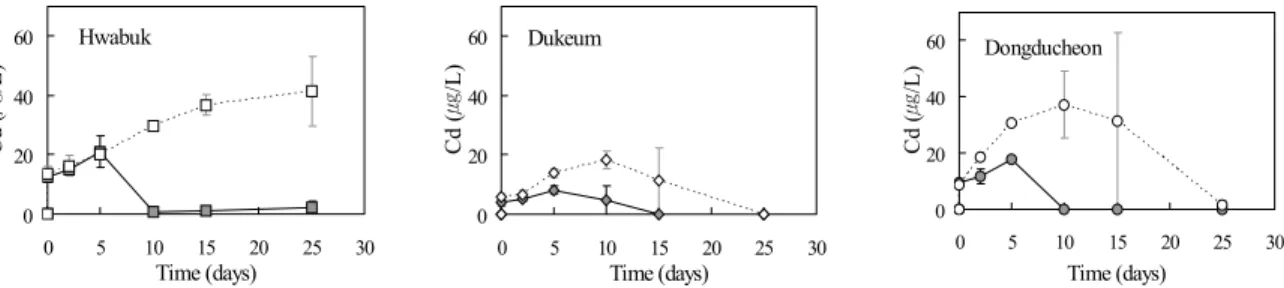
Dissolved heavy metals were microbially removed from solutions when compared with abiotic controls (Figure 1). The result was likely due to the formation and precipitation of metal sulfides after reduction of sulfate by indigenous sulfate-reducing bacteria, since indigenous bacteria accelerated the rate of sulfate reduction (Eq. 1).
Figure 1. Concentrations of cadmium in the studied soil and sediment slurries over time. Solid: microbial, open: abiotic control.
Sulfate-reducing bacteria; SO42- → S2- (or HS-) Me2+ + S2- → MeS(s) (Eq. 1) 0 20 40 60 0 5 10 15 20 25 30 Time (days) Cd ( ㎍/L ) Hwabuk 0 20 40 60 0 5 10 15 20 25 30 Time (days) Cd ( ㎍/L ) Dukeum 0 20 40 60 0 5 10 15 20 25 30 Time (days) Cd ( ㎍/L) Dongducheon
66
Symposia
As a result, it was concluded that addition of appropriate carbon sources and sulfate to contaminated geological media may result in activation of indigenous bacteria and thus in situ stabilization of heavy metals. However, since activation of indigenous bacteria also led to enhancement of dissolved arsenic in some contaminated sites, potential of As release into solution after the amendment should be preferentially investigated
The experimental results of bacterial control on the geochemical behaviour of the toxic elements were practically applied to a contaminated paddy soil site. After 117-day incubation of indigenous bacteria, arsenic and cadmium, which had been above Korean Standard Soil Criteria after weak acid extraction, appeared to be successfully in situ stabilized in the geological media showing long-term stability of the stabilized toxic elements.
References
[1] Oremland RS and Stolz JF Science, 300, 939, 2003.