Journal of the American Heart Association
J Am Heart Assoc. 2020;9:e016218. DOI: 10.1161/JAHA.119.016218 1
ORIGINAL RESEARCH
Patterns of Antiplatelet Therapy During
Noncardiac Surgery in Patients With
Second- Generation Drug- Eluting Stents
Choongki Kim, MD; Jung-Sun Kim, MD, PhD; Hyeongsoo Kim, MD; Sung Gyun Ahn, MD, PhD; Sungsoo Cho, MD, PhD; Oh-Hyun Lee, MD; Jong-Kwan Park, MD; Sanghoon Shin, MD;Jae Youn Moon, MD, PhD; Hoyoun Won, MD, PhD; Yongsung Suh, MD, PhD; Jung Rae Cho, MD, PhD; Yun-Hyeong Cho, MD, PhD; Seung-Jin Oh, MD; Byoung-Kwon Lee, MD, PhD; Sung-Jin Hong, MD; Dong-Ho Shin, MD; Chul-Min Ahn, MD, PhD; Byeong-Keuk Kim, MD, PhD; Young-Guk Ko, MD, PhD; Donghoon Choi, MD, PhD; Myeong-Ki Hong, MD, PhD; Yangsoo Jang, MD, PhD
BACKGROUND: Continuing antiplatelet therapy (APT) has been generally recommended during noncardiac surgery, but it is uncertain if preoperative discontinuation of APT has been avoided or harmful in patients with second- generation drug- eluting coronary stents.
METHODS AND RESULTS: Patients undergoing noncardiac surgery after second- generation drug- eluting coronary stent implan-tation were assessed in a multicenter cohort in Korea. Net adverse clinical events within 30 days postoperatively, defined as all- cause death, major adverse cardiac events, and major bleeding, were evaluated. Of 3582 eligible patients, 49% patients discontinued APT during noncardiac surgery. The incidence of net adverse clinical events was comparable between patients with continuation versus discontinuation (4.1% versus 3.4%; P=0.257) of APT during noncardiac surgery. Perioperative discon-tinuation of APT did not impact on net adverse clinical events (adjusted hazard ratio [HR], 1.00; 95% CI, 0.69–1.44; P=0.995). In subgroup analysis, patients undergoing intra- abdominal surgery were exposed to less risk of major bleeding by discontinu-ing APT (adjusted HR, 0.26; 95% CI, 0.08–0.91; P=0.035). Prolonged discontinuation of APT for ≥9 days was associated with higher risk of a major adverse cardiac event compared with continuing APT (adjusted HR, 3.38; 95% CI, 1.36–8.38; P=0.009). CONCLUSIONS: APT was discontinued preoperatively in almost half of patients with second- generation drug- eluting coronary stents. Our explorative analysis showed that there was no significant impact of discontinuing APT on the risk of perioperative adverse events except that discontinuing APT may be associated with decreased hemorrhagic risk in patients undergoing intra- abdominal surgery.
REGISTRATION: URL: https://www.clini caltr ials.gov; Unique identifier: NCT03908463. Key Words: antiplatelet agent ■ stent ■ surgery
S
econd- generation drug- eluting stents (DESs) re-flect technological improvements to provide better efficacy and safety, with a lower risk of restenosis and stent thrombosis after percutaneous coronary intervention (PCI).1,2 Continuous antiplatelet therapy(APT) is important to prevent ischemic events following PCI3–5; however, platelet inhibition increases the risk of hemorrhage, especially during invasive procedures.
In patients with DESs, clinicians must decide whether to continue or discontinue APT before
Correspondence to: Jung-Sun Kim, MD, PhD, Division of Cardiology, Severance Cardiovascular Hospital, Yonsei University College of Medicine, 50-1 Yonsei-ro, Seodaemun-gu, Seoul 03722, Korea. E-mail: [email protected]
Supplementary Materials for this article are available at https://www.ahajo urnals.org/doi/suppl/ 10.1161/JAHA.119.016218 For Sources of Funding and Disclosures, see page 11.
© 2020 The Authors. Published on behalf of the American Heart Association, Inc., by Wiley. This is an open access article under the terms of the Creative Commons Attribution-NonCommercial-NoDerivs License, which permits use and distribution in any medium, provided the original work is properly cited, the use is non- commercial and no modifications or adaptations are made.
noncardiac surgery (NCS) to achieve the appropri-ate balance between thromboembolic and bleed-ing risks. In the POISE- 2 (Perioperative Ischemic Evaluation 2) randomized trial, continuing aspirin did not reduce ischemic events and increased bleeding risk in patients overall,6 but a secondary analysis demonstrated an association between aspirin use and lower ischemic risk after NCS among patients with previous PCI.7 Conversely, a large population- based cohort study of patients with previous PCI reported no reduction of ischemic events with con-tinuing APT perioperatively.8 Nevertheless, continu-ing APT is widely regarded as optimal perioperative management in patients undergoing NCS without excessive bleeding risk, for which prompt discon-tinuation of all antiplatelet agents, including aspirin and P2Y12 inhibitors, may also be considered.6,8
Evidence is especially limited regarding continuation or discontinuation of APT in patients with second- generation DESs undergoing NCS. The objectives of this study were to describe patterns of perioperative APT in this setting and to evaluate whether discontin-uing APT is safe in patients with second- generation DESs.
METHODS
The data that support the findings of this study are available from the corresponding author upon reason-able request.
Study Design and Population
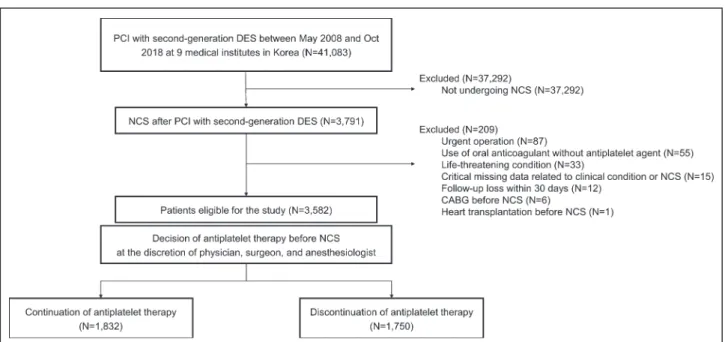
We used data from a prospective multicenter cohort registry (KOMATE [Korean Multicenter Angioplasty Team registry]; NCT03908463), which collects infor-mation regarding all patients undergoing PCI at major medical centers in Korea. The registry records include demographic, anatomic, and procedural characteris-tics, and postprocedure clinical outcomes. Nine cent-ers participated in this study. Among 41 083 patients with a second- generation DES in 9 institutes, we iden-tified 3791 who underwent NCS from May 2008 to October 2018. We included 3582 patients in the final analysis, after excluding those undergoing emergency surgery, which should not be delayed >3 days since initial decision (n=87), receiving anticoagulants without an antiplatelet agent (n=55), with life- threatening condi-tions at the time of surgery (n=33), missing critical data (n=15), and lost to follow- up (n=12), as well as those who underwent coronary artery bypass graft (n=6) or heart transplantation (n=1) before NCS (Figure 1). If patients underwent >1 NCS after second- generation DES implantation, we considered only the first opera-tion in our analyses. Investigators at each study site collected the medical records regarding surgery- related variables and cessation of antiplatelet agents. The institutional review board at each site approved the study protocol and waived the need for informed consent. We followed the Strengthening the Reporting of Observational Studies in Epidemiology reporting guidelines.9
End Points
We primarily assessed clinical outcomes within 30 days post- NCS, including death and adverse cardiac and hemorrhagic events. Net adverse clini-cal event (NACE) was defined as a composite of all- cause death, major adverse cardiac event (MACE), and major bleeding. MACE included cardiac death, myocardial infarction (MI), and stent thrombosis. Cardiac death was defined as death with ischemic symptoms, typical electrocardiographic ischemic
CLINICAL PERSPECTIVE
What Is New?
• Among patients undergoing noncardiac sur-gery after second-generation drug-eluting stent implantation, preoperative discontinuation of antiplatelet therapy was common and safe in terms of both ischemic and hemorrhagic risk. • Discontinuing APT may be associated with
lower risk of major bleeding in the certain types of surgery (eg, intra-abdominal) compared with continuing antiplatelet therapy in patients with second-generation drug-eluting stents.
What Are the Clinical Implications?
• Our study supports the notion that discontinu-ing antiplatelet therapy may be considered an acceptable option for patients undergoing cor-onary revascularization with second-generation drug-eluting stents before noncardiac surgery unless unduly prolonged (≥9 days).
Nonstandard Abbreviations and Acronyms
APT antiplatelet therapy
DAPT dual antiplatelet therapy DES drug-eluting stent
HR hazard ratio
MACE major adverse cardiac event MI myocardial infarction
NACE net adverse clinical event NCS noncardiac surgery
PCI percutaneous coronary intervention
J Am Heart Assoc. 2020;9:e016218. DOI: 10.1161/JAHA.119.016218 3
Kim et al Antiplatelet Therapy During Noncardiac Surgery
patterns, cardiac enzyme elevation, or fatal ventric-ular arrhythmia with no obvious noncardiac cause of death. MI was defined according to the Third Universal Definition as an increase in creatine kinase myocardial band fraction above the upper limit of nor-mal or an increase in troponin- T or - I above the 99th percentile of the upper limit of normal and ≥1 of the following: symptoms, electrocardiographic changes, or imaging or angiographic findings indicative of MI.10 Stent thrombosis was defined according to the Academic Research Consortium recommenda-tions.11 Major bleeding was defined according to the International Society of Thrombosis and Hemostasis (available in Data S1).12 Each event was independently adjudicated by 2 investigators (CK, HK). In a case of disagreement, a third investigator (J- SK) reviewed it to provide final adjudication. Two independent ad-judications showed 88% agreement and k=0.75 for classification of cardiac death.
Revascularization, APT, and Surgical Risk
All patients underwent PCI according to each par-ticipating site’s standard protocol. Second- generation DES included durable polymer everolimus- and zotarolimus- eluting stents; biodegradable polymer everolimus- , biolimus- , and sirolimus- eluting stents; and polymer- free biolimus- eluting stents. All patients received dual APT (DAPT) with aspirin and P2Y12 in-hibitor at discharge after PCI. High- risk PCI was defined as the presence of ≥1 risk factors, including left main stenting, 3 stents or long total stent length (≥60 mm), small- diameter stent (<2.5 mm), 2 stents at bifurcation,
or chronic total occlusion.13,14 All study sites share a policy of consensus decision for perioperative APT be-fore NCS in patients with previous PCI. Cardiologists recommended whether each antiplatelet agent should be continued or discontinued for a certain period of time before NCS. Surgeons and anesthesiologists fi-nally decided and recorded the duration of APT dis-continuation before NCS. Investigators reviewed medical records to confirm the discontinuation dura-tion for antiplatelet drugs. Patients who were guided to withdraw all antiplatelet agents for ≥1 days were clas-sified as discontinuing APT, and prescription patterns of continuing APT were subsequently categorized into aspirin monotherapy, P2Y12 inhibitor monotherapy, and DAPT. Urgent surgery was defined as if surgery should be performed within 30 days for a condition that has the potential to deteriorate quickly and be-come an emergency.15 Cardiac risk of each NCS was classified as low (<1%) or intermediate to high (≥1%), according to ≈30- day risk of cardiovascular death or MI.4,16 Hemorrhagic risk of each NCS was categorized into 3 groups (low, intermediate, or high), according to Rossini et al.14
Statistical Analysis
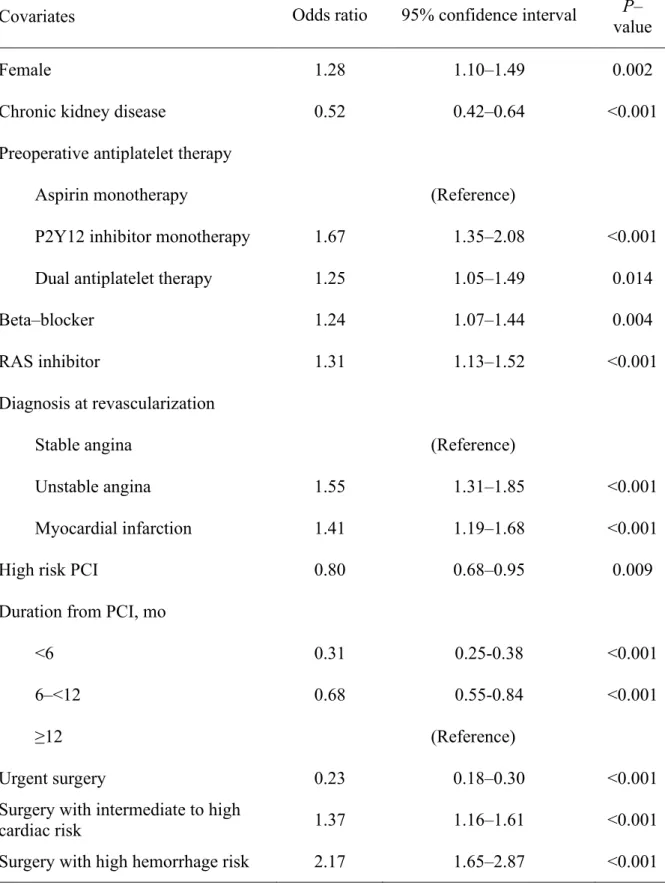
Continuous variables were reported as median and quartiles and compared using Mann–Whitney U test. Categorical variables were reported as number and percentage and compared using chi- square or Fisher’s exact tests. A multivariate logistic regres-sion model was used to identify independent fac-tors associated with discontinuing APT by backward
Figure 1. Flow diagram of study participants.
CABG indicates coronary artery bypass graft; DES, drug- eluting stent; NCS, noncardiac surgery; and PCI, percutaneous coronary intervention.
elimination, which first included significant covariates identified by univariate analysis, and the final model including significant covariates was diagnosed by McFadden’s R2 statistics. Fit of the model was con-firmed by using the likelihood- ratio test comparing with reduced model deleting each single covariate.17 Kaplan–Meier estimate and the log- rank test were used to depict cumulative incidences of adverse events,18 and the Cox proportional hazards model was used to compare the hazard of each adverse event between APT strategies, adjusting for potential confounders, which included explanatory variables finally chosen in a parsimonious multivariate model by backward stepdown deletion of covariates with the least significant variables and comparison of Akaike information criterion (Tables S1 through S3, Figure S1). Covariates associated with NACE, MACE, and major bleeding were applied to control for con-founding in each subgroup model. Diabetes mel-litus, chronic heart failure, chronic kidney disease, anemia, high- risk PCI, preoperative DAPT and β- blocker, urgent surgery, and surgery risk for cardiac and hemorrhagic event were adjusted for multivari-ate models for NACE. Chronic heart failure, anemia, use of β- blocker, high- risk PCI, duration between PCI and surgery, urgent surgery, and cardiac risk of surgery adjusted for multivariate models for MACE. Body mass index, anemia, urgent surgery, and hem-orrhagic risk of surgery were applied for adjustment of multivariate models for major bleeding. Subgroup analyses were performed according to variable con-ditions associated with patient, procedure, surgery- related risk factors, and each type of surgery. For the analysis, particular types of surgery including oph-thalmologic, spinal, head and neck, intrathoracic, gynecologic, breast, and transplantation surgeries were combined because adverse events occurred in fewer than 10 patients undergoing each surgery. A generalized additive model was applied to describe the nonparametric association between NACE and duration of APT discontinuation by using the “mgcv” package in R statistical software.19 After duration of APT discontinuation for the least risk for NACE was determined by the nonparametric smoothing plot, different durations of discontinuation were cat-egorized and compared with continuing APT and continuing aspirin monotherapy in regard to clinical outcomes. The multiple imputation by chained equa-tion approach was used to impute missing values. We generated 5 complete data sets and pooled the coefficients of subsequent analyses.20 Two- sided tests were performed, and P<0.05 was considered statistically significant. All statistical analyses were performed using R statistical software (version 3.5.2; R Foundation for Statistical Computing, Vienna, Austria).
RESULTS
Patterns of Perioperative APT
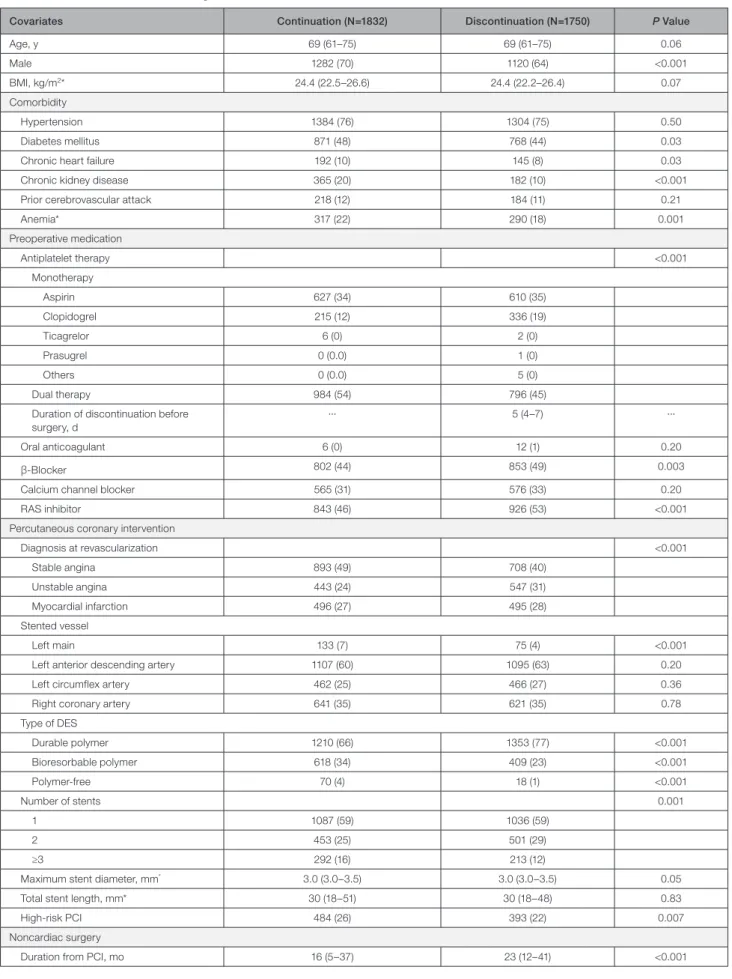
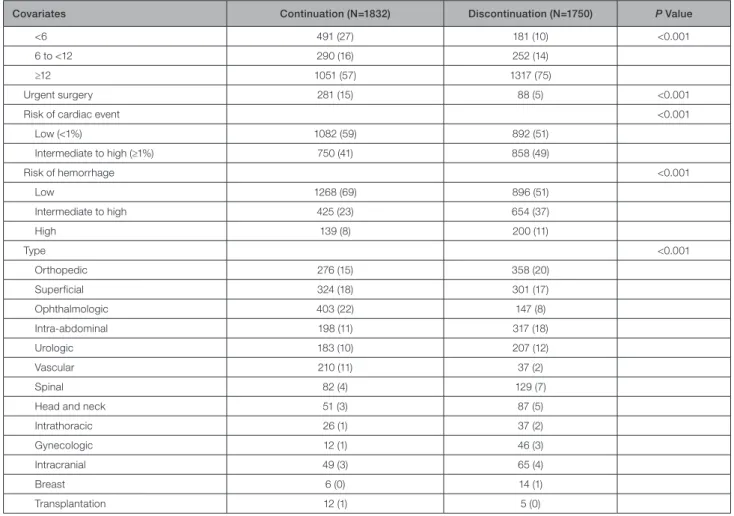
Of the 3582 eligible patients, 1832 (51%) contin-ued APT and 1750 (49%) discontincontin-ued APT before NCS (Figure 1). The baseline characteristics of the 2 groups are shown in Table 1. Incidence of discontinu-ing APT widely differs across types of surgery. More patients discontinued APT before certain type of surgeries including gynecology (79%), breast (70%), head and neck (63%), and intra- abdominal (62%) surgeries; however, only some of the candidates for vascular (15%) or ophthalmologic (27%) surger-ies discontinued APT. In women, preoperative use of aspirin monotherapy, β- blocker, or renin- angiotensin system inhibitor and surgery with higher cardiac or hemorrhage risk were independently associated with discontinuing APT. Chronic kidney disease, stable an-gina, high- risk PCI, and urgent surgery were related to discontinuing APT (Table 1, Table S4). Seventy- five percent of patients undergoing NCS within 6 months after PCI preoperatively continued APT, while 44% of patients undergoing NCS 12 months after PCI continued APT. Compared with other patterns of perioperative APT, continuing DAPT was associated with higher incidence of risk factors, including dia-betes mellitus, chronic heart failure, chronic kidney disease, anemia, MI, and high- risk PCI (Table S5). Median time interval between PCI and NCS in pa-tients continuing DAPT (7 months) was much shorter than the other groups (23–27 months; Table S5). Median duration of DAPT was 10.3 months in pa-tients with stable angina and 11.2 months in papa-tients with acute coronary syndrome.
Incidence and Risk of Perioperative
Adverse Events
Perioperative NACE, MACE, and major bleeding oc-curred in 135 (3.8%), 40 (1.1%), and 97 (2.7%) patients, respectively. There were no significant differences in the incidence of NACE (4.1% versus 3.4%; P=0.257), MACE (1.4% versus 0.8%; P=0.109), and major bleeding (2.6% versus 2.9%; P=0.664) between continuation versus discontinuation of APT, respec-tively (Figure 2, Table S6). Adjusted hazard ratio (HR) of discontinuing APT was 1.00 (95% CI, 0.69–1.44;
P=0.995) for NACE and 1.22 (95% CI, 0.80–1.87; P=0.349) for major bleeding (Table 2). Discontinuing
APT tended to lead to a lower incidence of MACE compared with continuing APT (0.8% versus 1.4%; unadjusted HR, 0.56; 95% CI, 0.29–1.07; P=0.081). However, discontinuing APT did not have an inde-pendent effect on MACE in adjusted analysis (HR, 1.13; 95% CI, 0.57–2.24; P=0.721). Anemia, urgency, and surgical risk had independent influences on
J Am Heart Assoc. 2020;9:e016218. DOI: 10.1161/JAHA.119.016218 5
Kim et al Antiplatelet Therapy During Noncardiac Surgery
Table 1. Baseline Patient and Surgical Characteristics
Covariates Continuation (N=1832) Discontinuation (N=1750) P Value
Age, y 69 (61–75) 69 (61–75) 0.06 Male 1282 (70) 1120 (64) <0.001 BMI, kg/m2* 24.4 (22.5–26.6) 24.4 (22.2–26.4) 0.07 Comorbidity Hypertension 1384 (76) 1304 (75) 0.50 Diabetes mellitus 871 (48) 768 (44) 0.03
Chronic heart failure 192 (10) 145 (8) 0.03
Chronic kidney disease 365 (20) 182 (10) <0.001
Prior cerebrovascular attack 218 (12) 184 (11) 0.21
Anemia* 317 (22) 290 (18) 0.001 Preoperative medication Antiplatelet therapy <0.001 Monotherapy Aspirin 627 (34) 610 (35) Clopidogrel 215 (12) 336 (19) Ticagrelor 6 (0) 2 (0) Prasugrel 0 (0.0) 1 (0) Others 0 (0.0) 5 (0) Dual therapy 984 (54) 796 (45)
Duration of discontinuation before surgery, d
··· 5 (4–7) ···
Oral anticoagulant 6 (0) 12 (1) 0.20
β- Blocker 802 (44) 853 (49) 0.003
Calcium channel blocker 565 (31) 576 (33) 0.20
RAS inhibitor 843 (46) 926 (53) <0.001
Percutaneous coronary intervention
Diagnosis at revascularization <0.001 Stable angina 893 (49) 708 (40) Unstable angina 443 (24) 547 (31) Myocardial infarction 496 (27) 495 (28) Stented vessel Left main 133 (7) 75 (4) <0.001
Left anterior descending artery 1107 (60) 1095 (63) 0.20
Left circumflex artery 462 (25) 466 (27) 0.36
Right coronary artery 641 (35) 621 (35) 0.78
Type of DES Durable polymer 1210 (66) 1353 (77) <0.001 Bioresorbable polymer 618 (34) 409 (23) <0.001 Polymer- free 70 (4) 18 (1) <0.001 Number of stents 0.001 1 1087 (59) 1036 (59) 2 453 (25) 501 (29) ≥3 292 (16) 213 (12)
Maximum stent diameter, mm* 3.0 (3.0–3.5) 3.0 (3.0–3.5) 0.05
Total stent length, mm* 30 (18–51) 30 (18–48) 0.83
High- risk PCI 484 (26) 393 (22) 0.007
Noncardiac surgery
Duration from PCI, mo 16 (5–37) 23 (12–41) <0.001
NACE, MACE, and major bleeding. Chronic heart fail-ure, nonuse of β- blocker, and high- risk PCI were in-dependent predictors for NACE and MACE (Table 2). Shorter duration between PCI and NCS was as-sociated with increased risk of MACE in univariate analysis. NCS <6 months after PCI also tended to increase ischemic risk after adjustment (HR, 1.99; 95% CI, 0.98–4.01; P=0.056). However, the risk of major bleeding was not significantly affected by the post- PCI duration (Table 2). Risk of discontinuing APT was not significant for NACE, MACE, and major bleeding in subgroups (Figure 3, Figures S2 and S3) However, the effect of discontinuing APT widely dif-fered across different types of surgeries. In patients undergoing intra- abdominal surgery, discontinuing APT tended to be beneficial in terms of NACE (ad-justed HR, 0.40; 95% CI, 0.15–1.08; P=0.070), which was mainly driven by a reduction in major bleeding (adjusted HR, 0.26; 95% CI, 0.08–0.91; P=0.035). When continuing APT categorized into aspirin, P2Y12 inhibitor monotherapy, and DAPT, incidence of NACE
was not significantly different among the 3 groups and patients who discontinued APT. However, pa-tients continued DAPT had the highest incidence of all- cause death (3.8% versus 1.1–1.4%; P<0.001) and MACE (2.8% versus 0.8%; P=0.008) than other groups (Table S7).
Duration of Antiplatelet Therapy
Discontinuation and Perioperative
Adverse Events
Because a nonparametric smoothing plot indicated that discontinuing APT for 6 days was associated with the lowest risk of NACE in patients undergoing NCS, an interval of 4 to 8 days for discontinuing APT would be optimal for the least risk for NACE (Figure S4). In uni-variate analysis, discontinuing APT for 4 to 8 days was associated with the lowest risk for NACE (unadjusted HR, 0.59; 95% CI, 0.39–0.92; P=0.019) and MACE (un-adjusted HR, 0.12; 95% CI, 0.03–0.52; P=0.004) com-pared with continuing APT (Figure 4). After adjustment,
Covariates Continuation (N=1832) Discontinuation (N=1750) P Value
<6 491 (27) 181 (10) <0.001
6 to <12 290 (16) 252 (14)
≥12 1051 (57) 1317 (75)
Urgent surgery 281 (15) 88 (5) <0.001
Risk of cardiac event <0.001
Low (<1%) 1082 (59) 892 (51) Intermediate to high (≥1%) 750 (41) 858 (49) Risk of hemorrhage <0.001 Low 1268 (69) 896 (51) Intermediate to high 425 (23) 654 (37) High 139 (8) 200 (11) Type <0.001 Orthopedic 276 (15) 358 (20) Superficial 324 (18) 301 (17) Ophthalmologic 403 (22) 147 (8) Intra- abdominal 198 (11) 317 (18) Urologic 183 (10) 207 (12) Vascular 210 (11) 37 (2) Spinal 82 (4) 129 (7)
Head and neck 51 (3) 87 (5)
Intrathoracic 26 (1) 37 (2)
Gynecologic 12 (1) 46 (3)
Intracranial 49 (3) 65 (4)
Breast 6 (0) 14 (1)
Transplantation 12 (1) 5 (0)
Data are median (interquartile range) or number (percentage). BMI indicates body mass index; DES, drug- eluting stent; PCI, percutaneous coronary intervention; and RAS, renin- angiotensin system.
*These comparisons were performed among patients without missing values (values were missing for hemoglobin in 517 patients, BMI in 77 patients, stent diameter in 4 patients, and total stent length in 3 patients).
J Am Heart Assoc. 2020;9:e016218. DOI: 10.1161/JAHA.119.016218 7
Kim et al Antiplatelet Therapy During Noncardiac Surgery
prolonged discontinuation of APT for ≥9 days led to higher risk of MACE compared with continuing APT (adjusted HR, 3.38; 95% CI, 1.36–8.38; P=0.009) or aspirin monotherapy (adjusted HR, 4.57; 95% CI, 1.44– 14.5; P=0.010), however, discontinuation for ≤8 days was similar to continuing APT or continuing aspirin monotherapy in terms of the risk of NACE, MACE, and major bleeding (Figure S5).
DISCUSSION
Our study demonstrated that discontinuation of APT was presented in almost half of patients with second- generation DESs before NCS. Discontinuing APT was more frequent as surgical risk for cardiac or hemor-rhagic risk increased. It was not of importance for the risk of NACE, MACE, and major bleeding in over-all patients; however, it led to less major bleeding in intra- abdominal surgery. Prolonged discontinuation of APT for ≥9 days seemed to be associated with in-creased risk of MACE than continuing APT or aspirin monotherapy.
Current guidelines have stressed continuing APT during NCS. According to 2014 European Society of Cardiology/European Society of Anaesthesiology guidelines regarding NCS, continuing aspirin or a P2Y12 inhibitor may be recommended for surgery within 3 to 12 months of DES implantation, although discontinuing aspirin is another option if difficult he-mostasis is anticipated.4 The 2014 American College of Cardiology/American Heart Association guidelines regarding NCS also recommended that patients with coronary stents continue aspirin during NCS, if pos-sible.3 However, no firm evidence supports maintain-ing antiplatelet therapy; thus, both guidelines contain a proviso that the decision to continue or discontinue
APT should be based on weighing the risks of bleeding and stent thrombosis in each individual.
Multidisciplinary approaches regarding periop-erative APT during NCS have suggested classifying thrombotic and hemorrhagic risks for each type of surgery, type of coronary stent, and clinical and an-giographic characteristics. While this is reasonable in usual situations, it remains unclear whether continu-ing aspirin is preferred for patients with a second- generation DES.14 Indeed, predicting bleeding or ischemic events or comparing risk levels is difficult because high cardiac risk is frequently linked to an in-creased bleeding risk, and many instances of periop-erative bleeding, stent thrombosis, and MI occur unpredictably. The reduced risk of ischemic events following PCI with second- generation DES is also relevant: These stents are associated with a lower risk of MI and stent thrombosis than first- generation DES2 and bare- metal stents.1 Accordingly, continuing APT may be less necessary with second- generation DESs in those with previous stents. Although a cardi-ologist may recommend continuing APT to minimize ischemic events, a surgeon may recommend dis-continuation, especially in the presence of clinical or surgical factors increasing hemorrhagic risk, which would commonly increase cardiac risk as well. Thus, decisions should be individualized while consider-ing various clinical factors. Practical methods of risk stratification or comprehensive discussion should be explored to optimize perioperative APT to minimize both ischemic and bleeding risks.
Discontinuing APT was more common in interme-diate or high- cardiac- risk surgery, which was contrary to our expectations and previous recommendations for continuing APT based on the cardiac risk of surgery. Cardiac risk factors including chronic kidney disease,
Figure 2. Cumulative incidence of perioperative adverse events comparing continuation vs discontinuation of antiplatelet therapy.
Table 2. Predictors of Net Adverse Clinical Event, Major Adverse Cardiac Event, and Major Bleeding After Noncardiac Surgery
Predictors
Univariate Analysis Multivariate Analysis Hazard Ratio (95% CI) P Value Hazard Ratio (95% CI) P Value Net adverse clinical events
Discontinuing antiplatelet therapy 0.81 (0.58–1.14) 0.228 1.00 (0.69–1.44) 0.995
Age, per 1- y increase 1.03 (1.01–1.04) 0.006 ··· ···
BMI, per 1- kg/m2 increase 0.94 (0.89–0.99) 0.014 ··· ···
Diabetes mellitus 1.58 (1.13–2.23) 0.008 1.36 (0.95–1.95) 0.094 Chronic heart failure 2.10 (1.35–3.26) 0.001 1.63 (1.03–2.57) 0.038 Chronic kidney disease 2.04 (1.40–2.99) <0.001 1.53 (0.99–2.37) 0.058
Anemia 2.71 (1.92–3.83) <0.001 1.89 (1.28–2.79) 0.001
High- risk PCI 1.67 (1.17–2.38) 0.005 1.54 (1.08–2.21) 0.017 Preoperative medication
DAPT 1.77 (1.18–2.64) <0.001 1.42 (0.94–2.14) 0.096
β- Blocker 0.73 (0.51–1.03) 0.073 0.68 (0.48–0.96) 0.030
Duration between PCI and surgery, mo
<6 1.68 (1.13–2.50) 0.010 ··· ···
6 to <12 1.33 (0.83–2.11) 0.235 ··· ···
≥12 (Reference)
Urgent surgery 6.81 (4.84–9.58) <0.001 5.37 (3.74–7.69) <0.001 Surgery with intermediate to high
cardiac risk
3.73 (2.53–5.51) <0.001 1.81 (1.16–2.81) 0.008 Surgery with hemorrhagic risk
Intermediate 2.17 (1.44–3.28) <0.001 2.10 (1.36–3.24) 0.001
High 6.80 (4.48–10.3) <0.001 4.38 (2.69–7.14) <0.001
Major adverse cardiac events
Discontinuing antiplatelet therapy 0.56 (0.29–1.07) 0.081 1.13 (0.57–2.24) 0.721
Age, per 1- y increase 1.03 (1.00–1.06) 0.087 ··· ···
Diabetes mellitus 1.79 (0.95–3.37) 0.072 ··· ···
Chronic heart failure 5.28 (2.76–10.1) <0.001 3.06 (1.53–6.13) 0.002
Chronic kidney disease 2.42 (1.23–4.75) 0.011 ··· ···
Anemia 4.17 (2.24–7.74) <0.001 2.65 (1.36–5.14) 0.004
Use of β- blocker 0.44 (0.22–0.88) 0.020 0.40 (0.20–0.80) 0.010 High- risk PCI 2.55 (1.37–4.75) 0.003 2.28 (1.21–4.28) 0.011 Duration between PCI and surgery, mo
<6 3.17 (1.61–6.21) 0.001 1.99 (0.98–4.01) 0.056
6 to <12 1.47 (0.58–3.69) 0.417 1.36 (0.54–3.43) 0.517
≥12 (Reference) (Reference)
Urgent surgery 12.6 (6.74–23.6) <0.001 10.2 (5.35–19.5) <0.001 Surgery with intermediate to high
cardiac risk
4.30 (2.05–9.03) <0.001 3.81 (1.79–8.13) 0.001 Major bleeding
Discontinuing antiplatelet therapy 1.11 (0.75–1.66) 0.597 1.22 (0.80–1.87) 0.349
Age, per 1- y increase 1.02 (1.00–1.04) 0.033 ··· ···
BMI, per 1- kg/m2 increase 0.92 (0.86–0.98) 0.008 0.94 (0.88–1.00) 0.054
Anemia 2.58 (1.71–3.88) <0.001 2.33 (1.54–3.54) <0.001
Prior cerebrovascular attack 1.69 (1.00–2.86) 0.049 ··· ···
DAPT before surgery 1.77 (1.18–2.64) 0.006 ··· ···
Urgent surgery 5.43 (3.59–8.19) <0.001 4.21 (2.72–6.51) <0.001 (Continued)
J Am Heart Assoc. 2020;9:e016218. DOI: 10.1161/JAHA.119.016218 9
Kim et al Antiplatelet Therapy During Noncardiac Surgery
PCI characteristics, or time interval since PCI would concern the decision of continuing APT. However, pa-tients receiving potent APT with P2Y12 inhibitors, which
may be required for more powerful prevention against ischemic events, were discouraged from continuing APT during NCS. The discrepancy between the scopes of
Predictors
Univariate Analysis Multivariate Analysis Hazard Ratio (95% CI) P Value Hazard Ratio (95% CI) P Value Surgery with hemorrhagic risk
Intermediate 2.71 (1.59–4.59) <0.001 2.68 (1.57–4.58) <0.001
High 11.5 (6.94–19.0) <0.001 9.21 (5.49–15.5) <0.001
BMI indicates body mass index; DAPT, dual antiplatelet therapy; and PCI, percutaneous coronary intervention.
Table 2. Continued
Figure 3. Forest plot of adjusted hazard ratio of discontinuing antiplatelet therapy for net adverse clinical event in subgroup analysis.
Cox proportional hazards model for net adverse clinical event was adjusted with diabetes mellitus, chronic heart failure, chronic kidney disease, anemia, high- risk PCI, preoperative use of antiplatelet therapy and β- blocker, urgent surgery, and surgical risk for cardiac and hemorrhagic risk. Center dots and whiskers indicate hazard ratios and 95% CIs, respectively. DAPT indicates dual antiplatelet therapy; and PCI, percutaneous coronary intervention.
APT during the post- PCI period and during the perioper-ative period should be carefully taken on board.
Our 49% incidence of discontinuing APT during NCS is higher than previously reported rates. In a re-cent observation study with 847 patients receiving cor-onary stents,21 only 96 (11%) received no antiplatelet therapy during NCS. However, the study included pa-tients with all stent types, including bare- metal stents and first- generation DES. It also claimed harmfulness of DAPT, which led to a higher likelihood of bleeding (odds ratio, 4.00; P=0.031) without reduction in isch-emic events (odds ratio, 1.83; P=0.32). The incidence of MACEs was similar between antiplatelet (mostly as-pirin) monotherapy (3.0%), and no antiplatelet therapy (3.1%), as was the risk of bleeding.21
Our incidences of MACEs (40 events, 1.1%) and MI (13 events, 0.4%) were lower than those previously reported. POISE- 2 reported 30- day MI after NCS in 6.1% of patients without PCI and 8.1% of patients with PCI,6,7 and observational studies reported in- hospital or 30- day MACEs in 3.8% to 5.4% of patients after NCS.8,21–23 However, most previous studies enrolled small numbers of patients with PCI8 and included pa-tients with primarily previous generation DES. Our low percentage of ischemic events may be at least par-tially attributed to the use of second- generation DES. It may also relate to our lack of routinely measuring car-diac enzyme levels, which are associated with 30- day mortality and elevated ≈10% after NCS.24 However, participating sites in our study usually recommend routine measurement of postoperative cardiac enzyme and ECG after surgery with cardiac risk, and clinically relevant myocardial infarction requiring any further at-tention or further management by physician were in-cluded in our study.
It is uncertain how effectively short- term discon-tinuation of APT would withdraw platelet inhibition in patients undergoing NCS. Interestingly, we found that continuation of APT was very similar to short- term dis-continuation of APT (for 1–3 days) regarding both isch-emic and hemorrhagic risk during the perioperative period. Instead, prolonged discontinuation (≥9 days), which would reflect almost complete withdrawal of platelet inhibition, was independently associated with MACE. The finding may suggest the hypothesis that sustained and complete withdrawal of platelet inhibi-tion would be still harmful during NCS. Further investi-gation is warranted.
Limitations
Because of the observational manner, bias may have existed regarding the decision to discontinue APT. Although differences in covariates were adjusted for when comparing patterns of perioperative APT, undetected confounders may have affected our results. One- way decision or randomized assignment of APT was not appropriate because our population included a wide spectrum of clinical, surgical, and PCI- related factors. Another limitation was the lower incidence of MACEs than in previous studies, the potential reasons for which are discussed above. Furthermore, although our study included the largest number of patients with second- generation DES, the number was insufficient to allow comparisons of individual outcomes. As this study was conducted in Korea, the results may not be generalizable to other clinical settings. This study is thereby considered hypothesis generating, and further investigations are necessary to determine whether discontinuing APT
Figure 4. Cumulative incidence of perioperative adverse events comparing continuation of antiplatelet therapy vs different durations of antiplatelet therapy discontinuation.
Duration of 4 to 8 days was determined to be associated with the lowest risk for net adverse clinical event by generalized additive model. Discontinuation for 1 to 3, 4 to 8, and ≥9 days was compared with continuing antiplatelet therapy in regard to net adverse clinical event (A), major adverse cardiac event (B), and major bleeding (C).
J Am Heart Assoc. 2020;9:e016218. DOI: 10.1161/JAHA.119.016218 11
Kim et al Antiplatelet Therapy During Noncardiac Surgery
during NCS is appropriate for patients with second- generation DES. There would be the possibility of inflated type 1 errors since adjustments of multiplicity under a predefined protocol were not applied. However, the adjustment would not be necessary because of the exploratory nature of the study.
CONCLUSIONS
APT was discontinued preoperatively in almost half of patients undergoing PCI with second- generation DES by consensus decision before NCS. Our explorative analysis found that discontinuing APT may not be associated with increased risk of NACE, MACE, and major bleeding unless it is extended beyond 8 days. Discontinuing APT may be better in terms of NACE or MACE in selected patients awaiting certain types of surgery such as intra- abdominal surgery in which it would be more impactful for limiting hemorrhagic risk. Our findings may not imply causality and should be carefully interpreted considering the retrospective manner.
ARTICLE INFORMATION
Received February 13, 2020; accepted April 23, 2020.
Affiliations
From the Department of Cardiology, Ewha Womans University College of Medicine Seoul Hospital, Seoul, Korea (C.K., S.S.); Division of Cardiology, Department of Internal Medicine, Severance Cardiovascular Hospital, Yonsei University College of Medicine, Seoul, Korea (C.K., J.-S.K., H.K., S.-J.H., D.-H.S., C.-M.A., B.-K.K., Y.-G.K., D.C., M.-K.H., Y.J.); Division of Cardiology, Department of Internal Medicine, Wonju Severance Christian Hospital, Yonsei University Wonju College of Medicine, Wonju, Korea (S.G.A.); Division of Cardiovascular Medicine, Department of Internal Medicine, Dankook University Hospital, Dankook University College of Medicine, Cheonan, Korea (S.C.); Division of Cardiology, Yongin Severance Hospital, Yonsei University College of Medicine, Gyeonggi-do, Korea (O.-H.L.); Division of Cardiology, National Health Insurance Service Ilsan Hospital, Goyang, Korea (J.-K.P., S.-J.O.); Department of Cardiology, CHA Bundang Medical Center, CHA University, Seongnam, Korea (J.Y.M.); Cardiovascular & Arrhythmia Center, Chung-Ang University Hospital, Chung-Ang University College of Medicine, Seoul, Korea (H.W.); Department of Cardiology, Myongji Hospital, Hanyang University College of Medicine, Goyang, Korea (Y.S.,Y.-H.C.); Division of Cardiology, Kangnam Sacred Heart Hospital, Hallym University Medical Center, Seoul, Korea (J.R.C.); Division of Cardiology, Gangnam Severance Hospital, Yonsei University College of Medicine, Seoul, Korea (B.-K.L.).
Sources of Funding
This research was supported by a grant of the Korea Health Technology R&D Project through the Korea Health Industry Development Institute (KHIDI), funded by the Ministry of Health & Welfare, Republic of Korea (No: HI15C1277), a grant from the National Research Foundation of Korea (NRF) grant, funded by the Korean Government (MSIT) (No. 2017R1A2B2003191), the Ministry of Science & ICT (2017M3A9E9073585) and the Cardiovascular Research Center (Seoul, Korea).
Disclosures None. Supplementary Materials Data S1 Tables S1–S7 Figures S1–S5 REFERENCES
1. Philip F, Agarwal S, Bunte MC, Goel SS, Tuzcu EM, Ellis S, Kapadia SR. Stent thrombosis with second- generation drug- eluting stents compared with bare- metal stents: network meta- analysis of primary percutaneous coronary intervention trials in ST- segment–elevation myocardial infarction. Circ Cardiovasc Interv. 2014;7:49–61.
2. Navarese EP, Kowalewski M, Kandzari D, Lansky A, Górny B, Kołtowski L, Waksman R, Berti S, Musumeci G, Limbruno U, et al. First- generation versus second- generation drug- eluting stents in current clinical practice: updated evidence from a comprehensive meta- analysis of randomised clinical trials comprising 31 379 patients. Open Heart. 2014;1:e000064. 3. Fleisher LA, Fleischmann KE, Auerbach AD, Barnason SA, Beckman
JA, Bozkurt B, Davila-Roman VG, Gerhard-Herman MD, Holly TA, Kane GC, et al. 2014 ACC/AHA guideline on perioperative cardiovas-cular evaluation and management of patients undergoing noncardiac surgery: a report of the American College of Cardiology/American Heart Association Task Force on practice guidelines. Circulation. 2014;130:e278–e333.
4. Kristensen SD, Knuuti J, Saraste A, Anker S, Bøtker HE, Hert SD, Ford I, Gonzalez-Juanatey JR, Gorenek B, Heyndrickx GR, et al. 2014 ESC/ ESA guidelines on non- cardiac surgery: cardiovascular assessment and management: the Joint Task Force on non- cardiac surgery: car-diovascular assessment and management of the European Society of Cardiology (ESC) and the European Society of Anaesthesiology (ESA).
Eur Heart J. 2014;35:2383–2431.
5. Neumann FJ, Sousa-Uva M, Ahlsson A, Alfonso F, Banning AP, Benedetto U, Byrne RA, Collet JP, Falk V, Head SJ, et al. 2018 ESC/ EACTS guidelines on myocardial revascularization. Eur Heart J. 2019;40:87–165.
6. Devereaux PJ, Mrkobrada M, Sessler DI, Leslie K, Alonso-Coello P, Kurz A, Villar JC, Sigamani A, Biccard BM, Meyhoff CS, et al. Aspirin in patients undergoing noncardiac surgery. N Engl J Med. 2014;370:1494–1503.
7. Graham MM, Sessler DI, Parlow JL, Biccard BM, Guyatt G, Leslie K, Chan MTV, Meyhoff CS, Xavier D, Sigamani A, et al. Aspirin in patients with previous percutaneous coronary intervention undergoing noncar-diac surgery. Ann Intern Med. 2018;168:237–244.
8. Hawn MT, Graham LA, Richman JS, Itani KM, Henderson WG, Maddox TM. Risk of major adverse cardiac events following noncardiac surgery in patients with coronary stents. JAMA. 2013;310:1462–1472.
9. von Elm E, Altman DG, Egger M, Pocock SJ, Gøtzsche PC, Vandenbroucke JP. The Strengthening the Reporting of Observational Studies in Epidemiology (STROBE) statement: guidelines for reporting observational studies. Lancet. 2007;370:1453–1457.
10. Thygesen K, Alpert JS, Jaffe AS, Simoons ML, Chaitman BR, White HD, Katus HA, Lindahl B, Morrow DA, Clemmensen PM, et al. Third univer-sal definition of myocardial infarction. Circulation. 2012;126:2020–2035. 11. Cutlip DE, Windecker S, Mehran R, Boam A, Cohen DJ, van Es GA,
Steg PG, Morel MA, Mauri L, Vranckx P, et al. Clinical end points in coronary stent trials: a case for standardized definitions. Circulation. 2007;115:2344–2351.
12. Schulman S, Angerås U, Bergqvist D, Eriksson B, Lassen MR, Fisher W. Definition of major bleeding in clinical investigations of antihemo-static medicinal products in surgical patients. J Thromb Haemost. 2010;8:202–204.
13. Giustino G, Chieffo A, Palmerini T, Valgimigli M, Feres F, Abizaid A, Costa RA, Hong MK, Kim BK, Jang Y, et al. Efficacy and safety of dual antiplatelet therapy after complex PCI. J Am Coll Cardiol. 2016;68:1851–1864.
14. Rossini R, Tarantini G, Musumeci G, Masiero G, Barbato E, Calabrò P, Capodanno D, Leonardi S, Lettino M, Limbruno U, et al. A multidisci-plinary approach on the perioperative antithrombotic management of patients with coronary stents undergoing surgery: surgery after stent-ing 2. JACC Cardiovasc Interv. 2018;11:417–434.
15. Russell C, Roberts M, Williamson TG, McKercher J, Jolly SE, McNeil J. Clinical categorization for elective surgery in Victoria. ANZ J Surg. 2003;73:839–842.
16. Glance LG, Lustik SJ, Hannan EL, Osler TM, Mukamel DB, Qian F, Dick AW. The Surgical Mortality Probability Model: derivation and valida-tion of a simple risk predicvalida-tion rule for noncardiac surgery. Ann Surg. 2012;255:696–702.
17. Bewick V, Cheek L, Ball J. Statistics review 14: logistic regression. Crit
18. Rizopoulos D. JM: an R package for the joint modelling of longitudinal and time- to- event data. J Stat Softw. 2010;35:33.
19. Hastie T, Tibshirani R. Generalized additive models. Stat Sci. 1986;1:297–310.
20. White IR, Royston P, Wood AM. Multiple imputation using chained equations: issues and guidance for practice. Stat Med. 2011;30: 377–399.
21. Howell SJ, Hoeks SE, West RM, Wheatcroft SB, Hoeft A. Prospective observational cohort study of the association between antiplatelet ther-apy, bleeding and thrombosis in patients with coronary stents undergo-ing noncardiac surgery. Br J Anaesth. 2019;122:170–179.
22. Rabbitts JA, Nuttall GA, Brown MJ, Hanson AC, Oliver WC, Holmes DR, Rihal CS. Cardiac risk of noncardiac surgery after percutane-ous coronary intervention with drug- eluting stents. Anesthesiology. 2008;109:596–604.
23. Albaladejo P, Marret E, Samama CM, Collet JP, Abhay K, Loutrel O, Charbonneau H, Jaber S, Thoret S, Bosson JL, et al. Non- cardiac surgery in patients with coronary stents: the RECO study. Heart. 2011;97:1566–1572. 24. Devereaux PJ, Chan MT, Alonso-Coello P, Walsh M, Berwanger O, Villar
JC, Wang CY, Garutti RI, Jacka MJ, Sigamani A, et al. Association be-tween postoperative troponin levels and 30- day mortality among pa-tients undergoing noncardiac surgery. JAMA. 2012;307: 2295–2304.