D I A B E T E S & M E T A B O L I S M J O U R N A L D I A B E T E S & M E T A B O L I S M J O U R N A L
This is an Open Access article distributed under the terms of the Creative Commons Attribution Non-Commercial License (http://creativecommons.org/licenses/by-nc/4.0/) which permits unrestricted non-commercial use, distribution, and reproduction in any medium, provided the original work is properly cited.
The Association between Z-Score of Log-Transformed
A Body Shape Index and Cardiovascular Disease in
Korea
Wankyo Chung1,2, Jung Hwan Park3, Hye Soo Chung4, Jae Myung Yu4, Shinje Moon4,5, Dong Sun Kim3
1Department of Public Health Science, Graduate School of Public Health, Seoul National University, Seoul, 2Institute of Health and Environment, Seoul National University, Seoul,
3Department of Internal Medicine, Hanyang University College of Medicine, Seoul,
4Department of Internal Medicine, Hallym University Kangnam Sacred Heart Hospital, Hallym University College of Medicine, Seoul, 5Department of Internal Medicine, Graduate School, Hanyang University, Seoul, Korea
Background: In order to overcome the limitations of body mass index (BMI) and waist circumference (WC), the z-score of the
log-transformed A Body Shape Index (LBSIZ) has recently been introduced. In this study, we analyzed the relationship between the LBSIZ and cardiovascular disease (CVD) in a Korean representative sample.
Methods: Data were collected from the Korea National Health and Nutrition Examination VI to V. The association between CVD
and obesity indices was analyzed using a receiver operating characteristic curve. The cut-off value for the LBSIZ was estimated us-ing the Youden index, and the odds ratio (OR) for CVD was determined via multivariate logistic regression analysis. ORs accord-ing to the LBSIZ value were analyzed usaccord-ing restricted cubic spline regression plots.
Results: A total of 31,227 Korean healthy adults were analyzed. Area under the curve (AUC) of LBSIZ against CVD was 0.686
(95% confidence interval [CI], 0.671 to 0.702), which was significantly higher than the AUC of BMI (0.583; 95% CI, 0.567 to 0.599) or WC (0.646; 95% CI, 0.631 to 0.661) (P<0.001). Similar results were observed for stroke and coronary artery diseases. The cut-off value for the LBSIZ was 0.35 (sensitivity, 64.5%; specificity, 64%; OR, 1.29, 95% CI, 1.12 to 1.49). Under restricted cu-bic spline regression, LBSIZ demonstrated that OR started to increase past the median value.
Conclusion: The findings of this study suggest that the LBSIZ might be more strongly associated with CVD risks compared to
BMI or WC. These outcomes would be helpful for CVD risk assessment in clinical settings, especially the cut-off value of the LB-SIZ suggested in this study.
Keywords: Body composition; Body mass index; Cardiovascular diseases; Obesity; Waist circumference
Corresponding authors: Shinje Moon https://orcid.org/0000-0003-3298-3630 Department of Internal Medicine, Hallym University Kangnam Sacred Heart Hospital, Hallym University College of Medicine, 1 Singil-ro, Yeongdeungpo-gu, Seoul 07441, Korea
E-mail: [email protected]
Dong Sun Kim https://orcid.org/0000-0003-1256-7648
Department of Internal Medicine, Hanyang University College of Medicine, 222-1 Wangsimni-ro, Seongdong-gu, Seoul 04763, Korea
INTRODUCTION
World Health Organization defines obesity as body mass index (BMI) of ≥30 kg/m2, and around 13% of the world population
were reported to be obese in 2016. Prevalence of obesity has been steadily increasing and has tripled in the past 30 years [1]. In Korea, obesity is defined as BMI of ≥25 kg/m2, and
accord-ing to the Korea National Health and Nutrition Examination https://doi.org/10.4093/dmj.2018.0169
Survey (KNHANES), the prevalence of obesity in adults (≥19 years old) has increased from 25.8% in 1998 to 31.5% in 2014 [2]. Obesity is a known risk factor for multiple diseases includ-ing cardiovascular diseases (CVD), diabetes, stroke, and can-cer [3-6], and approximately 4.8% of worldwide mortalities are reported to be associated with obesity [7]. Considering the in-creasing prevalence of obesity and its clinical significance, an accurate diagnosis of obesity is crucial.
Accurate measurement of body fat can assist with the diag-nosis of obesity, and multiple tools including computed to-mography (CT), magnetic resonance imaging, dual-energy X-ray absorptiometry, and positron emission tomography-CT can be used [8]. However, these tools have several drawbacks, including high medical costs and clinically limited usage. Therefore, indirect measurement indices are often used to di-agnose obesity, and BMI has been one of the most frequently used indices of obesity due to its convenience. However, BMI is not an effective tool for distinguishing body fat and muscle mass, and the distribution of body fat mass cannot be estimat-ed using BMI [9]. As a result, BMI has its limitations in pre-dicting the risk of CVD, stroke, and death [10-12]. In order to overcome these limitations, a new measure called A Body Shape Index (ABSI)—utilizing the waist circumference (WC), height, and weight—has recently been introduced [13]. A re-cent meta-analysis reported an association between ABSI and hypertension, diabetes, CVD, and death; more specifically, ABSI showed superiority in predicting deaths in contrast to BMI or WC [14]. However, ABSI has limitations in its applica-bility in that the scaling exponents to calculate ABSI are esti-mated to differ across countries; when ABSI was directly used for logistic estimation, its coefficients were inflated beyond any reasonable interpretation [15]. The use of the z-score of the log-transformed ABSI (LBSIZ) [15], an improved version of ABSI, has been suggested to overcome the above limitations, as well as to determine the value of LBSIZ specific to the Korean population [16]. LBSIZ has been shown to predict CVD in a population-based cohort study [16]. However, there are very few studies that have applied LBSIZ to predict CVD in the gen-eral population until now.
This study aimed to examine the association of CVD risk with LBSIZ, in comparison to that of WC and BMI, in a Kore-an population. We hypothesize that LBSIZ will show a greater association with CVD risk in the Korean population than WC and BMI.
METHODS
Study populationData were collected from the KNHANES VI to V conducted from 2007 to 2012. Subjects with ≤20 years of age, cancer, re-nal failure, <60 mL/min/1.73 m2 of estimated glomerular
fil-tration rate, and liver cirrhosis were excluded from the analy-sis. A total of 31,227 out of 50,405 subjects were included in this study (Supplementary Fig. 1).
Clinical and laboratory measurements
WC was measured with a tape measure at the midpoint be-tween the lowest border of the rib cage and the upper lateral border of the iliac crest at the end of normal expiration. Blood pressure (BP) was measured three times in a seated position with ≥5 minutes of resting period, and the mean value was used in the analysis. After an 8-hour overnight fasting, glucose levels, high density lipoprotein cholesterol (HDL-C), and tri-glyceride (TG) levels were measured by enzymatic method (ADVIA 1650 in 2007, Siemens, Munich, Germany; and Hita-chi Automatic Analyzer 7600 from 2008 to 2012 HitaHita-chi, To-kyo, Japan) [17,18]. Presence of CVD was assessed through a structured questionnaire, and subjects with one or more con-ditions of angina pectoris, myocardial infarction, coronary heart disease, or cerebrovascular disease were considered to have CVD.
Measurement of LBSIZ
As a measure of obesity, we calculated LBSIZ using two steps: in the first step, we calculated the log-transformed ABSI (LBSI) using the equation: log [WC/(exp–2.69×weight0.73×height–1.06)],
where the scaling exponents –2.69, 0.73, and –1.06 were esti-mated from a log-log regression of WC for both weight and height using representative Korean data [15]. In the second step, we calculated LBSIZ using the equation: [LBSI–(LBSI mean)]/(LBSI standard deviation) where LBSI mean is –0.02 and standard deviation is 0.06. A detailed explanation and a supplementary excel file for calculations are provided in previ-ous studies [15,16].
Statistical analysis
Summary statistics are provided as mean±standard deviation or prevalence (%), based on the presence of CVD. Differences between groups were assessed with independent samples t-test for continuous variables and with Pearson’s chi-square test for
categorical variables. Furthermore, overall distributions for each obesity index were provided, and the correlation between obesity indices was tested. Using a receiver operating charac-teristic (ROC) curve, the association between CVD and each of the obesity indices was analyzed. De Long’s test was used to statistically confirm which of the obesity indices were signifi-cantly superior. The cut-off values of each obesity parameter were estimated by the highest score of Youden index in the area with sensitivity and specificity >50%, and the corre-sponding odds ratios (OR) were determined via multivariate logistic regression analysis. In addition, the OR for CVD ac-cording to continuous values of LBSIZ was analyzed using re-stricted cubic spline regression plots with five knots. Analyses were performed using SPSS software version 24.0 (IBM Co., Armonk, NY, USA) and the statistical program R (R version 3.1.0, 2014, www.r-project.org). A P value of 0.05 was consid-ered statistically significant.
Ethics statement
The study protocol was approved by the Institutional Review Board of the Korean Centre for Disease Control (2007-02CON- 04-P, 2008-04EXP-01-C, 2009-01CON-03-2C, 2010-02CON21- C) and Hallym University Kangnam Sacred Heart Hospital (IRB No. HKS 2017-07-007). All participants volunteered and provided written informed consent prior to their enrolment. All participants’ records were anonymized before being ac-cessed by the authors.
RESULTS
Baseline characteristics
A total of 31,227 Korean healthy adults (13,422 men and 17,805 women) aged 20 to 103 years (mean age=48.8) were analyzed (Supplementary Fig. 1). The anthropometric, clinical,
and biochemical characteristics are summarized in Table 1 ac-cording to CVD. There were 1,109 subjects (3.6%) with CVD, and among them, 528 subjects (1.7%) had stroke and 616 sub-jects (2.0%) had coronary artery disease. Compared to the normal group, CVD patient group had greater mean age and higher proportion of male subjects and smokers. CVD patient group exhibited higher BMI, WC, LBSIZ, BP, TG, fasting glu-cose, and glycosylated hemoglobin levels, and lower levels of HDL-C. Furthermore, the CVD patient group exhibited
high-Table 1. Characteristics of subjects according to CVD
Variable (n=30,118)Normal (n=1,109)CVD P value
Age, yr 48.2±15.7 64.9±10.0 <0.001 Male sex 12,839 (42.6) 583 (52.6) <0.001 Smoking 12,381 (41.1) 561 (50.6) <0.001 BMI, kg/m2 23.6±3.3 24.5±3.1 <0.001 Waist circumference, cm 81.1±9.9 85.9±8.8 <0.001 LBSIZ –0.0±1.0 0.6±0.9 <0.001 Systolic BP, mm Hg 118.3±17.1 128.0±17.4 <0.001 Diastolic BP, mm Hg 76.4±10.6 77.1±10.3 0.018 Hypertension 8,409 (28.0) 703 (63.9) <0.001 FBG level, mg/dL 97.0±21.9 106.2±28.1 <0.001 HbA1c, % 6.0±1.1 6.5±1.2 <0.001 Diabetes mellitus 2,482 (8.5) 275 (25.6) <0.001 Total cholesterol, mg/dL 189.1±35.9 180.0±40.7 <0.001 HDL-C, mg/dL 49.2±11.6 45.2±10.7 <0.001 TG, mg/dL 132.3±107.3 143.9±93.5 <0.001 Dyslipidemia 3,488 (12.0) 298 (27.8) <0.001 Values are presented as mean±standard deviation or number (%). CVD, cardiovascular disease; BMI, body mass index; LBSIZ, z-score of the log-transformed A Body Shape Index; BP, blood pressure; FBG, fasting blood glucose; HbA1c, glycosylated hemoglobin; HDL-C, high density lipoprotein cholesterol; TG, triglyceride.
Table 2. Distribution of the obesity parameters
Obesity parameters Percentile 10th 20th 30th 40th 50th 60th 70th 80th 90th LBSIZ –1.3 –0.8 –0.5 –0.2 0 0.3 0.5 0.8 1.3 BMI, kg/m2 19.6 20.8 21.8 22.6 23.4 24.3 25.2 26.2 27.8 WC, cm Men 73 77 80 82 85 87 89 92 96 Women 67 70 73 76 78 81 84 87 92
er prevalence of hypertension and dyslipidemia.
The distributions of obesity parameters are summarized in Table 2. LBSIZ showed a positive correlation with WC (Pear-son correlation, 0.507; P<0.001) but a weak positive correla-tion with BMI (Pearson correlacorrela-tion, 0.023; P<0.001).
Association between CVD and obesity parameters
Fig. 1 shows the ROC curves for CVD, stroke, and coronary artery disease according to the three obesity parameters. The area under the curve (AUC) for CVD was 0.686 (95% confi-dence interval [CI], 0.671 to 0.702) for LBSIZ, 0.646 (95% CI, 0.631 to 0.661) for WC, and 0.583 (95% CI, 0.567 to 0.599) for BMI. Stroke and coronary artery disease also showed similar outcomes.
The AUC of LBSIZ was significantly higher than that of WC (P<0.001) and BMI (P<0.001). Table 3 shows the AUC of each obesity parameter by sex and obesity status. WC showed high-er AUC than BMI regardless of sex and obesity status. Al-though WC showed a similar AUC to LBSIZ in women (P= 0.93), the same was not observed in men. In comparison with WC, LBISZ showed significantly higher AUC in men (P< 0.001). In the subgroup analysis by obesity status, BMI, and WC showed a severe decline in AUC for obesity or central obesity groups compared to the normal group, whereas LBSIZ showed only a modest decline (Table 3). Table 4 shows the cut-off values for each obesity parameter and its corresponding ORs. The cut-off value for LBSIZ was 0.35 (65th percentile: sensitivity, 64.5%; specificity, 64%) and its corresponding mul-tivariate OR with adjustment for age, sex, smoking, hyperten-sion, diabetes mellitus, and dyslipidemia was 1.29 (95% CI,
Table 3. The AUC for cardiovascular disease in each obesity
parameter by sex and obesity status
Obesity parameter AUC (95% CI)
Men LBSIZ 0.681 (0.659–0.703) BMI 0.517 (0.494–0.540) WC 0.586 (0.563–0.608) Women LBSIZ 0.682 (0.659–0.705) BMI 0.638 (0.616–0.660) WC 0.683 (0.662–0.704) Non-obesity (BMI <25 kg/m2) LBSIZ 0.707 (0.688–0.727) BMI 0.589 (0.568–0.610) WC 0.682 (0.661–0.702) Obesity (BMI ≥25 kg/m2) LBSIZ 0.654 (0.628–0.680) BMI 0.508 (0.480–0.535) WC 0.578 (0.552–0.605)
Non-central obesity (men <90 cm, women <85 cm)
LBSIZ 0.679 (0.658–0.700)
BMI 0.566 (0.545–0.587)
WC 0.653 (0.633–0.674)
Central obesity (men ≥90 cm, women ≥85 cm)
LBSIZ 0.644 (0.619–0.669)
BMI 0.458 (0.431–0.486)
WC 0.532 (0.505–0.560)
AUC, area under the curve; CI, confidence interval; LBSIZ, z-score of the log-transformed A Body Shape Index; BMI, body mass index; WC, waist circumference.
Fig. 1. Receiver operating characteristics curves for cardiovascular disease (CVD) by obesity parameters. (A) Total CVD. (B)
Stroke. (C) Coronary artery disease. LBSIZ, z-score of the log-transformed A Body Shape Index; WC, waist circumference; BMI, body mass index; AUC, area under the curve.
1.0 0.8 0.6 0.4 0.2 0 1.0 0.8 0.6 0.4 0.2 0 1.0 0.8 0.6 0.4 0.2 0 Se ns iti vit y Se ns iti vit y Se ns iti vit y 0 0.2 0.4 0.6 0.8 1.0 0 0.2 0.4 0.6 0.8 1.0 0 0.2 0.4 0.6 0.8 1.0
LBSIZ LBSIZ LBSIZ
WC WC WC
BMI BMI BMI
1-Specificity 1-Specificity 1-Specificity
AUC LBSIZ: 0.686 (0.671–0.702) WC: 0.646 (0.631–0.661) BMI: 0.583 (0.567–0.599) AUC LBSIZ: 0.695 (0.673–0.718) WC: 0.636 (0.615–0.658) BMI: 0.569 (0.546–0.593) AUC LBSIZ: 0.671 (0.650–0.692) WC: 0.645 (0.626–0.665) BMI: 0.590 (0.570–0.611) A B C
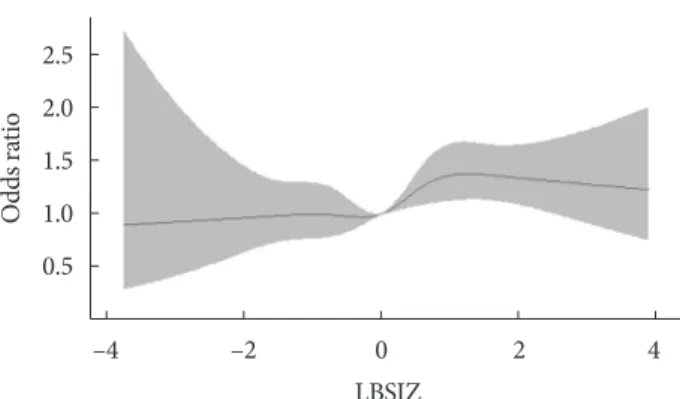
1.12 to 1.49). Under restricted cubic spline regression, LBSIZ demonstrated that OR started to increase past the median val-ue (Fig. 2).
DISCUSSION
In this study, we investigated the relationship between CVD and LBSIZ, BMI, and WC using a representative sample. LB-SIZ demonstrated a superior relationship with CVD than BMI or WC.
There is heterogeneity among previous studies assessing the relationship between BMI and CVD [10-12]. This heterogene-ity might be due to the limitations in defining obesheterogene-ity based on BMI [1,19-26]. BMI cannot accurately distinguish fat, bone, and muscle mass; therefore, it cannot effectively estimate the total body fat mass [19]. Even if different subjects have the same BMI, its clinical significance may be heterogeneous based on their age considering that aging humans exhibit re-duced muscle mass and increased body fat [20,21]. For exam-ple, a patient with excessive visceral fat and insufficient muscle mass may have high CVD risk despite having a normal BMI value [22]. Moreover, the metabolic effects of fat can change based on the location. More specifically, while visceral fat is as-sociated with type 2 diabetes mellitus and CVD [23,24], sub-cutaneous fat demonstrated beneficial effects in terms of me-tabolism [25,26]. Based on these limitations of BMI, multiple studies have been investigating other obesity indices [27,28]. Among them, WC showed stronger association with visceral adiposity, metabolic risk, and increased morbidity and mortal-ity [29-31], and as a result, WC has been used to define
meta-bolic syndrome instead of BMI [32]. However, there is insuffi-cient data regarding the appropriate WC to define obesity based on different age and sex of subjects [20,29]. Consequent-ly, we observed heterogeneity in the association between WC and CVD depending on sex.
Krakauer and Krakauer [13] introduced a new obesity index called ABSI, based on WC, weight, and height, using NHANES data in the United States. ABSI provided more effective predic-tion of premature mortality in contrast to BMI or WC [13,33]. Moreover, it has been suggested as an effective prognostic fac-tor of CVD and all-cause mortality [34,35]. Nevertheless, ABSI is an equation deduced from the data collected from American population, and thus, there are limitations in applying the equation to other ethnicities. Furthermore, due to the skew-ness of the value and lack of the cut-off value to define obesity, there are difficulties in clinical application of ABSI [15]. Hence, we suggested LBSIZ—an improved version of ABSI—that can be used regardless of subjects’ ethnicity and sex [15]. However, due to its complex nature, we have provided an additional equation that can be utilized in the Korean population [16]. In this study, we applied this equation to a representative sample and confirmed that the relationship between CVD and LBSIZ is stronger than that between CVD and BMI or WC. Further-more, while WC showed large differences in AUC depending on sex, LBSIZ showed no sex-based differences. Therefore, LB-SIZ could be used as a supplemental parameter to overcome the heterogeneity of WC according to sex. Moreover, the pro-found AUC decrease seen in BMI and WC among obesity groups means LBISZ could be a useful parameter for CVD risk assessment in those people.
Table 4. The cut-off value of each obesity parameters and its
corresponding ORs for cardiovascular disease Cut-off
value Sensitivity, % Specificity, % ORa (95% CI)
LBSIZ 0.35 64.5 64.0 1.29 (1.12–1.49)
BMI 23.65 59.5 52.9 1.22 (1.07–1.39)
WC
Men 84.5 64.0 50.4 1.07 (0.88–1.29) Women 81.5 65.3 63.4 1.44 (1.19–1.75) OR, odds ratio; CI, confidence interval; LBSIZ, z-score of the log-transformed A Body Shape Index; BMI, body mass index; WC, waist circumference.
aAdjusted for age, sex, smoking, hypertension, diabetes mellitus, and
dyslipidemia.
Fig. 2. The odds ratio for cardiovascular disease according to
z-score of the log-transformed A Body Shape Index (LBSIZ) value. Adjusted for age, sex, smoking, hypertension, diabetes mellitus, and dyslipidemia.
2.5 2.0 1.5 1.0 0.5 O dd s ra tio –4 –2 0 2 4 LBSIZ
Under restricted cubic spline regression plots, no significant increase in the risk of CVD was observed until the median LB-SIZ (LBLB-SIZ=0), while OR started to increase past the median value. This result supports the estimated cut-off value (0.35; 65th percentile) can effectively distinguish the group of sub-jects with high CVD risk and may be used as a clinically signif-icant standard.
Despite our findings, there are a few limitations to this study. First, this was a cross-sectional study, and therefore, the causal relationship between obesity and CVD cannot be determined. Therefore, prospective studies should be performed to address this issue. Second, this study utilized a representative Korean population, and additional studies should be performed in other ethnicities to generalize our findings. Third, the presence of CVD was not based on a physician diagnosis. Lastly, there was no data available regarding mortality and fatal CVD events, and therefore, relevant analyses could not be performed.
In conclusion, we confirmed there was a strong association between LBSIZ and CVD, which was superior to the associa-tions between CVD and BMI or WC. These outcomes would be helpful during CVD risk assessment in clinical settings, es-pecially with the cut-off value of LBSIZ suggested in this study. Nonetheless, in order to validate the role of LBSIZ with stron-ger evidence, additional larstron-ger-scale prospective studies should be performed.
SUPPLEMENTARY MATERIALS
Supplementary materials related to this article can be found online at https://doi.org/dmj.2018.0169.
CONFLICTS OF INTEREST
No potential conflict of interest relevant to this article was re-ported.
AUTHOR CONTRIBUTIONS
Conception or design: W.C., S.M., D.S.K.Acquisition, analysis, or interpretation of data: W.C., S.M. Drafting the work or revising: W.C., S.M., D.S.K.
Final approval of the manuscript: W.C., J.H.P., H.S.C., J.M.Y., S.M., D.S.K.
ORCID
Wankyo Chung https://orcid.org/0000-0001-8094-2433 Shinje Moon https://orcid.org/0000-0003-3298-3630 Dong Sun Kim https://orcid.org/0000-0003-1256-7648
ACKNOWLEDGMENTS
None
REFERENCES
1. World Health Organization: Fact sheet on obesity and over-weight. Available from: http://www.who.int/en/news-room/ fact-sheets/detail/obesity-and-overweight (updated 2018 Feb 16).
2. Korean Statistical Information Service: Prevalence of obesity in Korea. Available from: http://kosis.kr/statHtml/statHtml. do?orgId=117&tblId=DT_11702_N101# (updated 2019 Feb 20). 3. Solomon CG, Manson JE. Obesity and mortality: a review of
the epidemiologic data. Am J Clin Nutr 1997;66(4 Suppl): 1044S-50S.
4. Krauss RM, Winston M, Fletcher BJ, Grundy SM. Obesity: im-pact on cardiovascular disease. Circulation 1998;98:1472-6. 5. Moon S, Oh CM, Choi MK, Park YK, Chun S, Choi M, Yu JM,
Yoo HJ. The influence of physical activity on risk of cardiovas-cular disease in people who are obese but metabolically healthy. PLoS One 2017;12:e0185127.
6. Wallstrom P, Bjartell A, Gullberg B, Olsson H, Wirfalt E. A pro-spective Swedish study on body size, body composition, diabe-tes, and prostate cancer risk. Br J Cancer 2009;100:1799-805. 7. World Health Organization. Global health risks: mortality and
burden of disease attributable to selected major risks. Geneva: World Health Organization; 2009.
8. Kushner RF. Clinical assessment and management of adult obesity. Circulation 2012;126:2870-7.
9. Heymsfield SB, Scherzer R, Pietrobelli A, Lewis CE, Grunfeld C. Body mass index as a phenotypic expression of adiposity: quantitative contribution of muscularity in a population-based sample. Int J Obes (Lond) 2009;33:1363-73.
10. Romero-Corral A, Somers VK, Sierra-Johnson J, Thomas RJ, Collazo-Clavell ML, Korinek J, Allison TG, Batsis JA, Sert-Kuniyoshi FH, Lopez-Jimenez F. Accuracy of body mass index in diagnosing obesity in the adult general population. Int J Obes (Lond) 2008;32:959-66.
11. Schneider HJ, Friedrich N, Klotsche J, Pieper L, Nauck M, John U, Dorr M, Felix S, Lehnert H, Pittrow D, Silber S, Volzke H, Stalla GK, Wallaschofski H, Wittchen HU. The predictive value of different measures of obesity for incident cardiovascular events and mortality. J Clin Endocrinol Metab 2010;95:1777-85.
12. Flegal KM, Graubard BI, Williamson DF, Gail MH. Excess deaths associated with underweight, overweight, and obesity. JAMA 2005;293:1861-7.
13. Krakauer NY, Krakauer JC. A new body shape index predicts mortality hazard independently of body mass index. PLoS One 2012;7:e39504.
14. Ji M, Zhang S, An R. Effectiveness of A Body Shape Index (ABSI) in predicting chronic diseases and mortality: a system-atic review and meta-analysis. Obes Rev 2018;19:737-59. 15. Chung W, Park CG, Ryu OH. Association of a new measure of
obesity with hypertension and health-related quality of life. PLoS One 2016;11:e0155399.
16. Moon S, Park JH, Ryu OH, Chung W. Effectiveness of Z-score of log-transformed A Body Shape Index (LBSIZ) in predicting cardiovascular disease in Korea: the Korean Genome and Epi-demiology Study. Sci Rep 2018;8:12094.
17. Korea Centers for Disease Control and Prevention. The guide-line of the Forth Korea National Health and Nutrition Exami-nation Survey (KNHANES-IV). Cheongju: Korea Centers for Disease Control and Prevention; 2009.
18. Korea Centers for Disease Control and Prevention. The guide-line of the Fifth Korea National Health and Nutrition Exami-nation Survey (KNHANES-V). Cheongju: Korea Centers for Disease Control and Prevention; 2010.
19. Rahman M, Berenson AB. Accuracy of current body mass in-dex obesity classification for white, black, and Hispanic repro-ductive-age women. Obstet Gynecol 2010;115:982-8.
20. Gurunathan U, Myles PS. Limitations of body mass index as an obesity measure of perioperative risk. Br J Anaesth 2016;116: 319-21.
21. Rothman KJ. BMI-related errors in the measurement of obesi-ty. Int J Obes (Lond) 2008;32 Suppl 3:S56-9.
22. Coutinho T, Goel K, Correa de Sa D, Carter RE, Hodge DO, Kragelund C, Kanaya AM, Zeller M, Park JS, Kober L, Torp-Pedersen C, Cottin Y, Lorgis L, Lee SH, Kim YJ, Thomas R, Roger VL, Somers VK, Lopez-Jimenez F. Combining body mass index with measures of central obesity in the assessment of mortality in subjects with coronary disease: role of “normal weight central obesity”. J Am Coll Cardiol 2013;61:553-60.
23. Gastaldelli A, Miyazaki Y, Pettiti M, Matsuda M, Mahankali S, Santini E, DeFronzo RA, Ferrannini E. Metabolic effects of vis-ceral fat accumulation in type 2 diabetes. J Clin Endocrinol Metab 2002;87:5098-103.
24. Donohoe CL, Doyle SL, Reynolds JV. Visceral adiposity, insu-lin resistance and cancer risk. Diabetol Metab Syndr 2011;3:12. 25. Shimizu I, Yoshida Y, Minamino T. Maintenance of subcutane-ous fat homeostasis improves systemic metabolic dysfunction in obesity. Diabetes 2015;64:3984-6.
26. Tran TT, Yamamoto Y, Gesta S, Kahn CR. Beneficial effects of subcutaneous fat transplantation on metabolism. Cell Metab 2008;7:410-20.
27. Bener A, Yousafzai MT, Darwish S, Al-Hamaq AO, Nasralla EA, Abdul-Ghani M. Obesity index that better predict meta-bolic syndrome: body mass index, waist circumference, waist hip ratio, or waist height ratio. J Obes 2013;2013:269038. 28. Janssen I, Katzmarzyk PT, Ross R. Waist circumference and
not body mass index explains obesity-related health risk. Am J Clin Nutr 2004;79:379-84.
29. Onat A, Avci GS, Barlan MM, Uyarel H, Uzunlar B, Sansoy V. Measures of abdominal obesity assessed for visceral adiposity and relation to coronary risk. Int J Obes Relat Metab Disord 2004;28:1018-25.
30. Bays H. Central obesity as a clinical marker of adiposopathy: increased visceral adiposity as a surrogate marker for global fat dysfunction. Curr Opin Endocrinol Diabetes Obes 2014;21: 345-51.
31. Chan JM, Rimm EB, Colditz GA, Stampfer MJ, Willett WC. Obesity, fat distribution, and weight gain as risk factors for clinical diabetes in men. Diabetes Care 1994;17:961-9.
32. Zimmet P, Magliano D, Matsuzawa Y, Alberti G, Shaw J. The metabolic syndrome: a global public health problem and a new definition. J Atheroscler Thromb 2005;12:295-300.
33. Lee DY, Lee MY, Sung KC. Prediction of mortality with a body shape index in young Asians: comparison with body mass in-dex and waist circumference. Obesity (Silver Spring) 2018;26: 1096-103.
34. Dhana K, Kavousi M, Ikram MA, Tiemeier HW, Hofman A, Franco OH. Body shape index in comparison with other an-thropometric measures in prediction of total and cause-specif-ic mortality. J Epidemiol Community Health 2016;70:90-6. 35. Bozorgmanesh M, Sardarinia M, Hajsheikholeslami F, Azizi F,
Hadaegh F. CVD-predictive performances of “a body shape in-dex” versus simple anthropometric measures: Tehran lipid and glucose study. Eur J Nutr 2016;55:147-57.
Supplementary Fig. 1. Flowchart of final sample selection. KNHANES, Korea National Health and Nutrition Examination
Sur-vey; CVD, cardiovascular disease; eGFR, estimated glomerular filtration rate. A total of 50,405 participants were recruited from
KNHANES VI-V (2007–2012)
31,227 Participants were included in the final analysis 19,178 Participants were excluded
12,801 Participants under 20 years of age
3,876 Participants without data on anthropometric of laboratory data 537 Participants without data on CVD events
1,964 Particitpants with cancer, liver cirrhosis, chronic kidney disease or eGFR <60 mL/min/1.73 m2