2012년도 한국멀티미디어학회 춘계학술발표대회 논문집 제15권1호 71
-멀티모달 인간의 컨텍스트 스마트폰 인증 시스템
알리 파흐미*, 이창무*, 염재근*, 최덕재** *전남대학교 전자컴퓨터과학화 **전남대학교 전자컴퓨터공학과 e-mail : [email protected]Multimodal Human Context for Smartphone Authentication System
Ali Fahmi Perwira Negara*, Chang-moo Lee*, Jae-keun Yeom*, Deok-Jai Choi***School of Electronics & Computer Engineering, Chonnam National University **School of Electronics & Computer Engineering, Chonnam National University 1. Users’ Security & Privacy Issue
Smartphone has been extensively adopted and thus been integrated into human life seamlessly. The omnipresent smartphone era marks new computing paradigm where computing for human becomes ubiquitous and pervasive. The paradigm makes computing with smartphone being more personalized yet powerful enough as it is strongly complemented by wide array of connectivity options and rich sensor input. Computing with smarpthone has enabled exciting massive user-generated contexts collectable with smartphone as personal device. However, massive data generated from vast number of smartphone user contain personal and sensitive data stored in smartphone. This situation raises security and privacy issue for smartphone users.
2. Authentication System for Smartphone
1) Addressing security and privacy issue, one of the method to combat the potential damage is to authenti-cate users to ensure only authorized users ably access-ing their smartphone. Most smartphone deploys thentication system which transfers the burden to au-thenticate to user by depending on secret-knowledge (password, graphical pattern) that must be remembered all the time. The burden leads to several loopholes like using easy-guessed password, shared credential, stolen password, and so on. Furnell et al. [1] reported in a survey that users want increased security authentication that is transparent when authenticating users for their convenience. The solution to this user demand while also not to abandon the security issue is to develop an This research was supported by the MKE (The Ministry of Knowledge Economy), Korea, under the ITRC (Information Technology Research Center) support program supervised by the NIPA (National IT Industry Promotion Agency)" (NIPA-2012-H0301-12-3005).
authentication system that implicitly authenticate users making use of user-generated data that can be col-lected in multiple modality.
3. Proposed Framework
With advancement on mobile phone technology, recent trend surveyed by Sieger, H. et al. [2] reveals that be-side knowledge-based, biometric authentication is also implemented in mobile phone although not on vast amount of mobile phones. However, we believe that biometrics in smartphone is still infeasible due to its deployment cost and potential damage to user as re-ported in malaysia in [3]. Interaction between a user
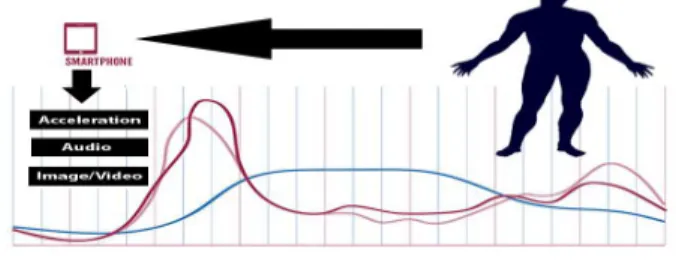
with smartphone can be classified through several types. Communication type usually relates to phone calling and message texting including chat as commu-nication activity. Motion type describes how a user in-teracts in motion with her smartphone using motion sensor measurement such as accelerometer, gyroscope, and orientation sensor. Multimedia (audio visual) type involves many human and phone interaction making use to camera capturing image and vide as well as voice recording. There are many other types can be men-tioned but up to this point, we can already see abun-dant data we can collect from user via user-phone interaction. We propose a framework that makes use of this multimodal human context from various user-phone interaction types as depicted in two figures as follows:
2012년도 한국멀티미디어학회 춘계학술발표대회 논문집 제15권1호
72 -그림 2 processing module in smartphone for
authentication References
[ 1 ] Furnell, S., Clarke, N., and Karatzouni, S. “Beyond the PIN: Enhancing User Authentication for Mobile Devices”, Computer Fraud and Security, Vol. 2008, Issue 8, pp. 2008
[ 2 ] Sieger, H., Kirschnik, N., Möller, S. “POSTER: User Preferences for Biometric Authentication Methods and Graded Security on Mobile Phones”,
Proceeding
of
the
6
thSymposiumonUsableP rivacyandSecurity(SOUP S’
10)
. 2010.Redmond, WA, USA.[ 3 ] Malaysia car thieves steal finger, http://new-s.bbc.co.uk/2/hi/asia-pacific/4396831.stm (Retrieved 3 April 2012)