Equilibrium and kinetic studies of an electro-assisted lithium
recovery system using lithium manganese oxide adsorbent
material
Dong-Hee Lee
1,*, Taegong Ryu
2,*, Junho Shin
3, and Young Ho Kim
1,♠1Department of Chemical Engineering and Applied Chemistry, Chungnam National University, Daejeon 34134, Korea 2Mineral Resources Research Division, Korea Institute of Geoscience and Mineral Resources, Daejeon 34132, Korea 3Department of Biological Engineering, Inha University, Incheon 22212, Korea
Received
6 March 2018
Accepted 20 March 2018
♠Corresponding Author
E-mail: [email protected] Tel: +82-42-821-5898
*The authors have contributed equally in discussions of the work, performing the experiments, and writing the paper.
Open Access
pISSN: 1976-4251 eISSN: 2233-4998
Article Info
Copyright © Korean Carbon Society
http://carbonlett.org
Abstract
This study examined the influence of operating parameters on the electrosorptive recovery system of lithium ions from aqueous solutions using a spinel-type lithium manganese oxide adsorbent electrode and investigated the electrosorption kinetics and isotherms. The results revealed that the electrosorption data of lithium ions from the lithium containing aqueous solution were well-fitted to the Langmuir isotherm at electrical potentials lower than –0.4 V and to the Freundlich isotherm at electrical potentials higher than –0.4 V. This result may due to the formation of a thicker electrical double layer on the surface of the electrode at higher electrical potentials. The results showed that the electrosorption reached equilibrium within 200 min under an electrical potential of –1.0 V, and the pseudo-second-order kinetic model was correlated with the experimental data. Moreover, the adsorption of lithium ions was dependent on pH and temperature, and the results indicate that higher pH values and lower temperatures are more suitable for the electrosorptive adsorption of lithium ions from aqueous solutions. Thermodynamic results showed that the calculated activation energy of 22.61 kJ mol–1 during the electrosorption of lithium ions onto the adsorbent electrode was primarily controlled by a physical adsorption process. The recovery of adsorbed lithium ions from the adsorbent electrode reached the desorption equilibrium within 200 min under reverse electrical potential of 3.5 V.
Key words: lithium recovery, lithium manganese oxide, electrosorption equilibrium, kinetic, isotherm
1. Introduction
The recovery of lithium from natural reservoirs is garnering significant attention because of the high demand for lithium, which is used in energy storage systems for portable electronic devices and electric vehicles [1-3]. Lithium can be recovered from various natural sources such as brines and ores [4], as well as the leaching solution of spent secondary lithium ion batteries [5,6]. Currently, various attempts have been made to recover lithium from solutions such as groundwater and seawater, which contain ex-tremely low concentrations of lithium compared with other cations [7-11]. To recover lithium ions from seawater more effectively, it is important to develop an adsorbent that has a high lithium selectivity against other coexisting cations, such as potassium, calcium, and magnesium contained in seawater. In particular, lithium manganese oxide (LMO) with a spinel structure has been increasingly considered as an effective adsorbent because it can selectively recover lithium ions in an aqueous solution containing various cations [11-16]. Numerous efforts have been made towards the practical application of LMO adsorbent in aqueous solutions by the fabrication of composites using a polymeric
DOI: http://dx.doi.org/
DOI:10.5714/CL.2018.28.087
This is an Open Access article distributed under the terms of the Creative Commons Attribution Non-Commercial License (http://creativecommons.org/licenses/ by-nc/3.0/) which permits unrestricted non-commercial use, distribution, and reproduction in any medium, provided the original work is properly cited.
A brief review on graphene applications in rechargeable lithium ion battery electrode materials Sameen Akbar, Muhammad Rehan, Liu Haiyang, Iqra Rafique, and Hurria Akbar
KCS Korean Carbon Society
carbonlett.org
pISSN: 1976-4251 eISSN: 2233-4998
REVIEWS
HMO powder. PVA dissolved in deionized water, glutaral-dehyde (GA; 25wt%, Samchun Pure Chemical, Korea) as a cross-linking agent, and the HMO powder were mixed using a slurry mixer to obtain a homogeneous slurry. The slurry was then cast on a graphite sheet (Sigaflex, SGL Carbon, Germa-ny) using a doctor blade (Mitutoyo, Japan) and dried at room temperature. To accelerate the esterification between the PVA and GA, an HCl solution was sprayed over the coated slurry. The electrode was then pressed using a roll press with a thick-ness of approximately 150 μm, and the loaded HMO on the graphite sheet (10 cm × 10 cm in size) was approximately 0.4 g.
As a counter electrode, an activated carbon powder (ACP; specific surface area of 1260 m2 g–1, Kuraray Chemical, Japan) electrode using poly(vinylidene fluoride) (PVdF; Sigma-Aldrich) as a polymeric binder was used for the experiment [24]. The total binder content in the ACP electrode was 15% dry weight. The thickness of the ACP composite layer was approximately 250 μm, and the loaded amounts of ACP on the graphite sheet (10 cm × 10 cm in size) was approximately 1.0 g.
2.2. Preparation of the test cell
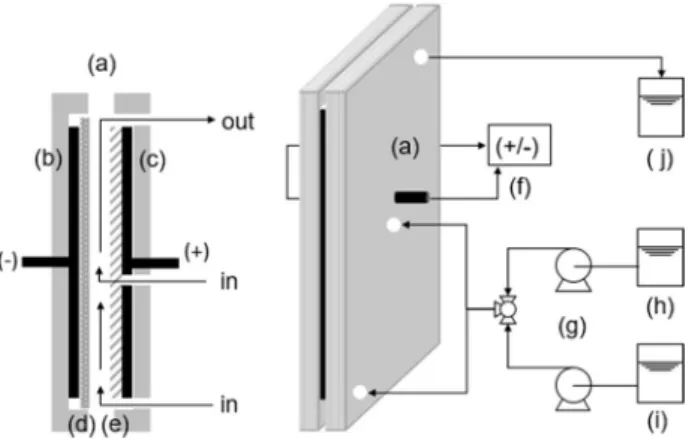
The test cell was fabricated by modifying a conventional MCDI cell that consisted of two carbon electrodes, an anion exchange membrane and a dielectric spacer [19,24,25]. Fig. 1 shows a schematic diagram of the test cell and the system con-figuration of the experimental device. It consisted of the ACP electrode for anion capture, the HMO electrode for lithium ion adsorption, an anion exchange membrane (Neosepta AMX, Tokuyama Soda Corp.), a dielectric spacer (porous urethane foam, 200 μm thick), and the two acryl plates. The distance between the two electrodes in the assembly of the components was maintained at approximately 150 μm by a flexible dielectric spacer. The upper plate was designed to give two inlet holes at the corner and one outlet hole at the center of the plate with an inner diameter of 2 mm so that a solution could flow and contact the inner sides of the electrodes.
binder. The use of a polymeric binder, however, might cause a decrease in adsorption efficiency because of the obstruction of lithium ion transfer into the composite by the binder on the adsorbent surface. In addition, the acidic solution used in the desorption of adsorbed lithium ions may lead to structural damage by dissolution of manganese from the adsorbent and secondary environmental problems [15,16].
To overcome these challenges, we previously reported an electro-assisted lithium recovery system [17,18] using the con-cept of a modified membrane capacitive deionization (MCDI) process [19,20]. Compared with the conventional adsorption process using an adsorbent-binder composite, the recovery sys-tem with the electro-assisted method was noteworthy in that the lithium adsorption/desorption rates were improved, and the use of acidic solutions in the desorption process were not required. Moreover, a relatively excellent selectivity of lithium ions against other cations, such as potassium, sodium, calcium, and magnesium dissolved in seawater, was obtained [21].
In this study, we report in detail the isotherms and kinetics of the adsorption of lithium ions from aqueous solution under an electrical potential on the adsorbent electrode. We investigat-ed the influence of the pH, temperature, appliinvestigat-ed potential, and lithium ion concentration experimental parameters. The classi-cal Langmuir and Freundlich adsorption isotherms were used to understand the adsorption behavior of lithium ions during electrosorption, and the electrosorption rates were determined quantitatively using pseudo-first and second-order kinetics mod-els. Moreover, we discuss the effect of electrosorptive potential on lithium ion recovery in terms of the recovered amount during the electro-desorption process. We expect that this experimental information will induce further development of electro-assisted lithium recovery systems for use in practical lithium ion recov-ery from such solutions as waste effluent, ground water, and seawater.
2. Experimental
2.1. Preparation of electrodes
The preparation procedure of the spinel-type LiMn2O4 pow-der (LMO) and adsorbent electrode used in this study was re-ported in our previous reports [18,21]. Briefly, the LMO was prepared through a solid-state reaction [22] using Li2CO3 (99%, Aldrich, USA) and MnCO3 (99.9%, Aldrich) as the reactants. After mixing reactants at a lithium/manganese molar ratio of 1 of 2 by ball milling, the mixture was calcined at 500°C for 4 h in air. The calcined powder was then immersed into a 0.3 M HCl solution and stirred by a mechanical stirrer for 5 days to fully extract the lithium ions from the LMO framework through an H+/Li+ exchange reaction, which was confirmed by inductively coupled plasma (ICP) analysis [23]. The resulting LMO powder was washed with deionized water for several times until the fil-trate reached a neutral pH, and then the filtered powder was col-lected and dried at 60°C overnight. Here, the resultant adsorbent powder is designated as HMO.
For the preparation of adsorbent electrodes, polyvinyl al-cohol (PVA; molecular weight of 31,000–50,000, 98–99% hydrolyzed, Sigma-Aldrich) was used as a binder for the
Fig. 1.
Schematic view of the lithium recovery system using electrodes: (a) test cell, (b) activated carbon electrode, (c) HMO electrode, (d) anion exchange membrane, (e) porous urethane spacer, (f ) potentiostat, (g) peristaltic pump, (h) Li-solution reservoir, (i) deionized water reservoir, and (j) effluent reservoir.2.6. Activation energy
The activation energy of the electrosorption of lithium ions onto the HMO electrode was calculated as a function of temper-ature using the Arrhenius model. The form of the model equa-tion can be expressed as follows:
ln k2 (6)
where k2 is the pseudo-second-order rate constant, A is the Ar-rhenius constant, E is the activation energy of adsorption, R is the gas constant, and T is the temperature in Kelvin and E/R is the slope value of lnk2 versus 1/T.
3. Results and Discussion
3.1. Adsorption kinetics
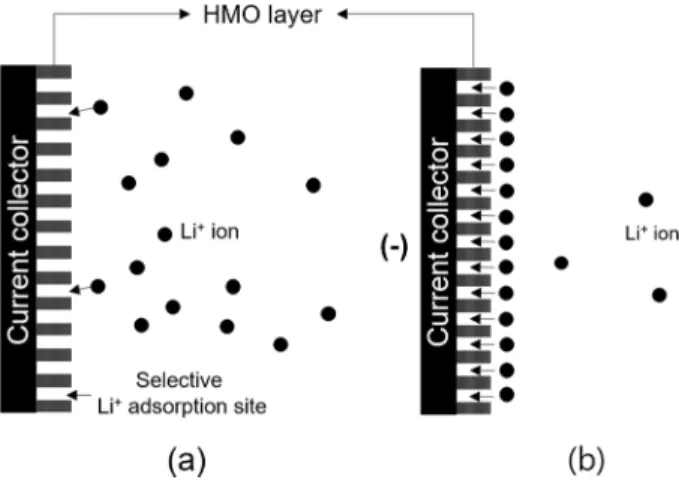
The most important factor in the adsorption study is the mass transfer rate. Considering the electrosorptive ion adsorption on the surface of the electrode, the adsorption and insertion of lithium ions onto the HMO electrode can be divided into the following three steps: (1) the mass transfer of lithium ions from the solution to the interface of the electrode and electrolyte; (2) the transfer of ions to the solid surface; and (3) the diffusion of lithium ions into the lithium vacant sites on the adsorbent. Typically, as illustrated in Fig. 2a, the adsorption efficiency was highly affected by the concentration of lithium ions in the aque-ous solution. In this system, the adsorbent-based lithium ad-sorption system might suffer from a slow adad-sorption rate when the concentration of lithium ions in the solution is low. On the other hand, the lithium adsorption rate can be improved under an applied electrical potential, as depicted in Fig. 2b, and the experimental results are shown in Fig. 3. As shown in Fig. 3, the adsorption rate and equilibrium capacity increased with ap-plied electrical potential. These results indicate that the adsorp-tion of lithium ions on the adsorbent was strongly affected by the electrical potential. The adsorption capacity increased with
2.3. Electrosorption properties
We investigated the influences of pH, temperature, electri-cal potential, and concentration of lithium ions in the feed so-lution on the lithium ion adsorption performance of the HMO electrode. The solution was continuously fed using a peristaltic pump from an influent reservoir with a flow rate of 20 mL min–1. The uptake of adsorbed lithium ions during the electrosorption process was calculated by the following equation [26]:
(1) where qt (mg g–1) is the adsorbed amount at sampled time (t), Co is the initial concentration of lithium ions, Ct is the concentration of lithium ions at sampled time (t), V is the solution volume (L), and m is the mass (mg) of the applied adsorbent. The concentra-tion of lithium ions in the sampled soluconcentra-tion was analyzed with an ICP-atomic emission spectrophotometer (ICP-AES; Optima 7300D, Perkin Elmer).
2.4. Adsorption kinetics
The adsorption kinetics were determined using the classical pseudo-first-order and pseudo-second-order adsorption kinetics equations [27-29], which are presented below.
(2) (3) where qe and qt are the amounts of adsorbed lithium ions (mg/g_ adsorbent) on the HMO electrode at equilibrium and time t (min), and k1 (min–1 or h–1) and k2 (g mg–1 min–1 or g mg–1 h–1) are pseudo-first and second-order rate constants, respectively. The lithium concentration of the feed solution was varied from 10 to 500 mg L–1 under various applied potentials (0 to –1.2 V).
2.5. Adsorption isotherms
The adsorption behavior of lithium ions on the HMO elec-trode was described quantitatively using adsorption isotherms. The classical Langmuir and Freundlich isotherms were used to describe the model of adsorption/electrosorption. Both iso-therms were plotted using the following equations by applying the experimental data.
(4) (5) where qe is the adsorbed amount of lithium ions at equilibrium (mg/g_adsorbent), qm is the maximum adsorption capacitance corre-sponding to monolayer coverage (mg/g_adsorbent), KL is the Lang-muir constant related to sorption energy (enthalpy of adsorp-tion), and C is the equilibrium concentration of lithium ions. KF (L mg–1) is the Freundlich constant, and 1/n is an indication of the adsorption tendency of the adsorbate.
Fig. 2.
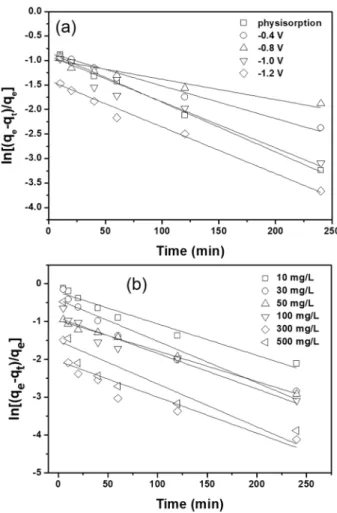
Schematic illustration of lithium ion movements in solution (a) without electrical potential (physisorption) and (b) with electrical poten-tial.as shown in Fig. 5, the experimental data and the pseudo-second-order kinetic model were in good agreement for vari-ous electrical potentials and a wide range of initial lithium concentrations with the higher R2 values of >0.99. Thus, the electrosorption kinetics of lithium ions on the adsorbent elec-trode more closely followed the pseudo-second-order model rather than the first-order model.
an increasing electrical potential up to –1.2 V. Compared with physisorption without the electrical potential, the equilibrium capacity increased by 5.7 times at –1.2 V. Although the adsorp-tion capacity did not increase proporadsorp-tionally with the electrical potential, we considered that the adsorption rate and capacity of lithium ions with respect to the HMO electrode depended on the electrical potential through the increasing electrostatic force [30].
The adsorption rate is important to understanding the lith-ium adsorption behavior on adsorbents. To examine the ef-fect of applied electrical potential on lithium ion adsorption, the electrosorption was continued until the reaction reached a dynamic equilibrium (as determined by monitoring the con-ductivity of the effluent solution) to give the lithium ions full access to the HMO electrode. Fig. 4a shows the linearized plot fittings of the first-order kinetic model under the experi-mental conditions of 100 mg L–1 lithium ions in the feed solu-tion at 25°C, and Fig. 4b shows the effect of different initial concentrations of lithium ions for electrosorption. The pseu-do-first order kinetics model appeared to be well fitted for an adsorption potential of –0.4 V, as presented in Table 1; how-ever, the coefficients of determination of the linearized plots under other conditions (R2) did not match properly with that of the pseudo-first-order kinetics model. On the other hand,
Fig. 3.
Electrosorption capacities and rates of lithium ions with various applied electrical potentials.Fig. 4.
Plots of the pseudo-first-order kinetics model with (a) different electrical potentials at 100 mg L–1 and (b) different initial concentrationsof lithium ions at –1.0 V.
Table 1.
Pseudo-first-order and pseudo-second-order parameters of the HMO and ACP electrodes system for the adsorption of lithium ions fromaqueous solution under various applied voltages (T=25°C, Co=100 mg L–1) Applied potential
Pseudo-first-order model Pseudo-second-order model
qe (mg g–1) (hk–11) R2 (mg gqe–1) (g mgk2-1 h-1) R2 Physisorption 2.070 0.682 0.901 2.175 1.193 0.993 –0.4 V 5.436 0.400 0.969 5.510 0.682 0.996 –0.8 V 5.876 0.248 0.866 5.882 0.604 0.991 –1.0 V 11.335 0.564 0.929 11.506 0.444 0.999 –1.2 V 11.838 0.681 0.753 11.993 0.581 0.999
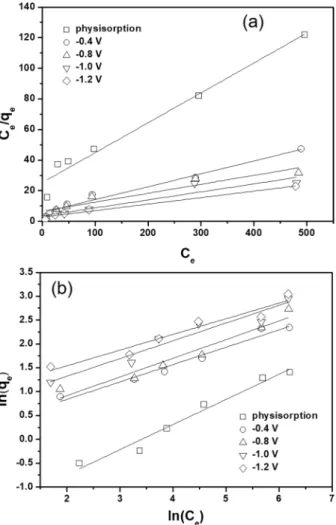
dlich adsorption isotherms. The Langmuir equation is the most commonly used isotherm because of its simplicity and capabil-ity to correlate a variety of adsorption experimental data into the isotherm model. To understand the effect of ion concentration and applied potential on the adsorption and/or electrosorption behavior, systematic experiments were conducted under various lithium concentrations of the feed solution (10 to 500 mg L–1) and applied electrosorption potentials (physisorption to –1.2 V against the HMO and ACP electrode system). The linearized
3.2. Adsorption isotherms
Electrosorption is generally defined as the potential-induced adsorption onto the surface of electrodes [31]. Thus, it is impor-tant to understand equilibrium adsorption in designing an ad-sorption system under applied electrical potential. In this study, the adsorption behavior of lithium ions on the HMO electrode can be described quantitatively using the Langmuir and
Freun-Fig. 5.
Plots of the pseudo-second-order kinetics model with (a) differ-ent electrical potdiffer-entials at 100 mg L–1 and (b) different initialconcentra-tions of lithium ions at –1.0 V.
Table 2.
Parameters determined by plotting the Langmuir and Freundlich isotherms for the electrosorption performance of the HMO and ACPelectrodes system
Applied potential Langmuir Freundlich
qm KL R2 KF n R2 Physisorption 5.116 0.008 0.966 0.165 1.898 0.965 –0.4 V 11.898 0.015 0.972 1.116 2.746 0.965 –0.8 V 17.117 0.009 0.879 1.140 2.552 0.933 –1.0 V 19.139 0.015 0.879 1.777 2.684 0.914 –1.2 V 20.973 0.016 0.883 2.412 3.041 0.926
Fig. 6.
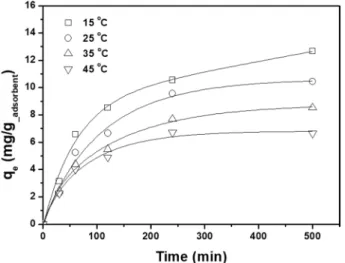
Electrosorption isotherms of lithium ions with various applied voltages. (a) The Langmuir isotherm and (b) the Freundlich isotherm. (T of 25°C, V of 1000 mL, and adsorption time of 500 min).interaction between the adsorbent and adsorbate becoming stronger at low temperatures [35,36]. Therefore, we conclud-ed that a lower operation temperature might be advantageous for enhancing the adsorption capacity of lithium adsorption on the adsorbent electrode used in this system.
3.4. Activation energy
The pseudo-second-order rate constants were used to eval-uate the spontaneity of the lithium adsorption on the HMO electrode during the electrosorption process and the type of interactions between the adsorbent and lithium ions. Accord-ing to Eq. 6, k2 was plotted versus 1/T, and a straight line with slope –Ea/R was obtained. In the capacitive ion adsorption process, the magnitude of activation energy should provide information on the type of adsorption [37]. As shown in Fig. 8, the calculated Arrhenius activation energy was 22.61 kJ mol–1. This indicates that the adsorption of lithium ions on the adsorbent electrode under application of an electrical po-tential was mainly dominated by physisorption rather than chemisorption (E > 40 kJ mol–1) [38].
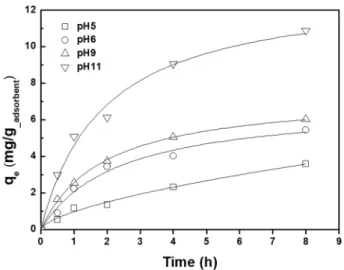
3.5. Effect of pH
Fig. 9 shows the electrosorption kinetics and electrosorption capacities of lithium ion solutions with various pH values. The pH of the solutions was adjusted using LiCl, LiOH, and HCl. The solution was purged with N2 gas (99.999%) to remove the dissolved oxygen during the experiment. As shown in Fig. 9, the pH of the solution played a significant role in lithium ion electrosorption under an applied electrical potential of –1.0 V. The lithium ion uptake increased from 3.1 mg/g_adsorbent at pH 5 to 11 mg/g_adsorbent at pH 11. A lower solution pH reduced the lithium uptake, in which even the adsorbed lithium ions could be extracted from the adsorbent structure because of the compet-ing ion exchange reaction between the protons in solution and the lithium ions on the adsorbent. The results showed that the adsorption rate and capacity decreased with a decreasing solu-tion pH, which corresponded to the adsorpsolu-tion contribusolu-tion to physisorption [39].
plots of Langmuir and Freundlich isotherms for lithium ions are presented in Fig. 6. The parameter values and correlation coef-ficients for the adsorption isotherms are presented in Table 2, which confirmed that all of the isotherm model parameters for the electrosorption of lithium ions in the HMO and ACP elec-trode system were well fitted for the two isotherm models. More specifically, according to the correlation coefficient (R2), the Langmuir isotherm correlated better with the experimental data at the lower electrical potential range (< –0.4 V). On the other hand, the Freundlich isotherm correlated better at the higher electrical potential range (–0.8 to –1.2 V). These results indicate that monolayer adsorption was predominant at a low electrical potential, and multilayer adsorption was predominant at a high electrical potential because of the formation of a thicker electric double layer. Several studies have also applied the Freundlich equation to describe electrosorption in a capacitive system with high electrosorption potentials (> –1.0 V) [19,32]. However, it is difficult to explain the electrosorption mechanism using the classical Langmuir and Freundlich adsorption isotherm models because of the presence of an electrical potential. To explain the electrosorption phenomenon, various approaches have been employed. Biesheuvel et al. [33] suggested a modified Donann model that describes ion storage in the micropores of porous carbon materials such as activated carbon. Han et al. [34] sug-gested a quasi-equilibrium system that shows a Freundlich-like sorption behavior attributed to the micropore structure of the electrode material.
3.3. Effect of temperature
We investigated the effect of temperature on electrosorp-tion in the range from 15 to 45°C at –1.0 V adsorpelectrosorp-tion poten-tial, and the results are represented in Fig. 7. It was found that the temperature of the feed solution had a significant effect on the adsorption performance. Moreover, a lower temperature was more favorable for lithium ion adsorption on the HMO electrode under an electrical potential, where the amount of adsorbed lithium increased from 6.65 mg/g_adsorbent at 45°C to 12.66 mg/g_adsorbent at 15°C. This might have been due to the
Fig. 7.
Electrosorption kinetics of lithium ions at various solutiontem-peratures.
Fig. 8.
Arrhenius plot for the activation energy of the electrosorption of lithium ions on the adsorbent-ACP electrodes system.
adsorption potential of -1.2 V was applied, and this indicated that the adsorption capacity was dependent on the electrical potential for this electro-based lithium recovery process.
4. Conclusions
To understand the electrosorption behavior of lithium ions on an adsorbent electrode in the proposed electro-assisted lithium recovery system, we investigated the influence of experimen-tal parameters, including pH, temperature, applied potential, and lithium ion concentration. The electrosorption capacity in-creased with an increasing electrostatic force. The experimental data were well matched with the Langmuir isotherm at poten-tials lower than –0.4 V and the Freundlich isotherm model at potentials higher than –0.4 V. The amount of adsorbed lithium ions decreased with an increasing solution temperature. The electrosorption kinetics well fit the pseudo-second-order kinetic model. The calculated activation energy was 22.61 kJ mol–1, which indicated that the adsorption of lithium ions on the HMO surface was primarily consistent with physical adsorption. In the desorption process, adsorbed lithium ions were effectively recovered with an electrical potential of 3.5 V within 200 min from the effluent water.
Conflict of Interest
No potential conflict of interest relevant to this article was reported.
Acknowledgements
This work was also supported by the National Research Foundation of Korea (NRF) grant funded by the Korean govern-ment (MSIP) (NRF-2015R1A2A2A01002828).
References
[1] Diouf B, Pode R. Potential of lithium-ion batteries in renewable en-ergy. Renewable Energy, 76, 375 (2015). https://doi.org/10.1016/j. renene.2014.11.058.
[2] Ren G, Ma G, Cong N. Review of electrical energy storage system for vehicular applications. Renewable Sustainable Energy Rev, 41, 225 (2015). https://doi.org/10.1016/j.rser.2014.08.003.
[3] Scrosati B, Hassoun J, Sun YK. Lithium-ion batteries: a look into the future. Energy Environ Sci, 4, 3287 (2011). https://doi. org/10.1039/C1EE01388B.
[4] Gruber PW, Medina PA, Keoleian GA, Kesler SE, Everson MP, Wallington TJ. Global lithium availability. J Ind Ecol, 15, 760 (2011). https://doi.org/10.1111/j.1530-9290.2011.00359.x. [5] Meshram P, Pandey BD, Mankhand TR. Extraction of lithium from
primary and secondary sources by pre-treatment, leaching and separation: a comprehensive review. Hydrometallurgy, 150, 192 (2014). https://doi.org/10.1016/j.hydromet.2014.10.012.
[6] Shuva MAH, Kurny ASW. Hydrometallurgical recovery of value metals from spent lithium ion batteries. Am J Mater Eng Technol,
3.6. Desorption characteristics
The electrodesorption kinetics was examined at a fixed electrical potential of 3.5 V. Before the tests, 100 mg L–1 of a LiCl solution was fed into the test cell, and the adsorption test was conducted by varying the electrical potential from physi-sorption to –1.2 V for 90 min. Then, the adsorbent electrode was washed with deionized water for 180 min to remove the lithium ions that were not adsorbed on the adsorbent elec-trode. The desorption equilibrium was reached within ap-proximately 200 min for all cases and maintained at a nearly similar level up to 500 min, as shown in Fig. 10. This means that most of the lithium ions inserted into the adsorbent were desorbed at the earlier stage of electrodesorption (within 100 min) and slowly released afterwards. Moreover, the maxi-mum amount of lithium (6.3 mg/g_adsorbent) desorbed when an
Fig. 9.
Effect of pH on the electrosorption of lithium ions (T of 30°C; V of 200 mL; electrosorption for 8 h; a lithium concentration in the stock solution of 100 mg L–1, and cell potential of –1.0 V).Fig. 10.
Desorption rate of lithium ions from the adsorbent electrode under a reverse potential of 3.5 V. (a-e) indicate the applied adsorption potentials for the electrosorption process.[22] Ryu T, Shin J, Ryu J, Park I, Hong H, Kim BG, Chung KS. Prep-aration and characterization of a cylinder-type adsorbent for the recovery of lithium from seawater. Mater Trans, 54, 1029 (2013). https://doi.org/10.2320/matertrans.M2013028.
[23] Han Y, Kim H, Park J. Millimeter-sized spherical ion-sieve foams with hierarchical pore structure for recovery of lithium from sea-water. Chem Eng J, 210, 482 (2012). https://doi.org/10.1016/j. cej.2012.09.019.
[24] Kim YJ, Choi JH. Enhanced desalination efficiency in capacitive deionization with an ion-selective membrane. Sep Purif Technol, 71, 70 (2010). https://doi.org/10.1016/j.seppur.2009.10.026. [25] Li H, Gao Y, Pan L, Zhang Y, Chen Y, Sun Z. Electrosorptive
desalination by carbon nanotubes and nanofibres electrodes and ion-exchange membranes. Water Res, 42, 4923 (2008). https://doi. org/10.1016/j.watres.2008.09.026.
[26] Abbasi S, Noorizadeh H. Adsorption of Nile Blue A from aque-ous solution by different nanostructured carbon adsorbents. Carbon Lett, 23, 30 (2017). https://doi.org/10.5714/CL.2017.23.030. [27] Wan MW, Kan CC, Rogel BD, Dalida MLP. Adsorption of copper
(II) and lead (II) ions from aqueous solution on chitosan-coated sand. Carbohydr Polym, 80, 891 (2010). https://doi.org/10.1016/j. carbpol.2009.12.048.
[28] Ho Y. Review of second-order models for adsorption systems. J Hazard Mater, 136, 681 (2006). https://doi.org/10.1016/j. jhazmat.2005.12.043.
[29] Ho YS, McKay G. Kinetic models for the sorption of dye from aqueous solution by wood. Process Saf Environ Prot, 76, 183 (1998). https://doi.org/10.1205/095758298529326.
[30] Chen Z, Song C, Sun X, Guo H, Zhu G. Kinetic and isotherm stud-ies on the electrosorption of NaCl from aqueous solutions by acti-vated carbon electrodes. Desalination, 267, 239 (2011). https://doi. org/10.1016/j.desal.2010.09.033.
[31] Huang SY, Fan CS, Hou CH. Electro-enhanced removal of copper ions from aqueous solutions by capacitive deioniza-tion. J Hazard Mater, 278, 8 (2014). https://doi.org/10.1016/j. jhazmat.2014.05.074.
[32] Biesheuvel PM. Thermodynamic cycle analysis for capacitive deionization. J Colloid Interface Sci, 332, 258 (2009). https://doi. org/10.1016/j.jcis.2008.12.018.
[33] Biesheuvel PM, Zhao R, Porada S, van der Wal A. Theory of mem-brane capacitive deionization including the effect of the electrode pore space. J Colloid Interface Sci, 360, 239 (2011). https://doi. org/10.1016/j.jcis.2011.04.049.
[34] Han L, Karthikeyan KG, Anderson MA, Wouters JJ, Gregory KB. Mechanistic insights into the use of oxide nanoparticles coated asymmetric electrodes for capacitive deionization. Elec-trochim Acta, 90, 573 (2013). https://doi.org/10.1016/j.electac-ta.2012.11.069.
[35] Li H, Pan L, Zhang Y, Zou L, Sun C, Zhan Y, Sun Z. Kinetics and thermodynamics study for electrosorption of NaCl onto carbon nanotubes and carbon nanofibers electrodes. Chem Phys Lett, 485, 161 (2010). https://doi.org/10.1016/j.cplett.2009.12.031.
[36] Wang HJ, Xi XK, Kleinhammes A, Wu Y. Temperature-induced hydrophobic-hydrophilic transition observed by water adsorp-tion. Science, 322, 80 (2008). https://doi.org/10.1126/sci-ence.1162412.
[37] Mossad M, Zou L. A study of the capacitive deionisation perfor-mance under various operational conditions. J Hazard Mater, 213-214, 491 (2012). https://doi.org/10.1016/j.jhazmat.2012.02.036. 1.8 (2013). https://doi.org/10.12691/materials-1-1-2
[7] Hong HJ, Park IS, Ryu T, Ryu J, Kim BG, Chung KS. Granulation of Li1.33Mn1.67O4(LMO) through the use of cross-linked chitosan for the effective recovery of Li+ from seawater. Chem Eng J, 234, 16 (2013). https://doi.org/10.1016/j.cej.2013.08.060.
[8] Park MJ, Nisola GM, Beltran AB, Torrejos REC, Seo JG, Lee SP, Kim H, Chung WJ. Recyclable composite nanofiber adsorbent for Li+ recovery from seawater desalination retentate. Chem Eng J, 254, 73 (2014). https://doi.org/10.1016/j.cej.2014.05.095. [9] Sagara F, Ning WB, Yoshida I, Ueno K. Preparation and
adsorp-tion properties of λ-MnO2-cellulose hybrid-type ion-exchanger for lithium ion. Application to the enrichment of lithium ion from seawater. Sep Sci Technol, 24, 1227 (1989). https://doi. org/10.1080/01496398908049899.
[10] Umeno A, Miyai Y, Takagi N, Chitrakar R, Sakane K, Ooi K. Prep-aration and adsorptive properties of membrane-type adsorbents for lithium recovery from seawater. Ind Eng Chem Res, 41, 4281 (2002). https://doi.org/10.1021/ie010847j.
[11] Chung K, Lee J, Kim W, Kim S, Cho K. Inorganic adsorbent containing polymeric membrane reservoir for the recovery of lithium from seawater. J Membr Sci, 325, 503 (2008). https://doi. org/10.1016/j.memsci.2008.09.041.
[12] Feng Q, Miyai Y, Kanoh H, Ooi K. Lithium (1+) extraction/in-sertion with spinel-type lithium manganese oxides. Characteriza-tion of redox-type and ion-exchange-type sites. Langmuir, 8, 1861 (1992). https://doi.org/10.1021/la00043a029.
[13] Ooi K, Miyai Y, Katoh S, Maeda H, Abe M. Topotactic lithium (1+) insertion to. lambda.-manganese dioxide in the aqueous phase. Langmuir, 5, 150 (1989). https://doi.org/10.1021/la00085a028. [14] Chitrakar R, Kanoh H, Makita Y, Miyai Y, Ooi K. Synthesis of
spinel-type lithium antimony manganese oxides and their Li+ ex-traction/ion insertion reactions. J Mater Chem, 10, 2325 (2000). https://doi.org/10.1039/B002465L.
[15] Ma LW, Chen BZ, Chen Y, Shi XC. Preparation, characteriza-tion and adsorptive properties of foam-type lithium adsorbent. Microporous Mesoporous Mater, 142, 147 (2011). https://doi. org/10.1016/j.micromeso.2010.11.028.
[16] Shi X, Zhou D, Zhang Z, Yu L, Xu H, Chen B, Yang X. Synthesis and properties of Li1.6Mn1.6O4 and its adsorption application. Hy-drometallurgy, 110, 99 (2011). https://doi.org/10.1016/j.hydrom-et.2011.09.004.
[17] Ryu T, Ryu JC, Shin J, Lee DH, Kim YH, Chung KS. Recovery of lithium by an electrostatic field-assisted desorption process. Ind Eng Chem Res, 52, 13738 (2013). https://doi.org/10.1021/ ie401977s.
[18] Ryu T, Lee DH, Ryu JC, Shin J, Chung KS, Kim YH. Lithium re-covery system using electrostatic field assistance. Hydrometallurgy, 151, 78 (2015). https://doi.org/10.1016/j.hydromet.2014.11.005. [19] Biesheuvel PM, van der Wal A. Membrane capacitive
deioniza-tion. J Membr Sci, 346, 256 (2010). https://doi.org/10.1016/j.mem-sci.2009.09.043.
[20] Lee JH, Ahn HJ, Cho D, Youn JI, Kim YJ, Oh HJ. Effect of sur-face modification of carbon felts on capacitive deionization for desalination. Carbon Lett, 16, 93 (2015). https://doi.org/10.5714/ CL.2015.16.2.093.
[21] Lee DH, Ryu T, Shin J, Ryu JC, Chung KS, Kim YH. Selective lithium recovery from aqueous solution using a modified mem-brane capacitive deionization system. Hydrometallurgy, 173, 283 (2017). https://doi.org/10.1016/j.hydromet.2017.09.005.
[39] Wang L, Meng CG, Han M, Ma W. Lithium uptake in fixed-pH so-lution by ion sieves. J Colloid Interface Sci, 325, 31 (2008). https:// doi.org/10.1016/j.jcis.2008.05.005.
[38] Boparai HK, Joseph M, O’Carroll DM. Kinetics and thermody-namics of cadmium ion removal by adsorption onto nano zerova-lent iron particles. J Hazard Mater, 186, 458 (2011). https://doi. org/10.1016/j.jhazmat.2010.11.029.