한국정밀공학회 2013 년도 춘계학술대회논문집
1. Introduction
Acrylic pressure sensitive adhesives (PSAs) are widely used in various industrial applications. However, higher thermal stability of PSAs is needed especially for the recent semiconductor manufacturing processes. In this study, the thermal resistance of acrylic PSAs was improved by modifying the chain structure of acrylic polymers with the thermally stable moieties. The fluorene derivatives are well known to have high fluorescence yields, good thermal stability, and high glass-transition temperature. The adhesion performance of acrylic PSAs was investigated by measuring peel strength, gel content, and dynamic mechanical analysis. The thermal properties of acrylic PSAs were evaluated by differential scanning calorimetry, thermo gravimetric analysis, and dynamic mechanical analysis.
2. Experimental
2-Ethylhexyl acrylate (2-EHA), ethyl acrylate (EA), and acrylic acid (AA) were used to synthesize the acrylic copolymer. The acrylic copolymer was synthesized by solution radical polymerization with 1.5wt% AIBN in ethyl acetate at the solid content of 32.5wt%. The acrylic copolymer was modified with glycidylmethacrylate (GMA) which induced the carbon-carbon double bonds that were used for UV-curing. 9,9-bis(4-(but-3-enyl)phenyl)-9H-fluorene was synthesized to be used as crosslinking agent for
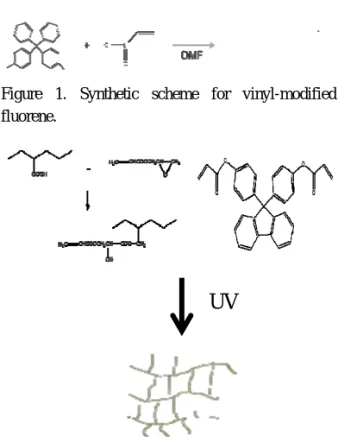
UV-radiation curing of acrylic PSAs. Firstly, 4,4´-(9-fluorenylidene) diphenol was synthesized with fluorenone and phenol. Then, 9,9-bis(4-(but-3-enyl)phenyl)-9H-fluorene was finally synthesized from 4,4´-(9-fluorenylidene) diphenol and acryloyl chloride. The vinyl-modified fluorene derivatives were dispersed in ethyl acetate and then incorporated into the acrylic copolymer structure via UV-curing method.
Figure 1. Synthetic scheme for vinyl-modified fluorene.
Figure 2. Preparation of UV-cured acrylic PSA containing fluorene structures.
비닐 변성 불소에 의한 광경화형
점착제의 열 안정성 향상
Improvement of thermal stability of UV-cured pressure sensitive
adhesive by incorporating vinyl-modified fluorene
*유종민
1, 김흠
1, 방패리
1, 강명랑
1, 한지호
1#김형일
1, 김현중
2*C.M. Ryu
1, X. Jin
1, B.L. Pang
1, M.R. Kang
1, J.H. Han
1,
#H. I. Kim([email protected])
1,
H. J. Kim
21충남대학교 공과대학 공업화학전공, 2서울대학교 농업생명과학대학 산림과학부
환경재료과학 전공
Key words : pressure sensitive adhesive, vinyl modified fluorene, thermal stability, photo curable
UV
한국정밀공학회 2013 년도 춘계학술대회논문집
3. Results
The extent of crosslinking in UV-cured acrylic PSAs was controlled by varying both the contents of modified fluorene derivatives and the UV dose. Figure 3 represents the effect of both the contents of modified fluorene derivatives and the UV dose on the gel content of UV-cured acrylic PSAs. The higher gel content was generally obtained for the acrylic PSAs having higher content of modified fluorene derivatives and higher UV dose as expected. It was proposed that the fluorene derivatives had high fluorescence yields, good thermal stability, and high glass-transition temperature. Therefore, the resistance to thermal degradation of the PSAs containing fluorene derivatives was expected to be improved. Figure 4 shows the TGA results. The degradation temperature of the UV-cured acrylic PSAs increased with increasing the content of fluorene derivatives.
Figure 3. Gel content of UV-cured acrylic PSAs at various fluorene derivatives contents and UV doses.
Figure 4. TGA thermogram of UV-cured acrylic PSAs at various flourene derivatives contents.
4. Conclusions
The vinyl-modified fluorene derivatives were uniformly dispersed in the acrylic copolymer, which was prepared by radical polymerization of 2-EHA, EA, and AA resulting in the formation of UV-cured acrylic PSAs films. The extent of crosslinking of acrylic PSAs varied significantly depending on the content of vinyl-modified fluorene derivatives and UV doses. The UV-cured acrylic PSAs containing vinyl-modified fluorene derivatives showed the improvement in thermal stability and elastic deformation characteristics.
Acknowledgements
This study was supported from a grants for “Development and Performance Control of Bonding and Debonding PSAs for MCP Semiconductor” by the Ministry of Knowledge Economy and Korea Research Council for Industrial Science & Technology.
References
1. Tao, S., Peng, Z., Zhang, X., Wang, P., Lee, C.S., Lee, S.T., Adv. Funct. Mater., 15, 1716-1721, 2005.
2. Pudzich, R., Salbeck, J., Synth. Mater., 21, 138, 2003.
3. Dean, D., Kenneth D. United States Patent : Patent Number, 5,124,307