© Korean Powder Metallurgy Institute 718 -1. Introduction
The present paper focuses on the effect of the initial composition of two Al powders and the pre-sintering heat treatment prior to the extrusion on the extrusion force, the hardness and the microstructure of the final product.
2. Experimental method, results and discussion Two different commercial aluminium powder grades were selected, a “pure” aluminium grade, ECKA ALUMINIUM AS91/S (ALP), and a premix 2000 series grade, ECKA ALUMIX 13 (EA13), containing 4.5 wt% Cu, 0.5 wt% Mg and 0.2 wt% Si. Cu is added as elemental particle, whereas Mg and Si are present as master alloys. The powders were uniaxially cold compacted at 94 %T.D. as cylinders 42.5 and 35 mm diameter and 20 mm height. The pre-sintering heat-treatment took place in a muffle, heating to 500 ºC, in Ar, soaking for 60 min. and cooling inside the tube. Prior to the extrusion runs, the compacts were heated at 425 ºC for 50 minutes inside the extrusion die. The extrusion ratio was 1:16 and the ram speed 1.5 mm/s.
Longitudinal cross-sections were mechanically polished and the microstructure was analyzed by SEM, EBSD and XRD. Vickers micro-hardness tests (500 g) were also performed.
The evolution of the extrusion load with time for both grades exhibit similar features: a first stage where load increases in a non-linear way, a second linear zone where full densification is obtained, and finally a plateau where the load takes a stationary value or decrease [1].
The pre-sintering heat treatment prior to extrusion does not affect significantly the extrusion loads for ALP.
Pre-sintering or pre-heating the compacts before extrusion decreases the hardness of the material, from 36 to 22 HV.
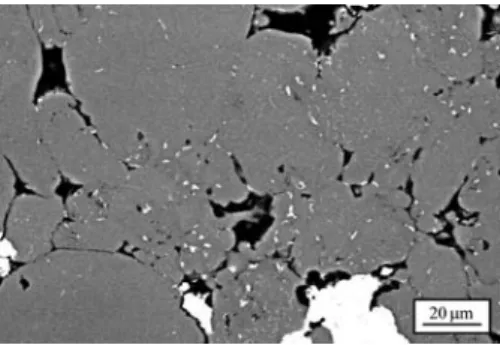
On the contrary, the pre-sintering prior to the extrusion produces an increase in the extrusion load for EA13, from 35 to 40 Ton. When the green compacts are heated, dissolution of the Cu and Mg into the Al matrix takes place. After pre-sintering, the outer layer of the former Cu particles is constituted by the inter-metallic CuAl2 phase together with other inter-metallic Cu-Al compounds concentrically arranged [2]. Additionally, a fine precipitation of CuAl2 takes place [3], Fig. 1, causing the almost complete disappearance of the elemental Cu, as observed by XRD. In these conditions, an increase of both the hardness (from 30 to 43 HV) and the extrusion load occurs.
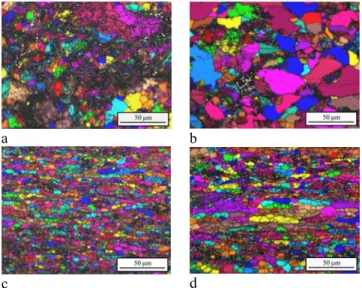
Fig. 1.- SEM micrographs of a pre-sintered product. During die-compaction, the Al powder particles experience a considerable cold deformation evidenced by the dark grit decorating a big part of the microstructure (Fig. 2a). Either heating to 425 °C or pre-sintering to 500 °C before extrusion leads to a statically recrystallized 2006 POWDER METALLURGY
World Congress
C02-02-2
Softening-hardening Mechanisms in the Direct Hot-extrusion
of Aluminium Compacts
C. Zubizarretab, I. Arribasc, S. Giménezd and I. Iturrizaa
CEIT and TECNUN Pº Manuel de Lardizabal 15, 20018 San Sebastian, Spain a
[email protected], [email protected]; [email protected]; [email protected] Abstract
Two different commercial aluminium powder grades have been densified by direct hot extrusion. The extrusion temperature was 425 °C, with an extrusion ratio of 1:16. Prior to extrusion, some green compacts were pre-sintered (500 °C). The evolution of the extrusion load during the process and the hardness of the final products have been investigated. Additionally, microstructural characterization by X-ray diffraction (XRD), Scanning Electron Microscopy (SEM) and Electron Backscattered Diffraction (EBSD) was carried out. The obtained results evidence grain refinement. Additionally, inter-metallic precipitation, dynamic recovery and geometric dynamic recrystallization take place depending on some process variables, powder composition, heat treatment, strain ...
© Korean Powder Metallurgy Institute 719
-microstructure (Fig. 2b). The hardness values for ALP, illustrate the softening effect of the heat-treatment agreeing well with this observation. All the different extruded products for ALP showed some similar characteristics, Fig. 2c, d. Extrusion produces an important grain refinement and a clear grain elongation in accordance with the macroscopic deformation. Additionally, due to the different degree of deformation between the periphery and the center of the extruded products, different softening mechanisms take place, Fig. 2c, d.
a b
c d
Fig. 2. - Unique grain color and image quality pictures corresponding to ALP: a) green compact; b) just before extrusion (after 50 min. at 425 ºC). Extruded product: c) periphery; d) center.
At the center of the specimen, the deformation-temperature combination produces elongated grains with a subgrain structure as a result of a Dynamic Recovery process, DRV. At the periphery, the material experiences a higher strain. Consequently, a finer and more equiaxed microstructure is attained, as a result of a Geometric Dynamic Recrystallization process (GDRX) [4]. GDRX takes place in the course of hot deformation when the original grain thickness is reduced to about two subgrains. Grain boundaries come locally into contact with each other causing the grain to pinch off. Therefore, a refined and nearly equiaxed grain structure is formed. On the other hand, the extrusion process leads to an increase of hardness in the material, from 22 to 32 HV due to the densification, the strain hardening and the grain refinement achieved. A smaller grain size is also responsible for a harder periphery. The microstructure of the EA13 green compacts obtained by EBSD before and after extrusion is similar to that of the ALP grade and can be represented by Fig. 2. However, when the specimens are pre-sintered, the microstructure after extrusion is different and not only in terms of inter-metallic precipitates. In the center of the specimen the
material shows, once again a DRV microstructure similar to Fig. 2d. However, the periphery shows a recovered structure instead of a GDRX one, Figure 3. The CuAl2 precipitates in the material before extrusion induce a pinning effect on the dislocations avoiding the grain serration. The presence of Cu in the EA13 products is responsible for the higher hardness ( >40 HV) comparing to the ALP. Again the periphery is harder than the center.
Fig. 3.- Unique grain color and image quality pictures corresponding to the periphery of a EA13 pre-sintered extruded product.
3. Conclusions
The effect of pre-sintering prior to extrusion depends on the composition of the initial powder. For the ALP grade, it does produce neither changes in the extrusion load nor differences in the microstructure and hardness of the extruded products. For the EA13 grade, the fine precipitation of CuAl2 particles taking place during the heat treatment, increases both hardness and extrusion load. DRV (centre) and GDRX (periphery) processes have been identified in the extruded products for both powders as the softening mechanisms taking place during extrusion. CuAl2 precipitates have demonstrated to hinder the progression from DRV to GDRX, affecting the final microstructure.
4. References
[1] E. K. Ioannidis and T. Sheppard. Journal of Materials Science, 1991. Vol. 26, p 4795.
[2] J.M.Martin, B. Navarcorena, I. Arribas, T. Gómez-Acebo and F. Castro.PM Wolrd Congress, PM'2004, Viena, 2004.
[3] B. Navarcorena, PhD Thesis, TECNUN, University of Navarra, 2005.
[4] H. J. McQueen, E. Evangelista and M. E. Kassner. Zeitschrift fuer Metallkunde, 1991. Vol. 82, N 5, p 336.