194 www.labmedonline.org eISSN 2093-6338 that caution must be exercised in the diagnosis of malaria when using anti-pLDH antibody.
CASE
A 22-year-old man was admitted to the hospital following 4 days of fever and chills. One month prior, the patient, with no re-markable medical history, was admitted to the Armed Forces Cap-ital HospCap-ital and was diagnosed with malaria. He was adminis-tered chloroquine for 3 days and primaquine for 11 days, and his symptoms subsided. However, the symptoms recurred 4 days be-fore admission to our hospital. On admission, his leukocyte count was 6,400/μL; hemoglobin, 14.8 g/dL; platelet, 78,000/μL; and C-reactive protein was elevated, 3.61 mg/dL. No pathogens were isolated from sputum or throat cultures. PBS was performed and more than 300 fields were examined at high magnification (×400). At the time of admission, both PBS and RDT (Malaria Ag Pf/Pan test, Standard Diagnostics, Yongin, Korea) results were negative.
Due to negative RDT and PBS results and low clinical suspicion
INTRODUCTION
Rapid diagnostics tests (RDTs) using anti-pan-Plasmodium lac-tate dehydrogenase (pLDH) antibody have been widely used along with peripheral blood smears (PBS) for the diagnosis of malaria. Malaria parasitemia, as determined by PBS, correlates with pLDH concentration in most cases [1]. Here, we report a case of malaria recurrence associated with false-negative RDT results, suggesting
독시사이클린에 의한 말라리아 신속검사의 위음성 결과
1예
A Case of False-negative Malaria Rapid Diagnostic Test Induced by Treatment with
Doxycycline
임재형·백은정
Jae-Hyung Lim, M.D., Eun Jung Baek, M.D. 한양대학교 의과대학 진단검사의학과
Department of Laboratory Medicine, College of Medicine, Hanyang University, Seoul, Korea
증례보고
Lab Med Online
Vol. 9, No. 3: 194-196, July 2019
https://doi.org/10.3343/lmo.2019.9.3.194 진단면역학
Corresponding author: Eun Jung Baek, M.D., Ph.D. https://orcid.org/0000-0001-5477-6486
Department of Laboratory Medicine, Hanyang University Guri Hospital, 153 Gyeongchun-ro, Guri 11923, Korea
Tel: +82-31-560-2485, Fax: +82-31-560-2489, E-mail: [email protected] Received: October 2, 2018
Revision received: October 10, 2018 Accepted: October 11, 2018
This article is available from http://www.labmedonline.org 2019, Laboratory Medicine Online
This is an Open Access article distributed under the terms of the Creative Commons Attribution Non-Commercial License (http://creativecommons.org/licenses/by-nc/4.0/) which permits unrestricted non-commercial use, distribution, and reproduction in any medium, provided the original work is properly cited.
Rapid diagnostic tests (RDTs) for malaria using antibodies against pan-Plasmodium antigen lactate dehydrogenase (pLDH) are commonly used for malaria diagnosis. The level of malaria parasitemia determined by peripheral blood smears (PBS) correlates with the pLDH concentration in most cases. We report a case of malaria recurrence associated with false-negative RDT results. A 22-year-old male patient was admitted to the Armed Forces Capital Hospital with fever and chills, and was diagnosed with malaria infection. Four days after antimalarial treatment, these symptoms recurred. After admitting to our hospital, doxycycline was administered for 4 days. Even after administration of doxycycline, the malaria parasites in blood smears remained positive, but RDT showed negative results. Therefore, for patients receiving doxycycline, serial blood smear testing should be performed to exclude false-negative malaria RDT results.
Key Words: Malaria, Rapid diagnostic test, Peripheral blood smear, Doxycycline, Lactate dehydrogenase 1 / 1
CROSSMARK_logo_3_Test
2017-03-16 https://crossmark-cdn.crossref.org/widget/v2.0/logos/CROSSMARK_Color_square.svg
임재형 외: False-negative Malaria Rapid Diagnostic Test
https://doi.org/10.3343/lmo.2019.9.3.194 www.labmedonline.org 195
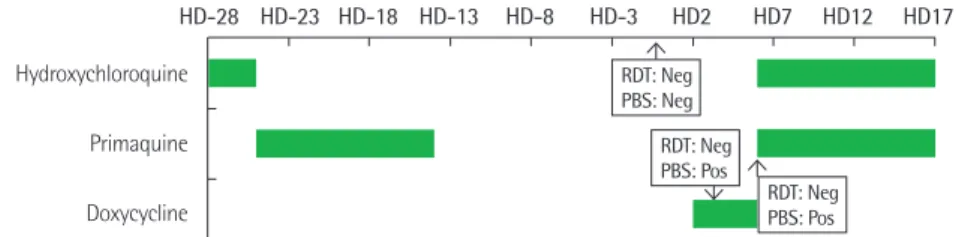
of malaria reinfection or recurrence, clinicians initiated a course of doxycycline for suspected epidemic hemorrhagic fever (EHF). On the 3rd day of hospitalization, PBS was repeated and yielded a positive result with a titer of 1,131/μL, rising to 1,360/μL on the 5th day. However, RDTs performed on both days remained negative. The patient was administered hydroxychloroquine and primaquine, and PBS results were negative after three days of treatment; he was discharged 10 days after admission (Fig. 1).
To evaluate the inconsistency between the RDT and PBS results on the 3rd and 5th days, the RDT was re-evaluated using internal quality control samples, but the results did not differ. A prozone phenomenon due to a high level of pLDH has been previously described [2], so to investigate this potential explanation, the spec-imens were diluted 2 and 4 times with normal saline; however, the results of this test were also negative.
DISCUSSION
Diagnosis of malaria based only on RDTs is cost-effective and operationally advantageous, since RDTs are easy to perform and provide results rapidly [3]. Most RDTs detect parasite histidine-rich protein 2 (pHRP-2) and pLDH from Plasmodium falciparum and
Plasmodium spp., respectively. While the pHRP-2 antigen can be
detected up to 40 days post-antibiotics treatment [4], the pLDH antigen has very short half-life of less than 2 days, and the median time on treatment for this test to become negative was reported as just 2 days [5]. Even though RDTs show good correlation with PBS results and can be used for evaluation of the treatment response and follow-up, low blood levels of pLDH can lead to false-nega-tive results [1, 6]. We were not able to evaluate the pLDH level in this patient’s sample; the parasitemia was much higher than that reported previously with low detectable pLDH (<1,000/μL) [1, 6]. Similarly, Jang et al. [1] reported 7 cases of high parasitemia with
low pLDH levels, but did not provide additional detailed data re-garding treatment history. pLDH levels reflect the level of viable parasitemia [7], and the World Health Organization guidelines also state that parasitemia is the most important criteria for confi-dent diagnosis [8].
In this case, we suspect that doxycycline administration may have influenced the RDT results. Doxycycline exhibits antimicro-bial activity via inhibition of bacterial cell wall synthesis and elim-inates malarial parasites in hepatocytes. Due to its effectiveness, doxycycline is administered as a therapeutic and preventive drug for malaria [9]. Despite a lack of studies reporting a direct associa-tion between doxycycline treatment and RDT results, Pasricha et al. [10] showed that 50% of patients with malarial infection and negative PBS and RDT results at the time of admission, had a his-tory of treatment with doxycycline. Even though anti-malarial drugs decrease the number of parasites in the blood [11], in our case, the malarial parasite titers were not low. These reports sug-gest that antibiotics administration lowered the pLDH concentra-tion due to a decreased number of viable parasites, resulting in false-negative RDT results. Therefore, in patients receiving doxy-cycline, serial PBS testing should be performed to exclude false-negative malarial RDT results. Further studies are required to elu-cidate the effect of doxycycline administration on RDT results.
요 약
pan-Plasmodium antigen lactate dehydrogenase (pLDH)에 대 한 항체를 이용하는 말라리아 신속검사는 말초혈액도말법과 함께 말라리아감염을 진단하는 대표적인 검사 방법이다. 혈청에서의 pLDH의 농도는 말초혈액도말법에서 확인할 수 있는 말라리아 원 충수와 상관관계가 있다고 알려져 있다. 우리는 말초혈액도말법에 서 말라리아 원충을 관찰할 수 있었지만 신속검사에서 위음성 결 과가 보고된 증례를 보고하고자 한다. 22세 남자 환자가 발열과 오
Fig. 1. Flow chart of diagnostic tests and treatments.
Abbreviations: HD, hospital day of admission; RDT, rapid diagnostic test; PBS, peripheral blood smear; Neg, negative; Pos, positive. Hydroxychloroquine Primaquine Doxycycline HD-28 HD-23 HD-18 HD-13 HD-8 HD-3 HD2 HD7 HD12 HD17 RDT: Neg PBS: Pos RDT: Neg PBS: Pos RDT: Neg PBS: Neg
임재형 외: False-negative Malaria Rapid Diagnostic Test https://doi.org/10.3343/lmo.2019.9.3.194 196 www.labmedonline.org 한으로 국군수도병원으로 내원하였고 말라리아 감염으로 진단 후 치료받았다. 치료 종료 후 4일째부터 다시 증상이 재발하여 독시 사이클린을 4일간 투약했다. 독시사이클린 투여 후 말초혈액도말 법에서 말라리아 원충이 지속적으로 관찰되었지만 신속검사에서 는 위음성으로 일관되게 보고되었다. 신속검사와 독시사이클린 간의 연관성을 배제할 수 없기 때문에 독시사이클린을 투여받은 환자들은 말초혈액도말법을 통하여 말라리아 신속검사 결과를 확 인해야 할 것이다.
AUTHORS’ DISCLOSURES OF POTENTIAL
CONFLICTS OF INTEREST
No potential conflicts of interest relevant to this article were re-ported.
REFERENCES
1. Jang JW, Cho CH, Han ET, An SS, Lim CS. pLDH level of clinically iso-lated Plasmodium vivax and detection limit of pLDH based malaria rapid diagnostic test. Malar J 2013;12:181.
2. Gillet P, Scheirlinck A, Stokx J, De Weggheleire A, Chaúque HS, Can-hanga OD, et al. Prozone in malaria rapid diagnostics tests: how many cases are missed? Malar J 2011;10:166.
3. Kim HS, Kang G, Lee S, Yoon CG, Kim M. Cost-benefit analysis of laria chemoprophylaxis and early diagnosis for Korean soldiers in
ma-laria risk regions. J Korean Med Sci 2018;33:e59.
4. Dalrymple U, Arambepola R, Gething PW, Cameron E. How long do rapid diagnostic tests remain positive after anti-malarial treatment? Ma-lar J 2018;17:228.
5. Grandesso F, Nabasumba C, Nyehangane D, Page AL, Bastard M, De Smet M, et al. Performance and time to become negative after treat-ment of three malaria rapid diagnostic tests in low and high malaria transmission settings. Malar J 2016;15:496.
6. Fogg C, Twesigye R, Batwala V, Piola P, Nabasumba C, Kiguli J, et al. Assessment of three new parasite lactate dehydrogenase (pan-pLDH) tests for diagnosis of uncomplicated malaria. Trans R Soc Trop Med Hyg 2008;102:25-31.
7. Piper R, Lebras J, Wentworth L, Hunt-Cooke A, Houzé S, Chiodini P, et al. Immunocapture diagnostic assays for malaria using Plasmodium lactate dehydrogenase (pLDH). Am J Trop Med Hyg 1999;60:109-18. 8. World Health Organization. Guidelines for the treatment of malaria -
3rd edition. Geneva: World Health Organization, 2015:27-30.
9. Gaillard T, Madamet M, Pradines B. Tetracyclines in malaria. Malar J 2015;14:445.
10. Pasricha JM, Juneja S, Manitta J, Whitehead S, Maxwell E, Goh WK, et al. Is serial testing required to diagnose imported malaria in the era of rapid diagnostic tests? Am J Trop Med Hyg 2013;88:20-3.
11. Miller RS, McDaniel P, Wongsrichanalai C. Following the course of malaria treatment by detecting parasite lactate dehydrogenase enzyme. Br J Haematol 2001;113:558-9.