[6] Y. Y. T. Cho, S. Shin, Disaggregation Simulation Analysis on Distinct Aβ40 Fibril Models, 2016, p.
[7] D. R. B. J. A. Lemkul in Thermodynamics of Amyloid Fibril Dissociation: Identifying Targets for Therapeutic Intervention in Alzheimer's
disease, Vol. Edward Via College of
Osteopathic Medicine 6th Anuual Research Day
2009.
[8] T. Yamazaki, N. Blinov, D. Wishart and A. Kovalenko, Biophysical Journal 2008, 95, 4540-4548.
Tracer diffusion in a polymer network:
influence of network flexibility
Haein Kim, Jun Soo Kim*
Department of Chemistry and Nanoscience, Ewha Womans University, Seoul 03760, Republic of Korea E-mail: [email protected]
Abstracrt We present a Brownian dynamics simulation study on the diffusion of
a neutral tracer particle confined in a regularly crosslinked polymer network, especially, when the tracer size is comparable to the mesh size of the network. Polymer networks with different mesh sizes are prepared and compressed to the extent that the total polymer densities become the same. Irrespective of the network mesh size, the tracer diffusion in the networks is slowed down, showing the subdiffusion on intermediate time scales followed by the normal diffusion at long times. However, the confinement effect on the tracer diffusion becomes more significant when network strands are tightly stretched with smaller mesh size. The time scales of dynamic transitions are analyzed in terms of the probability distribution of time-correlated particle displacements.
Introduction
Molecular transport in crowded, entangled environments plays an important role in many scientific and engineering areas. Biological molecules diffuse through crowded cellular environments to perform their functions responsible for life processes. Pharmaceutical molecules are delivered using hydrogels within which molecular transport can be regulated in more controlled fashion. In this work, we investigate molecular transport in crowded, entangled environment using the Brownian dynamics (BD) simulations1. A simple, but highly relevant model system can be a tracer confined in a lattice-like polymeric network and, thus, we study the diffusion of a tracer
particle within a regularly crosslinked polymer network2.
A Brownian particle in bulk moves by diffusion with its mean squared displacement at sufficiently long times proportional to time t, that is, 〈(𝑟𝑟𝑟𝑟⃗(𝑡𝑡𝑡𝑡) − 𝑟𝑟𝑟𝑟⃗(0))2〉 ~ 𝑡𝑡𝑡𝑡, where 𝑟𝑟𝑟𝑟⃗(𝑡𝑡𝑡𝑡) and
𝑟𝑟𝑟𝑟⃗(0) are positional vectors of the particle at times t and 0, respectively, and 〈⋯ 〉 is the average. However, on shorter time scales, it was shown that the mean squared displacement increases a bit more slowly with time, that is, 〈(𝑟𝑟𝑟𝑟⃗(𝑡𝑡𝑡𝑡) − 𝑟𝑟𝑟𝑟⃗(0))2〉 ~ 𝑡𝑡𝑡𝑡𝛼𝛼𝛼𝛼, where 𝛼𝛼𝛼𝛼 < 1,
and it is called the subdiffusion or anomalous diffusion. The tracer diffusion in entangled polymers or gels is often described by the tracer diffusion in a random media with static obstacles. The effect of confinement or
subdiffusive dynamic behavior is most clearly observed due to the trapping of a tracer in
void spaces confined by the static obstacles3,4.
However, since the entangled polymers or gels are dynamic rather than static obstacles on the time scale of tracer diffusion, the effect of confinement on tracer diffusion is expected to be influenced by the dynamic fluctuation of network strands between crosslinking
junctions5-7. Therefore, we investigate the
diffusive properties of a tracer particle confined in polymer networks with varying
strand flexibility8. While changing the network
flexibility, we measure the mean square displacement and the probability distribution of time-correlated particle displacements to show the effect of dynamic fluctuation of the polymer networks on the tracer diffusion confined in polymer networks.
Simulation model and method
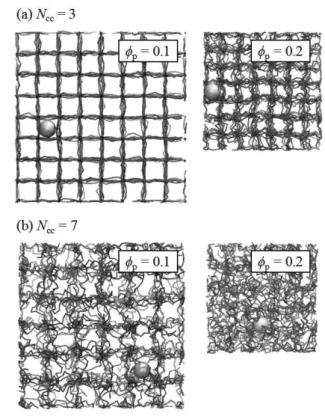
As a model for a polymer network, we consider a crosslink of linear chains, as shown in Figure 1 (a). Linear chains are modeled as a bead-spring chain in which spherical monomers are bonded together linearly by a combination of the finitely extensible nonlinear elastic (FENE) potential
𝑈𝑈𝑈𝑈𝑏𝑏𝑏𝑏(𝑟𝑟𝑟𝑟) = −12 𝑘𝑘𝑘𝑘𝑏𝑏𝑏𝑏𝑅𝑅𝑅𝑅𝑏𝑏𝑏𝑏2ln[1 − (𝑟𝑟𝑟𝑟 𝑅𝑅𝑅𝑅⁄ 𝑏𝑏𝑏𝑏)2] (1)
and the repulsive part of the LJ potential
𝑈𝑈𝑈𝑈𝑟𝑟𝑟𝑟(𝑟𝑟𝑟𝑟) = �4𝜀𝜀𝜀𝜀[(𝜎𝜎𝜎𝜎 𝑟𝑟𝑟𝑟) 12− (𝜎𝜎𝜎𝜎 𝑟𝑟𝑟𝑟⁄ )6 ⁄ ] + 𝜀𝜀𝜀𝜀 0 0 < 𝑟𝑟𝑟𝑟 < 𝑟𝑟𝑟𝑟𝑐𝑐𝑐𝑐 𝑒𝑒𝑒𝑒𝑒𝑒𝑒𝑒𝑒𝑒𝑒𝑒𝑒𝑒𝑒𝑒𝑒𝑒𝑒𝑒ℎ𝑒𝑒𝑒𝑒𝑟𝑟𝑟𝑟𝑒𝑒𝑒𝑒 , (2)
where 𝜎𝜎𝜎𝜎 is a unit of length in this work, 𝑘𝑘𝑘𝑘𝑏𝑏𝑏𝑏=
30𝑘𝑘𝑘𝑘𝐵𝐵𝐵𝐵𝑇𝑇𝑇𝑇 𝜎𝜎𝜎𝜎⁄ , 𝑅𝑅𝑅𝑅2 𝑏𝑏𝑏𝑏 = 1.5𝜎𝜎𝜎𝜎, 𝜀𝜀𝜀𝜀 = 1𝑘𝑘𝑘𝑘𝐵𝐵𝐵𝐵𝑇𝑇𝑇𝑇 and the cut-off
distance 𝑟𝑟𝑟𝑟𝑐𝑐𝑐𝑐 is set to 21 6⁄ 𝜎𝜎𝜎𝜎 . Here, 𝑘𝑘𝑘𝑘𝐵𝐵𝐵𝐵 is the
Boltzmann constant and T is the temperature.
To form a polymer network, linear chains are
crosslinked regularly at every n monomer
along each chain. We made different polymer
Figure 1. Snapshots of a tracer particle
confined in a polymer network. The 𝑵𝑵𝑵𝑵𝑪𝑪𝑪𝑪𝑪𝑪𝑪𝑪 is
defined as the number of monomers between two crosslinking sites. The volume fraction of the polymer network is adjusted to 0.10 and 0.20 by compression.
networks in diverse sizes with controlling the number of monomers between the nearest
crosslinking sites (𝑁𝑁𝑁𝑁𝐶𝐶𝐶𝐶𝐶𝐶𝐶𝐶= 𝑛𝑛𝑛𝑛 − 1) . We consider
the range of network sizes represented by 𝑁𝑁𝑁𝑁𝐶𝐶𝐶𝐶𝐶𝐶𝐶𝐶
from 3 to 10. To model a polymer network on a large scale, we use the periodic boundary condition with a simulation box size of nearly 30𝜎𝜎𝜎𝜎 × 30𝜎𝜎𝜎𝜎 × 30𝜎𝜎𝜎𝜎 depending on the network size. The initial box is compressed until the total polymer density represented as a volume
fraction (𝜙𝜙𝜙𝜙𝑃𝑃𝑃𝑃) becomes 0.1 as shown in Figure 1.
subdiffusive dynamic behavior is most clearly observed due to the trapping of a tracer in
void spaces confined by the static obstacles3,4.
However, since the entangled polymers or gels are dynamic rather than static obstacles on the time scale of tracer diffusion, the effect of confinement on tracer diffusion is expected to be influenced by the dynamic fluctuation of network strands between crosslinking
junctions5-7. Therefore, we investigate the
diffusive properties of a tracer particle confined in polymer networks with varying
strand flexibility8. While changing the network
flexibility, we measure the mean square displacement and the probability distribution of time-correlated particle displacements to show the effect of dynamic fluctuation of the polymer networks on the tracer diffusion confined in polymer networks.
Simulation model and method
As a model for a polymer network, we consider a crosslink of linear chains, as shown in Figure 1 (a). Linear chains are modeled as a bead-spring chain in which spherical monomers are bonded together linearly by a combination of the finitely extensible nonlinear elastic (FENE) potential
𝑈𝑈𝑈𝑈𝑏𝑏𝑏𝑏(𝑟𝑟𝑟𝑟) = −12𝑘𝑘𝑘𝑘𝑏𝑏𝑏𝑏𝑅𝑅𝑅𝑅𝑏𝑏𝑏𝑏2ln[1 − (𝑟𝑟𝑟𝑟 𝑅𝑅𝑅𝑅⁄ 𝑏𝑏𝑏𝑏)2] (1)
and the repulsive part of the LJ potential
𝑈𝑈𝑈𝑈𝑟𝑟𝑟𝑟(𝑟𝑟𝑟𝑟) = �4𝜀𝜀𝜀𝜀[(𝜎𝜎𝜎𝜎 𝑟𝑟𝑟𝑟) 12− (𝜎𝜎𝜎𝜎 𝑟𝑟𝑟𝑟⁄ )6 ⁄ ] + 𝜀𝜀𝜀𝜀 0 0 < 𝑟𝑟𝑟𝑟 < 𝑟𝑟𝑟𝑟𝑐𝑐𝑐𝑐 𝑒𝑒𝑒𝑒𝑒𝑒𝑒𝑒𝑒𝑒𝑒𝑒𝑒𝑒𝑒𝑒𝑒𝑒𝑒𝑒ℎ𝑒𝑒𝑒𝑒𝑟𝑟𝑟𝑟𝑒𝑒𝑒𝑒 , (2)
where 𝜎𝜎𝜎𝜎 is a unit of length in this work, 𝑘𝑘𝑘𝑘𝑏𝑏𝑏𝑏=
30𝑘𝑘𝑘𝑘𝐵𝐵𝐵𝐵𝑇𝑇𝑇𝑇 𝜎𝜎𝜎𝜎⁄ , 𝑅𝑅𝑅𝑅2 𝑏𝑏𝑏𝑏 = 1.5𝜎𝜎𝜎𝜎, 𝜀𝜀𝜀𝜀 = 1𝑘𝑘𝑘𝑘𝐵𝐵𝐵𝐵𝑇𝑇𝑇𝑇 and the cut-off
distance 𝑟𝑟𝑟𝑟𝑐𝑐𝑐𝑐 is set to 21 6⁄ 𝜎𝜎𝜎𝜎 . Here, 𝑘𝑘𝑘𝑘𝐵𝐵𝐵𝐵 is the
Boltzmann constant and T is the temperature.
To form a polymer network, linear chains are
crosslinked regularly at every n monomer
along each chain. We made different polymer
Figure 1. Snapshots of a tracer particle
confined in a polymer network. The 𝑵𝑵𝑵𝑵𝑪𝑪𝑪𝑪𝑪𝑪𝑪𝑪 is
defined as the number of monomers between two crosslinking sites. The volume fraction of the polymer network is adjusted to 0.10 and 0.20 by compression.
networks in diverse sizes with controlling the number of monomers between the nearest
crosslinking sites (𝑁𝑁𝑁𝑁𝐶𝐶𝐶𝐶𝐶𝐶𝐶𝐶= 𝑛𝑛𝑛𝑛 − 1) . We consider
the range of network sizes represented by 𝑁𝑁𝑁𝑁𝐶𝐶𝐶𝐶𝐶𝐶𝐶𝐶
from 3 to 10. To model a polymer network on a large scale, we use the periodic boundary condition with a simulation box size of nearly 30𝜎𝜎𝜎𝜎 × 30𝜎𝜎𝜎𝜎 × 30𝜎𝜎𝜎𝜎 depending on the network size. The initial box is compressed until the total polymer density represented as a volume
fraction (𝜙𝜙𝜙𝜙𝑃𝑃𝑃𝑃) becomes 0.1 as shown in Figure 1.
For the same way, a polymer network with
volume fraction 𝜙𝜙𝜙𝜙𝑃𝑃𝑃𝑃= 0.2 is made from a
initial simulation box (Figure 1).
The excluded-volume interaction between the tracer particle (with diameter of 3𝜎𝜎𝜎𝜎 )and monomers of a polymer network (with diameter of 𝜎𝜎𝜎𝜎) is modeled by the repulsive LJ potential that is described below.
𝑈𝑈𝑈𝑈𝑟𝑟𝑟𝑟(𝑟𝑟𝑟𝑟) = �4𝜀𝜀𝜀𝜀 �( 𝜎𝜎𝜎𝜎 𝑟𝑟𝑟𝑟 − 𝜎𝜎𝜎𝜎)12− ( 𝜎𝜎𝜎𝜎 𝑟𝑟𝑟𝑟 − 𝜎𝜎𝜎𝜎)6� + 𝜀𝜀𝜀𝜀 0 0 < 𝑟𝑟𝑟𝑟 < 𝑟𝑟𝑟𝑟𝑐𝑐𝑐𝑐 𝑒𝑒𝑒𝑒𝑒𝑒𝑒𝑒𝑒𝑒𝑒𝑒𝑒𝑒𝑒𝑒𝑒𝑒𝑒𝑒ℎ𝑒𝑒𝑒𝑒𝑟𝑟𝑟𝑟𝑒𝑒𝑒𝑒 , (3)
Since the repulsive barrier starts when the center-to-center distance between a tracer and a monomer becomes less than 2𝜎𝜎𝜎𝜎 , this potential represents the repulsive interaction between two particles with their radii of 1.5𝜎𝜎𝜎𝜎
and 0.5𝜎𝜎𝜎𝜎, respectively. Although various types
of interactions may influence the particle dynamics, we only consider the excluded-volume interaction in order to focus on how the collective effect of a polymer network influences the tracer diffusion.
BD simulations are run to mimic the solvent-induced stochastic dynamics of a tracer and polymer segments. The system is evolved using conventional BD without hydrodynamic interactions. At each time step
Δ𝑡𝑡𝑡𝑡, the position 𝑟𝑟𝑟𝑟𝑖𝑖𝑖𝑖(𝑡𝑡𝑡𝑡) of a particle i is updated
via
𝑟𝑟𝑟𝑟𝑖𝑖𝑖𝑖(𝑡𝑡𝑡𝑡 + Δ𝑡𝑡𝑡𝑡) = 𝑟𝑟𝑟𝑟𝑖𝑖𝑖𝑖(𝑡𝑡𝑡𝑡) +𝐷𝐷𝐷𝐷0𝑘𝑘𝑘𝑘𝐹𝐹𝐹𝐹𝑖𝑖𝑖𝑖(𝑡𝑡𝑡𝑡)
𝐵𝐵𝐵𝐵𝑇𝑇𝑇𝑇 Δ𝑡𝑡𝑡𝑡 + 𝑅𝑅𝑅𝑅𝑖𝑖𝑖𝑖(Δ𝑡𝑡𝑡𝑡) (4)
where 𝐹𝐹𝐹𝐹𝑖𝑖𝑖𝑖(𝑡𝑡𝑡𝑡) is the total force acting on the
particle i, and 𝑅𝑅𝑅𝑅𝑖𝑖𝑖𝑖(Δ𝑡𝑡𝑡𝑡) is a random
displacement with a Gaussian distribution function with zero mean and variance-covariance 〈𝑅𝑅𝑅𝑅𝑖𝑖𝑖𝑖(Δ𝑡𝑡𝑡𝑡)𝑅𝑅𝑅𝑅𝑗𝑗𝑗𝑗(Δ𝑡𝑡𝑡𝑡)〉 = 2𝐷𝐷𝐷𝐷0Δ𝑡𝑡𝑡𝑡𝛿𝛿𝛿𝛿𝑖𝑖𝑖𝑖𝑗𝑗𝑗𝑗. 𝐷𝐷𝐷𝐷0 is the
diffusion coefficient of each monomer in a polymer chain in pure solvent and sets the time scale by a definition of the unit of time 𝜏𝜏𝜏𝜏𝐵𝐵𝐵𝐵𝐵𝐵𝐵𝐵 = 𝜎𝜎𝜎𝜎2⁄ . A time step Δ𝑡𝑡𝑡𝑡 = 10𝐷𝐷𝐷𝐷0 −4𝜏𝜏𝜏𝜏𝐵𝐵𝐵𝐵𝐵𝐵𝐵𝐵 is used
for all the simulations. The total force 𝐹𝐹𝐹𝐹𝑖𝑖𝑖𝑖(𝑡𝑡𝑡𝑡) is
given by the gradient of 𝑈𝑈𝑈𝑈𝑡𝑡𝑡𝑡𝑡𝑡𝑡𝑡𝑡𝑡𝑡𝑡𝑡𝑡𝑡𝑡𝑡𝑡𝑡𝑡, which is the
sum of the bonded and non-bonded interactions described above. BD simulations are run using GROMACS v. 5.4.5.
Five sets of simulations with 1 × 10⁹ time
steps (1 × 10⁵𝜏𝜏𝜏𝜏
𝐵𝐵𝐵𝐵𝐵𝐵𝐵𝐵) are run over which the
statistical properties are calculated by averaging over.
Results and Discussions
We perform BD simulations of a tracer
particle (with diameter of 3𝜎𝜎𝜎𝜎) confined in a set
of polymer networks with different mesh sizes 𝑵𝑵𝑵𝑵𝑪𝑪𝑪𝑪𝑪𝑪𝑪𝑪 ranging between 3𝜎𝜎𝜎𝜎 and 9𝜎𝜎𝜎𝜎 . From the
simulation trajectories, we calculate the mean squared displacement (MSD) of a tracer
particle defined as 〈(𝑟𝑟𝑟𝑟⃗(𝑡𝑡𝑡𝑡) − 𝑟𝑟𝑟𝑟⃗(0))2〉. It is well
known that the MSD in diffusive regime is
proportional to time t and the slope of the
MSD corresponds to 6D. Mathematically,
〈(𝑟𝑟𝑟𝑟⃗(𝑡𝑡𝑡𝑡) − 𝑟𝑟𝑟𝑟⃗(0))2〉 = 6𝐷𝐷𝐷𝐷𝑡𝑡𝑡𝑡, where D is the diffusion
coefficient. However, on shorter time scales,
the MSD increases more slowly than time t
and 〈(𝑟𝑟𝑟𝑟⃗(𝑡𝑡𝑡𝑡) − 𝑟𝑟𝑟𝑟⃗(0))2〉 ~ 𝑡𝑡𝑡𝑡𝛼𝛼𝛼𝛼, where 𝛼𝛼𝛼𝛼 < 1. If the
MSD is divided by 6t as 〈(𝑟𝑟𝑟𝑟⃗(𝑡𝑡𝑡𝑡) − 𝑟𝑟𝑟𝑟⃗(0))2〉/6𝑡𝑡𝑡𝑡 ,
the value is expected to be constant in the diffusive regime attained at long times, but it
decreases on shorter time scales as 𝑡𝑡𝑡𝑡𝛼𝛼𝛼𝛼−1.
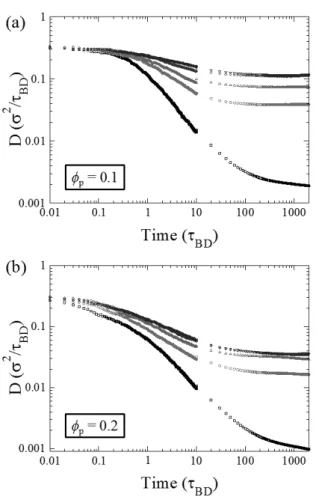
Therefore, we calculated the MSD from our
simulation trajectories and divided it by 6t to
distinguish the dynamic regimes of subdiffusion and normal diffusion, as shown in
Figure 2. We call the MSD/6t as the
instantaneous diffusion coefficient, hereafter. The data for the instantaneous diffusion coefficient are presented for two different
volume fractions of polymer networks, 𝜙𝜙𝜙𝜙𝑃𝑃𝑃𝑃=
Figure 2. Time-dependent diffusion coefficient defined as the mean square displacement
divided by 6t. (a) At volume fraction 0.1. (b) At
volume fraction 0.2. Data are obtained for the 𝑵𝑵𝑵𝑵𝑪𝑪𝑪𝑪𝑪𝑪𝑪𝑪(𝝈𝝈𝝈𝝈) of 3, 4, 5, 7, and 9 from bottom to top.
respectively. In each figure, the data for
different 𝑵𝑵𝑵𝑵𝑪𝑪𝑪𝑪𝑪𝑪𝑪𝑪 are presented ranging between
3𝜎𝜎𝜎𝜎 and 9𝜎𝜎𝜎𝜎 in different colors. Small values of 𝑵𝑵𝑵𝑵𝑪𝑪𝑪𝑪𝑪𝑪𝑪𝑪 correspond to the polymer networks with
tightly stretched network strands between crosslinking junctions and with smaller mesh
sizes. For instance, a tracer of diameter 3𝜎𝜎𝜎𝜎 is
likely to be tightly held in a network with
mesh size of 𝑵𝑵𝑵𝑵𝑪𝑪𝑪𝑪𝑪𝑪𝑪𝑪= 3𝜎𝜎𝜎𝜎 whereas the tracer is
rather free in a network with mesh size of 𝑵𝑵𝑵𝑵𝑪𝑪𝑪𝑪𝑪𝑪𝑪𝑪= 9𝜎𝜎𝜎𝜎. Due to the large accumulation of
data points required to provide accurate average values, the simulations are performed separately on short and long time scales
(separated at 10𝜏𝜏𝜏𝜏𝐵𝐵𝐵𝐵𝐵𝐵𝐵𝐵) and both sets of data
from short and long time simulations are presented together in the same color in Figure 2.
A tracer of 3𝜎𝜎𝜎𝜎 diameter has an instantaneous diffusion coefficient of ~ 0.3𝜎𝜎𝜎𝜎2/𝜏𝜏𝜏𝜏
𝐵𝐵𝐵𝐵𝐵𝐵𝐵𝐵 at the very beginning. This is
because we set the diffusion coefficient of a
network monomer with size 1𝜎𝜎𝜎𝜎 in bulk as
𝐷𝐷𝐷𝐷0= 1𝜎𝜎𝜎𝜎2/𝜏𝜏𝜏𝜏𝐵𝐵𝐵𝐵𝐵𝐵𝐵𝐵 and the size of the tracer is
three times bigger. At the intermediate scales
from 1𝜏𝜏𝜏𝜏𝐵𝐵𝐵𝐵𝐵𝐵𝐵𝐵 to 10𝜏𝜏𝜏𝜏𝐵𝐵𝐵𝐵𝐵𝐵𝐵𝐵 , neighboring network
monomers interacts with the tracer causing it to lose movement speed, so the falling curves are observed in the middle. The plots show that the tracer exhibits anomalous diffusive
behavior: the tracer MSD is proportional to 𝑡𝑡𝑡𝑡𝛼𝛼𝛼𝛼
where the 𝛼𝛼𝛼𝛼 is smaller than 1. It slowly diffuses because of the confinement effect of a dynamic jam-packed polymer network. The greater the effect of a network, the steeper the slope of the declining line. The slope of a 𝑵𝑵𝑵𝑵𝑪𝑪𝑪𝑪𝑪𝑪𝑪𝑪= 3𝜎𝜎𝜎𝜎 network falls the most, so it's clear
that the network has the largest confinement effect, though the volume fractions of all sets are same.
After a long time of 1000𝜏𝜏𝜏𝜏𝐵𝐵𝐵𝐵𝐵𝐵𝐵𝐵, the tracer
recovers its standard diffusive motion. As expected, because the polymer network
becomes denser when 𝑵𝑵𝑵𝑵𝑪𝑪𝑪𝑪𝑪𝑪𝑪𝑪 decreases from
top to bottom, the final diffusion coefficient of the confined tracer decreases. A tracer in a 𝑵𝑵𝑵𝑵𝑪𝑪𝑪𝑪𝑪𝑪𝑪𝑪= 3𝜎𝜎𝜎𝜎 network has an especially low value
and it seems to still decline gradually. As volume fraction of the polymer network
Figure 2. Time-dependent diffusion coefficient defined as the mean square displacement
divided by 6t. (a) At volume fraction 0.1. (b) At
volume fraction 0.2. Data are obtained for the 𝑵𝑵𝑵𝑵𝑪𝑪𝑪𝑪𝑪𝑪𝑪𝑪(𝝈𝝈𝝈𝝈) of 3, 4, 5, 7, and 9 from bottom to top.
respectively. In each figure, the data for
different 𝑵𝑵𝑵𝑵𝑪𝑪𝑪𝑪𝑪𝑪𝑪𝑪 are presented ranging between
3𝜎𝜎𝜎𝜎 and 9𝜎𝜎𝜎𝜎 in different colors. Small values of 𝑵𝑵𝑵𝑵𝑪𝑪𝑪𝑪𝑪𝑪𝑪𝑪 correspond to the polymer networks with
tightly stretched network strands between crosslinking junctions and with smaller mesh
sizes. For instance, a tracer of diameter 3𝜎𝜎𝜎𝜎 is
likely to be tightly held in a network with
mesh size of 𝑵𝑵𝑵𝑵𝑪𝑪𝑪𝑪𝑪𝑪𝑪𝑪= 3𝜎𝜎𝜎𝜎 whereas the tracer is
rather free in a network with mesh size of 𝑵𝑵𝑵𝑵𝑪𝑪𝑪𝑪𝑪𝑪𝑪𝑪= 9𝜎𝜎𝜎𝜎. Due to the large accumulation of
data points required to provide accurate average values, the simulations are performed separately on short and long time scales
(separated at 10𝜏𝜏𝜏𝜏𝐵𝐵𝐵𝐵𝐵𝐵𝐵𝐵) and both sets of data
from short and long time simulations are presented together in the same color in Figure 2.
A tracer of 3𝜎𝜎𝜎𝜎 diameter has an instantaneous diffusion coefficient of ~ 0.3𝜎𝜎𝜎𝜎2/𝜏𝜏𝜏𝜏
𝐵𝐵𝐵𝐵𝐵𝐵𝐵𝐵 at the very beginning. This is
because we set the diffusion coefficient of a
network monomer with size 1𝜎𝜎𝜎𝜎 in bulk as
𝐷𝐷𝐷𝐷0= 1𝜎𝜎𝜎𝜎2/𝜏𝜏𝜏𝜏𝐵𝐵𝐵𝐵𝐵𝐵𝐵𝐵 and the size of the tracer is
three times bigger. At the intermediate scales
from 1𝜏𝜏𝜏𝜏𝐵𝐵𝐵𝐵𝐵𝐵𝐵𝐵 to 10𝜏𝜏𝜏𝜏𝐵𝐵𝐵𝐵𝐵𝐵𝐵𝐵 , neighboring network
monomers interacts with the tracer causing it to lose movement speed, so the falling curves are observed in the middle. The plots show that the tracer exhibits anomalous diffusive
behavior: the tracer MSD is proportional to 𝑡𝑡𝑡𝑡𝛼𝛼𝛼𝛼
where the 𝛼𝛼𝛼𝛼 is smaller than 1. It slowly diffuses because of the confinement effect of a dynamic jam-packed polymer network. The greater the effect of a network, the steeper the slope of the declining line. The slope of a 𝑵𝑵𝑵𝑵𝑪𝑪𝑪𝑪𝑪𝑪𝑪𝑪= 3𝜎𝜎𝜎𝜎 network falls the most, so it's clear
that the network has the largest confinement effect, though the volume fractions of all sets are same.
After a long time of 1000𝜏𝜏𝜏𝜏𝐵𝐵𝐵𝐵𝐵𝐵𝐵𝐵, the tracer
recovers its standard diffusive motion. As expected, because the polymer network
becomes denser when 𝑵𝑵𝑵𝑵𝑪𝑪𝑪𝑪𝑪𝑪𝑪𝑪 decreases from
top to bottom, the final diffusion coefficient of the confined tracer decreases. A tracer in a 𝑵𝑵𝑵𝑵𝑪𝑪𝑪𝑪𝑪𝑪𝑪𝑪= 3𝜎𝜎𝜎𝜎 network has an especially low value
and it seems to still decline gradually. As volume fraction of the polymer network
Figure 3. 𝑷𝑷𝑷𝑷(𝒓𝒓𝒓𝒓, 𝒕𝒕𝒕𝒕) of 𝑵𝑵𝑵𝑵𝑪𝑪𝑪𝑪𝑪𝑪𝑪𝑪= 𝟑𝟑𝟑𝟑𝝈𝝈𝝈𝝈 and 𝟕𝟕𝟕𝟕𝝈𝝈𝝈𝝈 on
short time scales.
increases from 0.1 to 0.2, the confinement effect of tracer promotes. The tracer gets a lower diffusion coefficient and needs more time to reach standard diffusion in a long-time simulation. We find out why it does not become constant with following figures.
We calculate 𝑃𝑃𝑃𝑃(𝑟𝑟𝑟𝑟, 𝑡𝑡𝑡𝑡) from short-time
simulations, the probability to find a Brownian tracer at some point at a certain time, for every set, then compare 𝑵𝑵𝑵𝑵𝑪𝑪𝑪𝑪𝑪𝑪𝑪𝑪= 3𝜎𝜎𝜎𝜎 with 𝑵𝑵𝑵𝑵𝑪𝑪𝑪𝑪𝑪𝑪𝑪𝑪=
7𝜎𝜎𝜎𝜎 in Figure 3. 𝑃𝑃𝑃𝑃(𝑟𝑟𝑟𝑟, 𝑡𝑡𝑡𝑡) data at 𝑡𝑡𝑡𝑡 = 1𝜏𝜏𝜏𝜏𝐵𝐵𝐵𝐵𝐵𝐵𝐵𝐵 are
divided into several peaks, which means that the tracer movement is blocked by interactions between the tracer and network monomers. Hence, the subdiffusion occurs
Figure 4. 𝑷𝑷𝑷𝑷(𝒓𝒓𝒓𝒓, 𝒕𝒕𝒕𝒕) of 𝑵𝑵𝑵𝑵𝑪𝑪𝑪𝑪𝑪𝑪𝑪𝑪= 𝟑𝟑𝟑𝟑𝝈𝝈𝝈𝝈 and 𝟕𝟕𝟕𝟕𝝈𝝈𝝈𝝈 on long
time scales.
and the MSD increases more slowly with time.
Figure 4 is the results of 𝑃𝑃𝑃𝑃(𝑟𝑟𝑟𝑟, 𝑡𝑡𝑡𝑡) on longer
time scales. The spot separating the first and second peaks is the distance where the tracer crashes against the polymer network strands.
It doesn't go far until 10𝜏𝜏𝜏𝜏𝐵𝐵𝐵𝐵𝐵𝐵𝐵𝐵 later, just walking
around at the same place. At 𝑡𝑡𝑡𝑡 = 100𝜏𝜏𝜏𝜏𝐵𝐵𝐵𝐵𝐵𝐵𝐵𝐵, a
tracer in a 𝑵𝑵𝑵𝑵𝑪𝑪𝑪𝑪𝑪𝑪𝑪𝑪= 7𝜎𝜎𝜎𝜎 network is possible to
move to the next room and even spreads far
away. The other in a 𝑵𝑵𝑵𝑵𝑪𝑪𝑪𝑪𝑪𝑪𝑪𝑪= 3𝜎𝜎𝜎𝜎 network is still
confined. It can diffuse through the network
after 𝑡𝑡𝑡𝑡 = 1000𝜏𝜏𝜏𝜏𝐵𝐵𝐵𝐵𝐵𝐵𝐵𝐵 passes, but over the half of
total probability remains in the initial room. The tracer needs much longer time to diffuse to a distance with a constant diffusion
Figure 5. Radial distribution functions between crosslinks.
coefficient. Thus, the tracer in a 𝑵𝑵𝑵𝑵𝑪𝑪𝑪𝑪𝑪𝑪𝑪𝑪= 3𝜎𝜎𝜎𝜎
network has not reached diffusive motion in Figure 2 (a).
There are radial distribution functions (RDF) of crosslinking junctions on Figure 4. The size of 𝑵𝑵𝑵𝑵𝑪𝑪𝑪𝑪𝑪𝑪𝑪𝑪, the number of monomers between
neighboring two crosslinks, is associated with the shape of RDF, and how sharp or broad it is decides the polymer network flexibility. RDF of a 𝑵𝑵𝑵𝑵𝑪𝑪𝑪𝑪𝑪𝑪𝑪𝑪= 3𝜎𝜎𝜎𝜎 network is separated into distinct
sharp peaks. The crosslinks are fixed in their initial position and try to keep the distance between two neighbors. The immovable rigid network makes a tracer have a difficulty in
diffusion. RDF of a 𝑵𝑵𝑵𝑵𝑪𝑪𝑪𝑪𝑪𝑪𝑪𝑪= 7𝜎𝜎𝜎𝜎 network,
however, shows a broad shape. These dynamic crosslinks have relatively free movement, so the soft network monomers can fluctuate making way for the diffusive tracer. Flexibility
of polymer network strands reduce the confinement effect on the tracer.
Conclusions
In this work, BD simulations are performed to study a tracer particle diffusion confined in a crosslinked polymer network. The time-dependent mean square displacement of the
tracer is proportional to time t at the initial
state. On the intermediate scales, the tracer anomalously diffuses due to the confinement effect of the network strands, so the MSD
increases with time 𝑡𝑡𝑡𝑡𝛼𝛼𝛼𝛼, where 𝛼𝛼𝛼𝛼 < 1 . It is
called the subdiffusion, and the tracer loses its
speed as the 𝑵𝑵𝑵𝑵𝑪𝑪𝑪𝑪𝑪𝑪𝑪𝑪 becomes small. The tracer
recovers standard diffusive motion after a sufficiently long time with a constant diffusion coefficient. When the volume fraction increases from 0.1 to 0.2, the compact network promotes the confinement effect.
𝑷𝑷𝑷𝑷(𝒓𝒓𝒓𝒓, 𝒕𝒕𝒕𝒕), the probability to find a Brownian tracer at some point at a certain time, shows that the tracer movement is blocked by interactions between the tracer and network
monomers. The 3𝜎𝜎𝜎𝜎 tracer in a relatively rigid
polymer network with 𝑵𝑵𝑵𝑵𝑪𝑪𝑪𝑪𝑪𝑪𝑪𝑪= 3𝜎𝜎𝜎𝜎 needs very
long time to diffuse to a distance with a constant diffusion coefficient. Shape of RDF decides the polymer network flexibility. The
immovable rigid network of 𝑵𝑵𝑵𝑵𝑪𝑪𝑪𝑪𝑪𝑪𝑪𝑪= 3𝜎𝜎𝜎𝜎 makes a
tracer have a difficulty in diffusion, while
dynamic crosslinks of 𝑵𝑵𝑵𝑵𝑪𝑪𝑪𝑪𝑪𝑪𝑪𝑪= 7𝜎𝜎𝜎𝜎 can freely
fluctuate for the tracer diffusion. Flexibility of polymer network strands reduce the effect of confinement on the Brownian tracer.
Figure 5. Radial distribution functions between crosslinks.
coefficient. Thus, the tracer in a 𝑵𝑵𝑵𝑵𝑪𝑪𝑪𝑪𝑪𝑪𝑪𝑪= 3𝜎𝜎𝜎𝜎
network has not reached diffusive motion in Figure 2 (a).
There are radial distribution functions (RDF) of crosslinking junctions on Figure 4. The size of 𝑵𝑵𝑵𝑵𝑪𝑪𝑪𝑪𝑪𝑪𝑪𝑪, the number of monomers between
neighboring two crosslinks, is associated with the shape of RDF, and how sharp or broad it is decides the polymer network flexibility. RDF of a 𝑵𝑵𝑵𝑵𝑪𝑪𝑪𝑪𝑪𝑪𝑪𝑪= 3𝜎𝜎𝜎𝜎 network is separated into distinct
sharp peaks. The crosslinks are fixed in their initial position and try to keep the distance between two neighbors. The immovable rigid network makes a tracer have a difficulty in
diffusion. RDF of a 𝑵𝑵𝑵𝑵𝑪𝑪𝑪𝑪𝑪𝑪𝑪𝑪= 7𝜎𝜎𝜎𝜎 network,
however, shows a broad shape. These dynamic crosslinks have relatively free movement, so the soft network monomers can fluctuate making way for the diffusive tracer. Flexibility
of polymer network strands reduce the confinement effect on the tracer.
Conclusions
In this work, BD simulations are performed to study a tracer particle diffusion confined in a crosslinked polymer network. The time-dependent mean square displacement of the
tracer is proportional to time t at the initial
state. On the intermediate scales, the tracer anomalously diffuses due to the confinement effect of the network strands, so the MSD
increases with time 𝑡𝑡𝑡𝑡𝛼𝛼𝛼𝛼, where 𝛼𝛼𝛼𝛼 < 1 . It is
called the subdiffusion, and the tracer loses its
speed as the 𝑵𝑵𝑵𝑵𝑪𝑪𝑪𝑪𝑪𝑪𝑪𝑪 becomes small. The tracer
recovers standard diffusive motion after a sufficiently long time with a constant diffusion coefficient. When the volume fraction increases from 0.1 to 0.2, the compact network promotes the confinement effect.
𝑷𝑷𝑷𝑷(𝒓𝒓𝒓𝒓, 𝒕𝒕𝒕𝒕), the probability to find a Brownian tracer at some point at a certain time, shows that the tracer movement is blocked by interactions between the tracer and network
monomers. The 3𝜎𝜎𝜎𝜎 tracer in a relatively rigid
polymer network with 𝑵𝑵𝑵𝑵𝑪𝑪𝑪𝑪𝑪𝑪𝑪𝑪= 3𝜎𝜎𝜎𝜎 needs very
long time to diffuse to a distance with a constant diffusion coefficient. Shape of RDF decides the polymer network flexibility. The
immovable rigid network of 𝑵𝑵𝑵𝑵𝑪𝑪𝑪𝑪𝑪𝑪𝑪𝑪= 3𝜎𝜎𝜎𝜎 makes a
tracer have a difficulty in diffusion, while
dynamic crosslinks of 𝑵𝑵𝑵𝑵𝑪𝑪𝑪𝑪𝑪𝑪𝑪𝑪= 7𝜎𝜎𝜎𝜎 can freely
fluctuate for the tracer diffusion. Flexibility of polymer network strands reduce the effect of confinement on the Brownian tracer.
Acknowledgements
This research was supported by the EDISON Program through the National Research Foundation of Korea(NRF) funded by the Ministry of Science, ICT & Future Planning (NRF-2011-0020576)
References
[1] D. L. Ermak and J. McCammon, J. Chem. Phys. (1978), Vol. 69, pp.1352-1360. (Journal Article) [2] J. Jung, E. Jang, M. A. Shoaib, K. Jo and J. S. Kim, J. Chem. Phys. (2016), Vol. 144, 134502. (Journal
Article)
[3] B. J. Sung and A. Yethiraj, J. Phys. Chem. (2008), Vol. 112, pp.143-149. (Journal Article)
[4] J. Kim, C. Kim and B. J. Sung, Phys. Rev. Lett. (2013), Vol. 110, 047801 (Journal Article)
[5] A. Godec, M. Bauer and R. Metzler, New J. Phys. (2014), Vol. 16, 092002. (Journal Article)
[6] F. Tabatabaei, O. Lenz and C. Holm, Colloid Polym. Sci. (2011), Vol. 289, pp.523-534. (Journal
Article)
[7] N. Kamerlin and C. Elvingson, J. Phys: Condens. Matter (2016), Vol. 28, 475101. (Journal Article) [8] Daan Frenkel and Berend Smit, Editor, Molecular Simulation, Academic Press (2001). (Book)