Heat Sink Assurance Plan Analysis for Core Cooling Safety Function Assessment Trees
Huichang Yang,a Seong Soo Choi,a Bag Soon Chung,b Myung Ki Kim,b Sung Yull Hong,ba Atomic Creative Technology Co., Ltd., 1688-5 Sinil-dong Daedeok-gu Daejeon 306-230, [email protected] b Korea Electric Power Research Institute, Munji-dong Yuseong-gu Daejeon, Korea, 305-380
1. Introduction
To develop the safety function assessment tree (SFAT) logics for core cooling safety functions, heat sink assurance plan of CANDU type reactors were analyzed. In this paper, analysis result for heat sink assurance plan which is implemented before entering preventive maintenance and its usage during the development of safety function assessment trees were discussed.
2. Safety Functions for PHWR
2.1 Safety Functions
For PWR, safety functions are clearly defined in EOP and the safety features and actions are described. In PHWR EOP used in Korea, action statements are not based on symptom or safety functions but accident scenario. To define the safety functions for PHWR, the general safety functions for PWRs such as reactivity control, core cooling, secondary side heat removal, containment integrity, essential power, and cooling waters are considered as draft set of PHWR safety functions. Through the review by plant personnel who has expertise in operation and maintenance, PHWR safety function were defined as following;
1. Reactivity Control 2. Core Cooling
3. Secondary Side Heat Removal 4. PHT Pressure and Inventory Control 5. Reactor Building Integrity
6. Essential Power AC 7. Essential Power DC 8. Cooling Water
These safety function definitions can be applied to both at-power and shutdown operations.
Figure 1. PHWR Safety Functions and System for Safety Functions
2.2 Heat Sink Assurance Plan in PHWR
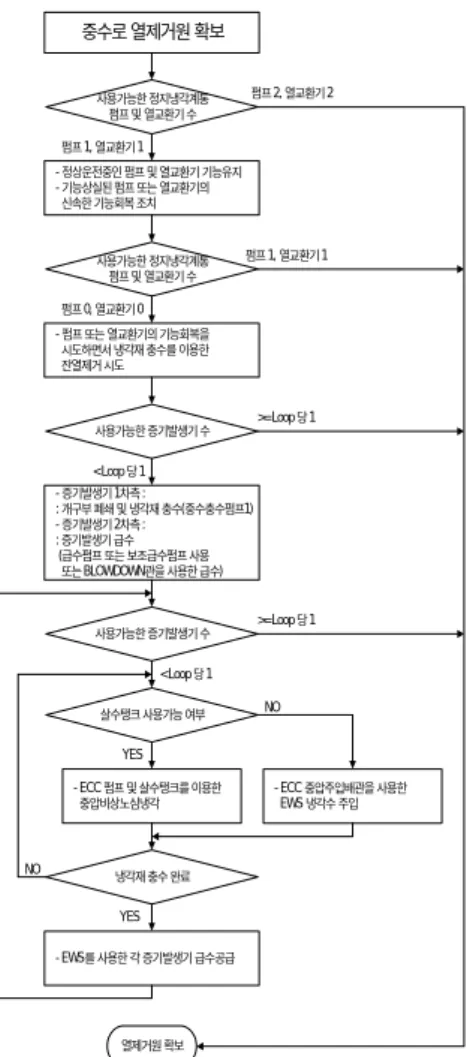
In PHWR plant, heat sink assurance plan should be established before entering preventive maintenance period. Generally, decay heat removal is performed by shutdown cooling system. In this heat sink assurance plan is to prepare compensatory actions for the case in which the main residual heat removal from core, or shutdown cooling system is lost. Main and alternative heat sink assurance methods for the loss of shutdown cooling system are as following;
(1) Main heat removal method – cooling with SDC - 2 SDC pumps and 2 SDC heat exchangers
- or at least 1 SDC pump and 1SDC heat exchanger
(2) Alternative heat removal method – cooling with PHTS charging
- Primary side : close the opening in PHTS and 1 charging pump
- Secondary side : maintain SG feeding capability with feedwater pumps or 1 aux. feedwater pump, or feeding raw water through blowdown line (3) Emergency heat removal method – cooling with
ECCS
- ECCS : mid-pressure injection using ECC pump or dousing tank, or injection from EWS through ECC MP injection line
Procedure for assure alternative heat sink was illustrated in figure 2.
2.3 Core Cooling SFAT Logic Development
Operation of nuclear power plant can be divided into several plant operating status (POS). Especially for shutdown and outage operations of PHWR, almost 5~7 POS can be classified along with their characteristics in terms of heat removal method. In this paper, core cooling SFAT were developed for example POS. The example POS represents the operating status as following;
- Operational Mode : 4, Cold Shutdown - ROH Temperature : 89°C~100 °C
Transactions of the Korean Nuclear Society Autumn Meeting Busan, Korea, October 27-28, 2005
사용가능한 정지냉각계통 펌프 및 열교환기 수 - 정상운전중인 펌프 및 열교환기 기능유지 - 기능상실된 펌프 또는 열교환기의 신속한 기능회복 조치 사용가능한 정지냉각계통 펌프 및 열교환기 수 펌프 1, 열교환기 1 펌프 2, 열교환기 2 - 펌프 또는 열교환기의 기능회복을 시도하면서 냉각재 충수를 이용한 잔열제거 시도 펌프 0, 열교환기 0 펌프 1, 열교환기 1 중수로 열제거원 확보 사용가능한 증기발생기 수 - 증기발생기 1차측 : : 개구부 폐쇄 및 냉각재 충수(중수충수펌프1) - 증기발생기 2차측 : : 증기발생기 급수 (급수펌프 또는 보조급수펌프 사용 또는 BLOWDOWN관을 사용한 급수) >= Loop 당 1 < Loop 당 1 - ECC 중압주입배관을 사용한 EWS 냉각수 주입 사용가능한 증기발생기 수 < Loop 당 1 >= Loop 당 1 살수탱크 사용가능 여부 - ECC 펌프 및 살수탱크를 이용한 중압비상노심냉각 - EWS를 사용한 각 증기발생기 급수공급 YES NO 냉각재 충수 완료 YES NO 열제거원 확보
Figure 2. PHWR Heat Sink Assurance Plan
- Operational State : Zero power High Temp. Pressurized
For this POS, shutdown cooling system is the most preferred method for decay heat removal. Therefore, the first logic block in core cooling should be the question about the availability of SDC trains. The question about the availability of steam generators should come after the first logic box as in heat sink assurance plan. For third, availability of emergency core cooling system (manual operation is required for this POS) should be identified. Generally, moderator system, which is unique feature of CANDU type reactors, is credited as ultimate heat sink in LOCA or other accident scenarios. To consider this, the availability of moderator system is asked only if there is no available S/G’s. Example of developed core cooling SFAT was illustrated in figure 3.
2.4 Color Assignment
Color assignment in example core cooling SFAT is based on the optimistic assumptions following;
- each method for decay heat removal, or SDC/steam generator/ECCS can be used as independent methods for core cooling
Figure 3. Example of core cooling SFAT
Therefore, if one of three different methods were available, orange status was assigned. For moderator system, it is not credited as an independent method for core cooling but credited as an additional method for defense-in-depth.
If more restrictive and conservative assumption on the criteria for color assignment such as current technical specifications, were used, the logic and color assignment should be modified. Used assumption on criteria is based on the practice and experience of operators. The most important factor for determining the color is confidence of operator on their operational methods.
3. Conclusion
Defense-in-depth evaluation model for PHWRs in Korea is under development. During the development, many information sources should be referred. Heat sink assurance plan is one of those sources and it is unique compensatory action plan in CANDU type reactor. In this paper, SFAT logic and color assignment criteria development for core cooling based on heat sink assurance plan for preventive maintenance was discussed. Through this kind of analysis on information sources used in real plants, more practical and optimized defense-in-depth evaluation can be implemented in Korea.
REFERENCES
[1] IAEA, “Defense in Depth in Nuclear Safety,” INSAG-10, 1996.
[2] EPRI, “ORAM-Sentinel Development and ORAM Integration at Catawba and McGuire,” EPRI TR-106802, 1998.
[3] U.S. NRC, “Final Policy Statement on the Use of Probabilistic Risk Assessment Methods in Nuclear Regulatory Activities,” SECY-95-126, 1995.
[4] U.S. NRC, “An Approach for Plant Specific, Risk-Informed Decisionmaking: Technical Specifications,” Regulatory Guide 1.177, 1998