09-S-202
대한설비공학회 2009 하계학술발표대회 논문집 pp. 1141 ~ 1146Experimental Investigation of Flow Boiling Heat Transfer of R-410A and
R-134a in Horizontal Small Tubes
A.S. Pamitran, Kwang-Il Choi, Jong-Taek Oh*†, Pega Hrnjak**
Graduate School, Chonnam National University, Yeosu, Chonnam 550-749, Korea *
Dept. of Refrigeration and Air Conditioning Eng., Chonnam National University, Yeosu, Chonnam 550-749, Korea
**
Department of Mechanical and Science Engineering, University of Illinois at Urbana-Champaign, USA
Key words: Two-phase vaporization, Heat transfer coefficient, R-410A, R-134a, Horizontal minichannel, Pressure drop
ABSTRACT: Experimental investigation on two-phase flow boiling heat transfer of R-410A and R-134a in horizontal small tubes is reported. The pressure drop and local heat transfer coefficients were obtained over heat flux range of 5 to 40 kW/㎡, mass flux range of 70 to 600 kg/㎡s, saturation temperature range of 2 to 12°C, and quality up to 1.0 in test section with inner tube diameters of 3.0 and 0.5 mm, and lengths of 2000 and 330 mm, respectively. The section was heated uniformly by applying a direct electric current to the tubes. The effects of mass flux, heat flux, and inner tube diameter, on pressure drop and heat transfer coefficient are presented. The experimental results are compared against several existing correlations. A new boiling heat transfer coefficient correlation based on the superposition model for refrigerants in small tubes is developed.
†Corresponding author
Tel.: +82-61-659-3273; fax: +82-61-659-3003 E-mail address: [email protected]
Nomenclature
a : Accelerational contribution C : Chisholm parameter D : Diameter [m]
F : Convective two-phase multiplier F : Frictional contribution
f : Friction factor G : Mass flux [kg/㎡s] i : Enthalpy [kJ/kg]
L : Length of test section [m] Q : Electric power [kW] q : Heat flux [kW/㎡]
Re : Reynolds number
S : Suppression factor of nucleate boiling T : Temperature [K]
W : Mass flow rate [kg/s] X : Martinelli parameter x : Mass quality
Greek symbols α : Void fraction
λ : Correction factor on Baker (1954) flow pattern map,
µ : Dynamic viscosity [Ns/㎡]
ρ
: Density [kg/㎥]σ
: Surface tension [N/m]ø2 : Two-phase frictional multiplier
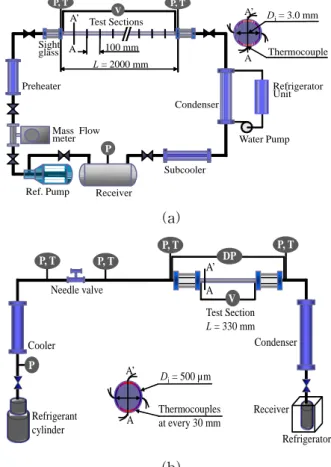
Di= 3.0 mm A A’ Thermocouple Subcooler Receiver Condenser Ref. Pump Preheater Water Pump Refrigerator Unit P Sight glass A’ L = 2000 mm P, T V A P, T Test Sections Mass Flow meter 100 mm (a) Cooler Receiver Condenser Refrigerant cylinder
Mass Flow meter
Test Section L = 330 mm P P, T Needle valve P, T V DP P, T Di= 500 µm A A’ Thermocouples at every 30 mm A’ A P, T Refrigerator (b)
Fig. 1 The experimental test facility and test section: (a) Di=3.0 mm, (b) Di=0.5 mm flow pattern map,
Gradients and Differences (dp/dz) : Pressure gradient [N/㎡m]
Subscript f : Saturated liquid g : Saturated vapor i : Inner tube
nbc : Nucleate boiling contribution o : Outlet tube
pb : Nucleate pool boiling sat : Saturation sc : Subcooled t : Turbulent tp : Two-phase v : Laminar w : Wall 1. Introduction
Demand for refrigeration system with smaller evaporators becomes higher recently because of increasing awareness of the advantages of process intensification. However, flow pattern, pressure drop and heat transfer for two-phase flows in small tubes cannot be properly pre-dicted using the existing correlations that are intended to be applied for large tubes. Several studies dealing with two-phase flow heat transfer in small tubes, as reported in [1-3] have been published in the past years. However, the published studies did not present flow pattern, pressure drop and heat transfer coefficient all at once.
The flow pattern of the present experimental data was evaluated with published flow pattern maps in this study. The pressure drop and heat transfer coefficients of flow boiling of R-410A and R-134a in horizontal small tubes
were measured. The effects of mass flux, heat flux and tube diameter on pressure drop and heat transfer coefficient were presented.
2. Experimental Aspects
The experimental facility, as shown in Fig. 1 (a) and (b), consisted of a condenser, a sub-cooler, a receiver, a pump, a mass flow meter, a preheater, and test sections. For the test with 3.0 mm tube, the flow rate was controlled with a variable A.C output motor controller, and a Coriolis-type mass flow meter was used to measure the refrigerant flow rate. For the test with 0.5 mm tube, a needle valve was used to control the flow rate of refrigerant, and a weighing balance was used to measure the refrigerant flow rate. The mass quality at the test section inlet was controlled by
instal-Working fluid R-410A R-134a Mass flux (kg/㎡s) 70 600 100 600 Inlet Tsat(ºC) 2 12 5 10
Heat flux (kW/㎡) 5 40 Tube length (mm) 0.5, 3.0 Inner tube diameter
(mm)
330, 2000
Test section Horizontal smooth minichannels Quality 0.0 1.0
Table 1 Experimental condition
ling a preheater. For evaporation at the test section, a certain heat flux was conducted from a variable A.C voltage controller. The vapor refrigerant from the test section was con-densed in the condenser, and then supplied to the receiver.
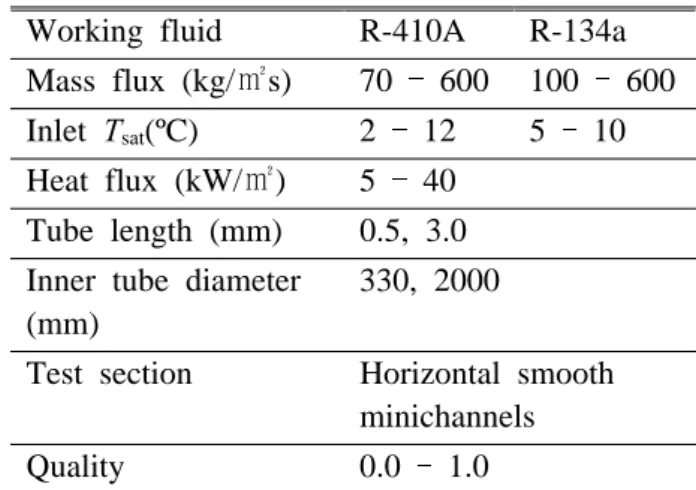
The experimental test setup specifications were tabulated in Table 1. The local saturation pressure, which was used to determine the saturation temperature, was measured using bourdon tube type pressure gauges at the inlet and the outlet of the test section. The satu-ration pressure at the initial point of satusatu-ration was determined by interpolating the measured pressure and the calculated subcooled length. The subcooled length was calculated using Eq. (1).
(1)
The outside tube wall temperatures at the top, both sides, and bottom were measured at certain axial intervals from the start of the heated length with thermocouples at each measured site. The tubes were well insulated with rubber and foam.
The experimental two-phase frictional pres-sure drop can be obtained by subtracting the calculated accelerational pressure drop from the measured pressure drop. The void fraction is predicted using the Steiner [4] void fraction. In
order to obtain the two-phase frictional multi-plier based on the pressure drop for the total flow assumed for the liquid, the calculated two-phase frictional pressure drop is divided by the calculated frictional two-phase pressure drop assuming the total flow to be liquid.
(2)The inside tube wall temperature was de-termined by steady-state one-dimensional radi-al conduction heat transfer through the wradi-all with internal heat generation. The vapor qual-ity was determined based on the thermody-namic properties. to determine the initial point of saturation. The outlet mass quality was de-termined using Eq. (3).
(3)
3. Results and Discussion 3.1 Pressure Drop
Fig. 2 shows that mass flux has a strong effect on the pressure drop. An increase in the mass flux results in a higher flow velocity, which increases the pressure drops. The figure also illustrates that the pressure drop increases as the heat flux increases. It is presumed that the increasing heat flux results in a higher va-porization, which increases the average fluid vapor quality and flow velocity.
As shown in Fig. 3, the pressure drop in the 0.5 mm tube is higher than that in the 3.0 mm tube. The smaller tube diameter results in a higher wall shear stress, wherein for a given temperature condition it results in a higher friction factor and flow velocity, and then pro-vides higher pressure drops.
0 8 16 24 32 40 150 200 250 300 350 400 450 0.5 0.5 3.0 3.0 G (kg/m2s) d p (k Pa ) R-410A q = 10 kW/m2 Tsat= 10oC Di(mm)
Fig. 3 The effect of mass flux and heat flux on pressure drop 0 5 10 15 20 25 30 35 0 0.1 0.2 0.3 0.4 0.5 0.6 0.7 180 280 x htp (k W /m 2K) R-410A q = 5 kW/m2 Di= 0.5 mm Tsat= 7oC G (kg/m2s)
Fig. 4 The effect of mass flux on heat transfer coefficient 0 20 40 60 80 100 0 100 200 300 400 500 600 700 10 20 30 G (kg/m2s) d p (kPa ) R-134a Di= 3.0 mm Tsat= 10oC q (kW/m2)
Fig. 2 The effect of mass flux and heat flux on pressure drop 0 1 2 3 4 5 6 7 0 0.2 0.4 0.6 0.8 1 5 10 x htp (kW/m 2K) R-134a G = 100 kg/m2s Di= 0.5 mm Tsat= 8oC q (kW/m2)
Fig. 5 The effect of mass flux on heat trans-fer coefficient
3.2 Heat Transfer Coefficient
Fig. 4 shows that mass flux has an insignif-icant effect on the heat transfer coefficient in the low quality region. It indicates that nucle-ate boiling heat transfer is predominant. A higher mass flux corresponds to a higher heat transfer coefficient at intermediate-high vapor quality, due to an increase of the convective boiling heat transfer contribution. The steep decreasing of the heat transfer coefficient at high qualities is due to the effect of a small diameter on the boiling flow pattern because dry-patch occurs easier at a higher mass flux.
Fig. 5 depicts the dependence of heat flux on heat transfer coefficients in the
low-inter-mediate quality region. At quality of around 0.2 nucleate boiling is suppressed and convective heat transfer contribution is predominant; it is indicated by a low effect of heat flux on heat transfer coefficient.
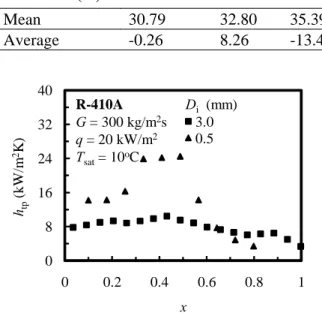
Fig. 6 shows that a smaller inner tube has a higher heat transfer coefficient at low quality regions. As the tube diameter becomes smaller, the contact surface area for heat transfer in-creases, hence the nucleate boiling is more active. It then causes dry-patches to appear earlier. The quality for a rapid decrease in the heat transfer coefficient is lower for the small-er tube. It is supposed that the annular flow appears at a lower quality in the smaller tube
0 8 16 24 32 40 0 0.2 0.4 0.6 0.8 1 3.0 0.5 x htp (k W/ m 2K) R-410A G = 300 kg/m2s q = 20 kW/m2 Tsat= 10oC Di (mm)
Fig. 6 The effect of inner tube diameter on heat transfer coefficient
Deviation (%) Tran etal. Shah Chen Gungor- Winterton Wattelet Jung etal.
Mean 30.79 32.80 35.39 38.92 39.87 44.94
Average -0.26 8.26 -13.49 9.84 -26.37 -0.14
Table 2 Deviation of the pressure drop comparison between the present data and the previous correlation
and therefore, the dry-out quality is relatively lower for the smaller tube.
The present heat transfer coefficients were compared with six existing correlations, as shown in Table 2. The Gungor-Winterton [5] correlation provided the best prediction among the other correlations. The Gungor-Winterton [5] correlation was developed using some fluids in several small and conventional channels with various test conditions. The large devia-tion in the predicdevia-tion because the previous cor-relations fail to predict a higher nucleate boil-ing heat transfer contribution for evaporative refrigerants in small channels, and the appear-ance of laminar flow.
4. New Correlation Development
A modification of pressure drop correlation was proposed on the basis of the Lockhart-Martinelli method. The two-phase pressure drop of Lockhart-Martinelli consisted of the following three terms: the liquid phase
pressure drop, the interaction between the liq-uid phase and the vapor phase, and the vapor phase pressure drop. The two-phase frictional multiplier based on the pressure gradient for liquid alone flow is calculated by Eq. (4).
(4)The value of C is found by an interpolation of the Chisholm parameter. For the liquid-va-por flow condition of turbulent-turbulent(tt), laminar-turbulent(vt), turbulent-laminar(tv) and laminar-laminar(vv), the values of the C pa-rameters are 20, 12, 10, and 5, respectively. The Martinelli parameter, X, is defined by the Eq.(5).
(5)The friction factor was obtained by consid-ering the flow conditions of laminar (for Re < 2300, f=16Re-1) and turbulent ( for Re>3000, f=0.079Re-0.25).
It is well known that the flow boiling heat transfer is mainly governed by the following two important mechanisms: nucleate boiling and forced convective evaporation. Chen in-troduced a multiplier factor, , to account for the increase in the convective
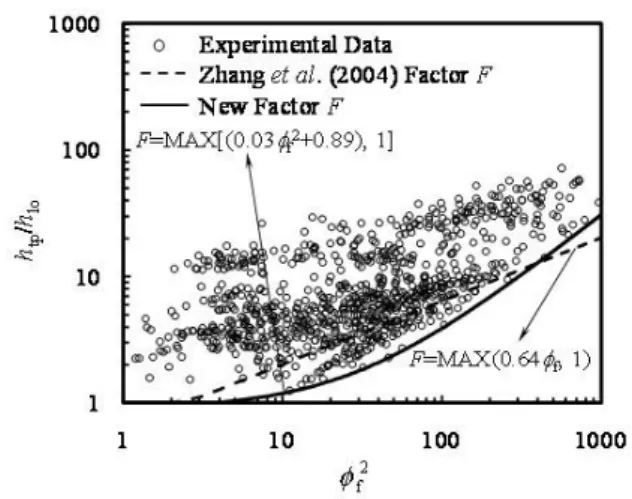
tur-Fig. 7 Two-phase heat transfer multiplier as a function of
bulence that is due to the presence of the va-por phase. The function should be physically evaluated again for flow boiling heat transfer in a minichannel that has a laminar flow con-dition, which is due to the small diameter effect. The F factor in this study is developed as a function of , , where is
obtained from Eqs. (4-5). The liquid heat transfer is defined by the Dittus Boelter corre-lation and a new factor as is shown in Fig. 7, is developed using a regression method. The prediction of the nucleate boiling heat transfer used Cooper. A new nucleate boiling sup-pression factor, as a ratio of , is pro-posed as follows:
(6)
5. Concluding Remarks
Convective boiling pressure drop and heat transfer experiments were performed in hori-zontal minichannels with R-410A and R-134a. The pressure drop is higher for the conditions of higher mass and heat fluxes, and for the conditions of smaller inner tube diameter. Mass flux, heat flux, inner tube diameter and satu-ration temperature have an effect on the heat
transfer coefficient. The heat transfer co-efficient increases with a decreased inner tube diameter and with an increased saturation temperature. The geometric effect of the small tube must be considered to develop a new heat transfer coefficient correlation. Laminar flow appears for flow boiling in small channels, so the modified correlation of the multiplier factor for the convective boiling contribution, , and the nucleate boiling suppression factor, , is developed using laminar and turbulent flows consideration.
References
1. Zhang, W., Hibiki, T., and Mishima, K., 2004, Correlation for flow boiling heat transfer in mini-channels, Int J Heat and Mass Transfer, 47, pp. 5749-5763.
2. Tran, T. N., Wambsganss, M. W., and France, D.M., 1996, Small circular- and rectangular-channel boiling with two refrigerants, Int J Multiphase Flow, 22(3), pp. 485-498.
3. Mishima, K. and Hibiki, T., 1996, Some characteristics of air-water two-phase flow in small diameter vertical tubes, Int. J. Multiphase Flow, 22,pp.703-712.
4. Steiner, D., 1993, Heat transfer to boiling saturated liquids. VDI-Wärmeatlas (VDI Heat Atlas), Verein Deutcher Ingenieure, ed., VDI-Gessellschaft Verfahrenstechnik und Chemieinge- nieurwesen (GCV), Düsseldorf, Germany, (J.W. Fullarton, translator).
5. Gungor, K. E. and Winterton, H. S., 1987, Simplified general correlation for saturated flow boiling and comparisons of correlations with data, Chem Eng Res, 65,pp.148-156.