The Effect of Suicidal Ideation, Self-esteem,
and Family Life Satisfaction on Depression
Among the Young-old, Middle-old and
Old-old Elderly Koreans
Sohn, Yong-Jin
(Catholic University of Pusan)While the prevalence of depression in later life rises, little is known about how depression varies as the older population is divided into age-subgroups. The current study attempts to determine whether psychosocial factors have a varying effect on each of the age-subgroups. A sample of 5,445 individuals aged 55 and over was adopted from the 7th Korea Welfare Panel Study(KOWPs) surveyed in 2012. The sampled subjects were divided into three age subgroups - the young-old, the middle-old, and the old-old. Three hypothesis were as follows. Those having suicidal ideation will be at a greater risk for depression. In times of reduced social status, having lowered self-esteem will also lead to more depressive symptoms. In the traditional Korean family culture where family harmony is greatly emphasized, decreased family life satisfaction will increase depression. The old-old were found to be at greater risk for developing poorer mental health. Those belonging to the old-old showed the highest score for depressive symptoms, the highest score for susceptibility to suicidal ideation, lowest self-esteem and negative family life satisfaction. To achieve a better mental health status, appropriate programs and policy implications for each age group were suggested.
Keywords: Depression, Elderly Koreans, Suicidal Ideation, Self-Esteem, Family Life Satisfaction
The part of this paper was presented at Symposium on Cross-cultural studies, the 20th IAGG World Congress of Gerontology and Geriatrics held in Seoul, June 2013.
This paper was supported by 2013 RESEARCH FUND offered from Catholic University of Pusan.
Ⅰ. Introduction
The number and proportion of Koreans aged 65 or older has continuously risen since the 1960s following the aftermath of the Korean War. Baby boomers now in their late 40s to late 50s will add more to the retired population. Since the Korean baby boomers are aging and have begun retiring, the number of elderly people struggling with depression will swell. The Korean population is marked by both a low birth rate and an aging population. The average number of children per couple as of 2010 was 1.6, the lowest fertility rate ever recorded. The availability of younger family members to care for older relatives will decrease with this ever-declining birth rate. Over the last few decades, the increase in the elderly population has skyrocketed, what was 2.2 million in 1990 doubled to approximately 5.5 million persons in 2010 (Statistics Korea, 2011). In comparison to other OECD1) nations which had an average
of 14.8% for individuals 65 and over, Korea stood at 11% in 2010. However, in the year 2050, the percentage of elderly Koreans is expected to be higher than most of the OECD countries. In 2050, Korea will have the second oldest population after Japan (OECD, 2010). The percentage of the population aged 65 and over is projected to increase to 24.3% in 2030 and 37.4% in 2050. The most noticeable increase is that of individuals aged 80 and over. In 2010, those aged 80 and older made up 1.9% of the elderly population, with this group projected to reach 14.3% by the year 2050. Overall, life situations surrounding the elderly population are not promising. Traditional values of supporting aged parents are increasingly attenuating. Consequently, the trend of elderly people living alone or with a spouse is on the rise, with the multi-generation household shrinking over the last decades. An increased trend in the number of elderly living alone foretells that elderly care, support for the elderly, emotional alienation and suicidal ideation are all expected to be more visible and daunting challenges. Also, old age divorce rates have steadily 1) In 1996, Korea became a member of the Organization for Economic Cooperation and Development
increased relative to the younger population. The rate of divorce among individuals 49 and below has a tendency to go down in contrast to an increase in the divorce rate among those aged 60 and over.
With the older segment of the Korean population increasing at an unprecedented rate, the number of elderly having mental problems such as depression is also likely to increase. Emotional problems in old age are threatening older adults’ quality of life and is increasingly given the top priority by public health policy makers(Lim, 2012). The concern for an increasingly depressed population lies in the fact that the negative outcome of subsequent mental health problems is pervasive. The main purpose of this study is to identify how depression relates to suicidal ideation, self-esteem and family life satisfaction. While many factors are known to contribute to depression, this paper focuses on the psychosocial components (e.g., suicidal ideation, self-esteem and family life satisfaction). Previous studies have indicated that these three components might be inter-related when applied to contributing depression factors.
The main reason for suicide among the elderly population is known to be failing health which accounts for 45.7 percent (Korea Times, 2013. 1). Depression starts when people think about suicide. Suicide can then result from a long, pre-meditated, cognitive process involving depressive symptoms. Considering the fact that people are diagnosed with depression before attempting or completing suicide, having extreme thoughts such as suicidal ideation acts to develop depressive symptoms.
High self-esteem appears to be an indicator of psychological well-being (Dittmann- Kohli, 2005). Although it is commonly hypothesized that self-esteem would decline in later life as a result of aged-related losses and negative life events, there is no sufficient evidence for confirming these assumptions (Bengtson, et al., 1985). However, it is hinted at that negative self-esteem may hamper psychological well-beings. This suggests that decreases in self-esteem among older adults are linked to depression. The last psychosocial component considered in this study is family life satisfaction which measures elderly Koreans’ happiness in family life events. Having positive family interaction will then determine the quality of life. Factors such
as satisfaction with adult children, spouse and/or siblings are also likely to influence emotional well-being.
As gerontological research evolved, more studies have recognized diversities among the older population and thus tend to examine varying needs and expectations based upon different age cohorts. Socioeconomic and political events have impacts on different age groups and consequently each age cohort has their own outlook and attitudes on overall life situations. The legal definition of old age has become a social definition, and the age of 65 is established as the onset of old age. Retirement, one of the life course transitions, is considered as initiation into ‘old age’. For example, pension programs used to begin at age 65 for retiring workers in the U.S.. When the U.S. passed the Social Security Act in 1935, initial eligibility for retirement income was workers 65 years or older. Since then, when age is categorized, it usually consists of three age-subgroups - the young-old (ages 65 to 74), the middle-old(ages 75 to 84), and the old-old (ages 85 and over).
In Korea, the retirement age or beginning of old age needs to be viewed differently. Retirement age in Korea is the earliest among the OECD nations. The retirement age of Korea is approximately 10 years earlier than that of other OECD nations. Around 55, most private sector employees, with the exception of a limited number of civil government officials and college professors, start retiring. The first cohort of baby boomers born in 1955 had already started retirement in 2010 when they became 55 years old. In fact, the average retirement age is found to be 54 (Statistics Korea, 2011). In the Korean institutional context where the retirement age is earlier than the average OECD nations, this paper operationalized the young-old as starting from 55 through 642), the middle-old as 65 through 74, and the old-old as 75 and
2) One of the measures to sustain solvency of Korea’s Social Security trust funds is to raise the age for full retirement. Retirement age for Social Security pension eligibility will have increased up to 65. Beginning in this year of 2013, the age of eligibility for full benefits gradually increases from 61 until the year 2033, when it will be 65. That is, additional one year will be added every 5 year from 2013.
above. Instead of lumping old age into a single, homogeneous group, this paper for the purpose of a more detailed study divided the study sample into three age groups - the young-old (55 thru 64), the middle-old (65 thru 74), and the old-old (75 and older).
This paper attempts to focus more on Korea’s unique family culture and its influence on depressive symptoms. Across all cultures and nations, the family has provided the bulk of care to the frail and poor elderly; that is, both self-sufficiency and family care have always been a pillar of the care system. Socioemotional selectivity theory is applied to better understand the psychosocial aspects of depression in later life. This theory posits that older adults become more selective about their social networks. Since older adults place a higher value on emotional satisfaction, they often spend more time with familiar individuals with whom they have had rewarding relationships (Carstensen, 1991). In a similar vein, elderly Koreans are likely to maintain close contact with the family, in particular with close family members, with whom they feel strongly connected.
1. Test Hypothesis
I. Since people tend to have pre-meditated thoughts before suicide, those having suicidal ideation are more likely to be depressed.
II. In times of aging, experiences such as poor health conditions, lowered social status and having low level of self-esteem acts to increase depressive symptoms.
III. As socioemotional theory suggests the elderly interact with close family members due to shrunken social network size, the respondents less satisfied with family members will have more depressive symptoms.
Ⅱ. Literature Review
1. Depression in Later Life
Depression threatens older people’s mental health along with dementia, anxiety and sleep disorders. Old age depression has been badly underdiagnosed and undertreated, because older individuals are more likely to complain of physical symptoms such as insomnia, loss of appetite or the inability to concentrate above or before mental issues. Across the life span, people of different ages can have different causes for being depressed. In comparison to lay-offs and lower income triggering depression among middle-aged individuals, senior citizens’ depression can be triggered by the death of family members, the loss of memory, or relocations. Depression in old age tends to be viewed as natural, resulting from declining health status, retirement, death of spouse/relatives, living alone, fewer social networks, relocation, institutionalization or reduced income. Thus, it is considered transitional and as a secondary problem to other disorders, such as dementia and chronic illness. The elderly tend to be less aware of what it means to have depressive symptoms. Only 14% of 104 older adults living in an urban area were able to correctly identify symptoms of depression, and the rest defined the symptoms as social, economic or other psychological issues (Lee & Ko, 2009).
Estimates are that no more than 10% of the elderly have a clinical depressive disorder and these prevalence estimates are lower than those in western countries (Cho, et al., 2011). In contrast, the prevalence of depressive symptoms is much higher than that of major depressive disorder or dysthymic disorder. The prevalence of depressive symptoms among the elderly had a broad range of 15% to 35%, posing a mental health risk to community-dwelling residents. This discrepancy is also in line with similar studies conducted from other countries.
2. Depression in The Korean Family Context
Traditions underlying the Korean family are driven by the Confucian ideal of filial piety. In Korea’s unique cultural settings, values associated with providing care for the frail elderly have replaced the public welfare system for older people. Caring for older people nowadays is becoming of grave concern due to changing cultural norms and expectations. The government-led long-term care insurance introduced in 2008 may have transformed generational interdependency. Availability of long-term care facilities is said to act as encouraging adult children to institutionalize their parents who may hope to be cared for by their own adult children.
In an agrarian society, the family system as a social institute works more as a joint production unit than as an individual unit. The traditional function of the family was to share the provision of care for the frail, sick elderly. Five essential functions performed by the family are replacing population, caring for the young and the old, socializing new members, regulating sexual behavior and providing affection (Zastrow, 2000). With a rapidly aging population, family functions such as providing affection and caring for the aged parents are a continuous challenge for the family. Elderly parents do not have enough resources to provide for their own retirement in old age. However, the elderly cannot expect their adult children to provide care for them.
According to the principle of reciprocity originated from exchange theory, when rewards are not proportional to investments over the long term, persons tend to feel angry with social relations, instability is created and the propensities for conflict increase. This paper assumes that the influence of culture on depression plays a pivotal role because closely tied family members are mutually interdependent on each other.
As people get older, the concept of socioemotional selectivity theorizes that as the elderly withdraw from a set of social networks, they narrow social interaction to maximize positive emotional experiences and minimize emotional risks (Carstensen,
1991). From a Korean cultural perspective, this theory suggests that the elderly Korean will decrease the total number of their social contacts by spending more time with their family members and being more concerned for the welfare of their adult children and extended family.
In Korea, family culture plays a pivotal role in determining family relations. Even if adult children get married, aged parents tend to show a strong emotional attachment to them. A lot of emotional and economic transfers between generations consequently follow. Familism, which values only the interests of one’s own family, still has a strong impact on the contemporary elderly. They tend to put their families’ interest foremost to the exclusion of all other interests. For instance, a majority of contemporary elderly Koreans missed their chances of accumulating retirement assets which were used for their children. Even if they set aside a large amount of wealth, they would use it for the welfare of their adult children in times of economic hardships. In cases where the elderly are not satisfied with what they expect to receive for what they have invested, they may feel disappointed and get easily depressed.
3. Suicidal Ideation
Suicidal ideation as a strong risk factor for suicide threatens the elderly mental health status. Several studies indicate that those having suicidal ideation may be more depressed. With a sample of 836 elderly persons living in Busan, people having less education, higher subjective stress or severe loneliness have greater rates of suicidal ideation (Kim et al., 2013). People tend to have self-deprecating thoughts before committing suicide. However, a study showed that elderly people usually did not express their suicidal feelings and thoughts, which made it more difficult for health care professionals to detect symptoms of suicide (McIntosh et al., 1994).
The elderly population living in almost all industrialized countries showed a high rate of suicide (Nicholl et al., 2008). Korea as a developed country is not an exception to this trend. Death resulting from suicide for all Koreans is ranked as
the 4th leading cause in Korea. As of 2011, elderly Koreans have a suicide rate of about 80 persons out of every 100,000. This suicide rate is two times higher than the average suicide rate, that is, about 32 persons per 100,000 among all Korean people (Korea Times, 2013. 1).
Healthy life expectancy is certainly compromised due to suicidal ideation (Byun et al., 2011). Over the past 10 years, suicides in member countries of the OECD have dropped; however, those committing suicide have increased in Korea across all age groups. The average suicide rate in Korea is significantly higher than all other OECD nations. In 2010, in comparison with 12.8 out of 100,000 people living in other OECD countries, Korea’s suicide rate stood at 33.5, which was double the average of OECD countries. In Korea, a positive association between age and suicide was found. As age rises, so does the suicidal rate. Especially those in their 70’s and 80’s are more susceptible to committing suicide. Those 80 and over had the highest suicide rate which was 123.3 out of 100,000 people. The suicide rate among those in their 70’s was also high at 83.5 deaths, followed by 52.7 for those in their 60’s and 40.1 for those in their 50s. As time has progressed, the suicide rate has sharply increased. The suicide rate among those aged in their 50’s climbed from 22.2 in 2000 to 40.1 in 2010.
4. Self-esteem and Family Life Satisfaction
Self-esteem can be defined in at least two ways. One definition connects self-esteem to a person’s general success or competence in areas of life that are meaningful to a given individual. A second definition and more relevant to the current study is understanding self-esteem as an attitude or feeling concerning a sense of worth or one’s ‘worthiness’ as a person (Mruk, 2013). It refers to the values, either positive or negative, a person places on his or her sense of worth, acknowledging one’s strengths and weaknesses (Breytspraak, 1984). Although it is often a neglected point in late life research, the relationship between self-esteem and mental health deserves
to be investigated, considering that positive self-esteem is linked to better mental health status (Dittmann-Kohli, 2003).
In general, depression in later life was found to have an inversely proportional relationship with self-esteem (Choi, 2003). However, in a study conducted with a limited sample of 393 older people living in T community, self-esteem did not affect depressive symptoms. Thus, overall self-esteem appeared not to decline significantly in later life, but a sub-group of older adults with less personal resources such as negative relationships with family and friends were likely to have increased depression (Sohn, 2013). Appropriate interventions appeared to be effective in lowering levels of depression. In a music psychotherapy intervention study, after 14 hemiplegia patients receive about 16 weeks of music therapy programs, the sampled elderly music therapy programs play a positive role in decreasing the depression and improving their self-esteem, suggesting that the increases in self-esteem will help to decline depression among this group (Yang, 2010).
People suffering from depression tend to have a negative self-image. Depression involves a disturbance in thinking: the depressed individuals think in negative ways about themselves, their environment, and their future. This pessimistic mental state affects their mood, their motivation, and their relationships with others (Burns, 1999). They have a low estimation of themselves and appraise their lives negatively and as useless. The cognitive explanation for depression suggests that a low level of self-esteem resulting from self-defeating thinking goes through a complex self-rating process and leads to depression.
The occurrence of negative interactions with one’s spouse and adult children will adversely affect the mental health status for aged people. Having family concerns places an increasingly higher demand on old people. Negative psychological coping patterns will also increase depressive symptoms. Those who are less satisfied with their family situations tend to rely on the usage of negative psychological coping strategies, which in turn results in increased depression.
developmental task to be achieved is integrity. This involves reflecting on the past and piecing together a positive review. If the older adult resolved one or more of the past events in a negative way (e.g., being socially isolated in early adulthood or stagnated in middle adulthood), that person will be less satisfied with family life and have a low level of self-esteem. Numerous studies have validated Erikson’s integrity concept, suggesting that those having higher levels of self-esteem and living with family members happily were more likely to have better mental health (Yang, 2010; Kang & Kim, 2011; Lee & Bae, 2004).
5. Socio-demographic Factors
It is well-documented that socio-demographic standings are highly associated with depressive symptoms (Lee et al., 2008). Those located in an adverse socioeconomic status are more prone to be depressed. Various socioeconomic factors play a role in depression. Groups such as women, those living without a spouse tend to have higher levels of depression. Other factors such as unemployment and/or lower levels of income tend to influence levels of depression as well. Poverty rate among the elderly in Korea has gone down due to public welfare relief (called “National Basic Livelihood Act”) over the last decade. However, the absolute poverty rate of senior citizens living under the minimum income for livelihood expenses is far greater than the basic livelihood recipient rate, standing at an alarming rate of 32.5% (Chang et al., 2012). This may result from stringent means-testing and eligibility criteria. Consequently, a large proportion of the elderly are still excluded from receiving public welfare relief as a last resort in the social safety net. Concerning the effect of religion on depression, the existing literature shows inconsistent results. Having religious belief does not necessarily lead to positive effects on depression (Seomun, 2010).
6. Health and Health Care Utilization Variables
It is well-known that self-rated health status and stressful life events lead to depression. Among 234 elderly Korean immigrants living in New York City, those experiencing stressful life events and appraising their health negatively are more prone to have depressive symptoms (Ahn, 2007).
Living with chronic diseases has long been considered a risk factor for depression among the elderly. One major chronic illness among the elderly is diabetes. Many efforts have been made to prevent the onset of diabetes, but the prevalence of it has not abated yet. The prevalence of high blood pressure is also on the rise. Those aged 65 and over had a 56.1% occurrence of high blood pressure in 1998, which increased to 64.9% by 2009.
Another threat for depressive symptoms is cognitive disorder. By 2011, older people aged 65 and over having dementia were 8.9%, accounting for about 490,000 persons. In 2030, dementia is projected to affect 9.6% of the population, which will add up to be more than one million people who will suffer from this. While it is difficult to pinpoint one certain cause for dementia, there are identifiable risk factors that appear to be more prevalent among those who suffer from dementia. Factors such as older age, female, having lower levels of education, losing a spouse, smoking and showing signs of depression all appear to be risk factors for dementia (Chang et al., 2012). While little is known about the relation between health care utilization (e.g., being outpatient, regular health check-cup, etc) and depression, it is likely that those having depressive symptoms resort to the formal health care system.
Ⅲ. Methodology
1. Sample
The current study sample was adopted from the 7th wave of the Korea Welfare Panel Study (KOWPS) which contained enriched information on welfare, health conditions, health care utilizations, family relations, and mental health status. It was originally intended to tap the area of income after the onset of IMF era. The KOWPS was done by the Korea Institute for Health and Social Affairs (KIHASA) under the supervision of the Ministry of Health and Welfare. The first wave of the KOWPS was done in 2006 and data have been collected annually. From the 7th wave (2012), a sample of 5,445 persons aged 55 and over was selected and used for the analysis. In previous studies, the exact boundaries of old age grading vary and are flexible. The ambiguities surrounding terms such as age grading/grouping, life course, life stages, and life transitions demonstrate that the age category is a cultural concept in a given society. They do not necessarily reflect a wide array of different types of biological and socio-psychological needs and legislated legal definitions. For the purpose of the current study reflecting the initial age of Korea’s retirement cultural context, a selected sample of 5,445 was divided into three age groups - the young-old (elderly 55 thru 64), the middle-old (elderly 65 thru 74), and the old-old (elderly over 75). Those 65 thru 74 defined as the middle-old were the largest at 2,069, followed by 1,796 for the old-old and 1,580 for the young-old.
Those born 55 or more years ago have witnessed a variety of historical and political turmoils, along with sociological and economical changes in their lives. The first age cohort of the present study sample defined by the young-old (55~64years old) was born in 1948 through 1957. The first cohort of this young-old sample(born in 1948) was born the same year South Korea’s first legal government was established. Another major political event that the young-old experienced was the Korean War (1950~1953). When the war ended, the Korea peninsula was divided
and it has remained so since. Both North Korea and South Korea have established different governments.
The second cohort of this study defined by the middle-old (65~74years old) was born between 1938 and 1947. This era corresponded with the last period of Japanese colonialism. In 1941, Japan attacked a U.S. base in Pearl Harbor, which drove America into World War II. In 1945 Japan surrendered to the allied forces after the H-bomb was dropped on the Japanese mainland. Thus, this middle-old sample was born during Japan’s entry into the WWII and years later the end to the colonial rule in Korea.
The last birth cohort of the present study called the old-old (75 years old and over) was born before the year 1937. This period was punctuated by the darkest days of Korea’s modern history. They were mostly born and grew up during the colonized Japanese period (1910~1945). Most of them were illiterate and less educated, and a government-led welfare system virtually did not exist. This group had the highest illiteracy rate out of the three age subgroups.
<Table 1> represents selected differences among the three age sub-groups based on selected variables. Included demographic variables were: gender, education, marital status, religion, economic involvement, social security beneficiary and basic livelihood recipient. In this study, instead of using a single income variable, three indices of income factors such as economic activity, social security enrollment and basic livelihood recipient were used for reflecting source of income. More than half of all three groups were female and not more than 10% surveyed had a two year college degree or higher level of education. 53% of the old-old did not have a spouse, and almost two-thirds of all respondents practiced some form of religion. Relatively high percentages of both the middle-old (43.2%) and the old-old (23.9%) were still economically involved, in contrast to a low percentage being social security beneficiaries for both the middle-old (39.7%) and the old-old (14.1%). The old-old living on basic livelihood recipients tended to be higher (12%) in comparison to the other two groups.
young-old (55~64) middle-old (65 ~ 74) old-old (75+) Variables Group N(%) N(%) N(%) Gender male 702(44.4) 841(40.6) 676(37.6) female 878(55.6) 1228(59.4) 1120(62.4) Education no school 59(3.7) 344(16.6) 725(40.4) elementary 528(33.4) 928(44.9) 675(37.6) middle 404(25.6) 345(16.7) 162(9.0) high 424(26.8) 312(15.1) 140(7.8) college+ 165(10.4) 140(6.8) 94(5.2) Table 1. Variable Descriptions for Three Groups
Health and health care utilization variables were: self-rated health status, number of chronic diseases, disability status, being outpatient (e.g., usage of health care facilities during the last year) and having a health check-up. More than half of the old-old (56.3%) perceived their health status as either poor or very poor, followed by a 37.7% of the middle-old. Both the middle-old (81.2%) and the old-old (88.5%) responded they had two or more chronic diseases. When asked if they had family concerns (e.g., health problems, debts, unemployment, alcohol abuse, family violence, runaway, education and misbehavior, housing, and adult children’s delayed marriage), more than two-thirds of all age samples had such concerns. Importantly, as high as 76% of the old-old had one or more of these family concerns.
Finally, depression, suicidal ideation, self-esteem, family life satisfaction, and negative coping strategy were used. The old-old group showed the highest mean depression score, followed by the middle-old and the young-old. In all groups, around 5% of the respondents answered they had seriously thought about committing suicide during the last year. A 10-item composite self-esteem score indicated that the younger the group was the higher self-esteem they had. The young-old had the highest self-esteem score, and the old-old had the lowest level of self-esteem. A 4-item family life satisfaction score showed that the young-old were the most satisfied with their family members, and the old-old were the least satisfied among the three groups.
young-old (55~64) middle-old (65 ~ 74) old-old (75+) Marital Status no spouse 352(22.3) 644(31.1) 952(53.0)
having spouse 1228(77.7) 1425(68.9) 844(47.0) Religion no 667(42.2) 791(38.2) 728(40.5) yes 913(57.8) 1278(61.8) 1068(59.5) Economic Involvement no 579(36.6) 1175(56.8) 1366(76.1) yes 1001(63.4) 894(43.2) 430(23.9) Social Security Beneficiary no 703(44.5) 1247(60.3) 1542(85.9) yes 877(55.5) 822(39.7) 254(14.1) Basic Livelihood Recipient no 1431(90.6) 1865(90.1) 1572(87.5) yes 149(9.4) 204(9.9) 224(12.5) Self-rated Health Status very good/good 848(53.7) 614(29.7) 303(16.9) average 414(26.2) 676(32.7) 481(26.8) poor/very poor 318(20.1) 779(37.7) 1012(56.3) Number of Chronic Disease no 539(34.1) 299(14.5) 170(9.5) one 99(6.3) 90(4.3) 36(2.0) two or more 942(59.6) 1680(81.2) 1590(88.5) Having Family Concerns no 559(35.4) 637(30.8) 429(23.9) yes 1021(64.6) 1432(69.2) 1367(76.1) Disability Status no 1332(84.3) 1694(81.9) 1486(82.7) yes 248(15.7) 375(18.1) 310(17.3) Being Outpatient no 143(9.1) 55(2.7) 54(3.0) one or more 1437(90.9) 2014(97.3) 1742(97.0) Having Health Check-Up no 761(48.2) 1013(49.0) 962(53.6) yes 819(51.8) 1056(51.0) 834(46.4) Suicidal Ideation yes 73(4.6) 103(5.0) 70(3.9)
no 1415(89.6) 1860(89.9) 1548(86.2) Depression Scale mean(S.D.) 3.52(4.39) 4.69(4.68) 6.08(5.38) Self-esteem Scale mean(S.D.) 30.07(3.98) 28.97(4.04) 27.47(4.03)
Family Life
Satisfaction Scale mean(S.D.) 19.30(5.74) 19.13(5.15) 17.80(5.07) Negative Coping
Strategy Scale mean(S.D.) 8.32(2.42) 8.21(2.28) 8.31(2.34)
A. Dependent and Explanatory Variables
Depression Scale: As for a dependent variable, the Korean version of the Center for Epidemiologic Studies-Depression Scale (CES-D; Radloff, 1977) was used, and it includes 11 items asking individuals how often they have experienced a given
statement. The original form of CES-D has been translated into the Korean language, and its psychometric properties in the Korean language have been validated in several studies. The short form of the present CES-D contained questions such as poor appetite, loneliness, feelings of being disliked, and sleep restlessness during the past week. The four-point response format included ‘rarely or none of the time’ (0), ‘some of the time’ (1), ‘much of the time’ (2), and ‘most or all of the time’ (3). The two positively worded items were reverse-coded, and the total scores had a potential range of 0-33, with higher scores indicating greater levels of depressive symptoms. Suicidal Ideation: The respondents were asked if they had seriously thought about committing suicide during the last year, and this single-item was used for a suicidal ideation variable. The answer format was dichotomized as either ‘yes’ (1) or ‘no’ (0). Self-esteem Scale: Self-esteem was measured by using the Rosenberg Self-esteem Scale (Rosenberg, 1965). Those 5 inversely coded items were re-coded, and the total score was created by compositing 10 items. The higher the score, the higher one’s self-esteem.
Family Life Satisfaction Scale: A 7-point family life satisfaction scale was indexed by four questions. The respondents were asked how much they were satisfied with their family lives, spouse, adult children, and interactions among adult children. A 7-point likert scale ranged from ‘very unsatisfied’ (1) to ‘very satisfied’ (7). All scores were added up and a total life satisfaction score was created. The higher the scores were the more satisfied the respondents were.
Family Concern: The family concern variable used a single question. The respondents were asked if they had any family-related worries in areas of economic difficulties, unemployment, health problems of family members, alcohol abuse, family violence, negative relationship among families, walkout of families, housing problems, and problems of adult children’s marriage. If the individuals responded ‘yes’ on this item, they were coded as ‘1’. If not, they were given ‘0’.
Young-Old Middle-Old Old-Old
Variable Group Mean
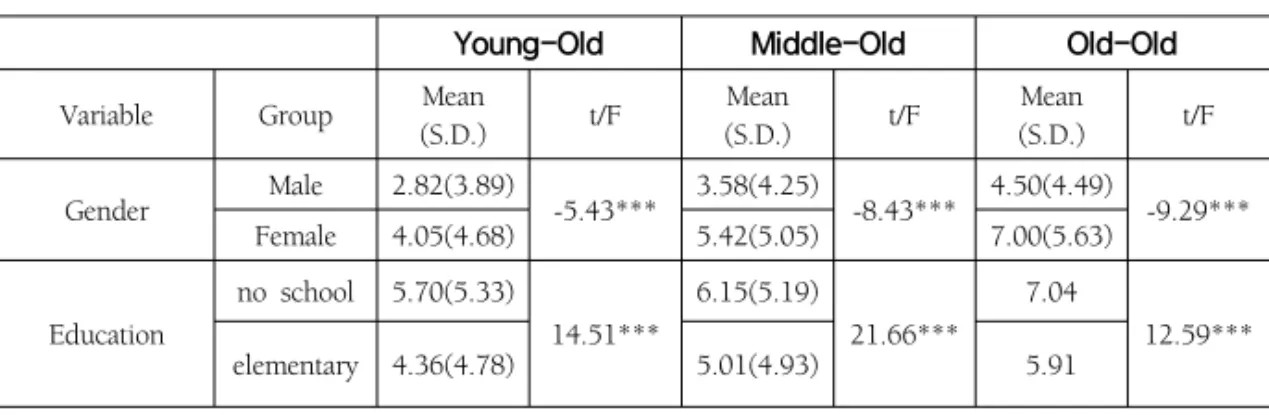
(S.D.) t/F Mean (S.D.) t/F Mean (S.D.) t/F Gender Male 2.82(3.89) -5.43*** 3.58(4.25) -8.43*** 4.50(4.49) -9.29*** Female 4.05(4.68) 5.42(5.05) 7.00(5.63) Education no school 5.70(5.33) 14.51*** 6.15(5.19) 21.66*** 7.04 12.59*** elementary 4.36(4.78) 5.01(4.93) 5.91
Ⅳ. Results
<Table 2> shows the results of bivariate analysis on depression for all three groups. Sociodemographic variables such as being female, less educated, living without spouse, not economically active, not having social security benefits and living on basic livelihood aids were significantly related to depressive symptoms in all groups. Whether one had religion or not did not have an influential impact on depression in the old-old group. When it comes to sociodemographic factors, the old-old sample proved to be much more susceptible to depression than the other two age sub-groups. Considering health and the health care utilization variables, perceiving one’s health as poor, being afflicted with chronic diseases, being immersed in family concerns, and suffering from disabilities tended to have increased depressive symptoms. However, receiving health check-ups during the last year did not have a consistent impact on all three groups.
It was found that if there were thoughts or inclinations toward suicide within the last year, that had a strong and profound influence on depression across all three groups. The magnitude of this relation, in particular, was very strong for the old-old group. A mean value of 12.7 (saying ‘yes’) on suicidal ideation out of a 11-item composite depression scale in the old-old group warns that they are at greater risk for attempting suicide after being depressed. As expected, those less satisfied with family members were highly likely to be depressed in all three groups.
Young-Old Middle-Old Old-Old
middle 3.40(4.07) 4.12(4.74) 5.09 high 2.77(3.71) 3.70(4.06) 4.44 college+ 2.27(3.71) 2.26(3.14) 4.13
Marital Status no spouse 6.24(5.52) 13.46*** 6.14(5.20) 9.28*** 7.14(5.61) 8.70*** spouse 2.76(3.68) 4.01(4.49) 4.87(4.81) Religion no 3.74(4.44) 1.64* 5.02(5.09) 2.44* 6.27(5.40) 1.14 yes 3.37(4.36) 4.48(4.65) 5.96(5.36) Economic Involvement no 4.63(5.24) 7.32*** 5.29(5.15) 6.30*** 6.49(5.63) 5.15*** yes 2.92(3.72) 3.92(4.27) 4.93(4.37) Social Security Beneficiary no 4.11(4.88) 4.61*** 5.23(4.95) 6.24*** 6.29(5.47) 3.76*** yes 3.06(3.91) 3.86(4.52) 4.89(4.59) Basic Livelihood Recipient no 3.10(3.94) -12.61*** 4.35(4.59) -9.41*** 5.78(5.20) -6.04*** yes 7.91(6.16) 7.72(5.81) 8.20(6.08) Self-rated Health Status very gd./good 2.30(3.31) 137.44*** 3.22(4.06) 95.38*** 3.55 91.17*** average 3.58(3.88) 4.00(4.17) 4.76 poor/very pr 6.92(5.79) 6.54(5.37) 7.62 Number of Chronic Disease no 2.36(3.40) 30.90*** 3.50(4.45) 14.24*** 4.94 3.90** one 3.15(3.96) 3.48(4.10) 6.14 two or more 4.23(4.79) 4.96(4.89) 6.20 Having Family Concerns no 2.12(3.15) -9.46*** 2.67(3.60) -13.03*** 3.46(3.83) -11.92*** yes 4.30(4.78) 5.60(5.03) 6.97(5.53) Disability Status no 3.34(4.26) -4.06*** 4.54(4,82) -2.95** 5.93(5.31) -2.65*** yes 4.66(5.04) 5.42(4,82) 6.91(5.69) Being Outpatient no 2.78(4.59) -2.00** 3.41(4.81) -1.91* 4.25(5.11) -2.07** one or more 3.60(4.38) 4.72(4.83) 6.12(5.38) Having Health Check-Up no 3.74(4.43) 1.79* 4.66(4.73) -.23 6.05(5.36) -.222 yes 3.33(4.36) 4.71(4.92) 6.11(5.40)
Suicide Ideation yes 10.73(5.76) 15.58*** 11.55(5.37) 15.72*** 12.7(6.04) 10.89*** no 3.14(3.95) 4.30(4.50) 5.79(5.15) Self-esteem Scale correlational coefficient -.512*** correlational coefficient -.486*** correlational coefficient -.477*** Family Life Satisfaction Scale -.403*** -.332*** -.374*** Negative Coping Strategy Scale .153*** .153*** .133*** Note: * P<.05, ** P<.01, *** P<.001
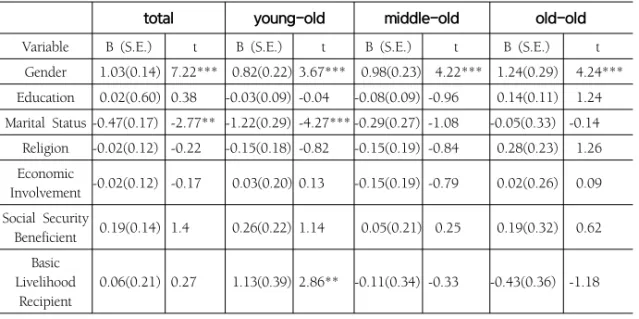
Both self-esteem and life satisfaction were found to be inversely proportional to depressive symptoms, indicating that those with lower self-esteem and less satisfaction with their family members (e.g., family lives, spouse, adult children and interactions among adult children) were more likely to be depressed. These results indicate that having heightened self-esteem and maintaining positive interactions with family members is vastly important for the elderly to achieve positive mental health. Results for the multivariate analyses including a total sample were shown in <Table 3>. To check with the problem of multicollinearity, the VIF tests were conducted across all models. Most of the VIF scores were around ‘1’, with the lowest of 1.02 to the highest of 2.49, indicating that the possibility of multicollinearity is very low. In a total sample model, an age-subgroup variable(indexed by young-old, middle-old and old-old) was entered to determine its effect on depression, along with 17 variables. While controlling for 17 variables, the age-subgroup variable showed a significant positive effect on depression. This means that as people get older, they are more likely to be depressed. In all three groups, 17 entered variables accounted for above 30 percentage of variance in explaining depression, indicating all three models fit well into determining depression. Across all three groups, being female, perceiving one’s health as poor, having suicidal ideation, having lowered self-esteem and having less satisfaction with family members were significantly related to depression, while controlling for all other relevant variables. Gender consistently showed its significance on depression. Females were much more likely to be depressed, and in particular, gender had the strongest impact among the old-old sample. The rest of the sociodemographic variables did not reach their statistical significance, except for marital status and being a basic livelihood recipient in the young-old sample. Those having rated their health status negatively also showed a higher level of depression in all three groups. Whether having family concerns (e.g., economic difficulties, unemployment, health problems, etc.) had a statistically significant negative impact on depression, but not in the old-old group.
total young-old middle-old old-old
Variable B (S.E.) t B (S.E.) t B (S.E.) t B (S.E.) t Gender 1.03(0.14) 7.22*** 0.82(0.22) 3.67*** 0.98(0.23) 4.22*** 1.24(0.29) 4.24*** Education 0.02(0.60) 0.38 -0.03(0.09) -0.04 -0.08(0.09) -0.96 0.14(0.11) 1.24 Marital Status -0.47(0.17) -2.77** -1.22(0.29) -4.27*** -0.29(0.27) -1.08 -0.05(0.33) -0.14 Religion -0.02(0.12) -0.22 -0.15(0.18) -0.82 -0.15(0.19) -0.84 0.28(0.23) 1.26 Economic Involvement -0.02(0.12) -0.17 0.03(0.20) 0.13 -0.15(0.19) -0.79 0.02(0.26) 0.09 Social Security Beneficient 0.19(0.14) 1.4 0.26(0.22) 1.14 0.05(0.21) 0.25 0.19(0.32) 0.62 Basic Livelihood Recipient 0.06(0.21) 0.27 1.13(0.39) 2.86** -0.11(0.34) -0.33 -0.43(0.36) -1.18
Table 3. Multivariate Analyses for Four Age Groups
after controlling for other variables. As predicted, those having suicidal ideation tended to be depressed. Having suicidal ideation was statistically significant in all three groups at 0.1% level, indicating its seriousness is very strong. Low self-esteem and its relation to depression was also firmly confirmed. Having low levels of self-esteem and not finding happiness with family members tended to increase depression across three age-groups. Guided by the socioemotional theory, the last hypothesis stated that the degree of satisfaction with one’s family members will determine levels of depressive symptom. As hypothesized, the respondents less satisfied with family members tended to have more depressive symptoms. In particular, the old-old group appeared to be exposed to greater risks for developing mental health problems. The association between dissatisfaction with family members and depressive symptoms in the old-old group was extremely strong at 0.1% level. In sum, depressive symptoms appeared to be the most serious concern for the old-old group. Predictive variables such as being female, poorly perceived health status, having suicidal ideation, lowered self-esteem and not finding happiness with family members had far more negative impacts on the old-old group than the other two age groups.
total young-old middle-old old-old Self-rate Health Status 0.84(0.08) 10.61*** 0.86(0.14)6.30*** 0.62(0.12) 5.11*** 1.13(0.15) 7.31*** Number of Chronic Diseases 0.07(0.08) 0.83 0.20(0.11)1.87 0.02(0.14) 0.17 -0.01(0.19) -0.06 Disability Status 0.11(0.16) 0.70 -0.57(0.28) -2.04* 0.09(0.25) 0.37 0.51(0.30) 1.66 Having Family Concerns 1.07(0.13) 8.35*** 0.45(0.19)2.29* 1.17(0.20) 5.78*** 1.57(0.26) 5.96 Being Outpatient -0.34(0.30) -1.14 -0.44(0.34) -1.27 -0.34(0.59) -0.58 -0.13(9.80) -0.17 Having Health Check-up 0.18(0.11) 1.61 -0.01(0.18) -0.03 0.13(0.18) 0.75 0.36(0.22) 1.65 Suicidal Ideation -4.40(0.27) -16.13***-4.20(0.46) -9.12*** -4.60(0.41) -11.05*** -4.44(0.54) -8.17*** Self-esteem Scale -0.38(0.02) -23.35***-0.32(0.03) -11.97***-0.38(0.03) -14.56*** -0.41(0.03) -13.01*** Family Life Satisfaction Scale -0.09(0.02) -5.63*** -0.05(0.02) -1.95* -0.08(0.03) -2.87* -0.17(0.04) -4.88*** Negative Coping Strategy Scale 0.08(0.02) 3.31*** 0.05(0.04)1.41 0.10(0.04) 2.43* 0.09(0.05) 1.79 age category 0.31(0.09) 3.51*** R2 0.38 0.39 0.35 0.36 adjusted R2 0.37 0.38 0.34 0.35 F 169.5 53.18 59.48 51.87 Note: * P<.05, ** P<.01, *** P<.001
V. Discussion & Conclusion
The main purpose of this paper was to explore depression in relation to psychosocial factors (e.g., suicidal ideation, self-esteem, and family life satisfaction) among community-dwelling residents 55 and over. It was attempted to show how these three psychosocial factors might differently affect predicting depression within each of the three age-subgroups. The study sample was divided into three age subgroups (the
young-old, middle-old, and old-old), reflecting the heterogeneity of the older population. One of the strengths of the present study was its use of a nationwide sample of the elderly surveyed under the auspices of the Ministry of Health and Welfare, which will help to generalize the current study results more accurately.
While the three psychosocial predictors had differential magnitude on depression across all three age models, all three psychosocial predictors reached their statistical significance in all three groups. These three psychosocial predictors were found to be directly proportional to depressive symptoms in all three age models. This finding concurs with the previous reports that healthy psychosocial well-being is of paramount importance for the daily lives of the elderly. Depressed individuals having lowered level of self-esteem and suicidal ideation need to receive a full attention from both health care practitioners and policy makers for maintaining healthy mental status. Based upon the results of the current study, several suggestions for each group are made as follows.
One of the major findings of this study is that the mental health status of the old-old group is in dire straits, with urgent intervention needed. The mean depression score for the old-old group was the highest among three groups. In all sample included model, the age-group variable approved to be statistically significant, showing that the old-old were most likely to be depressed. Using the bivariate analysis, the impact of suicidal ideation on depressive symptoms in the old-old group was noticeably strong. The suicide rate of elderly Koreans is found to be the highest among OECD countries. It is known that even if older people have suicidal ideation before committing suicide, they tend to refrain from verbalizing inner thoughts or complaining of psychosomatic symptoms. Suicidal ideation often leads to depressive symptoms, which is highly linked to committing suicide. Although a wider variety of measures have been introduced to reduce the number of suicides, they have not yet successfully abated elderly suicide. The results of the current study strongly suggest that both the preventive measures and treatment for depression deserve a top public health agenda. More rigorous programs and services targeting the suicidal
impulses in this old-oldest population should be given policy priority.
The life situation for the young-old group (age 55~64) has been relatively better than the other two age cohorts. They reaped the benefits of previous generations’ sacrifices, being born and raised in a period of moderation following after independence from Japan and the Korean War. They had a relatively good education and enjoyed a thriving economic boon during the 70’s and 80’s. Currently, they are called “the sandwich generation” being double-burdened caught in between their own children and parents. They more readily showed signs of depression if they experienced such factors as living without a spouse, living on basic benefits or having some form of disability. Psychological programs such as grief counseling after bereavement will be needed for them. One appropriate measure that could be taken for this group is to implement more rigorous job replacement programs. For those who are disabled, they need to have easier access to a variety of rehabilitation programs such as vocational job training and physical & psychological services along with higher welfare benefits.
The middle-old age group was clearly in between the young-old and the old-old group in predicting depression. Using multivariate analysis, it became clear that being female, rating one’s health status as poor, having family concerns and using negative coping strategies in addition to the three psychosocial predictors, were significant factors in depression among the middle-old age group. Unlike the young-old group, three predictors (e.g., marital status, basic livelihood recipient, and disability status) were no longer significant, but having family concerns remained statistically significant. Using negative coping strategy was the only significant variable found in the middle-old age group in regard to predicting depression. The age range for the middle-old age group is 65 to 74. As people move into this age range, they become increasingly aware of the effect of aging on both their physical and mental state. Concerns about family matters will tax these group’s mental health, while the use of negative coping strategies can then weaken their capacity for dealing with life events. For this middle-old age group, family counseling services appear to be
needed to relieve mental health difficulties associated with family worries. Currently, counselors who are specialized in meeting the needs of the older population are lacking. This lack of available counselors will create a demand that should be taken advantage by providing various incentives that could entice more people to consider this line of work. Policy makers should then prepare older people to participate effectively in resolving family-related problems.
The socioemotional theory suggests that the elderly will put more energy on familiar individuals such as family members. This paper has effectively shown that the level of depression is likely to be affected by how the elderly perceive their relationships with family members. The overall high percentage of family life satisfaction speaks to something very deep in the involvement of family relations. The high mean scores on family life satisfaction insinuated that the sampled elderly intimately get involved with their family members. One of the major purpose of the current study was to delineate the family satisfaction with depressive symptoms. The result showed that those less satisfied with family members were highly likely to be depressed. This is raising mental health concerns for the elderly distressed with family relations. At the bivariate analysis, the oldest-old group had the lowest life satisfaction score, which may act as the strongest predictor for depression in the multivariate analysis.
This paper carefully speculates that the sampled elderly may have a higher level of depression because of cultural expectations. Considering that Korean society is still family-oriented and the relationship between family members is of great importance in a Confucian society (Kim et al., 2012), the high score on depressive symptoms could be a cultural phenomenon. Policy makers should facilitate family harmony by encouraging families to live with their aged parents, which contributes to positive outlooks in family interactions.
The current generation of the elderly went through the tumultuous historical period of living in a poverty-stricken country and spent most of their income on their children’s educational expenses. When their adult children were ready to get
married, a vast majority of the elderly contributed to their children’s wedding expenses as well. Presently, elderly parents in general hold the belief of finding fulfillment from their adult children’s well-beings than what they have achieved in their own lives. Weakened family bonds which had once been known as a strong family custom can be linked to elder depression for being disappointed with their adult children’s behavior. Attitudes have changed towards the aged parents in that a growing number of adult children no longer take financial responsibility for their elderly parents. They also expect the government to have a duty to provide the retired population with basic necessities in life. The Social Survey conducted by the Statistics Korea Bureau showed that the perception of shared filial responsibility between family and government has continued(Social Survey, 2010). In one survey conducted in 2008, 48.3% of baby-boomers, born during the years of 1955 through 1963, answered that filial responsibility should be shared by both the family and the government (Statistics Korea, 2010).
Policy makers should make endeavors to come up with a modified definition ofmaintaining intergenerational harmony. For instance, the concept of the ideal family with its members supporting its elderly has continuously evolved towards the Western pattern of equality. Various points of data indicate that role expectations between the younger and the older generations are changing.
The contemporary elderly still appear to be strongly influenced by Confucius values which have permeated throughout their earlier learning stages of life. The results of this study indicate that the older generation which holds on to a traditional belief of giving priority to family concerns will be more prone to suffering from depressive symptoms. For example, family counselors ought to encourage stressed elderly Koreans to reconcile themselves with family members and pursue varied interests such as volunteering which contributes back to the community for what they may have acquired previously during their middle-aged years. For the elderly, the family is still the primary structure within which their lives are formed and processed. Families have been their backbone for providing them with emotional
comfort. Unfortunately, family members can also be a significant source of agony which will contribute to increased stress. Berscheid (1982) presented an interesting suggestion of how emotionally close relationships are changed when those relationships are interrupted. In close relationships, the more intimate the relationship, the more the two people’s goals depend on each other. If the interaction functions as usual, there will be no interruptions and little emotion. However, the greater the interdependence, the greater the potential for intense negative emotion will follow. This theory predicts that if the parent-children relation turns into disappointment or frustration, it will be more likely to result in negative emotions such as depression.
Yet policy makers often neglect addressing the basics of how the elderly control their feelings and moods. Mental health is affected by various factors, including family interactions. Educating and propagating these facts may enhance life for the elderly to an significant degree. Health professionals should observe this fact and use various techniques to help them maintain better mental health. A great starting point would be to encourage the elderly to feel freedom to express their negative thoughts. Such a simple discussion can be useful information for the health care professionals to determine what valuable sources are needed for advancing health care by concerned doctors.
Policy makers should be geared toward training more professionals to help those faced with family problems. Older adults are reluctant to seek mental health services due to the stigma attached to mental health. However, the effectiveness of psychotherapy with older adults has continuously been proved (Knight, 2007). The health care professionals should endeavor to create new improved “health care plans” designed to meet the mental health needs for the elderly. The graying of a population carries with it the challenge that the additional “years to life” are not wasted, and new opportunities should be provided for personal development, which will add “life to years.”
health policy is needed for support of a growing older population. Baby-boomers are increasingly being recognized as “the new aging generation,” who are more aware of the importance of their health. They want to enrich their lives by not just adding years to their life, but adding life to their years. They are expected to be healthier, better educated, and more demanding of improved lifestyles than similar aged persons in earlier decades. While they are in retirement, they wish to remain active and involved. Life expectancy at 65 has increasingly grown from 12.4 in 1970 to 19.7 in 2010. Life expectancy at old age will continue to increase due to advances in medicine and nutritional improvement. The lengthened life expectancy is likely to challenge old age policy makers who are in high demand to meet the mental health needs for the elderly population.
The future directions for study are suggested based upon the current study. First, the interaction between age groups and psychosocial predictors needs to be examined. For instance, as age increases, suicidal ideation tends to rise, suggesting that age interacts with suicidal ideation. Also, the interaction between age and one’s degree of self-esteem can be assumed to have an effect on depression. The family has influenced most aspects of older people’s lives, which makes it difficult to adjust themselves to changing family norms and expectations. The interaction between age groups and family satisfaction will show if depression would be affected by the way older people perceive their levels of contentment.
More research can add consideration and understanding on how the negative use of coping strategies interacts with family life satisfaction, leading to depression. Old age depression may depend on the frequency of stressful family life events they experience, along with their limited ability to cope with them. If the individuals lack the resources to cope with stressful family events, depressive symptoms will result, which contributes to a speeding up in the aging process. People who are less equipped such as low income, poor health, and negative coping strategies will have compromised mental health status and be less adapted for what harmful family life events may bring. This inability to address negative, harrowing family life events will
in turn result in depression. Family concerns and at the same time negative outlook on family life may combine with other non-productive coping methods which lead to more depressive symptoms. The current study sample appeared to be less likely to cope with adverse family life situations such as poor health, debts, and delayed adult children’s marriage. Having these kinds of family concerns will have made them feel discouraged to the point that they may experience a nervous breakdown.
손용진은 미국 메사추세스 주립대학교에서 노년학 박사학위를 받았으며, 현재 부산가톨릭대학교 에서 부교수로 재직 중이다. 주요 관심분야는 은퇴 후 정신건강, 장기요양보험제도의 인력 개선 방안, 사회적 지지망 등을 연구하고 있다. (E-mail: [email protected])
References
Ahn, J. (2007). Explanatory factors for depressive symptoms among Korean elderly immigrants. Journal of the Korean Gerontological Society, 27(3), pp.597-616. Bengtson, et al., (1985). Aging and self-conceptions: Personality processes and social contexts. In J.E. Birren & K.W. Schaie(2nd Eds.), Handbook of the psychology
of aging, New York: Van Nostrand Reinhold. pp.544-593.
Berscheid, E. (1982). Attraction and emotion in interpersonal relationships. In M. Clark & S. Fiske (Eds.), Affect and cognition: The 17th Annual Carnegie
Symposium on Cognition. Hillsdale, NJ: Erlbaum, pp.37-54.
Breytspraak, K. (1984). The development of self in later life. Boston: Little, Brown. Burns, D. (1999). Feeling Good: The new mood therapy. Harpercollins.
Byun, et al., (2011). Regional differences in health expectancy in Korea and policy
suggestions. KIHASA.
Carstensen, L. L. (1991). Selectivity theory: Social activity in life-span context. Annual
Review of Gerontology and Geriatrics, 11, pp.195-217.
Chang, et al., (2012). Korea’s Health and Welfare Trends in 2012. KIHASA.
Cho, et al., (2011). Prevalence of the major mental disorders among the Korean elderly. Journal of Korean Medical Sciences, 26, pp.1-10.
Choi, Y. (2003). A survey on the depression, self-esteem and health behavior of the aged. Journal of Welfare for the Aged. 21(Fall), pp.27-47.
Dittmann-Kohli, F. (2005). Self and identity. In M. L. Johnson. The Cambridge Handbook of Age and Ageing. Cambridge University Press. pp.275-291. Erikson, E. H. (1968). Identity: Youth and crisis. New York: W. W. Norton. Kang, S., Kim, H. (2011). A study of impact of social activities and religion/spirituality
on depression and life satisfaction among the Korean elderly. Korea
Demographics, 34(2), pp.163-190.
Kim, et al., (2012). Inside Korea: Discovering the people and culture. Hollym. Kim, K., et al., (2013). The effect of negative life stress and loneliness on suicidal
ideation of the elderly: With special reference to moderating effect of spirituality. Korean Journal of Social Welfare Research, 34, pp. 161-185. Knight, B. N. (2007). Improving the mental health of older adults. In J. E. Birren
& K. W. Schaie (Eds.), The Handbook of the psychology of Aging, 6th ed. Academic Press.
Korea Times. (2013. 1. 30). Why suicide rate so high in Korea?
Lee, et al., (2008). The effects of socioeconomic position and health behavior on geriatric depressive symptom. Journal of the Korean Gerontological Society,
28(4), pp.1129-1145.
Lee, H., Bae, K. (2004). The effects of a reminiscence group counseling on depression and self-esteem of the elderly. The Korean Journal of Counseling, 5(2), pp.409-421. Lee, S., Ko. J. (2009). Factors affecting the ability of older adults to identify symptoms of depression. Journal of the Korean Gerontological Society, 29(2), pp.529-546. Lim, C. (2012). The White Paper for Public Health and Welfare. Ministry of Health
& Welfare Republic of Korea.
McIntosh, et al., (1994). Elderly suicide: Research, theory and treatment. Washington, DC: American Psychological Association.
Mruk, C. (2013). Self-esteem and Positive Psychology. New York: Springer Publishing Company. Nicholl, et al., (2008). Elderly Care Medicine.(7th eds.) United Kingdom: Blackwell Publishing. OECD. (2010). OECD Facebook.
Radloff, L. S. (1977). The CES-D Scale: a self-report depression scale for research in the general population. Applied Psychological Measurement, 1, pp.385-401. Rosenberg, M. (1965). Society and adolescent self-image. Princeton, NJ: Princeton
University Press.
Seomun, J. (2010). A study on the relation between religion and depression/quality of life for the elderly people. Journal of Church Social Work, 12, pp.67-95. Sohn, J. (2013). Factors influencing depressive symptoms in community dwelling
older people Journal of Korean Academy Psychiatry and Mental Health Nursing,
Statistics Korea. (2010). Social Trend 2010 in Korea. Korea Statistics Bureau. Statistics Korea. (2011). Projects for Future Demography. Korea Statistics Bureau. Yang, H. (2010). The effects of music psychotherapy programs upon the reduction
of the depression of hemiplegia patients after stroke. Journal of Welfare for
the Aged, 49, pp.127-144.
Zastrow, C. (2000). Introduction to Social Work and Social Welfare. (7th eds.), Brooks/Cole Publishing Company.