I. INTRODUCTION
With rapidly growing wireless communications, to support seamless handover becomes one of the crucial issues to be addressed [1],[2]. The Mobile IPv6 (MIPv6) [3] was designed to manage the movement of mobile nodes in the network. To improve handover performance of MIPv6, the Fast Mobile IPv6 (FMIPv6) was proposed [4]. FMIPv6 is primarily used to reduce the handover latency in the
'
unicast'
networks, whereas the issues on multicast handover support in the mobile networks are still for further study.For support of IP multicasting, a lot of schemes have been proposed, which include the Internet Group Management Protocol (IGMP) [5],[6] and Multicast
Listener Discovery (MLD) [7],[8] for multicast group join and leave, and also several multicast routing protocols for construction of multicast trees such as Protocol Independent Multicast [9] and Source Specific Multicast [10].
It is noted that a lot of schemes have been proposed to support mobile multicasting in MIPv6-based networks, which can be classified into the following two approaches: Remote Subscription (RS) and Bi-Directional Tunnelling (BT). In the RS scheme, a mobile node (MN) will join the multicast tree in the newly visited network. This RS scheme does not require the packet encapsulation, since it does not use the MIP Home Agent (HA) and tunnelling, and it also gives an optimal multicast forwarding path from a multicast source to many mobile receivers. These benefits come from the explicit join to the multicast tree, This paper proposes a fast tree join scheme to provide seamless multicast handover in the mobile networks using the Fast Mobile IPv6 (FMIPv6). In the existing FMIPv6-based multicast handover schemes, the bi-directional tunnelling or the remote subscription is employed with the packet buffering at the new access router (AR). In general, the remote subscription approach is preferred to the bi-directional tunnelling, since in the remote subscription scheme we can exploit an optimized multicast path from a multicast source to many mobile receivers. However, in the remote subscription scheme, if the tree joining operation takes a long time, a significant amount of data packets will be buffered at the new AR, and thus it may result in the buffering overhead that may induce the buffer overflow and packet losses. In this paper, we propose a fast join to multicast tree so as to reduce the handover delay and the associated buffering overhead. In the proposed scheme, the new AR will join the multicast tree as soon as the associated handover event is detected. This ensures that the new multicast data packets can arrive at the new AR as fast as possible, which is helpful to reduce the packet buffering overhead as well as the handover delay. From the ns-2 simulations, it is shown that the proposed scheme can give better performance than the existing FMIPv6-based multicast handover schemes in terms of handover delay and buffering overhead.
Keywords: Mobile multicast, FMIPv6, Fast tree join, Handover delay, Buffering overhead
논문번호: TR09-106 논문접수일자:2009.09.07, 논문수정일자:2010.06.30, 논문게재확정일자:2010.10.19 Moneeb Gohar, Sang Tae Kim, Seok Joo Koh: Kyungpook National University
Fast Tree Join for Seamless Multicast Handover
in FMIPv6-based Mobile Networks
not using the MIP tunnelling. However, some multicast data packets may be disrupted during the tree join process. On the other hand, the BT scheme uses the MIP HA, in which MN receives the data packets using the bi-directional (unicast) tunnelling from the HA in the point-to-point fashion. This BT scheme requires much overhead for packet encapsulation at HA, and also the multicast packet delivery path between a multicast source and a mobile receiver is not an optimum.
In fact, the BT scheme for MIP-based multicast handover has also the
'
tunneling convergence'
problem, in which the duplicate packets will arrive at MNs, even though they have subscribed to the same multicast group [11]. To solve this problem, the Mobile Multicast (MoM) protocol was proposed in [12], in which a new agent called'
Designated Multicast Service Provider (DMSP)'
is employed in the remote network so as to forward the multicast packets from HA to MNs. The idea behind this approach is to decrease the number of duplicated multicast packets toward MNs in the HA side. The'
Range Based Mobile Multicast (RBMoM)'
[13] was also proposed to find out the optimal trade-off between the shortest delivery path and the low frequency of multicast tree rebuilding, in which an agent called'
multicast home agent (MHA)'
is introduced.Some more works have been done to improve the MIP-based mobile multicasting scheme. In the
'
Multicast by Multicast Agent (MMA)'
protocol [14], the two agents were separately used: Multicast Agent who joins the multicast group, and Forwarding Agent who forwards the multicast data packets to MNs. Another proposal is the'
Timer-Based Mobile Multicast Protocol (TBMoM)'
[15], which is purposed to find out a trade-off between the shortest path delivery and the disruption period of multicast packet delivery. In this scheme, a new agent called Foreign Multicast Agent (FMA) is introduced so as to decrease the disruption period, which selectively use the tunnelling between FMAs or the remote subscription. By the way, compared to the MIP-based mobile multicasting, the studies on FMIPv6-based mobile multicasting have not been done enough yet.In this paper, we propose a fast tree join scheme to provide seamless multicast handover in the mobile networks using the Fast Mobile IPv6 (FMIPv6). The proposed scheme can be used to reduce the handover delays and the associated packet buffering overhead during handover. By the ns-2 simulations, we compare the proposed scheme with the existing schemes in terms of handover delay and buffering overhead.
The rest of this paper is organized as follows. Section
II reviews the existing works on the FMIPv6-based mobile multicasting. Section III describes the proposed scheme in details. Section IV evaluates the performances of the existing and proposed schemes by ns-2 simulations. Section V concludes this paper.
II. EXISTING FMIPv6-BASED
MULTICAST HANDOVERS
In this paper, we note the scheme of FMIPv6-based multicast handover that was proposed in [16], which is denoted by'
FMIP-M'
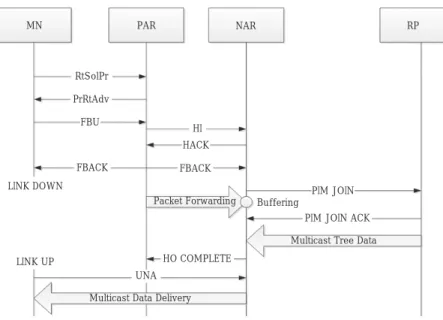
in this paper. In particular, we will focus on the following two schemes: Bidirectional Tunnelling (BT) and Remote Subscription (RS), which are based on the packet forwarding for multicast handover.In the FMIP-M scheme, as shown in Figure 1 and 2, the following operations are commonly applied to both of the BT and RS schemes. First, MN will receive an L2 trigger from the network, and sends a Router Solicitation for Proxy (RtSolPr) to the Previous Access Router (PAR). The PAR replies to MN with a Proxy Router Advertisement (PrRtAdv). MN then obtains a new care of address. The fast handover procedure actually starts by sending a Fast Binding Update (FBU) message towards PAR that contains a multicast group address. Given the information contained in the FBU message, PAR sends a Handover Initiation (HI) message to the New Access Router (NAR). The NAR will check the validity and uniqueness of the nCoA. After that, NAR can reply to PAR with a Handover acknowledgement (HACK) message. The HACK message contains the sequence number of data packets to be forwarded. This sequence number represents the sequence number of the first packet that will be stored in the NAR buffer. PAR then sends the Fast Binding Acknowledge (F-BACK) message to MN and NAR both.
After sending the F-BACK message, the PAR begins to forward multicast data packets to NAR. The subsequent operations are different for each of the two cases: FMIP-M-BT (See. Figure 1) and FMIP-M-RS (See. Figure 2).
In the FMIP-M-BT scheme of Figure 1, PAR starts to forward the multicast packets (received via the bi-directional tunnelling from the HA) to NAR. This packet forwarding will be continued, until PAR receives the HO COMPLETE message from NAR. This HO COMPLETE message will be triggered only when NAR receives the Unsolicited Neighbour Advertisement (UNA) message from MN, and also it completes the MIPv6 Binding Update (BU) operation with HA, as indicated in the figure.
data packets are now delivered to the NAR by using the newly configured multicast tree. During the tree join or configuration time, PAR will also forward the multicast packets to NAR. The subsequent operations include the transmission of HO COMPLETE message from NAR to MN and UNA message from MN to NAR, and the delivery of buffered data packets from NAR to MN. After this, the buffered data packets will be forwarded by
NAR to MN.
In the FMIP-M-RS scheme of Figure 2, NAR sends a tree join message (e.g., PIM JOIN) to the upstream
Rendezvous Point (RP), as shown in the figure. For the join message, the RP will respond to NAR with a Join ACK (PIM JOIN-ACK) message, and then the multicast
MN PAR NAR HA
Packet Forwarding
Multicast Data Delivery
Figure 1. FMIP-M handover using the bidirectional tunnelling (BT)
Tunneling RtSolPr PrRtAdv FBU HI HACK FBACK Buffering FBACK LINK DOWN LINK UP UNA BU BU ACK HO COMPLETE MN PAR NAR RP Packet Forwarding
Multicast Data Delivery
Multicast Tree Data
Figure 2. FMIP-M handover using the remote subscription (RS)
PIM JOIN PIM JOIN ACK RtSolPr PrRtAdv FBU HI HACK FBACK Buffering FBACK LINK DOWN LINK UP UNA HO COMPLETE
scheme, NAR will begin the tree join operation just when it receives HI message from PAR. Accordingly, if the tree joining process is completed before NAR receive the FBACK message from PAR, PAR does not need to forward the data packets to NAR, since NAR can receive the multicast data packets directly from the multicast tree.
Figure 3shows the basic operations of the proposed
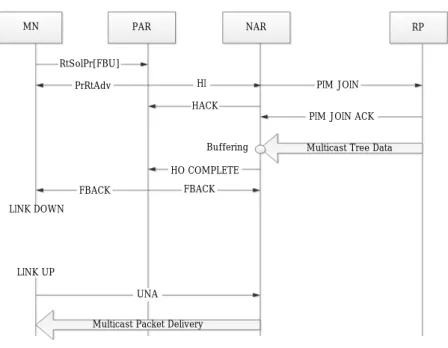
FMIP-FTJ-RS scheme in case that the tree join operation is completed relatively earlier. In the figure, MN initiates the multicast handover by sending the RtSolPr message to PAR. The RtSolPr message contains both the FBU option and the multicast address, as shown in Figure 4. Note that the handover latency could be more reduced by encapsulating the FBU option into the RtSolPr message.
After receiving the RtSolPr message, PAR sends the PrRtAdv message to MN. In addition, PAR will send the HI message to the NAR. When receiving the HI message, the NAR will immediately respond with the HACK message to PAR, and at the same time, it begins the tree joining process to RP by sending the PIM JOIN message it will receive the responding PIM JOIN-ACK message from the upstream RP.
In the proposed scheme, if the tree joining operation is completed earlier (i.e., NAR can receive the multicast data packets from the multicast tree, before it receives the FBACK message from PAR), the NAR sends the HO-COMPLETE message to PAR in this case PAR does not need to perform the packet forwarding to NAR. In the existing schemes, the packet buffering may be
subject to the
'
buffer overflow'
at the buffer of NAR. That is, during the handover, NAR will continue to buffer the data packets forwarded from PAR, until the MIPv6 BU operation (in case of BT) or the PIM Join operation (in case of RS) is completed. As the MIPv6 BU or PIM Join time gets larger, the buffering of NAR may induce the buffer overflow and thus a significant amount of data losses. Moreover, the existing two schemes tend to give large handover delays.In this paper, we propose a fast join to multicast tree so as to reduce the handover delay and buffering overhead during handover. In the proposed scheme, NAR will try to join the multicast tree as soon as the handover event is detected (i.e., when NAR receives HI message from PAR).
III. PROPOSED FAST TREE
JOIN FOR MULTICAST
HANDOVER
In this paper, we propose a fast tree join scheme for seamless multicast handover, which is based on the existing RS scheme and thus denoted by
'
FMIP-FTJ-RS'
in this paper. The main idea of the proposed scheme is that NAR begins the tree join process as fast as possible, so as to the new multicast data packets arrive at the NAR earlier over the optimized multicast data path. In the proposedMN PAR NAR RP
Multicast Tree Data
Multicast Packet Delivery
Figure 3. Proposed FMIP-FTJ-RS scheme (early completion of tree join)
RtSolPr[FBU] PrRtAdv HI HACK FBACK FBACK PIM JOIN Buffering
PIM JOIN ACK
HO COMPLETE
LINK DOWN
LINK UP
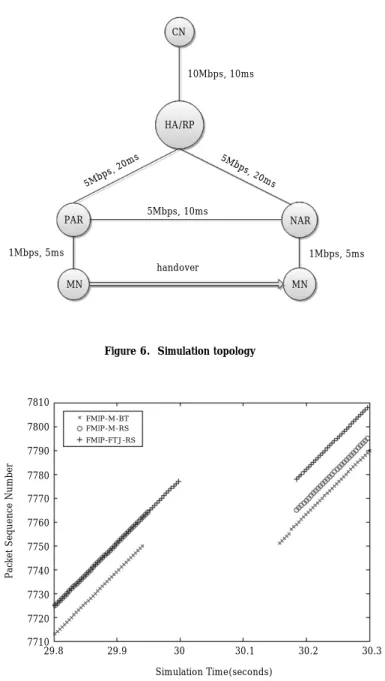
simulation, as shown in Figure 6. In the figure, a correspondent node (CN) is communication with MN, and the MN is initially in the remote network of PAR, and then it moves into the NAR network by handover. For simple comparison of BT and RS schemes, it is assumed that HA is co-located with RP.
For simulation, a variety of parameters are set as follows. The fixed/wired link between CN and HA/RP is set to 10Mbps of network bandwidth and 10ms of transmission delay. The links between HA/RP and AR are all set to 5Mbps of bandwidth and 20ms of transmission delay. The wireless links between AR and MN are all are set to 1Mbps of bandwidth and 5ms of transmission delay. In addition, the link between PAR and NAR is set to 5 Mbps of bandwidth and 10 ms of transmission delay. The link switching delay from PAR to NAR by handover is set to 150ms.
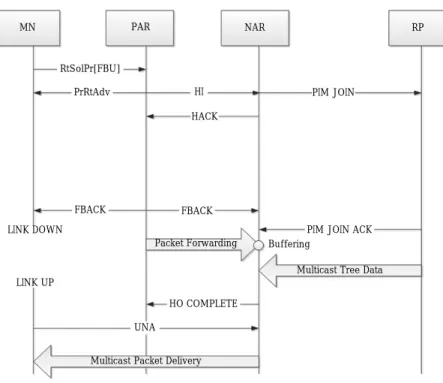
Otherwise, if the tree joining process has not been completed until NAR receives the FBACK message from PAR, some of the multicast data packets may be forwarded by PAR to NAR, as done in the existing FMIP-M-RS scheme, as shown in Figure 5.
In both of the two cases, it is noted that the fast tree join to the multicast tree can ensure that the number of data packets buffered at NAR and the overall handover delay will be reduced, compared to the existing schemes.
IV. SIMULATION RESULTS
In this section, we present the performance analysis of the proposed scheme using ns-2 network simulator [17]. We first consider a simple network topology used for ns-2
Figure 4. RtSolPr message including the FBU option
Type Code Checksum
Subtype Reserved Identifier LLA Option
FBU Option Multicast Address
MN PAR NAR RP
Packet Forwarding
Multicast Packet Delivery
Multicast Tree Data
Figure 5. Proposed FMIP-FTJ-RS scheme (late completion of tree join)
PIM JOIN
PIM JOIN ACK RtSolPr[FBU] PrRtAdv HI HACK FBACK Buffering FBACK LINK DOWN LINK UP UNA HO COMPLETE
Figure 7shows the simulation results, which depicts the sequence numbers of data packets that MN has received from CN, for the three candidate schemes: FMIP-M-BT, FMIP-M-RS, and FMIP-FTJ-RS.
From the figure, we can see the handover delays experienced by MN during handover for the three candidate schemes. In the FMIP-M-BT scheme, the handover delay occurs in the time interval from 29.94 second to 30.16 second, which approximately corresponds to the handover delay of 220ms. Similarly, the FMIP-M-RS scheme gives the handover delay of 210ms. On the
other hand, the proposed FMIP-FTJ-RS scheme gives the handover delay of 160ms. Accordingly, the proposed scheme can reduce the handover delays of the existing schemes approximately by 50ms~60ms. Note that these gaps of handover delays are relatively large values, compared the wireless link delay of 5 ms, which is configured in the simulation.
Figure 8shows the handover delays of the candidate
schemes for different link switching delays, which varies from 100ms to 550ms. From the figure, we can see that both of the existing FMIP-M-BT and FMIP-M-RS CN PAR MN MN NAR HA/RP 10Mbps, 10ms 5Mbps, 10ms handover
Figure 6. Simulation topology
1Mbps, 5ms 1Mbps, 5ms 5Mbps, 20ms 5Mbps, 20ms 7810 7800 7790 7780 7770 7760 7750 7740 7730 7720 7710 FMIP-M-BT FMIP-M-RS FMIP-FTJ-RS 29.8 29.9 30 30.1 30.2 30.3 Simulation Time(seconds)
Figure 7. Traces of data packets received by MN during handover
scheme, as the transmission delay of TAR-MN gets larger. On the other hand, the two RS-based schemes, FMIP-M-RS and FMIP-FTJ-FMIP-M-RS, give almost the same performance.
Figure 10shows the handover delays of the candidate
schemes for transmission delays between AR and HA/RP (T
AR-RP). Similarly to the results of Figure 9, the
RS-based schemes, FMIP-M-RS and FMIP-FTJ-RS, give smaller handover delays than the BT-based FMIP-M-BT scheme, as the transmission delay of TAR-RP gets larger. On the other hand, the proposed FMIP-FTJ-RS scheme provides slightly better performance than the existing FMIP-M-RS scheme.
Now, we compare the performance of the buffering schemes give almost similar handover delays for all the
link switching delays. In the meantime, the proposed FMIP-FTJ-RS scheme provides smaller handover delays than the existing two schemes. Moreover, the gaps of handover delays between the existing and proposed schemes get larger, as the link switching time increases.
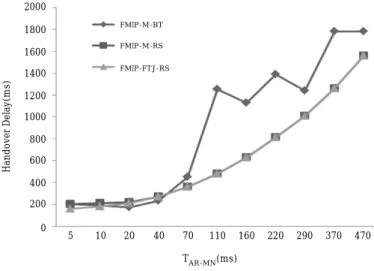
Figure 9 shows the impacts of the wireless
transmission delay between AR and MN (T
AR-MN) on the
handover delay, which compares the handover delays of candidate schemes, as T
AR-MNgradually increases from
5ms to 470ms. From the figure, we can see that the RS-based FMIP-M-RS and FMIP-FTJ-RS schemes give smaller handover delays than the BT-based FMIP-M-BT
1200 1000 800 600 400 200 0 FMIP-M-BT FMIP-M-RS FMIP-FTJ-RS 100 150 200 250 300 350 400 450 500 550 Link Switching Time(ms)
Figure 8. Handover delays for different link switching times
Handover Delay(ms) 2000 1800 1600 1400 1200 1000 800 600 400 200 0 FMIP-M-BT FMIP-M-RS FMIP-FTJ-RS 5 10 20 40 70 110 160 220 290 370 470 TAR-MN(ms)
Figure 9. Handover delays by transmission delay between AR and MN
overhead for each of the candidate schemes, which is measured by the number of data packets buffered at NAR during handover.
Figure 11 compares the amount of data packets
buffered at NAR for different link switching times. In the figure we can see that the number of buffered packets becomes larger, as the link switching time increases, since the handover delay gets larger. However, we note that the proposed FMIP-FTJ-RS scheme gives much smaller buffering overhead than the existing FMIP-M-BT and FMIP-M-RS schemes, as the link switching time increases. This is because the proposed scheme performs a faster tree join than the existing schemes, and thus the
amount of buffered packets can be reduced, compared to the existing schemes. The gap of the buffering overhead gets larger, as the link switching time increases.
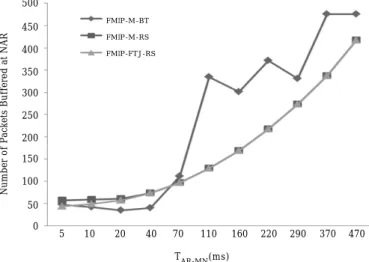
Figure 12 compares the buffering overhead of the
candidate schemes for different transmission delay between AR and MN (TAR-MN). In the figure, we can see that the buffering overhead tends to increase for all the schemes, as TAR-MNgets larger. It is noted that the RS-based FMIP-M-RS and FMIP-FTJ-RS schemes give smaller buffering overheads than the BT-based FMIP-M-BT scheme. The two RS-based schemes, FMIP-M-RS and FMIP-FTJ-RS, give almost the same performance.
Figure 13compares the buffering overheads of the
3000 2500 2000 1500 1000 500 0 FMIP-M-BT FMIP-M-RS FMIP-FTJ-RS 10 20 40 70 110 160 220 290 370 470 TAR-RP(ms)
Figure 10. Handover delays by transmission delay between AR and RP
Handover Delay(ms) 300 250 200 150 100 50 0 FMIP-M-BT FMIP-M-RS FMIP-FTJ-RS 100 150 200 250 300 350 400 450 500 550 Link Switching Time(ms)
Figure 11. Comparison of buffer overhead for different link switching times
seamless multicast handover in the FMIPv6-based wireless/mobile networks. In the existing schemes using the bi-directional tunnelling or the remote subscription rely on the packet buffering at the new access router during handover, which may tend to incur a large buffering overhead and also a large handover delay. In the proposed scheme, the new access router will join the multicast tree as soon as a mobile node detects a new AR by handover. This ensures that the new multicast data packets can arrive at the new AR as fast as possible, which is helpful to reduce the packet buffering overhead as well as the handover delay. From the ns-2 simulations, it is shown that the proposed scheme can reduce the buffering candidate schemes for different transmission delays
between AR and HA/RP (T
AR-RP). From the figure, we
can see that the RS-based FMIP-M-RS and FMIP-FTJ-RS schemes give smaller buffering overheads than the BT-based FMIP-M-BT scheme, as the transmission delay of T
AR-RPgets larger. On the other hand, the proposed
FMIP-FTJ-RS scheme provides slightly better performance than the existing FMIP-M-RS scheme.
V. CONCLUSION
This paper proposed a fast tree join scheme for 500 450 400 350 300 250 200 150 100 50 0 FMIP-M-BT FMIP-M-RS FMIP-FTJ-RS 5 10 20 40 70 110 160 220 290 370 470 TAR-MN(ms)
Figure 12. Comparison of buffer overhead for different TAR-MN
Number of Packets Buffered at NAR
800 700 600 500 400 300 200 100 0 FMIP-M-BT FMIP-M-RS FMIP-FTJ-RS 10 20 40 70 110 160 220 290 370 470 TAR-RP(ms)
Figure 13. Comparison of buffer overhead for different TAR-RP
overhead and the handover delays significantly, compared to the existing FMIPv6-based multicast handover schemes.
Acknowledgement
This research was supported by the IT R&D program of MKE/KEIT(10035245: Study on Architecture of Future Internet to Support Mobile Environments and Network Diversity) and the ITRC program of MKE/NIPA(NIPA-2010-C1090-1021-0002).
[References]
[1]
D. H. Kwon, et al., ''Design and implementation of an
efficient multicast support scheme for FMIPv6,''
Proceeding of INFOCOMM2006, 2006, pp. 1-12.
[2]
Nicolas Montavont and Thomas noel, ''Handover
Management for Mobile Nodes in IPv6 Networks,''
IEEE Communication Magazine, Vol. 40, No. 8, Aug.
2002, pp. 38-43.
[3]
D. Johnson, et al., Mobility Support in IPv6, IETF RFC
3775, Jun. 2004.
[4]
R. Koodli, Mobile IPv6 Fast Handovers, IETF RFC
5268, 2008.
[5]
W. Fenner, Internet Group Management Protocol, IETF
RFC 2236, November 1997.
[6]
B. Cain, S.Deering, et al., Internet Group Management
Protocol, IETF RFC 3376, Oct. 2002.
[7]
S.Deering, et al., Multicast Listener Discovery (MLD)
for IPv6, IETF RFC 2710, Oct. 1999.
[8]
R. Vida, and Costa, Multicast Listener Discovery
Version 2 (MLDv2) for IPv6, IETF RFC 3810,
Jun. 2004.
[9]
T.Pusateri, Protocol Independent Multicast - Sparse
Mode (PIM-SM), IETF RFC 4602, Aug. 2006.
[10] H. Holbrook and B. Cain, Source-Specific Multicast
for IP, IETF RFC 4607, Aug. 2006.
[11] I. Romdhani, et al., ''IP mobile multicast: challenges
and solutions,'' IEEE Communications, Vol. 6, No. 1,
2004, pp. 18-41.
[12] T. Harrison, et al., ''Mobile multicast (MoM) protocol:
multicast support for mobile hosts,'' Proceeding
of ACM/IEEE Mobile Computing and Networking
(MobiCom 97), Sep. 1997, pp. 151-160.
[13] Y.-J. Suh, et al., ''An efficient multicast routing protocol
in wireless mobile networks,'' ACM Wireless
Networks, Vol. 7, No. 5, Sep. 2001, pp. 443-453.
[14] C. R. Lin and K. M. Wang, ''Mobile multicast support
in IP networks,'' IEEE INFOCOM 2000, Mar. 2000,
pp. 1664-1672.
[15] J. Park and Y.-J. Suh, ''A Timer-based mobile multicast
routing protocol in mobile network,'' Computer
Communications, Vol. 26, Issue 17, Nov. 2003,
pp. 1965-1974.
[16] S. Yoo and S. Shin, ''Fast Handover Mechanism
for Seamless Multicasting Services in Mobile
IPv6Wireless Networks,'' Wireless Personal
Communications, Vol. 42, 2007, pp. 509-526.
[17] NS-2 Network Simulator, http://www.isi.edu/nsnam/ns/
Moneeb Gohar
He received B.S. degree in Computer Science from University of Peshawar, Pakistan, and M.S. degree in Technology Management from Institute of Management Sciences, Pakistan, in 2006 and 2009, respectively. He is now as a Ph.D. student with the School of Computer Science and Engineering in Kyungpook National University, Korea. His current research interests include Mobile Multicasting and Internet Mobility.
Seok Joo Koh
He received B.S. and M.S. degrees in Management Science from KAIST in 1992 and 1994, respectively. He also received Ph.D. degree in Industrial Engineering from KAIST 1998. From August 1998 to February 2004, he worked for Protocol Engineering Center in ETRI. He is now an Associate Professor at the School of Computer Science and Engineering in the Kyungpook National University since March 2004. His current research interests include the architecture and mobility control for Future Internet, Mobile Multicasting, and mSCTP handover. He has so far participated in the International standardization as an editor in ITU-T SG13 and ISO/IEC JTC1/SC6.
E-mail: [email protected]
Sang-Tae Kim
He received B.S. and M.S. degrees in School of Electrical Engineering and Computer Science from Kyungpook National University in 2005 and 2007, respectively. He is now a Ph.D. candidate at Electrical Engineering and Computer Science in the Kyungpook National University. His current research interests are the mobility support for the locator/identifier separation protocol (LISP) and routing scalability of LISP.