저작자표시-비영리-변경금지 2.0 대한민국 이용자는 아래의 조건을 따르는 경우에 한하여 자유롭게 l 이 저작물을 복제, 배포, 전송, 전시, 공연 및 방송할 수 있습니다. 다음과 같은 조건을 따라야 합니다: l 귀하는, 이 저작물의 재이용이나 배포의 경우, 이 저작물에 적용된 이용허락조건 을 명확하게 나타내어야 합니다. l 저작권자로부터 별도의 허가를 받으면 이러한 조건들은 적용되지 않습니다. 저작권법에 따른 이용자의 권리는 위의 내용에 의하여 영향을 받지 않습니다. 이것은 이용허락규약(Legal Code)을 이해하기 쉽게 요약한 것입니다. Disclaimer 저작자표시. 귀하는 원저작자를 표시하여야 합니다. 비영리. 귀하는 이 저작물을 영리 목적으로 이용할 수 없습니다. 변경금지. 귀하는 이 저작물을 개작, 변형 또는 가공할 수 없습니다.
농학박사학위논문
대표적 포장에서 농약살포자의 노출량,
위해성 평가 및 노출량 예측 모델 개발
Exposure, Risk Assessment and
Predictive Exposure Model Development for
Agricultural Operator in Representative
Crop Fields
2017년 2월
서울대학교 대학원
농생명공학부 응용생명화학전공
김 은 혜
A dissertation for the Degree of Doctor of Philosophy
Exposure, Risk Assessment and Predictive
Exposure Model Development for
Agricultural Operator in Representative
Crop Fields
February 2017
Eunhye Kim
Applied Life Chemistry Major
Department of Agricultural Biotechnology
Seoul National University
i
Abstract
Korea predictive model for the estimation of agricultural operator exposure has been developed on the basis of new exposure data to improve the current agricultural operator exposure and risk assessment in the Korea. The new operator exposure model represents current application techniques (speed sprayer and power sprayer) and practices in representative crop fields (apple orchard and rice field). 30 replicate exposure studies conducted between 2010 and 2012 were evaluated for the new model. Exposure and risk assessment were conducted for agricultural applicators during preparation of spray suspension and application with speed sprayer and power sprayer on crop fields. Several exposure matrices, including patches, cotton gloves, socks, masks and XAD-2 resin were used to measure the potential exposure for workers. The analytical methods were fully validated to guarantee the precision and accuracy of analysis. As a major factor contributing to the exposure of operators, the amount of active ingredient used per day was identified. Other parameters such as formulation type, density of the canopy were selected as factors for sub-scenarios. Accordingly, 75 percentile of exposure dose was calculated for mixing / loading and application according to scenario, and it was derived as exposure factor of Korean model. In vitro metabolism of kresoxim-methyl was conducted with human liver microsome. Two metabolites were identified. The screening test for identifying which recombinant CYP involved with metabolism of kresoxim-methyl was conducted with 10 human cDNA-expressed CYP isoforms. Eight rCYPs (except 2A6, 2E1) contributed to metabolism of kresoxim-methyl.
ii
Key Words: dermal exposure, exposure model, human liver microsome,
inhalation exposure, metabolism, risk assessment
iii
Table of Contents
Abstract……….……..………i
Table of Contents………..iii
List of Tables……….……….x
List of Figures………..……….…xii
Chapter I: Exposure of Operators, Risk Assessment, and Model
Development
Introduction……….…...1
Occupational exposure study...1
Methodology of agricultural worker exposure to pesticides…...5
Dermal exposure………..…...5
Risk assessment...6
Predictive model...8
iv
Part 1 : Probabilistic Exposure Assessment for Applicators during
Treatment of the Fungicide Kresoxim-methyl on Apple Orchard by
Speed Sprayer
Introduction……….….15
Materials and Methods..……….……….17
Reagents and materials...17
Dermal exposure matrices...17
Inhalation exposure matrices...17
Experimental sites and field trial...18
Exposure matrices sampling...20
Extraction of kresoxim-methyl from exposure matrices……...20
Instrumental conditions...20
Method validation...21
Exposure assessment………...22
Exposure estimation using Monte Carlo simulation for kresoxim-methyl……….23
Risk assessment...24
Results and Discussion…..……….……..25
v
Method validation………..…………...25
Determination of the number of iterations…………...26
Dermal exposure assessment……….………….………33
Inhalation exposure assessment...……….……….………34
Exposure database for predictive model...34
Risk assessment...39
Part 2 : Exposure and Risk Assessment of Operators to Insecticide
Acetamiprid during Treatment on Apple Orchard
Introduction……….….47
Materials and Methods..……….……...49
Reagents and materials...49
Exposure matrices...49
Experimental sites………...50
Chromatographic condition...50
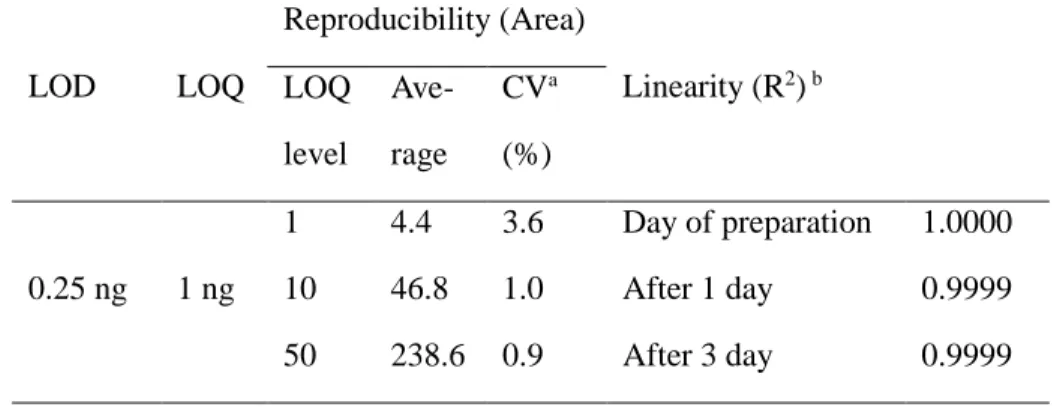
Limit of detection (LOD), limit of quantitation (LOQ), reproducibility and linearity of calibration curve ...52
Trapping efficiency and breakthrough tests ……... 52
Recovery (Matrix extraction efficiency) test………... 52
vi
Field trials and sampling procedure ……….53
Calculation of potential dermal and inhalation exposure…...54
Risk assessment………..…...54
Results and Discussion…..……….……..56
Method validation………..…………...56
PDE and PIE………...60
MOS and Risk Assessment ………...67
Database for model...67
Part 3 : Comparative Exposure of Operators to Fenthion during
Treatment in Paddy Field
Introduction……….….75
Materials and Methods..……….……….77
Reagents and materials...77
Sampling methodology….………...77
Calculation of dermal and inhalation exposure…... 77
Analytical condition...77
Method validation………….………...78
vii
Results and Discussion…..……….……..80
Method validation………..…………... 80
Potential dermal exposure and inhalation exposure……...80
Risk Assessment ………... 87
Database for model...87
Part 4 : Operator Exposure to Indoxacarb Wettable Powder and
Water Dispersible Granule during Mixing/loading and Risk
Assessment
Materials and Methods..………...……….……..95
Experimental materials...95
Exposure study samples and analytical conditions………..…………95
Extraction of exposure matrices...95
LOD, LOQ, and reproducibility...96
Recovery (Matrix extraction efficiency) test……...96
Trapping efficiency and breakthrough tests...96
Field study, calculation of exposure, and risk assessment……..…….97
Results and Discussion…..……….……..98
viii
Hand exposure, inhalation exposure and MOS…...99
Part 5 : Hand Exposure of Operator to Chlorpyrifos during
Mixing/loading and Risk Assessment
Materials and Methods..………...……109
Reagents and materials...109
Analytical method validation………….………... 109
Measurement of hand exposure and risk assessment……... 109
Results and Discussion…..……….……
111Method validation………..…………...111
Hand exposure and risk assessment……... 111
Chapter II: In vitro metabolism of kresoxim-methyl by human liver
microsomes
Introduction……….119
In vitro human metabolism studies of pesticides………..119
Human liver microsomal CYP450...122
Enzyme kinetics in metabolism………...125
Materials and Methods…………...………..
128ix
Analytical instruments and conditions...128
Metabolism of kresoxim-methyl in HLMs (Phase I reaction)……..130
Metabolite identification………...130
Optimization of metabolic conditions and kinetic studies...130
Metabolism of kresoxim-methyl by cDNA-expressed CYP450 isoforms……….131
Determination of crystal structure ...131
Results and discussion…..……….…....132
Formation of the kresoxim-methyl metabolite by HLMs……...132
Optimization of metabolic conditions and kinetic studies...132
Metabolism of kresoxim-methyl in cDNA-expressed CYP450 isoforms……….…133
Determination of crystal structure for kresoxim-methyl…..……...142
Supplementary Materials………..146
References……….…169
Abstract in Korean……….……179
x
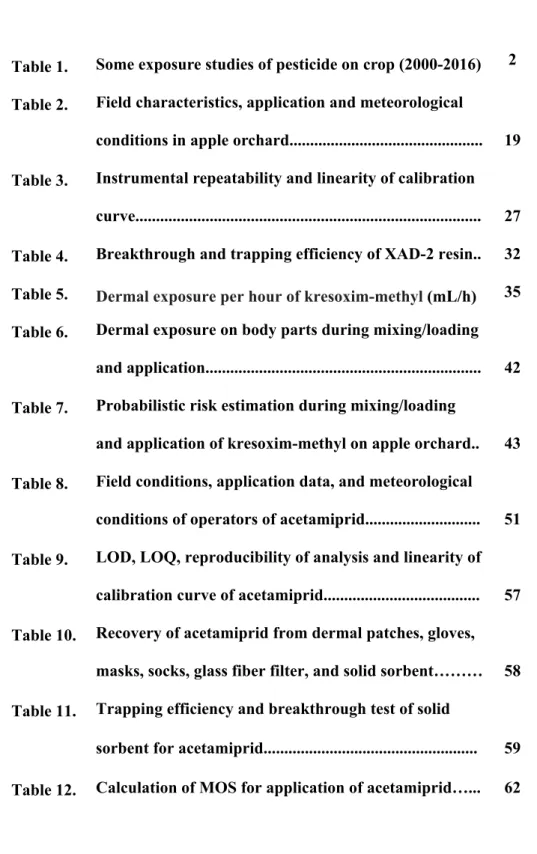
List of Tables
Table 1. Some exposure studies of pesticide on crop (2000-2016) 2 Table 2. Field characteristics, application and meteorological
conditions in apple orchard... 19 Table 3. Instrumental repeatability and linearity of calibration
curve... 27 Table 4. Breakthrough and trapping efficiency of XAD-2 resin.. 32 Table 5. Dermal exposure per hour of kresoxim-methyl (mL/h) 35 Table 6. Dermal exposure on body parts during mixing/loading
and application... 42 Table 7. Probabilistic risk estimation during mixing/loading
and application of kresoxim-methyl on apple orchard.. 43 Table 8. Field conditions, application data, and meteorological
conditions of operators of acetamiprid... 51 Table 9. LOD, LOQ, reproducibility of analysis and linearity of
calibration curve of acetamiprid... 57 Table 10. Recovery of acetamiprid from dermal patches, gloves,
masks, socks, glass fiber filter, and solid sorbent……… 58 Table 11. Trapping efficiency and breakthrough test of solid
sorbent for acetamiprid... 59 Table 12. Calculation of MOS for application of acetamiprid…... 62
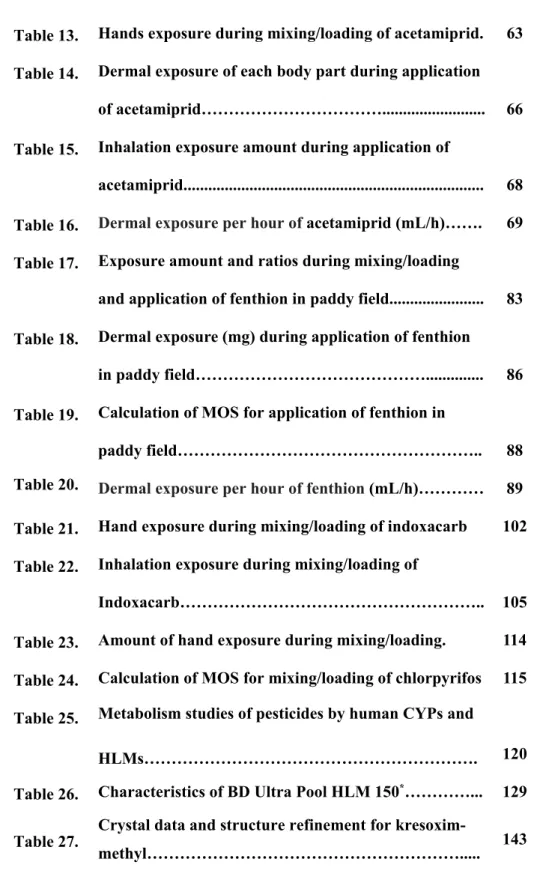
xi
Table 13. Hands exposure during mixing/loading of acetamiprid. 63 Table 14. Dermal exposure of each body part during application
of acetamiprid………... 66 Table 15. Inhalation exposure amount during application of
acetamiprid... 68 Table 16. Dermal exposure per hour of acetamiprid (mL/h)……. 69 Table 17. Exposure amount and ratios during mixing/loading
and application of fenthion in paddy field... 83 Table 18. Dermal exposure (mg) during application of fenthion
in paddy field………... 86 Table 19. Calculation of MOS for application of fenthion in
paddy field……….. 88
Table 20. Dermal exposure per hour of fenthion (mL/h)………… 89 Table 21. Hand exposure during mixing/loading of indoxacarb 102 Table 22. Inhalation exposure during mixing/loading of
Indoxacarb……….. 105 Table 23. Amount of hand exposure during mixing/loading. 114 Table 24. Calculation of MOS for mixing/loading of chlorpyrifos 115 Table 25. Metabolism studies of pesticides by human CYPs and
HLMs………. 120
Table 26. Characteristics of BD Ultra Pool HLM 150*…………... 129 Table 27. Crystal data and structure refinement for
xii
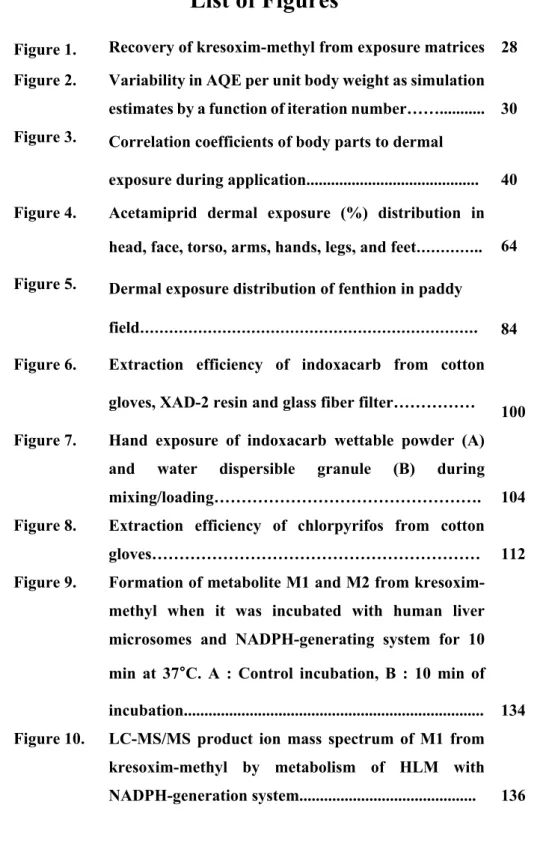
List of Figures
Figure 1. Recovery of kresoxim-methyl from exposure matrices 28 Figure 2. Variability in AQE per unit body weight as simulation
estimates by a function of iteration number……... 30 Figure 3. Correlation coefficients of body parts to dermal
exposure during application... 40 Figure 4. Acetamiprid dermal exposure (%) distribution in
head, face, torso, arms, hands, legs, and feet………….. 64 Figure 5. Dermal exposure distribution of fenthion in paddy
field………. 84
Figure 6. Extraction efficiency of indoxacarb from cotton gloves, XAD-2 resin and glass fiber filter………
100 Figure 7. Hand exposure of indoxacarb wettable powder (A)
and water dispersible granule (B) during mixing/loading………. 104 Figure 8. Extraction efficiency of chlorpyrifos from cotton
gloves……… 112 Figure 9. Formation of metabolite M1 and M2 from
kresoxim-methyl when it was incubated with human liver microsomes and NADPH-generating system for 10 min at 37°C. A : Control incubation, B : 10 min of
incubation... 134 Figure 10. LC-MS/MS product ion mass spectrum of M1 from
kresoxim-methyl by metabolism of HLM with
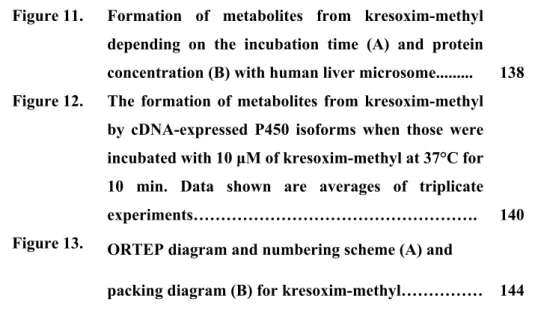
xiii
Figure 11. Formation of metabolites from kresoxim-methyl depending on the incubation time (A) and protein concentration (B) with human liver microsome... 138 Figure 12. The formation of metabolites from kresoxim-methyl
by cDNA-expressed P450 isoforms when those were incubated with 10 μM of kresoxim-methyl at 37°C for 10 min. Data shown are averages of triplicate experiments………. 140 Figure 13. ORTEP diagram and numbering scheme (A) and
Chapter I
Exposure of Operators using Patch Method,
Risk Assessment, and Model Development
1
Introduction
Occupational exposure studyPesticides have been used for the management of many insect pests, diseases, and weeds in agriculture for a long time. Agricultural workers would be exposed occupationally to pesticides during manufacture, mixing/loading, spraying, and harvest, while consumers could be exposed routinely by consumption of contaminated foods and drinks. In agriculture, the representative routes of exposure of pesticide applicators are dermal deposition and inhalation during pesticide application activities (Choi et al., 2006).
From recent studies that assessed occupational exposure to pesticides, it was consistently demonstrated that 99% or more of total exposure occurred by the dermal route and 1% or less occurred via the respiratory route (Machado-Neto, 2001). The most important variables that may affect occupational dermal exposure are the type of formulation and packaging, application technique, working method, and agricultural and climatic conditions (van Hemmen, 1992). Because pesticides are inherently toxic to living organisms, they are more likely to affect the health of humans than other agricultural chemicals (Tahir and Anwar, 2012). Therefore, it is positively necessary to quantify the occupational exposure to pesticides for safety evaluation of workers.
Many exposure studies have been conducted for a workers, such as mixer/loader and applicator in a greenhouse, paddy field, and orchard, including apple, mandarin, and mango (Calumpang and Medina, 1996; Capri et al., 1999; Liu et al., 2003; Byoun et al., 2005a; Ramos et al., 2010; Baharuddin et al., 2011; Kim et al., 2012a; Kim et al., 2012b; Moon et al., 2013), estimating the deterministic exposure of individual workers to pesticide.
2
Table 1. Some exposure studies of pesticide on crop (2000-2016)
Pesticides Substance Dermal exposure Inhalation exposure Risk assessment Reference
Spinosad Grape Whole body - - (Thouvenin et al., 2016) Flonicamid Apple Patches PAM XAD-2 - (Zhao et al., 2015) Deltamethrin
Procymidone
Tomato* Whole body - MOS (Ramos et al., 2010)
Chlorpyrifos Cotton Patches
PAM
XAD-2 OVS tubes
MOE (Farahat et al., 2010)
Pepper Patches - - (Nuyttens et al., 2009) Malathion Pepper Whole body - - (Machera et al., 2009) Deltamethrin Maize/Broccoli Whole body - MOS (Hughes et al., 2008b)
3
Pesticides Substance Dermal exposure Inhalation exposure Risk assessment Reference
Endosulfan Cotton Patches - another (Kuye et al., 2007) Captan Maize Whole body - MOS (Hughes et al., 2006) Cypermethrin Mandarin Patches PAM-XAD-2 MOS (Choi et al., 2006) Methidation Cucumber Patches PAM-XAD-2 MOS (Byoun et al., 2005b) Malathion Tomato Whole body PAM-XAD-2 - (MACHERA et al., 2003) Mancozeb Mandarin Patches - MOS (Liu et al., 2003)
Lindane,.etc
Tomato ,.etc
4
Pesticides Substance Dermal exposure Inhalation exposure Risk assessment Reference
Visible tracers Sunset Yellow
Tomato Cucumber
Whole body IOM samplers-GFA - (Machera et al., 2002a)
Lindane,.etc
Tomato ,.etc
Whole body - - (Frenich et al., 2002)
Chlopyrifos Patches Whole body OVS Sampling pump - (Cattani et al., 2001) Chlorpyrifos-methyl Fenitrothion
5
Methodology of agricultural worker exposure to pesticides
Agricultural workers who mix/loads and spray pesticide in fields expose to pesticide through dermal and inhalation routes. In such situation, exposed amount should be measured quantitatively for reasonable risk assessment. Patch, gloves, socks and mask will be good materials for monitoring for dermal exposure while personal air monitor equipped with solid adsorbent and air pump will be a tool for inhalation exposure. For extrapolation of absorbed amount in dermal exposure matrices and of trapped amount in solid sorbent to total dermal or inhalation exposure, Korean standard body surface area and respiration rate were proposed in substitution of EPA data. Important exposure factors such as clothing and skin penetration ratio of dermal and inhalation exposure were suggested based on Spraying time for exposure monitoring must be long enough that the amount of pesticide to get absorbed/trapped in exposure matrices results in reasonable analytical value. In domestic case for the both of speed sprayer and power spray machine, spraying time of 20~40 minutes (0.1~0.2ha) will be reasonable per single replicate before extrapolating to 4 hours a day with triplicates experiment.
Dermal exposure
Skin is an important route of exposure for materials at workplaces. It is clear that the behavioral component of exposure is very important, and that uptake of chemicals through the skin can exhibit high variability. Since the primary route of exposure in pesticide handlers is through the skin, most work in this field has focused on characterizing deposition of chemicals on the skin and their subsequent absorption into the body (Fenske and Day, 2005)
6
Dermal exposure is often divided into potential dermal exposure and actual dermal exposure. The definitions of these concepts vary in different sources. Whole body dosimetry, patch were mainly used to measure dermal exposure. In patch method, the potential contamination of the clothing is measured using a variable number of absorbent cloth or paper patches, attached to body regions inside or outside clothing (Durham and Wolfe, 1962). The surface area covered by the patches represents less than 10% of the total body surface area. After a defined or measured period of exposure, the patches are removed and analyzed for pesticide content. Body part surface areas can be obtained from standard reference texts and exposure guidance documents. The potential dermal exposure to pesticide sprays can be measured with the patch method (Durham and Wolfe, 1962; Davis, 1984; Gold and Holcslaw, 1985; Kurtz D and Bode W, 1985; Nigg H and Stamper J, 1985; Grover et al., 1986; Fenske et al., 1990; Fenske, 1993; Soutar et al., 2000; Liu et al., 2003; Kuye et al., 2007; Nuyttens et al., 2009; Farahat et al., 2010). The whole body method is an alternative to the patch method and allows measuring the body exposure over its whole surface area using dedicated cloth layers. The cloth layers mimic as well as possible the clothes people would normally wear during their work. Using this method, dermal exposure of the body and head (with a hood or a separate head cover or face/neck wipes) can be measured accurately.
Risk assessment
PDE, measured by analyzing the quantity of a pesticide that deposited on body regions, provides the information on the amount of exposure. But PDE data by itself cannot be used as a risk indicator because it must be related to acceptable
7
exposure limit. For this purpose, the MOS has been proposed as a useful risk indication (Machado-Neto, 2001) that relates the acceptable exposure to a pesticide with the mass absorbed by the body, which can be estimated from PDE. MOS value higher than 1 are considered as an indication of safe working condition. Durham and Wolfe (1962) derived the first equation to calculate the risk of intoxication from pesticides considering the toxicity and the exposure; residue/unit area of exposure pad surface is multiplied by a time factor, which is determined by the length of time the worker is exposed. In this equation, the risk was expressed in terms of percentage of toxic dose per hour (Davis, 1980). The MOS formula, proposed by Severn (1984), was the first equation to calculate the safety of work conditions for the agricultural handling of pesticides. Franklin (1985) proposed the following steps for risk assessment in the use of pesticides: obtain work exposure data and determine dermal/inhalation absorption correction, dosage estimation, NOEL from toxicological data, MOS or quantitative risk assessment, and acceptability of MOS. Work conditions, according to those risks, can be classified as safe or unsafe, considering the estimated MOS. In addition to the level of exposure incurred per hour of work, the hazard of pesticide exposure to workers was also related to the amount of time spent under these specified working conditions (Wolfe, 1976). However, risk characterization may have to proceed in the absence of an adequate or complete data set in many cases. In such circumstances, and when the adverse effect is considered to show a threshold in the dose-response relationship, additional uncertainty factors may be applied to the NOAEL (mg/kg body weight per day). The MOE is the ratio between the NOAEL and the estimated amount of human exposure. These approaches are
8
normally used when limited toxicological data or human data exist but the hazard identification and hazard characterization data are insufficient to set a health-based guidance value. Therefore, MOE is the ratio between the NOAEL in experimental or epidemiological studies, and the estimated amount of human exposure, while MOS is the ratio between the NOEL and the actual amount of human exposure (Renwick et al., 2003). Risk management / reduction is a major measurement if risk possibility was identified through risk assessment procedure. The determination of SWT and exposure control need ECN for unsafe work conditions (MOS < 1) can also be used in management strategies dealing with pesticide risks. The calculation of SWT can be used as a safety measure to control occupational exposure in pesticide use. The calculation of ECN permits the selection of a more appropriate safety measure, in regard to the needs of each set of working conditions (Machado-Neto, 2001).
Predictive model
Exposure estimates that are required for risk assessment may be obtained from chemical specific field studies, or from extrapolations from other field studies. This requires high quality exposure data that have been obtained under conditions relevant for the exposure and use scenarios under consideration. For risk assessment purposes, the exposure data obtained for relevant use scenarios can be compared with an appropriate accepted exposure level (Acceptable operator exposure level (AOEL)) based on the toxicological profiled of the compound. The generic approach to exposure assessment based on the grouping of uses into scenarios where activities are similar was presented by Franklin et al. (1982). This approach was further advanced by Hackathorn and Eberhart (1985), who discussed the development of a database for predictive
9
exposure modelling. The basic idea behind the development of such databases is that the level of exposure, when in a suitable format, can be extrapolated for similar-use scenarios. Currently, it is assumed that for mixing/loading, the main differentiation is for formulation type (i.e. between powders, granules, and liquids) used for hand-held application equipment, vehicle-mounted equipment. For application, the main differentiations used are upward or downward spraying and hand-held or vehicle-mounted spraying scenarios. Such databases contain field studies and exposure data extracted from those field studies in several formats (Kangas and Sihvonen, 1996). These studies are all different and most of them are not publicly available or critically reviewed in respect to documented criteria. The most important independent databases in use for risk assessment purposes in formal pesticide registration processes are PHED, the German model, UK-POEM, the Dutch model and EUROPOEM. These databases, also called predictive exposure models.
The UK-POEM database is based on a review of the data available on the exposure of pesticide spray operators (in the UK). The review indicated that several factors determined the dose absorbed by a spray operator. These included the following: the volume of external contamination, the extent to which this external contamination penetrated clothing to reach the skin and the rate at which the chemical come into direct contact with the skin surface and was absorbed. These various independent factors were assumed, with the exception of dermal absorption, to be of a sufficient generic nature to be suitable for extrapolation purposes. Two major work activities were differentiated: mixing/loading and application. An updated of the default values in UK-POEM has been presented (POEM, 1992) or mixing/loading, two formulation types are considered, namely liquids and powders. The database is largest for liquids and the level of exposure is shown to be largely dependent
10
on the container size and the neck aperture. A default value for the 75th
percentile was based on test data on pouring. The current risk assessment for pesticide operators is based on the comparison of a reliable exposure estimate with the respective AOEL normally derived from subacute or subchronic toxicological studies. The use of a plant protection product is considered safe when the exposure estimate calculated for daily systemic exposure is below the AOEL. UK POEM is deterministic models that rely on empirical data from exposure studies conducted before 1990 and allow exposure predictions for mixing/loading and application. Exposure in the models largely depends on the total amount of active substance used, the duration of exposure or the container size and number of mixing/loading tasks. Moreover, the formulation type and the spray equipment are important factors, too. In the UK-POEM professional operators are assumed to wear work clothes that cover the whole body and are permeable for a certain fraction of the contaminating pesticides. Additional protective equipment for the operators (e.g. protective gloves) can be chosen in model in order to reduce the exposure prediction (Großkopf et al., 2013).
The models are based on a limited number of studies and are not validated. Thus, the models may not always be sufficiently representative for Korea conditions. The limitations of model estimates of exposure are taken into consideration when the calculated level of exposure is close to the threshold limit for AOEL.
Korea Predictive Operator Exposure Model
A new model for prediction of exposure of professional operators applying plant protection products outdoors has been developed using previously unpublished field data collected between 2011 and 2012. It provides calculati- ions for estimating the exposure for typical scenarios including the mixing/
11
loading and the application of plant protection products. The underlying equations are based on log linear models for prediction of the 75th percentile and consist of exposure factors that were selected after a statistical analysis. The exposure mainly depends on the total amount of active substance used per day and is further described by additional factors or particular sub-scenarios. The model allows a tiered approach starting with estimating exposure for an operator wearing at least one layer of clothing; risk mitigation by using personal protective equipment can be considered if the AOEL is exceeded. The model reflects current application techniques and typical work conditions in Korea. It is, therefore, applicable for registrations of plant protection products in Korea. Updated versions of the model will be periodically created if new data become available.
13
Part 1
Probabilistic Exposure Assessment for Applicators
during Treatment of the Fungicide
Kresoxim-methyl on Apple Orchard by Speed Sprayer
15
Introduction
The deterministic approach (point estimation) is very simple method to estimate the exposure and completely lacking in uncertainty quantification (WHO, 2008). The deterministic exposure assessment could not be sufficient for risk management decision because the levels of pesticide exposure for applicator could be fluctuated widely by different agricultural conditions, even if same person apply the pesticide suspension on the same kinds of crops. For substances requiring further refinement beyond point estimates of exposure, a probabilistic (stochastic) analysis of exposure variability can be conducted (WHO, 2008). Probabilistic approach is conducted by combining frequency distributions that the variable will take any specific value in the range of values and can quantify uncertainties (Gilsenan et al., 2003). Therefore, worker exposure must be thought of a range of values, rather than a single value, because individual of worker population have different levels of exposure. Kresoxim-methyl is a strobilurin fungicide which has been used for the control of scab (Venturia spp.) and powdery mildew (Podosphaera leucotricha) in apples, mandarin, grape and pears. It has an inhibition activity against spore germination with long residual effect. It is poorly soluble in water (solubility: 2 mg/L), and is relatively stable at pH 5. Toxicity to mammalian is low as acute oral LD50 for rat is >5,000 mg/kg, and acceptable daily intake (ADI) value is 0.4 mg/kg b.w./day (Tomlin, 2009). To the best of our knowledge, there are no previously published studies on probabilistic exposure assessment for workers during application of kresoxim-methyl. The present study was carried out to estimate probabilistic exposure by Monte-Carlo simulation when kresoxim-methyl was applied in apple orchard using speed sprayer by thirty replicates.
16
Major exposure characteristics were identified and related risk assessment was conducted using acceptable operator exposure level (AOEL) of kresoxim-metyl.
17
Materials and Methods
Reagents and materialsKresoxim-methyl water-dispersible granule formulation (Haevichi, WG, 50%, Sungbo Chemical, Seoul, Korea) was obtained through the local vendor. Analytical standard of kresoxim-methyl (purity, 97.8%) was purchased from the ChemService Inc. (West chester, PA). All solvents were HPLC grade, and purchased from Burdick & Jackson (SK Chemical, Ulsan, Korea).
Dermal exposure matrices
Patches made by putting cellulose TLC (Thin-layer chromatography) paper (17CHR, 1 mm thickness, Whatman International Ltd., UK) in the patch pocket (10 cm × 10 cm). The area of the circular exposure part on the patch was 50 cm2. The back of the TLC paper in a patch was covered with aluminum foil to
prevent contamination (Kim et al., 2012b). Cotton gloves, socks and square cotton mask were used for hand, feet and face exposure measurement, respectively (Kim et al., 2011). The area of square cotton mask was 200 cm2.
Inhalation exposure matrices
For inhalation exposure measurement, a personal air monitor equipped with air pump (GilAir-3, Sensidyne, Clearwater, FL), solid sorbent tube (ORBOTM 609 Amberlite XAD-2 400/200 mg, Supelco, Bellefonte, PA) and glass fiber filter (Type AE, SKC, Eighty four, PA) in 37 mm open-faced cassettes were used (Kim et al., 2012b; Kim et al., 2013; Moon et al., 2013). The solid sorbent tube consisted of one larger bed of absorbent (400 mg) followed by a smaller back-up bed (200 mg) to capture any sample breakthrough.
18 Experimental sites and field trials
The field studies were conducted in apple field (Gunwi-myeon, Gyeongbuk, Korea). The temperature and relative humidity were monitored with a thermometer and a hygrometer at the start and end of the mixing / loading or spraying activity, respectively. Wind speed was measured using a pocket weather meters (Kestrel 3000, Nielsen-Kellerman, Boothwyn, PA) (Table 2). Before mixing/loading or application, all workers wore protective garments (SP protective, KleenGuard, Yuhan-Kimberly Korea Ltd, Seoul, Korea). Workers made spray suspension for 9~18 min by mixing Haevichi WG 50% (167 g, 1 pack) with 500 L water in mixing tank and sprayed two tanks of 500 L spray suspension with speed sprayer (Model TLD ASS-555, Asia Motors, Daegu, Korea) for 24~48 min on 0.2 ha. Each replicate consisted of two 500L mixing/loadings or applications and 30 replicates were made (60 spray of 500L tank).
19
Table 2. Field characteristics, application and meteorological conditions in apple orchard
Field Application
application area (ha) 0.20‒0.33 application method
speed sprayer age of plants (years) 3‒35 number of nozzle 25‒29
plant growth stage
fruiting stage
boom length (m) 4‒12
planting density dense climate
plant height (cm) 350‒500 temperature (oC) 15‒31
inner row distance (cm) 100‒500 relative humidity (%) 22‒82
20 Exposure matrices sampling
During mixing/loading, workers wore only gloves. In application, dermal patches were placed on the outer protective garment, over forehead, front of neck, back of neck, chest/abdomen, back, upper arms, forearms, thighs and shins of workers. Applicators wore cotton gloves, cotton socks and masks. A glass fiber filter cassette and a XAD-2 resin tube were attached with clips on breathing zone of worker, and air pump was fastened on the belt. The air flow rate was 1 L/min. After mixing/loading or spraying, exposure samples were collected by preventing contamination.
Extraction of kresoxim-methyl from exposure matrices
Kresoxim-methyl on patches, gloves, socks and mask were extracted with 50 or 300 mL of methanol in a 100 or 500 mL glass bottle by shaking at 200 rpm for 1 h in a shaker (Wooju Scientific, Gimpo, Korea). After 1‒2 mL of the extract were filtered through a 0.2 μm pore syringe filter (4 mm, Milipore, Billerica, MA), aliquots were analyzed with high performance liquid chromatography (HPLC). The pesticide trapped on XAD-2 resin and filter was extracted using 10 mL of methanol in a 20 mL vial and concentrated 10 times by nitrogen evaporator (Reacti-VapTM, PIERCE, Rockford, IL) before HPLC analysis.
Instrumental conditions
Kresoxim-methyl residues were determined with HPLC (Agilent 1100 series, Agilent Technologies Inc., Santa Clara, CA) with an automatic injector. Patch extract was analyzed with a Luna C18 column (5 μm particle size, 4.6×250 mm,
21
Phenomenex, Torrance, CA) using the mixture of acetonitrile : water = 80 : 20 (v/v) as mobile phase. Meanwhile, for analysis of gloves, socks, mask, XAD-2 and filter samples, gradient elution and a ZORBAX Eclipse XDB-C18 column (5 μm particle size, 4.6 x 250 mm, Agilent Technologies Inc., Santa Clara, CA) was used due to more complex matrix. The mobile phase in a gradient system was programmed as follows: 20% acetonitrile at initial time, increased to 50% acetonitrile for 10 min, held for 20 min, increased to 80% acetonitrile for 1 min, and held for 4 min. The flow rate was 1.0 mL/min and injection volume was 20 μL. A diode array detector (Agilent Technologies Inc., Santa Clara, CA) was used for detection at 220 nm.
Method validation
Aliquots of standard solutions from 0.001 to 1 mg/L were analyzed for determination of instrumental limits of detection (ILODs) and instrumental limits of quantitation (ILOQs). The method limits of quantitation (MLOQs) were calculated from ILOQs, injection volume and extract solvent volume in analytical method. After injecting three levels (MLOQ, 10MLOQ and 100 MLOQ) of standard solution 7 times, C.V. values of the integrated peak area was determined to validate instrumental repeatability. Various standard solutions (LOQ level) were analyzed and the linearity of the curve was investigated after one day and three days of preparation. For recovery test, control exposure samples were fortified in three levels (MLOQ, 10 MLOQ and 100 MLOQ) of standard solution. The trapping efficiency was tested by spiking two levels of standard solution (10 MLOQ and 100 MLOQ) on the bottom of U-shape glass tube (Daejung Chemical, Daejeon, Korea) connected with solid
22
sorbent, and passing air through the system at 1 L/min for 4 h. U-shape glass tube was heated to 70oC to help volatilization of compounds. The residue in
U-shape glass tube and the amount trapped in XAD-2 resin were analyzed for mass balance. Breakthrough test was conducted by spiking two levels of standard solution (10 MLOQ and 100 MLOQ) in the 1o-resin part of the solid
sorbent tube and passing air through the tube at 1 L/min for 4 h. Subsequently, 1o- and 2o-part of resin were analyzed separately. All analysis and test were
repeated 3 times.
Exposure assessment
Dermal exposure amount (μg) per body part was determined by extrapolating kresoxim-methyl residue (μg) on a dermal exposure matrix to the ratio of the area of the matrix to the body surface area (cm2) for adult Korean (Kim et al., 2011). Inhalation exposure amount (ng) was obtained by extrapolating pesticide residue (ng) in an inhalation exposure matrix to the ratio of the air volume collected to the respiration rate of working situation (1,270 L/h) for adult male Korean (Kim et al., 2011). The PDE and PIE per day were determined by multiplying the corresponding exposure amount with ten working activities (mix/loading and application using speed sprayer). The ADE for mixer/loader and applicator was calculated from PDE based on 1% and 10% the penetration rate through clothes (Kim et al., 2011) and 0.3% (neat formulation) and 13% (spray mix) skin absorption (European Food Safety, 2010), respectively. The AQE (mg/day) value was determined by adding up of ADE and PIE on the assumption of 100% absorption through inhalation (Oliveira and
Machado-23
Neto, 2003; Fenske and Day, 2005; Kim et al., 2012b). The AQE per unit body weight was obtained by dividing AQE by body weight.
Exposure estimation using Monte Carlo simulation
Pesticide exposure (AQE per body weight) was modeled as:
AQE per body weight =
{∑ (𝑑𝑑𝑑𝑑𝑑𝑑𝑑𝑑𝑑𝑑𝑑𝑑 𝑑𝑑𝑒𝑒𝑒𝑒𝑒𝑒𝑒𝑒𝑒𝑒𝑑𝑑𝑑𝑑)𝑖𝑖 𝑖𝑖×(𝑒𝑒𝑑𝑑𝑝𝑝𝑑𝑑𝑝𝑝𝑑𝑑𝑑𝑑𝑝𝑝𝑝𝑝𝑒𝑒𝑝𝑝 𝑑𝑑𝑑𝑑𝑝𝑝𝑑𝑑)𝑖𝑖×(𝑒𝑒𝑠𝑠𝑝𝑝𝑝𝑝 𝑑𝑑𝑎𝑎𝑒𝑒𝑒𝑒𝑑𝑑𝑒𝑒𝑝𝑝𝑝𝑝𝑒𝑒𝑝𝑝 𝑑𝑑𝑑𝑑𝑝𝑝𝑑𝑑)𝑖𝑖}+𝑝𝑝𝑝𝑝ℎ𝑑𝑑𝑑𝑑𝑑𝑑𝑝𝑝𝑝𝑝𝑒𝑒𝑝𝑝 𝑑𝑑𝑒𝑒𝑒𝑒𝑒𝑒𝑒𝑒𝑒𝑒𝑑𝑑𝑑𝑑
𝐵𝐵𝑒𝑒𝑑𝑑𝐵𝐵 𝑤𝑤𝑑𝑑𝑝𝑝𝑤𝑤ℎ𝑝𝑝 × 10
Where, dermal exposure for each body part i, inhalation exposure and body weight are randomly selected from input distributions. Dermal and inhalation exposure were fitted with the best distribution to describe the distribution of exposure per body part. Akaike Information Criterion (AIC) was used to choose the best fitted distribution. The quality and stability of the reported parameters and statistics for the best fitted distribution was proved by the method of parametric bootstrap. We made an a priori determination to represent body weight for adult male Korean (mean 70.5 kg b.w., 95%CI 51.2‒94.7 kg b.w.) as empirical cumulative distribution, because this distribution was considered the most representative description of the data of the large sample size. The forecasts, including PDE, PIE, ADE, ADE and AQE were determined by performing Monte Carlo simulations using probability distribution functions of body parts exposure. Monte Carlo simulations were conducted with Latin Hypercube sampling. After exposure estimation using Monte Carlo simulations, sensitivity analysis was conducted to look at which input distributions have the greatest effect on the eventual distribution. For checking the output reproducibility by simulations, the variance of forecasts for AQE per unit body weight was calculated by repeating each simulation three times with different
24
number of iterations. Fitting distributions to data and Monte Carlo simulations were conducted using @RISK (Palisade Corporation, Ithaca, NY, USA).
Risk assessment
The risk assessment was carried out by comparing the pesticide exposure forecasted to the relevant risk value, AOEL. For this, the margin of safety (MOS) for workers was calculated using following modified formula: MOS = AOEL / AQE per unit body weight. AOEL of kresoxim-methyl is 0.9 mg/kg b.w./day. If MOS ≥ 1, the working condition is considered to be safe.
25
Results and discussion
Selection of crops and pesticideApple, one of the most produced and consumed fruits in Korea, was selected to represent orchard because the cultivated area and yield of apple was 30,449 ha (18.9% of fruits) and 493,701 tons (19.6% of fruits) in 2013, respectively. In orchard, 64.9% of farmers prefer to use speed sprayers than power sprayers for the application of pesticides (Hong et al., 2007). Kresoxim-methyl was selected for this study because this pesticide was applied on more than 60% of apple farms in Korea.
Method validation
ILOQ was defined as 1.0 ng, 5 times greater than ILOD, 0.2 ng (signal-to-ratio of >3). MLOQs of exposure matrices were determined as 2.5, 15, 15, 15 and 0.05 μg for patches, gloves, socks, mask and XAD-2 resin, respectively. These values were low enough to quantify the trace level of kresoxim-methyl in exposure matrices. Good instrumental repeatability (C.V. < 8%) and consistent linearity of calibration curves for 3 days (R2 >0.999) showed the analytical
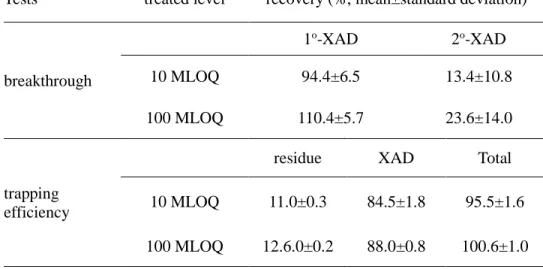
instrument was precise and stable (Table 3). Recovery from various matrices were ranged from 71.2 to 119.5% (C.V. = 1.3‒10.7%) (Fig. 1), providing the extraction efficiencies are reliable. In trapping efficiency test, mass balance (> 90%) was good and the most of kresoxim-methyl remained in XAD-2 resin (Table 4). Kresoxim-methyl was retained more than 90% on the first part of the XAD-2 resin in the breakthrough test, indicating that the first resin part possessed a suitable holding capacity (Table 4). Therefore, XAD-2 resin was useful for trapping and holding kresoxim-methyl in air, as successfully applied
26
for other pesticides (Kim et al., 2012b). In short, all analytical and sampling methods were well validated according to above results.
Determination of the number of iterations
The output stability from simulation to simulation was an especially important for the precision of forecasts. The variance of the mean and high-end 95th
percentile forecasts of AQE per unit body weight was calculated by repeating each simulation three times with 100, 500, 1,000, 5,000 and 10,000 iterations. Because the high-end forecasts consistently stabilized at <0.5% variance when the number of iterations was more than 10,000 iterations, 10,000 iterations were used in all subsequent analysis (Fig. 2).
27
Table 3. Instrumental repeatability and linearity of calibration curve
Instrumental repeatability
Levels Average (area) C.V. (%) ILOQ 4.7 7.7 10 ILOQ 37.6 1.3 100 ILOQ 374.3 0.4 Linearity (R2) Day of preparation 0.999 After 1 day 0.999 After 3 days 0.999
28
29
Patch Glove Sock Mask XAD-2 resin
R e c o v e ry , % 0 20 40 60 80 100 120 140 MLOQ 10 MLOQ 100 MLOQ
30
Figure 2. Variability in AQE per unit body weight as simulation estimates by a function of iteration number
31 Number of iterations #100 #500 #1000 #5000 #10000 V ar ian c e , % 0.0 0.5 1.0 1.5 2.0 2.5 3.0 Mean 95th percentile
32
Table 4. Breakthrough and trapping efficiency of XAD-2 resin
Tests treated level recovery (%, mean±standard deviation)
breakthrough 1o-XAD 2o-XAD 10 MLOQ 94.4±6.5 13.4±10.8 100 MLOQ 110.4±5.7 23.6±14.0 trapping efficiency
residue XAD Total 10 MLOQ 11.0±0.3 84.5±1.8 95.5±1.6 100 MLOQ 12.6.0±0.2 88.0±0.8 100.6±1.0
33 Dermal exposure assessment
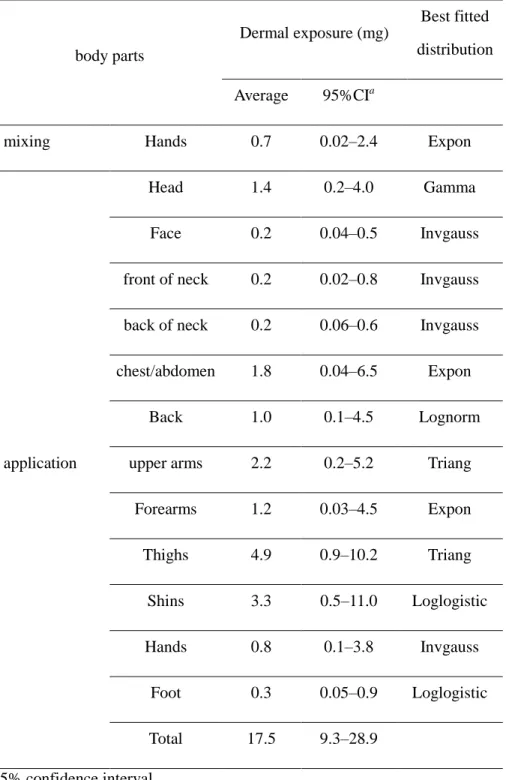
The dermal exposure during mixing/loading was measured on only hands as suggested by national guidelines. Because the hands were reported to be significantly more exposed than other body parts and occupied 19~100% of the total dermal exposure for mixer/loader (Machera et al., 2002b; Kim et al., 2012b; Choi et al., 2013; Moon et al., 2013; Choi and Kim, 2014). The hand exposure to kresoxim-methyl for mixer/loader was 0.7 mg (95%CI 0.02‒2.4) (Table 8), taking 0.0005% (95%CI 1.2×10⁻⁵‒0.001) of total prepared active
ingredient (a.i.). This ratio of dermal exposure was less than 0.0007~0.59% reported in the previous studies (Kim et al., 2012a; Kim et al., 2012b; Choi et al., 2013; Kim et al., 2013; Moon et al., 2013; Choi and Kim, 2014), because WG formulation used in this study is larger and heavier than WP and is less absorbed into cotton glove than EC or SL.
During application of kresoxim-methyl, the amount of dermal exposure was 17.5 mg (95%CI 9.3‒28.9), corresponding to 0.010% (95%CI 0.006‒0.017) of total applied a.i. (Table 8), being within the range of 0.003~0.048% on apple orchard as reported in previous studies (Kim et al., 2012b; Kim et al., 2013; Moon et al., 2013). The results of sensitive analysis showed that thighs and shins, each with correlation coefficients of 0.53 and 0.43, respectively, had the greatest influence on the dermal exposure during application, followed by chest/abdomen and upper arms showed correlation coefficient 0.33 and 0.30, respectively (Fig. 3). Similar tendency was also observed during application of acetamiprid, fenvalerate and methomyl with SS (Kim et al., 2012b; Kim et al., 2013; Moon et al., 2013). Whereas the hands was reported to be the major exposed parts if the power sprayer was used on apple orchard (Machera et al.,
34
2002b; Choi et al., 2013; Choi and Kim, 2014), hands for applicator using SS was exposed less than chest and arms.
Inhalation exposure assessment
The inhalation exposure during application was estimated as 6.8 ng (95%CI 0.4‒17.0) from Triang distribution. The ratio of inhalation exposure to dermal exposure was 0.04%, being less than 0.1% of dermal exposure as observed in other studies (Kim et al., 2012b; Moon et al., 2013).
Exposure database for predictive model
35 Table 5. Dermal exposure per hour of kresoxim-methyl (mL/h)
Trials 1 2 3 4 5 6 7 8 9 10 11 12 13 14 15 Head 24.7 9.1 3.6 7.2 11.8 4.4 8.1 19.4 7.6 4.5 4.3 17.3 12.2 3.4 20.3 Neck of front 5.4 0.5 0.3 0.6 0.4 0.2 1.1 1.0 1.8 0.7 0.6 2.1 1.3 0.4 2.3 Neck of back 4.0 1.4 1.4 1.0 1.7 0.7 1.3 2.8 0.9 0.8 0.5 4.6 1.5 3.1 2.3 Chest 31.0 9.0 2.2 6.4 10.9 0.2 3.9 9.9 9.9 2.2 5.0 38.1 27.7 27.3 47.2 Back 14.4 5.8 1.2 3.7 2.9 0.7 2.7 3.8 2.2 3.5 4.0 16.5 16.9 19.7 10.8 Upper arm(L) 10.8 2.3 0.8 1.3 2.1 0.5 2.2 13.3 9.0 2.2 2.2 9.2 10.6 16.2 8.9 Upper arm(R) 51.8 10.2 10.0 12.3 12.5 2.0 11.1 28.8 8.4 4.8 1.3 58.0 9.1 10.9 14.4 Forearm(L) 6.9 1.8 0.9 0.8 1.6 0.5 1.1 6.3 1.8 0.3 1.1 8.9 11.1 9.6 7.0 Forearm(R) 8.6 0.2 0.6 2.8 9.3 0.3 6.9 14.1 3.8 0.8 0.3 4.9 3.8 6.0 5.2 Thigh(L) 20.6 8.2 7.7 10.1 12.0 2.3 7.7 20.2 9.3 6.7 4.7 18.3 20.6 41.9 22.2 Thigh(R) 59.1 17.4 18.2 18.0 20.8 5.0 20.7 43.6 16.9 8.5 3.0 18.8 21.5 44.0 34.4 Shin(L) 24.5 13.6 6.2 3.7 8.8 4.4 7.4 10.6 10.1 3.2 5.7 27.9 25.9 19.0 14.6
36 Shin(R) 36.3 10.6 8.9 7.4 8.1 4.4 11.1 24.8 6.5 5.0 2.9 18.1 8.3 11.1 11.2 Face 5.5 0.7 0.6 1.4 0.9 0.8 1.3 2.6 2.8 2.7 0.5 1.0 0.7 1.3 1.0 Hands 14.8 2.9 2.4 3.2 4.1 1.5 1.4 0.8 14.2 1.3 14.6 1.0 28.6 3.8 2.8 Feet 6.2 1.0 0.5 1.2 1.5 0.6 2.5 2.8 2.7 8.9 1.3 4.9 2.6 5.2 3.9 Sum 324.6 94.7 65.5 81.1 109.4 28.5 90.5 204.8 107.9 56.1 52 249.6 202.4 222.9 208.5
37 Table 5. Continued Trials
16
17
18
19
20
21
22
23
24
25
26
27
28
29
30
Head 54.5 7.0 29.2 13.2 21.3 19.4 28.9 14.0 29.2 15.7 21.9 2.6 2.7 38.2 23.8 Neck of front 8.8 5.9 6.8 3.6 3.4 0.7 5.4 0.7 1.5 1.8 2.3 0.8 0.6 4.1 2.4 Neck of back 8.4 4.8 3.5 2.1 1.5 1.3 4.1 2.2 2.7 1.9 2.3 1.6 1.1 4.0 1.3 Chest 129.9 24.5 4.1 17.8 21.7 25.0 18.7 15.0 10.2 2.5 29.4 23.9 15.2 13.9 26.2 Back 88.9 5.2 6.9 42.4 6.1 4.4 10.7 15.7 2.3 2.2 26.2 18.1 4.6 10.2 18.3 Upper arm(L) 13.5 3.3 30.1 1.8 8.0 1.4 10.7 4.7 2.2 2.1 6.0 4.2 3.9 11.0 14.2 Upper arm(R) 17.2 26.2 20.8 2.7 20.1 24.3 7.5 5.3 24.0 19.9 29.2 8.1 3.0 5.4 30.2 Forearm(L) 23.0 6.0 3.4 2.2 11.8 11.2 5.3 3.6 2.2 2.2 5.4 2.9 1.4 24.3 14.7 Forearm(R) 29.3 24.2 19.2 1.4 19.3 9.6 12.0 0.9 5.4 2.5 16.9 2.5 2.0 5.3 15.8 Thigh(L) 70.8 31.0 25.5 11.3 35.5 17.7 20.8 22.8 19.5 14.3 25.0 20.3 19.8 34.2 57.4 Thigh(R) 44.0 63.0 60.4 11.6 32.4 26.8 17.4 43.8 49.4 21.9 37.5 16.6 15.7 67.4 50.6 Shin(L) 96.6 49.3 44.3 14.9 16.6 0.5 3.7 11.5 20.6 13.2 15.7 7.7 10.9 16.1 13.338 Shin(R) 76.2 66.5 55.5 15.7 12.4 2.9 45.1 16.2 11.8 14.2 19.3 12.8 2.5 25.7 20.6 Face 6.6 4.5 2.9 2.9 3.1 2.2 2.8 0.9 1.5 0.6 2.5 0.7 1.0 1.5 1.4 Hands 7.5 6.7 1.0 14.8 21.3 28.9 19.8 6.2 5.2 15.5 4.9 1.4 26.0 27.0 0.9 Feet 3.9 3.2 2.1 2.4 2.4 3.4 2.4 2.4 2.4 0.2 2.1 2.2 2.5 2.9 4.1 Sum 679.1 331.3 315.7 160.8 236.9 179.7 215.3 165.9 190.1 130.7 246.6 126.4 112.9 291.2 295.2
39 Risk assessment
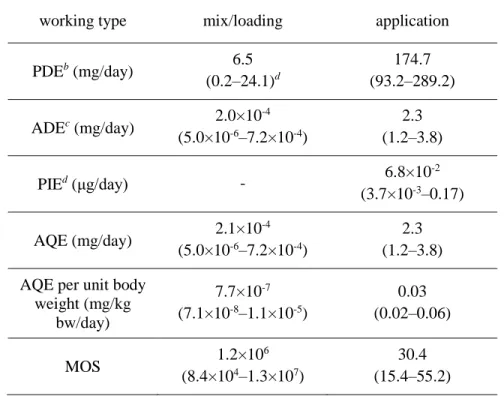
Because it takes average 48 min for preparation and application of 1,000L (500L x 2) spray suspension, workers could conduct about ten working activities with speed sprayer for 8 h per day. The reliable exposure estimates were determined from dermal and inhalation exposure amount on several assumptions, including day-to-day activity, penetration rate through clothes, skin absorption and body weight for adult male Korean (Table 14). The AQEs were 2.1×10⁻⁴ mg/day (95%CI 5.0×10⁻⁶‒7.2×10⁻⁴) and 2.3 mg/day (95%CI 1.2‒3.8) for mixer/loader and applicator, respectively. The 95th percentile AQEs for mixer/loader and applicator were 7.2×10⁻⁴ and 3.4 mg/day, which were higher 1.5‒3.4 times than average AQEs, respectively. The ratio of PIE to AQE during application was 0.003% (95%CI 0.0003‒0.004%), so inhalation exposure was negligible as the other study (PIE 0.02‒0.06 μg/day) with acetamiprid (Kim et al., 2013). The ADE during application was similar to the study with methomyl (1.1‒2.0 mg/day) and higher 3‒12 times than the study with acetamiprid (0.8 mg/day) and fenvalerate (0.2‒0.4 mg/day) (Kim et al., 2012b; Kim et al., 2013; Moon et al., 2013). Meanwhile, the AQE during mixing/ loading was 0.009% of that during application. The predicted distribution of MOS for kresoxim-methyl was 30.4 (95%CI 15.4‒55.2) (Table 5, Figure 4). The proportion of the general Korean workers under the threshold for concern (MOS <1) was almost zero, indicating workers using SS on apple orchard are considered to be safe from kresoxim-methyl exposure. This was due to low toxicity (AOEL, 0.9 mg/kg) and low skin absorption rate (13%) of kresoxim-methyl, despite high exposure occurrence and high a.i. content of pesticide products (50%).
40
Figure 3. Correlation coefficients of body parts to dermal exposure during application
42
Table 6. Dermal exposure on body parts during mixing/loading and application body parts Dermal exposure (mg) Best fitted distribution Average 95%CIa
mixing Hands 0.7 0.02‒2.4 Expon
application
Head 1.4 0.2‒4.0 Gamma Face 0.2 0.04‒0.5 Invgauss front of neck 0.2 0.02‒0.8 Invgauss back of neck 0.2 0.06‒0.6 Invgauss chest/abdomen 1.8 0.04‒6.5 Expon
Back 1.0 0.1‒4.5 Lognorm upper arms 2.2 0.2‒5.2 Triang
Forearms 1.2 0.03‒4.5 Expon Thighs 4.9 0.9‒10.2 Triang Shins 3.3 0.5‒11.0 Loglogistic Hands 0.8 0.1‒3.8 Invgauss Foot 0.3 0.05‒0.9 Loglogistic Total 17.5 9.3‒28.9 a 95% confidence interval
43
Table 7. Probabilistic risk estimation during mixing/loading and application of kresoxim-methyl on apple orcharda
working type mix/loading application PDEb (mg/day) (0.2‒24.1)6.5 d 174.7 (93.2‒289.2) ADEc (mg/day) 2.0×10 -4 (5.0×10⁻⁶‒7.2×10⁻⁴) 2.3 (1.2‒3.8) PIEd (μg/day) - 6.8×10 -2 (3.7×10⁻³‒0.17) AQE (mg/day) 2.1×10 -4 (5.0×10⁻⁶‒7.2×10⁻⁴) 2.3 (1.2‒3.8) AQE per unit body
weight (mg/kg bw/day) 7.7×10⁻⁷ (7.1×10⁻⁸‒1.1×10⁻⁵) 0.03 (0.02‒0.06) MOS 1.2×10 6 (8.4×10⁴‒1.3×10⁷) 30.4 (15.4‒55.2)
aPDE: potential dermal exposure, ADE: actual dermal exposure, PIE: potential
inhalation exposure, AQE: absorbable quantity of exposure, MOS: margin of safety.
b,d
PDE and PIE were calculated on assumption of working number: mixing/loading and application are conducted 10 times a day with SS.
c
ADE = [PDE × 1% (mix/loading) or 10% (application) of penetration rate through clothes] × 0.3% (mix/loading) or 13% (application) of skin absorption.
d
45
Part 2
Exposure and Risk Assessment of Operators to
Insecticide Acetamiprid during Treatment on
Apple Orchard
47
Introduction
Apple is one of the most produced and consumed fruits in Korea. The cultivated area and amount of production is 31,167 ha and 379,541 ton in 2011, respectively (KOSIS, 2011). Pesticides are indispensable chemicals that are widely used to control insects, diseases and weeds in agricultural field, and 165 pesticides were registered for apple (KFDA, 2012). Thus operator, who handle and apply pesticides in fields, can be exposed to pesticides during mixing/loading and spraying in apple orchard. Safety and health of operator during mixing/loading and application is a major concern in agricultural activities (Ramos et al., 2010) because direct contact with pesticides by operators who handle and apply these agents can lead to harmful effects depending on the toxicity of pesticides. In orchard, 64.6% of famers prefer to use speed sprayer than power sprayer for the application of pesticides (Hong et al., 2007). They wear long-sleeve shirts and long trouser instead of protective garments while spraying. Therefore there could be significant dermal exposure to operators to results in the unintended field-poisoning. During spraying, the representative routes of human exposure are dermal deposition and inhalation (Kim et al., 2012). Potential dermal exposure (PDE), measured by analyzing the quantity of a pesticide that deposited on body regions, provides the information on the amount of exposure. But PDE data by itself cannot be used as a risk indicator because it must be related to acceptable exposure limit. For this purpose, the margin of safety (MOS) has been proposed as a useful risk indication (Machado-Neto, 2001) that relates the acceptable exposure to a pesticide with the mass absorbed by the body, which can be estimated from PDE. MOS value higher than 1 are considered as an indication of safe working condition. Acetamiprid is a systemic neonicotinoid insecticide which is intended to control sucking insects on crops such as leafy vegetables, citrus fruits, pome fruits, grapes, cotton, and ornamental plants. It has a low acute and
48
chronic toxicity in mammals with no evidence of carcinogenicity, neurotoxicity endocrine disruption or mutagenicity (Marı́n et al., 2004). However, there is no previous exposure and risk assessment of operator to insecticide acetamiprid in apple orchard, to our knowledge. Thus, in this study, dermal and inhalation exposure amounts were measured during mixing/loading and application of acetamiprid after analytical methods were fully validated. Body parts of major exposure were identified and MOS for operator was calculated based on PDE to find out whether work condition is safe or not.
49
Materials and Methods
Reagents and materials
Acetamiprid (99.9%) of analytical standard grade was purchased from Sigma-Aldrich (MO, USA). All solvents were HPLC-grade, and were purchased from Fisher Scientific Korea Ltd (Ansung, Korea). Stock solution (100 μg/mL) was prepared HPLC-grade acetonitrile. The working standard solutions were prepared by serial dilution of stock solution in acetonitrile. Acetamiprid wettable powder (WP) (8%) was purchased from pesticide vender for field study.
Exposure matrices
Dermal patches for dermal exposure measurement were made by putting cellulose paper (Whatman 17CHR, 46 × 57 cm, 1 mm thickness; Kent, UK) in the patch pocket (10 cm × 10 cm), which has circular exposure part (50 cm2). Safety pins were used to attach patches on protective garment (SP protective, KleenGuard, Yuhan-kimberly Korea Ltd, Seoul, Korea) of operator. Cotton mask (face exposure; 200 cm2), cotton socks (feet exposure), cotton gloves (hands exposure) were purchased from local markets. A personal air monitor (PAM) consists of air pump (Gillian Model 224-PCXR7, MSA, Dong Ha Trading Co. Ltd, Seoul, Korea), glass fiber filter (37 mm, SKC, Eighty Four, PA) in open-faced cassette (SKC) and solid sorbent (ORBOTM 609 Amberlite XAD-2 400/200 mg, Supelco, MO, USA). U-shape glass tube for trapping efficiency test was manufactured by Dae-Jung Chemical (Daejon, Korea).
50 Experimental sites
All the field studies were carried out in apple research institute orchards (Table 8). The unit size of site for repetition was 0.2 ha. The apple crop height was 2.5 and 5 m, and rows were separated by 4-6 m. During the experiment, ambient temperature was 9-24 oC and relative humidity was 16-61%. Wind velocity did
not exceed 4 m/s (Kester 3000, Nielsen-Kellerma, USA).
Chromatographic condition
All chromatographic analysis were performed on a High Performance Liquid Chromatograph (Agilent 1100 HPLC; CA, USA) with automatic injector, DAD (diode array detector), and a Shiseido C18 column (250 mm × 4.6 mm, 5 μm particle; Kyoto, Japan) at 40 oC. The mobile phases A and B were water and
acetonitrile, respectively. A gradient system was employed for 15 min at the flow rate of 1.0 mL/min with A:B as follows: initial 0 min, 50:50; 1 min, 50:50; 10 min 30:70; 10.5 min 0:100; 12 min, 0:100; final 15 min 50:50. Injection volume was 10 μL, and elution of acetamiprid was monitored at 250 nm.
51
Table 8. Field conditions, application data, and meteorological conditions of operators of acetamiprid
Applicator Op. 1 Op. 2 Op. 3 Op. 4
Applicator
Years of experience 20 20 25 30 Repetition, 8 9 4 7 Sex male male male male Height (cm) 172 173 165 175 Weight (kg) 65 60 65 68
Field
Area (ha) 0.2 0.2 0.2 0.2 Crop age (years) 4-30 3-35 3-26 5-25 Crop growth stage Before blossom stage
Crop height (m) 3-4 3.5 2.5-4 3-4 Inner row crop distance
(m) 0.5-1 1-2 1-3 1-4 Row distance (m) 4-5 4 4-6 4-6 Pesticide AI content used (g) 40 Spray volume (L) 1,000 Application
Type of spray application Speed sprayer
Boom length (m) 10 8 8 7 Application time (min) 35-45 40-45 35-40 35-45 Nozzle size Small Small Small Small
Climate
Temperature (℃) 10-24 9-21 7-20 9-24 Relative humidity (%) 22-54 21-61 16-62 19-50 Wind speed (m/sec) 0-2 0-4 0-1 0-1 Precipitation None