ABSTRACT
CD4
+Foxp3
+regulatory T (Treg) cells play major roles in immune homeostasis. While
CD4
+Foxp3
+Treg cells act to suppress other immune effector cells, there is growing evidence that
they also produce pro-inflammatory cytokines, such as IL-17A, in inflammatory conditions. The
pro-inflammatory cytokine milieu, toll-like receptor (TLR) signaling, and specific transcription
factors are important for the production of IL-17A by CD4
+Foxp3
+Treg cells. In particular,
IL-17A-producing CD4
+Foxp3
+Treg cells express RORγt, the T helper (Th) 17-specific transcription
factor, in addition to Foxp3. IL-17A-producing CD4
+Foxp3
+Treg cells are also involved in the
pathogenesis of various diseases. Here we review the mechanisms underlying the induction of
IL-17A-producing CD4
+Foxp3
+Treg cells and the roles of these cells in human disease.
Keywords:
Regulatory T-cells; IL-17A; Inflammation; Pro-inflammatory cytokine
INTRODUCTION
CD4
+CD25
+Foxp3
+regulatory T (Treg) cells are important for the regulation of the immune
response. They contribute to maintenance of immune homeostasis by suppressing excessive
immune responses, and their dysregulation is involved in various human diseases, including
autoimmune diseases, allergy, and cancer (
1
-
5
). It is therefore essential to understand exactly
how they are modulated in inflammatory environments.
Conventional Treg cells exert their suppressive effect via cell-cell contact-dependent and
contact-independent mechanisms. In particular, they produce anti-inflammatory cytokines
such as IL-10, transforming growth factor (TGF)-β, and IL-35. However, there is growing
evidence that Treg cells secrete pro-inflammatory cytokines in inflammatory conditions (
6
-
13
).
Treg cells that produce pro-inflammatory cytokines can be categorized into 2 types according
to the stability of their expression of Foxp3. One type is reprogrammed Treg cells, also
known as exTreg cells (
14
,
15
), that lose Foxp3 expression and acquire the characteristics
of T helper (Th) cells, such as the secretion of pro-inflammatory cytokines in immune
dysregulated conditions (
16
). The other type is Th-like Treg cells that stably express Foxp3.
These cells express lineage-specific transcription factors and produce pro-inflammatory
cytokines (
12
,
17
). Th1-like Treg cells express the Th1-specific transcription factor T-bet
in addition to Foxp3 and produce a Th1-type cytokine, interferon (IFN)-γ (
17
). Th17-like
Review Article
Received: Aug 4, 2017 Revised: Sep 29, 2017 Accepted: Oct 2, 2017 *Correspondence to Min Kyung Jung
Laboratory of Immunology & Infectious Diseases, Graduate School of Medical Science and Engineering, KAIST, 291 Daehak-ro, Yuseong-gu, Daejeon 34141, Korea. E-mail: [email protected] Eui-Cheol Shin
Laboratory of Immunology & Infectious Diseases, Graduate School of Medical Science and Engineering, KAIST, 291 Daehak-ro, Yuseong-gu, Daejeon 34141, Korea. E-mail: [email protected]
Copyright © 2017. The Korean Association of Immunologists
This is an Open Access article distributed under the terms of the Creative Commons Attribution Non-Commercial License (https:// creativecommons.org/licenses/by-nc/4.0/) which permits unrestricted non-commercial use, distribution, and reproduction in any medium, provided the original work is properly cited.
Conflict of Interest
The authors declare no potential conflicts of interest.
Abbreviations
APC, antigen-presenting cell; IBD, inflammatory bowel disease; IFN, interferon; TCR, T cell receptor; TGF, transforming growth factor; TLR, toll-like receptor; Th, T helper; Treg, regulatory T; tTreg, thymus-derived Treg
Min Kyung Jung
1,*, Jeong-Eun Kwak
2, Eui-Cheol Shin
1,2,*1 Laboratory of Immunology & Infectious Diseases, Graduate School of Medical Science and Engineering, KAIST, Daejeon 34141, Korea
2BioMedical Science and Engineering Interdisciplinary Program, KAIST, Daejeon 34141, Korea
IL-17A-Producing Foxp3
+
Regulatory
Author Contributions
Conceptualization: Jung MK, Shin EC; Data curation: Jung MK, Kwak JE; Funding acquisition: Jung MK; Project administration: Jung MK, Shin EC; Supervision: Shin EC; Writing - original draft: Jung MK, Kwak JE; Writing - review & editing: Shin EC.
Treg cells express RORγt in addition to Foxp3 and produce IL-17A (
12
). In autoimmune
diseases, these inflammatory Treg cells are likely to play a role as pathologic effector T
cells, thereby contributing to inflammation and to tissue injury (
16
). During infection by
pathogens, inflammatory Treg cells may help elimination of the pathogens by secreting
pro-inflammatory cytokines like Th1 or Th17 effector cells. However, it is also possible that they
contribute to excessive inflammation and thus exacerbate host injury during infection.
Although inflammatory conversion of Treg cells has been reported in many pathologic
conditions, several questions remain: How are inflammatory Treg cells induced? What are
their roles in various diseases? And how are their functions modulated? Addressing these
questions could allow inflammatory Treg cells to be therapeutic targets for the treatment
of human diseases. In this review, we describe the current knowledge of inflammatory Treg
cells, particularly IL-17A-producing Treg cells, with an emphasis on their induction and the
roles they play in human disease.
CD4
+FOXP3
+Treg CELLS
CD4
+CD25
+Foxp3
+Treg cells negatively control the effector functions of diverse immune
cells. Many studies have demonstrated their key roles in preventing autoimmune diseases
and inflammatory diseases as well as their potential to control the rejection of transplanted
grafts (
18
). Indeed, their absence in Scurfy mice and in patients with immune dysregulation,
polyendocrinopathy, enteropathy, and X-linked (IPEX) syndrome, which are caused by defects
in the gene that encodes the Foxp3 protein, results in lethal lympho-proliferation and in
multiple autoimmune diseases (
18
).
CD4
+CD25
+Foxp3
+Treg cells are classified based on their development into naturally
occurring thymus-derived Treg (tTreg) cells (also known as natural Treg cells) and into
peripherally-derived Treg (pTreg) cells (also known as induced or adaptive Treg cells) (
19
-
21
).
tTreg cells develop during the process of T cell maturation in the thymus under T cell receptor
(TCR) engagement with self-antigens, and these cells play a key role in the maintenance
of self-tolerance (
22
). tTreg cells constitute the majority of the peripheral Treg cell pool in
naïve mice and in human cord blood. Conversely, pTreg cells are generated predominantly at
peripheral sites of inflammation and at environmental interfaces, such as in the gut.
Conventional Treg cells exert their immune-suppressive functions through various
mechanisms, including 1) metabolite inhibition mediated by CD25 or CD39; 2) dendritic
cell-dependent inhibition by CTLA-4 or LAG-3; and 3) the production of immunosuppressive,
anti-inflammatory cytokines, such as IL-10, TGF-β, and IL-35 (
23
). However, emerging
evidence shows that Treg cells can produce pro-inflammatory cytokines such as IL-17A in
inflammatory conditions related to various human diseases.
THE BIOLOGY OF IL-17A-PRODUCING CD4
+FOXP3
+Treg
CELLS
The origin of IL-17A-producing CD4
+Foxp3
+Treg cells
IL-17A-producing Foxp3
+Treg cells can develop from conventional CD4
+Foxp3
+Treg cells by
plastic changes. When murine CD4
+Foxp3
+Treg cells are cultured in Th17
differentiation-inducing conditions, the Treg cells can produce IL-17A (
24
). In the same conditions, naïve
CD4
+T cells also produce IL-17A and transiently express Foxp3 (
24
). That study showed that
conventional Treg cells that stably express Foxp3 can produce IL-17A, although the majority of
IL-17A-producing CD4
+Foxp3
+T cells were CD4
+T cells that transiently expressed Foxp3.
As noted above, CD4
+Foxp3
−T cells can transiently express Foxp3 upon TCR stimulation
(
25
,
26
). Unlike conventional Treg cells, these activation-induced Foxp3
+cells do not stably
express Foxp3, and ultimately, they stop expressing it. These cells do not have
immune-suppressive functions. Therefore, it has been suggested that non-immune-suppressive CD4
+Foxp3
+cells, which easily lose their ability to express Foxp3, are derived from conventional CD4
+T
cells in the periphery.
Markers of IL-17A-producing CD4
+Foxp3
+Treg cells
The expression of RORγt, the Th17 lineage-specific transcription factor, is the most
important characteristic of IL-17A-producing Treg cells (
12
) although all RORγt
+Foxp3
+Treg
cells are not IL-17A-producing cells. The expression of CCR6, CD49d, IL-1R-β, and CD161,
as well as the absence of human leukocyte antigen-DR (HLA-DR), have been described
as cell surface markers of IL-17A-producing Foxp3
+Treg cells (
7
,
27
-
30
). Collectively,
IL-17A-producing Foxp3
+Treg cells can be defined as CD4
+CD25
hiCD127
loCD45RA
−HLA-DR
−CD49d
+CD161
+Foxp3
loRORγt
+CCR6
+T cells. However, further investigation is needed to more
precisely define IL-17A-producing Treg cells.
Within the human CD4
+Foxp3
+T cell population, the expression patterns of Foxp3 and
CD45RA define 3 subpopulations: the Foxp3
loCD45RA
+resting Treg cell subpopulation,
the Foxp3
hiCD45RA
−activated Treg cell subpopulation, and the Foxp3
loCD45RA
−non-suppressive subpopulation (
31
). The majority of IL-17A-producing Foxp3
+T cells belong
to the Foxp3
loCD45RA
−non-suppressive subpopulation. However, the exact nature of the
Foxp3
loCD45RA
−non-suppressive subpopulation remains somewhat unclear. A recent study
suggested CD15s as a marker that differentiates between the activated suppressive Treg cell
subpopulation and the non-suppressive subpopulation. It is not clear yet whether CD15s
−Foxp3
+T cells produce IL-17A, although they are known to actively produce IFN-γ and IL-2 (
32
).
The induction of IL-17A-producing CD4
+Foxp3
+Treg cells
The pro-inflammatory cytokine milieu is the most important factor for the induction of
IL-17A production by CD4
+Foxp3
+Treg cells. IL-6, IL-23, and IL-1β are required for Treg cells
to differentiate into IL-17A-producing Th17-like Treg cells (
24
,
29
,
33
-
36
). In the presence
of TGF-β, IL-6 can induce CD4
+Foxp3
+Treg cells to produce IL-17A (
37
). As in Th17 cells,
IL-6-dependent STAT3 activation is also required, along with RORγt and RORα, for IL-17A
expression by Treg cells (
36
,
38
). A recent study of human Treg cells suggested that IL-6
promotes the expression of PIM1 kinase, which specifically phosphorylates Foxp3 protein at
Ser422, and this negatively regulates Foxp3 protein activity
in vitro (
39
).
Stimulation of toll-like receptors (TLRs) is another important factor that has been implicated
in the production of IL-17A by CD4
+Foxp3
+Treg cells (
24
,
40
). TLRs are expressed not only by
innate immune cells and antigen-presenting cells (APCs) (
41
,
42
), but also by CD4
+T cells,
including Foxp3
+Treg cells (
41
,
43
-
49
). In murine models, when TLR2 that is expressed on APCs
is stimulated by its ligands, the APCs produce pro-inflammatory cytokines, and the suppressive
function of Treg cells is reversed (
36
,
49
-
54
). When conventional CD4
+Foxp3
+Treg cells are
stimulated by TLR2 ligands in the presence of APCs and Th17-inducing cytokines like IL-6,
IL-23, and IL-1β, the Treg cells can produce IL-17A without losing Foxp3 expression, although
20% of Treg cells lose Foxp3 (
13
,
24
). These data indicate that excessive TLR2 stimulation may
contribute to the induction of IL-17A-producing Treg cells in inflammatory environments.
Specific transcription factors have important roles in the induction of IL-17A-producing Treg
cells. IL-17A-producing, Th17-like Treg cells express RORγt in addition to Foxp3, suggesting
that RORγt is involved in IL-17A expression in Foxp3
+Treg cells. Th17 cells and Treg cells
are more closely related in terms of their differentiation than are Th1 or Th2 cells, because
TGF-β is involved in the differentiation of both Th17 and Treg cells (
55
-
57
). While TGF-β
signaling is required for the expression of both Foxp3 and RORγt expression, the induction
of Foxp3 or RORγt is determined by collaborating cytokines. Specifically, TGF-β works in
concert with IL-2-dependent STAT5 activation for Foxp3 induction, whereas it works in
concert with IL-6-dependent STAT3 activation for RORγt induction (
15
,
58
). In the absence of
IL-6, Foxp3 inhibits Th17 differentiation by antagonizing the functions of RORγt and RORα
(
58
). However, excessive IL-6 in the milieu overcomes the inhibitory effect of Foxp3 and
induces the development of IL-17A-producing Treg cells in a RORγt- and STAT3-dependent
manner (
7
,
38
). One study showed that Treg cells from patients with STAT3 loss-of-function
mutations were unable to produce IL-17A (
33
), indicating that IL-6-mediated STAT3 activation
is critical for the production of IL-17A by Treg cells. Moreover, STAT3 is not only essential for
the induction of IL-17A-producing Treg cells, it is also required for the suppression of
Th17-mediated pathogenesis by Treg cells in mice (
59
,
60
). Regarding the suppressive functions
of IL-17A-producing, Th17-like Treg cells, some studies have shown that their suppressive
functions are impaired, while others showed that they retain their suppressive ability (
61
).
IL-17A-PRODUCING FOXP3
+Treg CELLS AND HUMAN
DISEASES
Inflammatory diseases
Psoriasis is a chronic inflammatory skin disease that is closely associated with Th17 effector
cytokines (
62
). In psoriasis, Treg cells are dysfunctional and have insufficient suppressive
activity (
63
). The presence of IL-17A-producing, Th17-like Treg cells in human inflammatory
conditions was first described in psoriasis patients (
12
,
64
-
66
). In human psoriatic skin,
CD4
+Foxp3
+T cells exhibit a memory phenotype in that they express CD45RO and show a
high capacity to produce IL-17A, IL-2, and IFN-γ (
29
,
64
,
65
). These IL-17A-producing T cells
are regarded as
bona fide Treg cells because the TCR Vβ sequences of IL-17A-producing T cells
overlap very little with those of effector CD4
+T cells (
65
).
Treg cells are critical for commensal tolerance in the intestine, and a lack of intestinal
tolerance can lead to inflammatory bowel disease (IBD) (
67
-
69
). Indeed, a number of studies
have investigated the protective roles of Treg cells in murine models of IBD. It is well known
that the number of IL-17A-producing Treg cells is increased in both the intestinal mucosa
and the circulation of IBD patients compared to healthy controls (
10
,
70
-
72
). Although one
study reported that the suppressive functions of these cells are defective (
72
), other study has
shown that IL-17A-producing Treg cells from colitis samples retain their immuno-suppressive
capacity (
70
). These cells suppress the proliferation of effector T cells
in vitro, supporting
the notion that they are not reprogrammed to lose their suppressive functions (
7
,
70
). Taken
together, these data suggest that the inflammatory conditions in IBD can induce IL-17A
production by conventional Treg cells
in vivo.
In rheumatoid arthritis, patients have been reported to have a higher level of
IL-17A-producing Treg cells than healthy controls (
33
). These cells produce IFN-γ and IL-2 along with
IL-17A (
73
,
74
). The ability of these cells to suppress the immune activity of effector T cells is
comparable to that of conventional Treg cells from healthy subjects, indicating that these
IL-17A-producing Treg cells do not lose their suppressive capacity.
Cancer
In cancer patients, CD4
+Foxp3
+Treg cells are considered to contribute to the immunosuppressive
tumor microenvironment (
75
). Analyses of human tumor-infiltrating lymphocytes in melanoma,
ovarian, breast, and colon cancers indicated that a substantial fraction of CD4
+Foxp3
+Treg cells
express pro-inflammatory cytokines such as IL-17A and IFN-γ (
76
,
77
). These IL-17A-producing
Treg cells, which were isolated from various tumors, had a strong suppressive function
in vitro
(
70
). These data indicate that although the precise roles of these cells in tumor progression
must be investigated further, they may affect the induction of active inflammation and tumor
development while still retaining their suppressive function on effector T cells.
A recent study reported interesting results in colorectal cancer regarding the
pro-inflammatory cytokine-secreting, non-suppressive Foxp3
loCD45RA
−subpopulation (
31
,
78
).
Colorectal cancer patients were divided into 2 groups based on the degree of infiltration of
CD4
+Foxp3
loCD45RA
−T cells (
78
). Patients with abundant infiltration of CD4
+Foxp3
loCD45RA
−T cells had a significantly better prognosis than those with predominant infiltration of
CD4
+Foxp3
hiCD45RA
−activated Treg cells. The development of such pro-inflammatory
cytokine-producing CD4
+Foxp3
loCD45RA
−T cells may depend on cytokines such as
IL-12 and TGF-β, which are produced by tumor tissues. Interestingly, the presence of
CD4
+Foxp3
loCD45RA
−T cells was related to bacterial invasion to tumor tissues by intestinal
bacteria, particularly
Fusobacterium nucleatum. This study demonstrated that pro-inflammatory
cytokine-producing CD4
+Foxp3
loCD45RA
−T cells can be induced by a specific species of
bacteria and suggested that they might contribute to tumor control.
Infectious diseases
There are a few reports about the presence of pro-inflammatory cytokine-producing
CD4
+Foxp3
+Treg cells in infectious diseases. In oropharyngeal candidiasis models,
IL-17A-producing Treg cells arise transiently in infected mice (
24
,
79
-
81
). IL-17-producing Treg cells
do not contribute to the pathology during acute candida infection in mice.
In a study of patients with chronic hepatitis B virus (HBV) infections, the relative frequency of
CD4
+Foxp3
loCD45RA
−T cells, which are pro-inflammatory cytokine-secreting, non-suppressive
cells, was increased in patients with acute-on-chronic liver failure and correlated with severe liver
injury (
82
). The results of that study suggested that CD4
+Foxp3
loCD45RA
−T cells may contribute
to immune-mediated liver injury during chronic HBV infection. In infections by other types
of pathogens, researchers need to examine the specific roles and induction mechanisms of
CD4
+Foxp3
+Treg cells that produce pro-inflammatory cytokines, particularly IL-17A.
CONCLUSION AND PERSPECTIVE
IL-17A-producing CD4
+Foxp3
+Treg cells have been extensively investigated in various
inflammatory diseases (
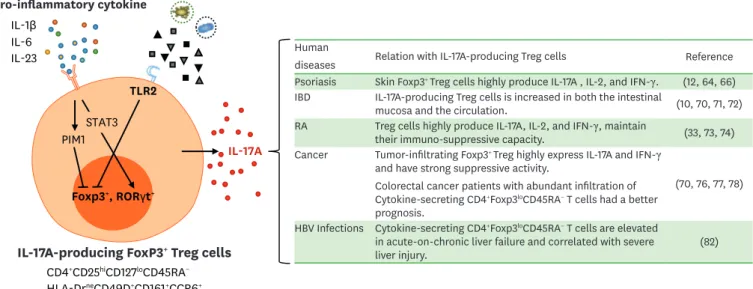
Fig. 1
). Pro-inflammatory cytokines, TLR signaling, and Th17
lineage-related transcription factors all play roles in the induction of IL-17A-producing Treg cells
(
Fig. 1
). The functions of IL-17-producing CD4
+Foxp3
+Treg cells depend on environmental
cues, including the local cytokine milieu, metabolites, and possibly the origins of the cells.
However, the specific characteristics of IL-17A-producing Treg cells and their mechanisms
of action merit further investigation. For example, the differences between the essential
functions of conventional Th17 cells vs. IL-17A-producing CD4
+Foxp3
+Treg cells are not
completely clear. Understanding how IL-17A-producing Treg cells are modulated in healthy
subjects and in various pathologic conditions is important as these cells may serve as
therapeutic targets for the treatment of human diseases.
ACKNOWLEDGEMENTS
This research was supported by Basic Science Research Program through the National
Research Foundation of Korea (NRF) funded by the Ministry of Education, Science and
Technology (NRF-2014R1A1A3050293).
REFERENCES
1. Curiel TJ, Coukos G, Zou L, Alvarez X, Cheng P, Mottram P, Evdemon-Hogan M, Conejo-Garcia JR, Zhang L, Burow M, et al. Specific recruitment of regulatory T cells in ovarian carcinoma fosters immune privilege and predicts reduced survival. Nat Med 2004;10:942-949.
PUBMED | CROSSREF
2. Ehrenstein MR, Evans JG, Singh A, Moore S, Warnes G, Isenberg DA, Mauri C. Compromised function of regulatory T cells in rheumatoid arthritis and reversal by anti-TNFalpha therapy. J Exp Med 2004;200:277-285.
PUBMED | CROSSREF
3. Kriegel MA, Lohmann T, Gabler C, Blank N, Kalden JR, Lorenz HM. Defective suppressor function of human CD4+ CD25+ regulatory T cells in autoimmune polyglandular syndrome type II. J Exp Med 2004;199:1285-1291.
PUBMED | CROSSREF
4. Miyara M, Amoura Z, Parizot C, Badoual C, Dorgham K, Trad S, Nochy D, Debré P, Piette JC, Gorochov G. Global natural regulatory T cell depletion in active systemic lupus erythematosus. J Immunol
2005;175:8392-8400. PUBMED | CROSSREF
Human
diseases Relation with IL-17A-producing Treg cells Reference Psoriasis Skin Foxp3+ Treg cells highly produce IL-17A , IL-2, and IFN-γ. (12, 64, 66)
IBD IL-17A-producing Treg cells is increased in both the intestinal
mucosa and the circulation. (10, 70, 71, 72) RA Treg cells highly produce IL-17A, IL-2, and IFN-γ, maintain
their immuno-suppressive capacity. (33, 73, 74) Cancer Tumor-infiltrating Foxp3+ Treg highly express IL-17A and IFN-γ
and have strong suppressive activity.
Colorectal cancer patients with abundant infiltration of Cytokine-secreting CD4+Foxp3loCD45RA− T cells had a better
prognosis.
(70, 76, 77, 78) HBV Infections Cytokine-secreting CD4+Foxp3loCD45RA− T cells are elevated
in acute-on-chronic liver failure and correlated with severe
liver injury. (82)
Pro-inflammatory cytokine
IL-17A-producing FoxP3
+Treg cells
Foxp3+, RORγt+ CD4+CD25hiCD127loCD45RA− HLA-DrneCD49D+CD161+CCR6+ PIM1 IL-1β IL-6 IL-17A IL-23 TLR2 STAT3
Figure 1. IL-17A-producing CD4+FOXP3+ Treg cells in human disease. IL-17A-producing Treg cells express RORγt in addition to Foxp3. They can be induced by
pro-inflammatory cytokines and TLR2 signals. Previous findings regarding IL-17A-producing Foxp3+ Treg cells in human disease are summarized.
5. Viglietta V, Baecher-Allan C, Weiner HL, Hafler DA. Loss of functional suppression by CD4+CD25+ regulatory T cells in patients with multiple sclerosis. J Exp Med 2004;199:971-979.
PUBMED | CROSSREF
6. Barbi J, Pardoll D, Pan F. Treg functional stability and its responsiveness to the microenvironment.
Immunol Rev 2014;259:115-139.
PUBMED | CROSSREF
7. Beriou G, Costantino CM, Ashley CW, Yang L, Kuchroo VK, Baecher-Allan C, Hafler DA. IL-17-producing human peripheral regulatory T cells retain suppressive function. Blood 2009;113:4240-4249.
PUBMED | CROSSREF
8. Du R, Zhao H, Yan F, Li H. IL-17+Foxp3+ T cells: an intermediate differentiation stage between Th17 cells and regulatory T cells. J Leukoc Biol 2014;96:39-48.
PUBMED | CROSSREF
9. Duarte JH, Zelenay S, Bergman ML, Martins AC, Demengeot J. Natural Treg cells spontaneously differentiate into pathogenic helper cells in lymphopenic conditions. Eur J Immunol 2009;39:948-955.
PUBMED | CROSSREF
10. Hovhannisyan Z, Treatman J, Littman DR, Mayer L. Characterization of interleukin-17-producing regulatory T cells in inflamed intestinal mucosa from patients with inflammatory bowel diseases.
Gastroenterology 2011;140:957-965.
PUBMED | CROSSREF
11. Pesenacker AM, Broady R, Levings MK. Control of tissue-localized immune responses by human regulatory T cells. Eur J Immunol 2015;45:333-343.
PUBMED | CROSSREF
12. Voo KS, Wang YH, Santori FR, Boggiano C, Wang YH, Arima K, Bover L, Hanabuchi S, Khalili J, Marinova E, et al. Identification of IL-17-producing FOXP3+ regulatory T cells in humans. Proc Natl Acad Sci U S A
2009;106:4793-4798. PUBMED | CROSSREF
13. Whibley N, Maccallum DM, Vickers MA, Zafreen S, Waldmann H, Hori S, Gaffen SL, Gow NA, Barker RN, Hall AM. Expansion of Foxp3(+) T-cell populations by Candida albicans enhances both Th17-cell responses and fungal dissemination after intravenous challenge. Eur J Immunol 2014;44:1069-1083.
PUBMED | CROSSREF
14. Joller N, Kuchroo VK. Good guys gone bad: exTreg cells promote autoimmune arthritis. Nat Med
2014;20:15-17. PUBMED | CROSSREF
15. Komatsu N, Okamoto K, Sawa S, Nakashima T, Oh-hora M, Kodama T, Tanaka S, Bluestone JA, Takayanagi H. Pathogenic conversion of Foxp3+ T cells into TH17 cells in autoimmune arthritis. Nat Med 2014;20:62-68.
PUBMED | CROSSREF
16. Zhou X, Bailey-Bucktrout S, Jeker LT, Bluestone JA. Plasticity of CD4(+) FoxP3(+) T cells. Curr Opin Immunol
2009;21:281-285. PUBMED | CROSSREF
17. Stock P, Akbari O, Berry G, Freeman GJ, Dekruyff RH, Umetsu DT. Induction of T helper type 1-like regulatory cells that express Foxp3 and protect against airway hyper-reactivity. Nat Immunol 2004;5:1149-1156.
PUBMED | CROSSREF
18. Josefowicz SZ, Lu LF, Rudensky AY. Regulatory T cells: mechanisms of differentiation and function. Annu Rev Immunol 2012;30:531-564.
PUBMED | CROSSREF
19. Sakaguchi S, Fukuma K, Kuribayashi K, Masuda T. Organ-specific autoimmune diseases induced in mice by elimination of T cell subset. I. Evidence for the active participation of T cells in natural self-tolerance; deficit of a T cell subset as a possible cause of autoimmune disease. J Exp Med 1985;161:72-87.
PUBMED | CROSSREF
20. Sakaguchi S, Sakaguchi N, Asano M, Itoh M, Toda M. Immunologic self-tolerance maintained by activated T cells expressing IL-2 receptor alpha-chains (CD25). Breakdown of a single mechanism of self-tolerance causes various autoimmune diseases. J Immunol 1995;155:1151-1164.
PUBMED
21. Abbas AK, Benoist C, Bluestone JA, Campbell DJ, Ghosh S, Hori S, Jiang S, Kuchroo VK, Mathis D, Roncarolo MG, et al. Regulatory T cells: recommendations to simplify the nomenclature. Nat Immunol
2013;14:307-308. PUBMED | CROSSREF
22. Hori S, Nomura T, Sakaguchi S. Control of regulatory T cell development by the transcription factor Foxp3. Science 2003;299:1057-1061.
23. Vignali D. How many mechanisms do regulatory T cells need? Eur J Immunol 2008;38:908-911.
PUBMED | CROSSREF
24. Bhaskaran N, Cohen S, Zhang Y, Weinberg A, Pandiyan P. TLR-2 signaling promotes IL-17A production in CD4+CD25+Foxp3+ regulatory cells during oropharyngeal candidiasis. Pathogens 2015;4:90-110.
PUBMED | CROSSREF
25. Hori S. Lineage stability and phenotypic plasticity of Foxp3⁺ regulatory T cells. Immunol Rev 2014;259:159-172.
PUBMED | CROSSREF
26. Miyao T, Floess S, Setoguchi R, Luche H, Fehling HJ, Waldmann H, Huehn J, Hori S. Plasticity of Foxp3(+) T cells reflects promiscuous Foxp3 expression in conventional T cells but not reprogramming of regulatory T cells. Immunity 2012;36:262-275.
PUBMED | CROSSREF
27. Cosmi L, De Palma R, Santarlasci V, Maggi L, Capone M, Frosali F, Rodolico G, Querci V, Abbate G, Angeli R, et al. Human interleukin 17-producing cells originate from a CD161+CD4+ T cell precursor. J Exp Med 2008;205:1903-1916.
PUBMED | CROSSREF
28. Kleinewietfeld M, Hafler DA. The plasticity of human Treg and Th17 cells and its role in autoimmunity.
Semin Immunol 2013;25:305-312.
PUBMED | CROSSREF
29. Koenen HJ, Smeets RL, Vink PM, van Rijssen E, Boots AM, Joosten I. Human CD25highFoxp3pos regulatory T cells differentiate into IL-17-producing cells. Blood 2008;112:2340-2352.
PUBMED | CROSSREF
30. Maggi L, Santarlasci V, Capone M, Peired A, Frosali F, Crome SQ, Querci V, Fambrini M, Liotta F, Levings MK, et al. CD161 is a marker of all human IL-17-producing T-cell subsets and is induced by RORC. Eur J Immunol 2010;40:2174-2181.
PUBMED | CROSSREF
31. Miyara M, Yoshioka Y, Kitoh A, Shima T, Wing K, Niwa A, Parizot C, Taflin C, Heike T, Valeyre D, et al. Functional delineation and differentiation dynamics of human CD4+ T cells expressing the FoxP3 transcription factor. Immunity 2009;30:899-911.
PUBMED | CROSSREF
32. Miyara M, Chader D, Sage E, Sugiyama D, Nishikawa H, Bouvry D, Claër L, Hingorani R, Balderas R, Rohrer J, et al. Sialyl Lewis x (CD15s) identifies highly differentiated and most suppressive FOXP3high regulatory T cells in humans. Proc Natl Acad Sci U S A 2015;112:7225-7230.
PUBMED | CROSSREF
33. Afzali B, Mitchell PJ, Edozie FC, Povoleri GA, Dowson SE, Demandt L, Walter G, Canavan JB, Scotta C, Menon B, et al. CD161 expression characterizes a subpopulation of human regulatory T cells that produces IL-17 in a STAT3-dependent manner. Eur J Immunol 2013;43:2043-2054.
PUBMED | CROSSREF
34. Leveque L, Deknuydt F, Bioley G, Old LJ, Matsuzaki J, Odunsi K, Ayyoub M, Valmori D. Interleukin 2-mediated conversion of ovarian cancer-associated CD4+ regulatory T cells into proinflammatory interleukin 17-producing helper T cells. J Immunother 2009;32:101-108.
PUBMED | CROSSREF
35. Li L, Kim J, Boussiotis VA. IL-1β-mediated signals preferentially drive conversion of regulatory T cells but not conventional T cells into IL-17-producing cells. J Immunol 2010;185:4148-4153.
PUBMED | CROSSREF
36. Yang XO, Nurieva R, Martinez GJ, Kang HS, Chung Y, Pappu BP, Shah B, Chang SH, Schluns KS, Watowich SS, et al. Molecular antagonism and plasticity of regulatory and inflammatory T cell programs.
Immunity 2008;29:44-56.
PUBMED | CROSSREF
37. Xu L, Kitani A, Fuss I, Strober W. Cutting edge: regulatory T cells induce CD4+CD25-Foxp3- T cells or are self-induced to become Th17 cells in the absence of exogenous TGF-beta. J Immunol 2007;178:6725-6729.
PUBMED | CROSSREF
38. Osorio F, LeibundGut-Landmann S, Lochner M, Lahl K, Sparwasser T, Eberl G, Reis e Sousa C. DC activated via dectin-1 convert Treg into IL-17 producers. Eur J Immunol 2008;38:3274-3281.
PUBMED | CROSSREF
39. Li J, Shi J, Ren W, Wu W, Chen Z. Regulatory role of CD4(+)CD25 (+)Foxp3 (+) regulatory T cells on IL-17-secreting T cells in chronic hepatitis B patients. Dig Dis Sci 2014;59:1475-1483.
PUBMED | CROSSREF
40. Nylander A, Hafler DA. Multiple sclerosis. J Clin Invest 2012;122:1180-1188.
41. Ishii KJ, Koyama S, Nakagawa A, Coban C, Akira S. Host innate immune receptors and beyond: making sense of microbial infections. Cell Host Microbe 2008;3:352-363.
PUBMED | CROSSREF
42. Uematsu S, Akira S. Toll-Like receptors (TLRs) and their ligands. Handb Exp Pharmacol 2008:1-20.
PUBMED | CROSSREF
43. Caramalho I, Lopes-Carvalho T, Ostler D, Zelenay S, Haury M, Demengeot J. Regulatory T cells selectively express toll-like receptors and are activated by lipopolysaccharide. J Exp Med 2003;197:403-411.
PUBMED | CROSSREF
44. Gelman AE, Zhang J, Choi Y, Turka LA. Toll-like receptor ligands directly promote activated CD4+ T cell survival. J Immunol 2004;172:6065-6073.
PUBMED | CROSSREF
45. Jin B, Sun T, Yu XH, Yang YX, Yeo AE. The effects of TLR activation on T-cell development and differentiation. Clin Dev Immunol 2012;2012:836485.
PUBMED | CROSSREF
46. Komai-Koma M, Jones L, Ogg GS, Xu D, Liew FY. TLR2 is expressed on activated T cells as a costimulatory receptor. Proc Natl Acad Sci U S A 2004;101:3029-3034.
PUBMED | CROSSREF
47. Liu H, Komai-Koma M, Xu D, Liew FY. Toll-like receptor 2 signaling modulates the functions of CD4+ CD25+ regulatory T cells. Proc Natl Acad Sci U S A 2006;103:7048-7053.
PUBMED | CROSSREF
48. Oberg HH, Juricke M, Kabelitz D, Wesch D. Regulation of T cell activation by TLR ligands. Eur J Cell Biol
2011;90:582-592. PUBMED | CROSSREF
49. van Maren WW, Nierkens S, Toonen LW, Bolscher JM, Sutmuller RP, Adema GJ. Multifaceted effects of synthetic TLR2 ligand and Legionella pneumophilia on Treg-mediated suppression of T cell activation.
BMC Immunol 2011;12:23.
PUBMED | CROSSREF
50. Hoffmann P, Boeld TJ, Eder R, Huehn J, Floess S, Wieczorek G, Olek S, Dietmaier W, Andreesen R, Edinger M. Loss of FOXP3 expression in natural human CD4+CD25+ regulatory T cells upon repetitive in vitro stimulation. Eur J Immunol 2009;39:1088-1097.
PUBMED | CROSSREF
51. Netea MG, Sutmuller R, Hermann C, Van der Graaf CA, Van der Meer JW, van Krieken JH, Hartung T, Adema G, Kullberg BJ. Toll-like receptor 2 suppresses immunity against Candida albicans through induction of IL-10 and regulatory T cells. J Immunol 2004;172:3712-3718.
PUBMED | CROSSREF
52. Nyirenda MH, Sanvito L, Darlington PJ, O'Brien K, Zhang GX, Constantinescu CS, Bar-Or A, Gran B. TLR2 stimulation drives human naive and effector regulatory T cells into a Th17-like phenotype with reduced suppressive function. J Immunol 2011;187:2278-2290.
PUBMED | CROSSREF
53. Sutmuller R, Garritsen A, Adema GJ. Regulatory T cells and toll-like receptors: regulating the regulators.
Ann Rheum Dis 2007;66 Suppl 3:iii91-iii95.
PUBMED | CROSSREF
54. Pasare C, Medzhitov R. Toll pathway-dependent blockade of CD4+CD25+ T cell-mediated suppression by dendritic cells. Science 2003;299:1033-1036.
PUBMED | CROSSREF
55. Chen W, Jin W, Hardegen N, Lei KJ, Li L, Marinos N, McGrady G, Wahl SM. Conversion of peripheral CD4+CD25- naive T cells to CD4+CD25+ regulatory T cells by TGF-beta induction of transcription factor Foxp3. J Exp Med 2003;198:1875-1886.
PUBMED | CROSSREF
56. Korn T, Bettelli E, Oukka M, Kuchroo VK. IL-17 and Th17 cells. Annu Rev Immunol 2009;27:485-517.
PUBMED | CROSSREF
57. McGeachy MJ, Cua DJ. T cells doing it for themselves: TGF-beta regulation of Th1 and Th17 cells. Immunity
2007;26:547-549. PUBMED | CROSSREF
58. Zhou L, Lopes JE, Chong MM, Ivanov II, Min R, Victora GD, Shen Y, Du J, Rubtsov YP, Rudensky AY, et al. TGF-beta-induced Foxp3 inhibits T(H)17 cell differentiation by antagonizing RORgammat function.
Nature 2008;453:236-240.
59. Chaudhry A, Rudensky AY. Control of inflammation by integration of environmental cues by regulatory T cells. J Clin Invest 2013;123:939-944.
PUBMED | CROSSREF
60. Chaudhry A, Rudra D, Treuting P, Samstein RM, Liang Y, Kas A, Rudensky AY. CD4+ regulatory T cells control TH17 responses in a Stat3-dependent manner. Science 2009;326:986-991.
PUBMED | CROSSREF
61. Pandiyan P, Zhu J. Origin and functions of pro-inflammatory cytokine producing Foxp3+ regulatory T cells. Cytokine 2015;76:13-24.
PUBMED | CROSSREF
62. Golden JB, McCormick TS, Ward NL. IL-17 in psoriasis: implications for therapy and cardiovascular co-morbidities. Cytokine 2013;62:195-201.
PUBMED | CROSSREF
63. Sugiyama H, Gyulai R, Toichi E, Garaczi E, Shimada S, Stevens SR, McCormick TS, Cooper KD. Dysfunctional blood and target tissue CD4+CD25high regulatory T cells in psoriasis: mechanism underlying unrestrained pathogenic effector T cell proliferation. J Immunol 2005;174:164-173.
PUBMED | CROSSREF
64. Bovenschen HJ, van de Kerkhof PC, van Erp PE, Woestenenk R, Joosten I, Koenen HJ. Foxp3+ regulatory T cells of psoriasis patients easily differentiate into IL-17A-producing cells and are found in lesional skin. J Invest Dermatol 2011;131:1853-1860.
PUBMED | CROSSREF
65. Sanchez Rodriguez R, Pauli ML, Neuhaus IM, Yu SS, Arron ST, Harris HW, Yang SH, Anthony BA, Sverdrup FM, Krow-Lucal E, et al. Memory regulatory T cells reside in human skin. J Clin Invest
2014;124:1027-1036. PUBMED | CROSSREF
66. Zhang L, Yang XQ, Cheng J, Hui RS, Gao TW. Increased Th17 cells are accompanied by FoxP3(+) Treg cell accumulation and correlated with psoriasis disease severity. Clin Immunol 2010;135:108-117.
PUBMED | CROSSREF
67. Arpaia N, Campbell C, Fan X, Dikiy S, van der Veeken J, deRoos P, Liu H, Cross JR, Pfeffer K, Coffer PJ, et al. Metabolites produced by commensal bacteria promote peripheral regulatory T-cell generation. Nature
2013;504:451-455. PUBMED | CROSSREF
68. Cebula A, Seweryn M, Rempala GA, Pabla SS, McIndoe RA, Denning TL, Bry L, Kraj P, Kisielow P, Ignatowicz L. Thymus-derived regulatory T cells contribute to tolerance to commensal microbiota. Nature
2013;497:258-262. PUBMED | CROSSREF
69. Cong Y, Feng T, Fujihashi K, Schoeb TR, Elson CO. A dominant, coordinated T regulatory cell-IgA response to the intestinal microbiota. Proc Natl Acad Sci U S A 2009;106:19256-19261.
PUBMED | CROSSREF
70. Kryczek I, Wu K, Zhao E, Wei S, Vatan L, Szeliga W, Huang E, Greenson J, Chang A, Roliński J, et al. IL-17+ regulatory T cells in the microenvironments of chronic inflammation and cancer. J Immunol
2011;186:4388-4395. PUBMED | CROSSREF
71. Li L, Boussiotis VA. The role of IL-17-producing Foxp3+ CD4+ T cells in inflammatory bowel disease and colon cancer. Clin Immunol 2013;148:246-253.
PUBMED | CROSSREF
72. Ueno A, Jijon H, Chan R, Ford K, Hirota C, Kaplan GG, Beck PL, Iacucci M, Fort Gasia M, Barkema HW, et al. Increased prevalence of circulating novel IL-17 secreting Foxp3 expressing CD4+ T cells and defective suppressive function of circulating Foxp3+ regulatory cells support plasticity between Th17 and regulatory T cells in inflammatory bowel disease patients. Inflamm Bowel Dis 2013;19:2522-2534.
PUBMED | CROSSREF
73. Pesenacker AM, Bending D, Ursu S, Wu Q, Nistala K, Wedderburn LR. CD161 defines the subset of FoxP3+ T cells capable of producing proinflammatory cytokines. Blood 2013;121:2647-2658.
PUBMED | CROSSREF
74. Pesenacker AM, Wedderburn LR. T regulatory cells in childhood arthritis--novel insights. Expert Rev Mol Med 2013;15:e13.
PUBMED | CROSSREF
75. McClymont SA, Putnam AL, Lee MR, Esensten JH, Liu W, Hulme MA, Hoffmüller U, Baron U, Olek S, Bluestone JA, et al. Plasticity of human regulatory T cells in healthy subjects and patients with type 1 diabetes. J Immunol 2011;186:3918-3926.
76. Jandus C, Bioley G, Speiser DE, Romero P. Selective accumulation of differentiated FOXP3(+) CD4 (+) T cells in metastatic tumor lesions from melanoma patients compared to peripheral blood. Cancer Immunol Immunother 2008;57:1795-1805.
PUBMED | CROSSREF
77. Ye J, Su X, Hsueh EC, Zhang Y, Koenig JM, Hoft DF, Peng G. Human tumor-infiltrating Th17 cells have the capacity to differentiate into IFN-γ+ and FOXP3+ T cells with potent suppressive function. Eur J Immunol
2011;41:936-951. PUBMED | CROSSREF
78. Saito T, Nishikawa H, Wada H, Nagano Y, Sugiyama D, Atarashi K, Maeda Y, Hamaguchi M, Ohkura N, Sato E, et al. Two FOXP3(+)CD4(+) T cell subpopulations distinctly control the prognosis of colorectal cancers. Nat Med 2016;22:679-684.
PUBMED | CROSSREF
79. Whibley N, Gaffen SL. Brothers in arms: Th17 and Treg responses in Candida albicans immunity. PLoS Pathog 2014;10:e1004456.
PUBMED | CROSSREF
80. Hernández-Santos N, Huppler AR, Peterson AC, Khader SA, McKenna KC, Gaffen SL. Th17 cells confer long-term adaptive immunity to oral mucosal Candida albicans infections. Mucosal Immunol 2013;6:900-910.
PUBMED | CROSSREF
81. Pandiyan P, Conti HR, Zheng L, Peterson AC, Mathern DR, Hernández-Santos N, Edgerton M, Gaffen SL, Lenardo MJ. CD4(+)CD25(+)Foxp3(+) regulatory T cells promote Th17 cells in vitro and enhance host
resistance in mouse Candida albicans Th17 cell infection model. Immunity 2011;34:422-434.
PUBMED | CROSSREF
82. Zhang M, Zhou J, Zhao T, Huang G, Tan Y, Tan S, Fu X, Niu W, Meng G, Chen X, et al. Dissection of a circulating and intrahepatic CD4(+)Foxp3(+) T-cell subpopulation in chronic hepatitis B virus (HBV) infection: a highly informative strategy for distinguishing chronic HBV infection states. J Infect Dis
2012;205:1111-1120. PUBMED | CROSSREF