Highly Enhanced Heavy Metal Adsorption Performance of Iron Oxide (Fe-Oxide)
upon Incorporation of Aluminum
Hye-Jin Hong
1, Ji-Won Yang
2, Jung-Seok Yang
3and Hyeon Su Jeong
4,*1Korea Institute of Geoscience and Mineral Resources (KIGAM), Gwahak-ro 124, Yuseong-gu, Daejeon, 34132, Republic of Korea 2Department of Chemical and Biomolecular Engineering, KAIST, 291, Daehak-re, Yuseong-gu, Daejeon 34141, Republic of Korea 3KIST Gangneung Institute, 679, Saimdang-ro, Gangneung-si, Gangwon-do 25451, Republic of Korea
4Applied Quantum Composite Research Center, Korea Institute of Science and technology (KIST), Eunha-ri San 101, Bongdong-eup, Wanju-gun, Jeollabuk-do 565–905, Republic of Korea
Iron oxide (Fe-oxide) has been widely used in the adsorption of heavy metals from aqueous solution. In this study, we improve the heavy metal adsorption capacity of Fe-oxide by synthesizing its binary oxide with aluminum (Al). In addition, we discuss the effect of characteristic changes caused by Al incorporation on the removal of arsenate (As(V)) and selenate (Se(VI)). Binary oxides with six different Fe:Al ratios (10:0, 9:1, 7:3, 5:5, 3:7 and 1:9) are synthesized by the sol-gel method, followed by a sintering process. The SEM-EDS result reveals that Fe and Al are homogeneously distributed in the oxides. It is found that the incorporation of Al into Fe-oxide not only provides a high specific surface area (90 200 m2/g, 10 times larger than pure Fe-oxide) but also inhibits the phase transition from α-FeOOH to α-Fe
2O3. The combination of
the expanded surface area and the α-FeOOH phase, which has a plentiful supply of hydroxyl groups, plays a crucial role in improving As(V) and Se(VI) adsorption. Among various Fe:Al ratio binary oxides, the highest uptake is achieved with 5:5 Fe:Al oxide sintered at 100 C. [doi:10.2320/matertrans.M2016277]
(Received August 2, 2016; Accepted October 18, 2016; Published November 18, 2016)
Keywords: iron oxide, aluminum, mixed oxide, arsenate, selenate, removal
1. Introduction
Iron oxides (Fe-oxide) in their various forms exhibit inter-esting properties such as catalytic activity, large surface area, positive surface charge and various functional groups1).
Be-cause of these advantageous properties, Fe-oxide is widely applied for the remediation of contaminated environments. Among various applications, heavy metal removal from waste aqueous solution is under active investigation2–6). Y.-H.
Huang et al. investigated copper (Cu(II)) removal by Fe-ox-ide7). M. Rovira et al. removed selenate (Se(VI)) using
natu-ral Fe-oxides and discovered the adsorption mechanisms8).
Zhong synthesized self-assembled 3D flowerlike Fe-oxide for the adsorption of arsenate (As(V)) and hexa-valent chro-mium (Cr(VI))9).
Recently, to improve the heavy metal adsorption capacity of Fe-oxide, several modification methods have been investi-gated. The incorporation of foreign metal into Fe-oxide is one modification method to improve its adsorption capability10).
K. Gupta investigated the incorporation of Ti into Fe-oxide and applied the combination to As(V) and arsenite (As(III)) removal11). Fe-Mn binary oxide is also reported to exhibit
good performance for As(III) adsorption accompanied with oxidation property of Mn-oxide12,13).
In this study, we aimed to enhance the heavy metal adsorp-tion capacity of Fe-oxide by incorporating Al. Amorphous Al-oxide is known to exhibit an extremely large surface area along with good thermal and chemical stability. These advan-tages of Al-oxide may improve the heavy metal adsorption characteristics of Fe-oxide. There have been several attempts to synthesize Fe-Al binary oxide for heavy metal removal, and some have enhanced the heavy metal sorption capacity of Fe-oxide after incorporation of Al14,15). However, the reason
the incorporation of Al into Fe-oxide results in good heavy metal sorption capacity is not yet clear.
Herein, six Fe-Al binary oxides with different Fe:Al ratios (10:0, 1:9, 7:3, 5:5, 3:7 and 1:9) are synthesized by the sol-gel method, followed by a sintering process. Characteristic changes such as morphology, surface area and crystallinity upon incorporating Al are investigated, and the effects of those changes on the heavy metal adsorption capacity of Fe-oxide are discussed. Finally, As(V), and Se(VI) adsorption on Fe-Al binary oxide are performed to evaluate the heavy metal adsorption capacity of Fe-Al binary oxide based on the Fe:Al ratio.
2. Experimental Procedure
2.1 Synthesis of Fe-Al binary oxide
Fe-Al binary oxide was synthesized by the sol-gel method. A solution was prepared by mixing 1 mol/L each of iron chloride (FeCl3, Aldrich) and aluminum chloride (AlCl3,
Al-drich), and then 2 mol/L of NaOH (Junsei) was added to this solution under vigorous stirring at room temperature. The pH of the suspension at the end of the reaction was 5.6–6.2. The precipitates were aged in the mother solution for 12 h, and they settled at the bottom of the beaker. After carefully re-moving the supernatant, the precipitate was washed with dis-tilled water to remove by-products. The resulting Fe-Al hy-drogel was dried and ground, then sintered at 100, 300, and 500 C for 5 h without supplying gas. The Fe:Al ratios tested were 10:0, 9:1, 7:3, 5:5, 3:7 and 1:9. The Fe:Al ratio was de-fined as the molar ratio of AlCl3 and FeCl3.
2.2 Heavy metal adsorption experiment by Fe-Al binary oxide
Synthesized Fe-Al binary oxides with various Fe:Al molar ratios, sintered at different temperatures, were evaluated for
*
Corresponding author, E-mail: [email protected] ©2016 The Japan Institute of Metals and Materials
their ability to remove heavy metals. Arsenate(As(V)) and selenate(Se(VI)) were used as model pollutants. We used 0.5 g/L of Fe-Al binary oxide with an initial pollutant con-centration of 100 mg/L and solution pH was 5.6. The adsorp-tion experiments were performed in a 20 ml glass vial. The oxides were mixed with the pollutant solution for 24 h at room temperature. Then, the used Fe-Al binary oxides were left to settle at the bottom of the vial, and the final heavy met-al concentration of the supernatant was anmet-alyzed. Sodium ar-senate (NaHAsO4·7H2O) and sodium selenate (Na2SeO4)
were used as sources of heavy metal. All chemicals were pur-chased from Sigma-Aldrich.
2.3 Characteristic analysis
Scanning electron microscopy (SEM, FEI Helios NanoLab 650, USA) = equipped energy-dispersive X-ray spectroscopy (EDS) was used to observe the morphology of the Fe-Al bi-nary oxides and the distribution of each element. EDS map-ping with 10 kV electrons was performed on the surface of the binary mixture. The surface area of the synthesized Fe-Al binary oxide was analyzed by N2 adsorption-desorption
iso-therms measured by BET surface analyzer (Tristar 3000 Mi-crometrics, USA).
X-ray diffraction (XRD, D/Max RB Rigaku, Japan) was used to analyze the crystallinity of the synthesized Fe-Al bi-nary oxide. The XRD patterns were analyzed using the X-ray analysis software MDI/JADE.
2.4 Analytical methods
The concentrations of As(V) and Se(VI) was measured us-ing an inductively coupled plasma-optical emission spectro-photometer (ICP-OES, 730-WA, Varian Inc., USA)
The adsorbed amounts of As(V) and Se(VI) were calculat-ed as follows:
q(mg/g) = (Ci− Cf) × V
m
where q is the amount of As(V) or Se(VI) adsorbed onto Fe-Al binary oxides (mg/g), and Ci and Cf are the mean initial
and final concentrations of the pollutant (mg/L), respectively.
V is the volume of the solution (L), and m is the amount of
Fe-Al binary oxide (g). 3. Results and Discussions
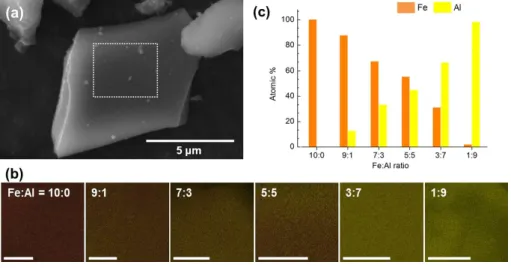
3.1 Elemental distribution of Fe-Al binary oxides Figure 1(a) shows a representative SEM image of Fe-Al binary oxide in a molar ratio of 5:5 synthesized by the sol-gel method. It reveals that the Fe-Al binary oxide has an irregular shape and an average size approximately 10 μm. To analyze the elemental distribution in Fe-Al binary oxide according to Fe:Al ratio, EDS analysis was performed with Fe-Al binary oxides sintered at 100 C. In Fig. 1(b), the overlapped map-ping image of Fe and Al, color-coded, are shown according to the Fe:Al ratio. Orange and yellow indicate Fe and Al, respec-tively. EDS elemental mapping shows a uniform distribution of each color regardless of Fe:Al ratios, indicating that Fe and Al are homogenously mixed over the area with no aggrega-tion of each element. It should be noted that the color of the maps changes from dark red to brown and finally to light green, indicating changes in the concentrations of each ele-ment. This sequential change of color in the EDS maps corre-sponds to increasing Al content in the binary oxide. Fig-ure 1(c) shows the quantitative data of Fe and Al in the EDS inspection field in units of atomic percent and confirms that the atomic percentage of each element is almost consistent with the as-synthesized molar ratio of Fe and Al. For exam-ple, a Fe-Al binary oxide in a molar ratio of 5:5 shows an atomic composition of 55% Fe and 45% Al.
3.2 Morphology of Fe-Al binary oxides
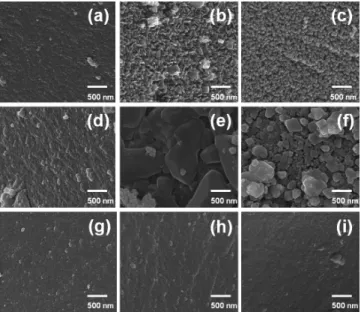
The morphology and surface characteristics of synthesized Fe-Al binary oxide were analyzed by SEM. Figure 2 shows SEM images of the synthesized Fe-Al binary oxides with var-ious Fe:Al ratios and sintered at different temperatures. The morphology of pure Fe-oxide (Fe:Al ratio = 10:0) was signifi-cantly affected by the sintering temperature. At a 100 C sin-tering temperature, Fe-oxide showed a smooth surface, but calcination above 300 C caused deformation on the surface (Fig. 2 (a), (b) and (c)). At 300 C, rod-shaped bumps are ob-served on the surface of the pure Fe-oxide. The surface trans-formed to ball-like bumps with a diameter of approximately
Fig. 1 SEM image of Fe-Al binary oxide with Fe:Al ratio 5:5 (a), SEM-EDS elemental mapping images according to Fe:Al ratio (sintered at 100 C). All scale bar indicates 2 μm (b), quantitative atomic percent from EDS area (c) according to Fe:Al ratio.
50 nm when the Fe-oxide was sintered at 500 C. The shape and distribution of bumps remained regular with increasing sintering temperature. This morphology change is attributed to the coarsening of the Fe-oxide surface16). Increasing
sinter-ing temperature resulted in the coarsensinter-ing of Fe-oxide, and the smooth surface converted to a regularly distributed bump-covered morphology.
The incorporation of Al into Fe-oxide shows different sur-face characteristics from Fe-oxide alone when sintered at the same temperature. A mixture of 10% Al in Fe-oxide (Fe:Al ratio of 9:1) exhibits a similar coarsening behavior of Fe-ox-ide followed by the appearance of small bumps on the surface when the sintering temperature was increased to 300 C and 500 C. However, the bumps are large and irregular compared with the ones in pure Fe-oxide, indicating that the incorpora-tion of Al interferes with the coarsening of Fe-oxide and the resulting surface area reduction at high temperature. This phenomenon is more obvious with Al contents higher than 30%. With Fe:Al ratios of 7:3, 5:5, 3:7 and 1:9, the surface morphology was not affected by the sintering temperature, and a smooth surface was observed at all tested temperatures. 3.3 BET surface area of Fe-Al oxides
Figure 3 shows the BET surface area of the prepared Fe-Al binary oxides according to Fe:Al ratio and sintering tempera-ture. Pure Al-oxide (Fe:Al ratio of 0:10) shows the largest BET surface area regardless of the sintering temperature. Sur-face areas of 218, 206, and 209 m2 were obtained for 1 g of
synthesized Al-oxide sintered at 100, 300, and 500 C, respec-tively. The nearly constant value of the surface area indicates that Al-oxide is not affected by sintering temperature. On the other hand, pure Fe-oxide (Fe:Al ratio of 10:0) shows a very small surface area, which is rapidly decreased by increasing the sintering temperature from 100 to 500 C due to coarsen-ing. Only a 15.1 m2/g surface area is obtained for 500 C
sin-tered pure Fe-oxide.
The BET surface area of Fe-Al binary oxide is increased in proportion to the incorporated amount of Al at all sintering temperatures. This tendency is more clearly observed at a sin-tering temperature of 500 C. Compared with Al-oxide, the Fe-oxide surface is almost negligible in the 500 C sintered case. The surface area shows a linear slope with the incorpo-rated amount of Al. In a series of BET experiments, we con-clude that Al in Fe-oxide expands the surface area in the mix-ture, which is a crucial factor for pollutant adsorption. 3.4 Crystalline phase of Fe-Al binary oxides
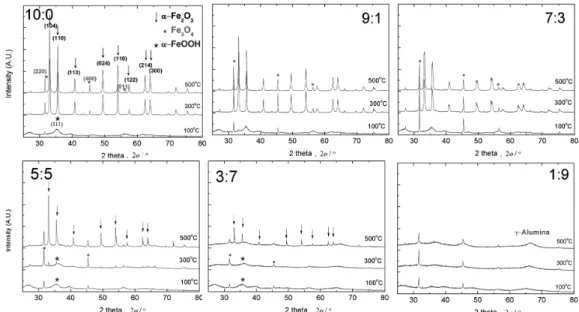
Figure 4 shows the XRD patterns of Fe-Al binary oxide for various Fe:Al ratios and sintering temperatures. Pure Fe-ox-ide (Fe:Al ratio = 10:0) shows a phase transition depending on sintering temperature. Fe-oxide sintered at 100 C shows an almost amorphous structure. The broad (111) peak indi-cates a slightly crystalline α-FeOOH phase. When the sinter-ing temperature increases above 300 C, the XRD pattern is clearly changed. The (111) peak disappears, and a sharp α-Fe2O3 (hematite) peak is observed. Increasing temperature
leads to a dehydroxylation reaction accompanied by transfor-mation from Fe-oxyhydroxide to α-Fe2O3, as described17)
2FeOOH → α-Fe2O3+ H2O
However, Fe3O4 is also mixed with α-Fe2O3 due to
insuffi-cient oxygen in the furnace. The (220), (400) and (551) peaks are evidence of a co-existing Fe3O4 (magnetite) phase18). The
incorporation of Al into Fe-oxide affects the phase transition of Fe-oxide depending on sintering temperature.
The oxides with Fe:Al ratios of 9:1 and 7:3 sintered at above 300 C show broader α-Fe2O3 peaks compared to pure
Fe-oxide. In addition, the Fe3O4 peak intensity is significantly
increased, which indicates that the incorporation of Al into Fe-oxide consumes oxygen during thermal treatment and in-hibits the phase transition of Fe-oxide. The intermediate phase (Fe3O4) is increased at the same thermal condition
(300 C).
For the binary oxide with the Fe:Al ratio of 5:5, the effects of Al incorporation into Fe-oxide are more obvious. In the 300 C sintered Fe-Al binary oxide, α-FeOOH and Fe3O4
peaks are observed instead of α-Fe2O3 peaks, indicating that
the phase transition of Fe-oxide does not occur for a Fe:Al Fig. 2 SEM image of Fe-Al bindery oxide according to Fe:Al ratio and
sintering temperature [Pure iron oxide (Fe:Al ratio 10:0) sintered at 100 C (a), 300 C (b), 500 C (c), Fe:Al ratio = 9:1 sintered at 100 C (d), 300 C (e), 500 C (f), Fe:Al ratio = 7:3 sintered at 100 C (g), 300 C (h), 500 C (i)].
Fig. 3 BET surface area of Fe-Al oxide according to Fe:Al ratio and sinter-ing temperature.
ratio of 5:5 at 300 C. In pure Fe-oxide, a highly crystalline α-Fe2O3 phase is obtained at the same temperature, which
means that the incorporation of Al into Fe-oxide completely interfered with the thermal phase transition of Fe-oxide. At a higher sintering temperature of 500 C, α-Fe2O3 peaks finally
appear. It is clear that the phase transition temperature moves to a higher value due to incorporating Al. Based on the XRD results, the incorporation of Al inhibited the structure conver-sion of Fe-oxide caused by the thermal treatment, elevating the phase conversion temperature19). In the case of pure
Fe-oxide, the phase transition from α-FeOOH to α-Fe2O3
oc-curs below 300 C, while the same phase transition ococ-curs above 300 500 C when Al is incorporated into Fe-oxide. This XRD result, that the phase transition shifts to a higher temperature with increasing Al content, is consistent with the SEM results (Fig. 2) showing minimal morphological change of binary mixtures incorporating Al at elevated sintering tem-peratures.
Meanwhile, almost no phase conversion is observed for the Fe-Al binary oxide with the Fe:Al ratio of 9:1. Because the amount of Fe-oxide is only 10%, the XRD patterns that indi-cate Fe-oxide are almost absent. At 500 C, a poorly crystal-lized γ-Al2O3 peak appears.
3.5 Heavy metal adsorption performance of Fe-Al bina-ry oxides
The heavy metal adsorption capacities of prepared Fe-Al binary oxides were evaluated. As(V) and Se(VI) were select-ed as model heavy metal ions. Figure 5 shows the As(V) and Se(VI) uptake on synthesized Fe-Al binary oxides with vari-ous Fe:Al ratios. As(V) and Se(VI) show similar adsorption behavior. Regardless of Fe:Al ratio, Fe-Al binary oxide sin-tered at 100 C showed the highest heavy metal uptake. The oxides sintered at 100 C consist of oxy-hydroxide phase met-al oxide (FeOOH and amorphous AlO(OH)). The many hy-droxyl groups on oxy-hydroxide phase metal oxide can effec-tively chelate heavy metal ions. Several reports have noted that oxyhydroxide is more effective for the adsorption of heavy metals than an oxide structure5,20).
Among the samples sintered at 100 C, the highest As(V) and Se(VI) uptake was obtained with the Fe:Al ratio of 5:5, which is attributed to the expansion of the surface area with increasing Al content in the Fe-Al binary oxide. The increased surface area promotes heavy metal contact with the Fe-oxide, Fig. 5 As(V) and Se(VI) uptake of Fe-Al binary oxide according to Fe:Al
ratio and sintering temperature.
but the decreasing amount of Fe-oxide does not, indicating an optimum Fe:Al ratio for heavy metal removal. In this study, the optimum As(V) and Se(VI) uptake was obtained with the Fe:Al ratio of 5:5. Further increases in Al content (Fe:Al ra-tios 3:7 and 1:9) caused a lack of Fe-oxide adsorption sites for As(V) and Se(VI).
Not only Fe-Al binary oxides sintered at 100 C but also the oxides sintered at high temperature (300 500 C) showed in-creased As(V) and Se(VI) uptake in proportion to Al content until the critical Fe:Al ratio. For the oxides sintered at 300 C and 500 C, the Fe:Al ratio of 3:7 showed the best As(V) and Se(VI) uptake instead of the 5:5 ratio, which is attributed to the effect of Al content on the phase transition of the Fe-Al oxide. At a 300 C sintering temperature, the pure Fe-oxide phase (α-FeOOH) transitions to α-Fe2O3 or Fe3O4, which is
less effective for heavy metal adsorption. Our SEM and XRD results show that the incorporation of Al delays the phase transition of Fe-oxide above 300 C. In other words, the more Al is incorporated into the Fe-Al binary oxide, the more of the α-FeOOH phase remains in the Fe-Al binary oxide. Thus, in contrast to the Fe-Al binary oxides sintered at 100 C, a 3:7 Fe:Al ratio, which incorporates more Al, shows the highest As(V) and Se(VI) uptake.
In conclusion, the incorporation of Al expands the surface area of Fe-oxide and also affects the phase transition tem-perature and crystallinity of Fe-oxide. Thus, the incorporation of an appropriate amount of Al controls the surface area and effective Fe-oxide phase, which are closely related to heavy metal removal. For example, the Fe-Al binary oxide with a 5:5 Fe:Al ratio sintered at 100 C exhibits 50.5 mg/g and 79.2 mg/g of As(V) and Se(VI) uptake, respectively, which are 2.5 times and 3 times higher uptake than pure Fe-oxide. It is thus demonstrated that the heavy metal adsorption perfor-mance of Fe-oxide is significantly improved by the incorpo-ration of Al.
4. Conclusion
In this study, we describe a method to improve the heavy metal adsorption capacity of Fe-oxide by incorporating Al, and discuss the characteristic changes and ultimate influence on arsenate (As(V)) and selenate (Se(VI)) removal. Fe-Al bi-nary oxides with various Fe:Al ratios (10:0, 9:1, 7:3, 5:5, 3:7 and 1:9) are synthesized by the sol-gel method followed by a sintering process. SEM with EDS analysis reveals that Fe and Al are homogeneously mixed without phase separation. The surface area of the Fe-Al binary oxide increases proportional-ly with the Al content. The oxide with a Fe:Al ratio of 5:5 shows a 90 150 m2/g surface area, which is more than 10
times the surface area of pure Fe-oxide. Sintering above 300 C causes deformation of the Fe-oxide due to coarsening and a phase transformation from α-FeOOH to α-Fe2O3. The
incorporation of Al into Fe-oxide inhibits both the surface de-formation and phase transition.
Among various Fe:Al ratio binary oxides, the highest As(V) and Se(VI) uptake was obtained with a 5:5 Fe:Al ratio oxide sintered at 100 C due to the expanded surface area and increased α-FeOOH phase, which provides a sufficient amount of hydroxyl groups. Further increases in Al content resulted in decreased As(V) and Se(VI) removal due to the lack of Fe-oxide.
In Fe-Al binary oxide sintered at 300 and 500 C, the phase transition of Fe-oxide occurs and As(V) and Se(VI) uptake is decreased compared with oxides sintered at 100 C. A Fe:Al ratio of 3:7 shows the best As(V) and Se(VI) uptake because of the maintenance of the α-FeOOH phase by the incorpora-tion of Al.
Acknowledgments
This research was supported in part by the Basic Research Project (GP2015-019, 16-3220) of the Korea Institute of Geo-science and Mineral Resources (KIGAM), Korea Institute of Science and Technology (KIST) Institutional Program (No. 2Z04720) and Nano-Material Technology Development Pro-gram through the National Research Foundation of Korea (2016M3A7B4905619).
REFERENCES
1) U.S.R.M. Cornell, The iron oxides. Structure, properties, reactions oc-currences and uses., Wiley-VCH, 2000.
2) J.-C. Hsu, C.-J. Lin, C.-H. Liao and S.-T. Chen: J. Hazard. Mater. 153 (2008) 817–826.
3) S. Kuo and R. Bembenek: Bioresour. Technol. 99 (2008) 5617–5625. 4) J. Gimenez, M. Martinez, J. de Pablo, M. Rovira and L. Duro: J.
Haz-ard. Mater. 141 (2007) 575–580.
5) R.J. Bowell: Appl. Geochem. 9 (1994) 279–286.
6) D. Peak and D.L. Sparks: Environ. Sci. Technol. 36 (2002) 1460–1466. 7) Y.-H. Huang, C.-L. Hsueh, H.-P. Cheng, L.-C. Su and C.-Y. Chen: J.
Hazard. Mater. 144 (2007) 406–411.
8) M. Rovira, J. Giménez, M. Martínez, X. Martínez-Lladó, J. de Pablo, V. Martí and L. Duro: J. Hazard. Mater. 150 (2008) 279–284.
9) L.S. Zhong, J.S. Hu, H.P. Liang, A.M. Cao, W.G. Song and L.J. Wan: Adv. Mater. 18 (2006) 2426–2431.
10) L. Wei, G. Yang, R. Wang and W. Ma: J. Hazard. Mater. 164 (2009) 1159–1163.
11) K. Gupta and U.C. Ghosh: J. Hazard. Mater. 161 (2009) 884–892. 12) G. Zhang, J. Qu, H. Liu, R. Liu and R. Wu: Water Res. 41 (2007) 1921–
1928.
13) G.-S. Zhang, J.-H. Qu, H.-J. Liu, R.-P. Liu and G.-T. Li: Environ. Sci. Technol. 41 (2007) 4613–4619.
14) P. Suresh Kumar, R.Q. Flores, C. Sjöstedt and L. Önnby: J. Hazard. Mater. 302 (2016) 166–174.
15) H.-J. Hong, W. Farooq, J.-S. Yang and J.-W. Yang: Sep. Sci. Technol. 45 (2010) 1975–1981.
16) Y.-H. Huang, Y.-J. Shih and C.-C. Chang: J. Hazard. Mater. 186 (2011) 1355–1359.
17) R. Derie, M. Ghodsi and C. Calvo-Roche: J. Therm. Anal. 9 435–440. 18) X. Zhang, Y. Niu, X. Meng, Y. Li and J. Zhao: CrystEngComm 15
(2013) 8166–8172.
19) Y. K. F. Gulshan, A. Nakajima, K. Okada, Proc. Waste Eng., 2008, 237–242.