Quasiparticle self-consistent GW
study of cuprates: electronic
structure, model parameters, and
the two-band theory for T
c
Seung Woo Jang1, Takao Kotani2, Hiori Kino3, Kazuhiko Kuroki4 & Myung Joon Han1,5
Despite decades of progress, an understanding of unconventional superconductivity still remains elusive. An important open question is about the material dependence of the superconducting properties. Using the quasiparticle self-consistent GW method, we re-examine the electronic
structure of copper oxide high-Tc materials. We show that QSGW captures several important features,
distinctive from the conventional LDA results. The energy level splitting between dx y2− 2 and d3z r2−2 is
significantly enlarged and the van Hove singularity point is lowered. The calculated results compare better than LDA with recent experimental results from resonant inelastic xray scattering and angle resolved photoemission experiments. This agreement with the experiments supports the previously suggested two-band theory for the material dependence of the superconducting transition
temperature, Tc.
After the seminal work of finding high temperature superconductivity in a ceramic copper oxide mate-rial1, efforts to understand the cuprate have long been a central part of modern condensed matter phys-ics. Although many intriguing aspects of its electronic behaviors have been unveiled and great progress has been made, an understanding of its superconducting mechanism, the novel interplay between com-peting phases, and its relationship to other correlated phenomena is still far from clear2–12. One simple, well-defined but still open question is what determines the superconducting transition temperature (Tc),
or its material dependency. For example, the Tc of the single layer cuprates can be different by a factor
of two; ~40 K for La2CuO4 and ~90 K for HgBa2CuO4. On the one hand, it may be too early to ask this question, while the superconducting mechanism itself still remains elusive. On the other, however, fig-uring out the detailed features behind the material dependency can provide the crucial hint for further understanding of superconductivity and other related properties. In fact, many directly or indirectly related theoretical studies have been performed on this issue13–25
In this regard, a notable suggestion has recently been made26–29. According to this theory, the T
c of
the single-layer cuprate can be described with a two-orbital model that considers both the dx y2− 2 and
−
d3z r2 2 Wannier orbitals, and the energy level offset between the two orbitals, Δ E, plays a key role in
determining Tc. Whereas the larger value of this energy separation produces the higher Tc ( e.g., the case
of HgBa2CuO4) due to the better one band feature achieved, the smaller value results in the lower Tc
(e.g., the case of La2CuO4) in spite of the better nested Fermi surface. The calculated Eliashberg param-eter (λ) based on the many-body calculation using the fluctuating exchange (FLEX) approximation30,31
1Department of Physics, Korea Advanced Institute of Science and Technology (KAIST), Daejeon 305-701, Korea. 2Department of Applied Mathematics and Physics, Tottori University, Tottori 680-8552, Japan. 3National Institute
for Materials Science, Sengen 1-2-1, Tsukuba, Ibaraki 305-0047, Japan. 4Department of Physics, Osaka University,
Machikaneyama-Cho, Toyonaka, Osaka 560-0043, Japan. 5KAIST Institute for the NanoCentury, Korea Advanced
Institute of Science and Technology, Daejeon 305-701, Korea. Correspondence and requests for materials should be addressed to M.J.H. (email: [email protected])
received: 19 January 2015 Accepted: 11 June 2015 Published: 24 July 2015
OPEN
clearly exhibits a linear dependence on Δ E while the other parameters are shown to be less important. Further, this theory can be extended to the bilayer case29, which explains the correlation between the Fermi surface shape and Tc24.
A possible experimental test to verify this two-band theory is to examine the correlation between Tc
and Δ E, the Fermi surface shape, or the partial density of states of the d3z r2−2 orbital, which can be
measured by recent techniques such as resonant inelastic xray scattering (RIXS), and (angle resolved) photoemission spectroscopy (ARPES). However, while the theoretical Δ E or the Fermi surface shape was obtained from the LDA and used as the “inputs” for the many-body FLEX calculation in Refs 26–29, the experimentally determined Δ E and the Fermi surface shape should be regarded as the “outputs” or “results” after the consideration of the many-body correlation effects beyond LDA/GGA. In fact, while a RIXS study reports that Tc is higher for larger Δ E32, the actual experimental value of Δ E is larger than
the theoretical evaluation, presumably due to this “input vs. output” problem. One possible way to resolve this problem, at least partially, is to re-evaluate Δ E as an output of the FLEX calculation. However, this approach would suffer from various ambiguities regarding the Hubbard interaction strength and the definition of the renormalized Δ E. It is problematic since a quantitative comparison is required in between the theory and experiment, while only the qualitative comparison was made regarding Tc in
Refs 26–29.
In the present paper, we use a first-principles approach, exploiting the quasiparticle self-consistent
GW (QSGW) method. It enables us to take into account the correlation effects beyond LDA/GGA. In
this way, we can obtain a well-defined renormalized Δ E without introducing adjustable parameters. In Ref. 17, a quantum chemical approach was adopted to evaluate the energy level offset between Cu-dx y2−2 and d3z r2−2 orbitals, where the correlation effects were taken into account within a cluster-based
configuration-interaction-type calculation. A good agreement with the RIXS experiment was found by assuming the energy difference of ferromagnetically and antiferromagnetically ordered states to be 2J, where J is the antiferromagnetic coupling constant. Our approach is fairly different and is along the line of the first-principles band calculation as in Refs 26–29. In the sense mentioned above, the calculated Δ E can be compared to the experiments, while it should not be regarded as an input parameter for the many-body calculation, because doing so would result in a partial double counting of the correlation effects. Still, the present approach can also provide a first-step hint toward obtaining a better “non-interacting” Hamiltonian that can be used as an input for the many-body calculation of supercon-ductivity. In fact, it is known that the non-interacting Hamiltonian obtained from LDA has a problem when used as an input for the FLEX calculation, and the LDA/GGA estimation of Δ E for La2CuO4 is too small to account for the maximum Tc of 40 K in the La2CuO433. In this context, it is worth pointing out that the GW method has been successfully applied to the many of strongly correlated materials in combination with, for example, dynamical mean field theory (DMFT)34–37.
Results and Discussion
To our knowledge, there is no previous QSGW study for the cuprate band structure although it has been discussed conceptually38. Here we first examine the electronic structure and the two-band theory for the material-dependent Tc of a single layer cuprate. While the QSGW calculation produces notable
differ-ences in the band structure and Fermi surface from LDA, the two-band explanation for Tc still remains
valid. QSGW results of model parameters are presented and compared to the RIXS data as well as the LDA calculations. It clearly shows that the parameters produced by QSGW are in better agreement with the experiment. Finally, we investigate the epitaxially strained La2CuO4 whose noticeable Tc increase has
been previously reported. Two-band theory also works well for this situation.
Electronic structure and the Tc of single layer compounds. Figure 1(a,b) show the band disper-sion and projected density of states (PDOS) of La2CuO4 calculated by LDA and QSGW, respectively. The LDA result is in good agreement with the previous calculation (see, for example, Ref. 26 and 27). In the QSGW, several important differences are noted. First, the band width of both eg orbitals are significantly
reduced, by about 1.30 and 0.65 eV for dx y2−2 and d3z r2−2, respectively, indicating that the band width
overestimation (or effective mass underestimation) problem of LDA is somehow overcome by the QSGW procedure. Another key difference is that the separation between the dx y2−2 and d3z r2−2 bands becomes
larger in QSGW, as seen in Fig. 1(b). The dx y2− 2 energy level, Ex y2−2, is shifted from − 0.14 (LDA) to
− 0.03 (QSGW) while E3z r2−2 is from − 0.98 (LDA) to − 1.68 (QSGW) (indicated by the arrows in Fig. 1;
see also Table 1). It is a factor of two difference in ΔEeg; 0.84 eV in LDA and 1.66 in QSGW. The correct
estimation of this quantity is important especially in the two-band theory for Tc26–29. The large value of
ΔEeg is indeed consistent with the RIXS data as will be discussed further below.
The same features are also found in HgBa2CuO4, as presented in Fig. 1(c,d). The dx y2− 2 band width is
reduced by ~0.75 eV in QSGW compared to LDA and its center position of PDOS moves slightly upward by 0.15 eV. While the d3z r2−2 dispersion in this material is already quite small due to the thicker blocking
layer, its band width in QSGW is further reduced. ΔEeg is 2.25 in QSGW, again noticeably larger than
In QSGW, the ΔEeg of both La2CuO4 and HgBa2CuO4 is enhanced compared to LDA/GGA. How does this affect the theoretical estimation of Tc? First, it should be noted that these parameters cannot be
directly adopted as the inputs for the FLEX calculation. This is because, in principle, the QSGW self energy should be partially subtracted before we put it into any of many-body calculations. While there is no well-defined prescription yet for this kind of ‘double-counting’ problem39, the “best” ΔE
eg that
should be adopted in the FLEX evaluation of Tc may be lying somewhere in between the QSGW and
LDA/GGA values. This can provide better quantitative agreement with the experiment, especially in La2CuO4, for which the LDA/GGA value of ΔEeg is found to be too small to account for Tc = 40 K.
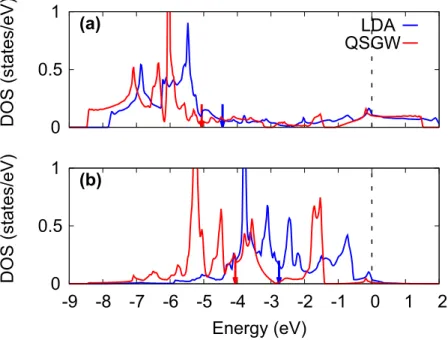
Oxygen states are also affected. Compared to LDA results, the O-2p levels obtained by QSGW are significantly lowered in energy, as indicated in Fig. 2. As summarized in Table 1, the center position of in-plane oxygen PDOS is located at − 4.44 (− 3.55) eV in LDA and at − 5.06 (− 4.05) eV in QSGW for La2CuO4 (HgBa2CuO4). The same feature is found for the apical O-pz PDOS. As a result, the energy
difference, Δ Ep = Eapical − Einplane, is changed from 1.68 (1.00) in LDA to 0.55 (− 0.86) in QSGW for the case of La2CuO4 (HgBa2CuO4), see Table 1. The correct estimation of Δ Ep is also important for
under-standing Tc since it is an underlying quantity to determine ΔEeg (≈ Δ E ≈ Δ Ed + Δ Ep) in combination
with other parameters. Note that our ΔEeg is different from Δ Ed and Δ E in Ref. 26–29 where
Δ E ≈ Δ Ed + Δ Ep, Δ =Ed Ex y2−2−E3z r2−2, Δ =Ep EapicalO −EOinplane, and all of the parameters are
calcu-lated from the maximally localized Wannier orbital analysis. The Δ E contains the contribution from -5 -4 -3 -2 -1 0 1 2 3 Γ XP N Γ Z Energy (eV)
(a)
0 0.5 1 DOS (states/eV) Cu (dx2-y2) Cu (dz2) -5 -4 -3 -2 -1 0 1 2 3 Γ XP N Γ Z Energy (eV)(b)
0 0.5 1 DOS (states/eV) Cu (dx2-y2) Cu (dz2) -5 -4 -3 -2 -1 0 1 2 3 Γ M X Γ Z Energy (eV)(c)
0 0.5 1 DOS (states/eV) Cu (dx2-y2) Cu (dz2) -5 -4 -3 -2 -1 0 1 2 3 Γ M X Γ Z Energy (eV)(d)
0 0.5 1 DOS (states/eV) Cu (dx2-y2) Cu (dz2)Figure 1. The band dispersion and PDOS of La2CuO4 (a,b) and HgBa2CuO4 (c,d) calculated by (a,c) LDA and (b,d) QSGW. The green and blue colors refer to the dx y2− 2 and d3z r2− 2 characters while the size of
the colored dots represents their weight. The same color scheme was used for PDOS. Other bands than the two eg states are represented by red color. The center of mass position of PDOS is marked by an arrow.
oxygen hybridization. We note, however, that our ΔEeg becomes effectively quite similar with Δ E in Ref. 26–29 since we set our Emin,max to cover only the anti-bonding band complex. Actually one can make it almost equal, i.e., ΔEeg≈ ΔE, by fine-tuning the Emin,max range.
Some other changes produced by QSGW are also noted. The d3z r2−2 components in the bands below
− 1.5 eV in Fig. 1(a) are reduced in QSGW, and the free-electron-like bands at Γ and Z points above the Fermi energy are shifted upward. As the position of the t2g complex is lowered (red color), the dx y2−2
band has almost no mixture with other bands below the Fermi energy. Higher-lying La-4f bands (not shown) move further upward as has been previously noted in the nickelate systems40.
Fermi surface. The shape of the Fermi surface is important for understanding cuprate superconduc-tivity. For example, its nesting is crucial for the spin fluctuation pairing. Also, a notable correlation
−
−
Edx y2 2 EFermi (eV) Edz2−EFermi (eV) EOpx y, −EFermi (eV) EOpz−EFermi (eV)
LDA QSGW LDA QSGW LDA QSGW LDA QSGW
Sr2CuO2Cl2 − 0.29 0.01 − 1.23 − 2.05 − 4.67 − 4.92 None None
La2CuO4 − 0.14 − 0.03 − 0.98 − 1.68 − 4.44 − 5.06 − 2.76 − 4.06
HgBa2CuO4 − 0.20 − 0.05 − 1.87 − 2.30 − 3.55 − 4.05 − 3.00 − 4.91
CaCuO2 − 0.30 − 0.17 − 2.34 − 2.63 − 3.67 − 4.05 None None
∆Eeg (4Ds + 5Dt) (eV) 3Ds − 5Dt (eV) 10Dq (eV)
LDA QSGW Exp (Ref. 32) LDA QSGW Exp (Ref. 32) LDA QSGW Exp (Ref. 32)
Sr2CuO2Cl2 0.94 2.05 1.97 0.22 0.21 0.33 0.81 1.82 1.50
La2CuO4 0.84 1.66 1.70 0.17 0.11 0.32 1.47 2.13 1.80
HgBa2CuO4 1.67 2.25 None 0.42 0.42 None 0.90 1.57 None
CaCuO2 2.04 2.46 2.65 0.05 0.28 0.31 0.92 1.69 1.64
Table 1. The calculated parameters by LDA and QSGW. The px,y is from the in-plane oxygen, and pz from
the out-of-plane. The definitions of parameters can be found in Fig. 4. The experimental values are taken from Ref. 32.
0
0.5
1
DOS (states/eV)
(a)
LDA
QSGW
0
0.5
1
-9 -8 -7 -6 -5 -4 -3 -2 -1 0 1 2
DOS (states/eV)
Energy (eV)
(b)
Figure 2. The calculated oxygen PDOS of La2CuO4 by LDA and QSGW. (a) In-plane oxygen px yσ, and
(b) out-of-plane oxygen pσ
z orbitals are plotted. The center of mass position of each PDOS is marked by an
between the experimentally observed Tc at the optimal doping (Tcmax) and the Fermi surface warping has
been identified by Pavarini et al.24. Here we discuss the Fermi surface calculated by QSGW in compari-son to the LDA result and experiment.
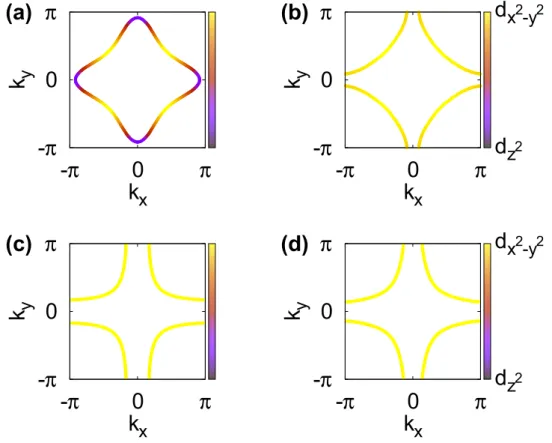
The calculated Fermi surfaces are presented in Fig. 3; LDA ((a, c)) and QSGW ((b, d)). The hole doping is simulated by the rigid band shift method so that the electron occupation in eg orbitals is
reduced by 0.15e per unit cell. Notable features are found in the QSGW Fermi surface for La2CuO4. Contrary to the LDA result of Fig. 3(a), Fig. 3(b) has the pocket centered at (π, π) point as in HgBa2CuO4 Fermi surface (see Fig. 3(c,d)). This feature is in good agreement with ARPES data41 which also reports the pocket centered at (π, π) point. Further, the d3z r2−2-orbital character (dark purple) is significantly
reduced and the dx y2− 2 character (bright yellow) is dominant in the QSGW result, which is distinctive
from the LDA in which the significant amount of d3z r2−2 components are observed near (π, 0) and (0,
π).
In the case of HgBa2CuO4, the difference between LDA and QSGW is less pronounced, see Fig. 3(c,d). While the QSGW Fermi surface is slightly more rounded, the overall shape is not much different. Since the dx y2−2 orbital character is dominant and d3z r2−2 band is well separated from Fermi level already in
LDA due to the thicker blocking layers enhancing two-dimensional feature, the LDA result is quite sim-ilar to QSGW.
Comparison with RIXS. We now turn to the comparison with the RIXS data. Recently, Sala et al.32 successfully extracted the important model parameters for several different cuprate materials based on RIXS spectra. In this subsection, we examine the material dependent parameters by QSGW and compare them to the experimental values. With Ref. 32 as our main reference, we include two more compounds, namely, Sr2CuO2Cl2 and CaCuO2. Although Sr2CuO2Cl2 is also one of the single-layer cuprates, it has Cl—Cu—Cl bonding (instead of O—Cu—O) along c-axis and therefore the naive comparison of param-eters such as ΔEeg and Δ Ep in the line of Tc discussion may be misleading. This material is excluded in
Ref. 26–29 because of the same reason.
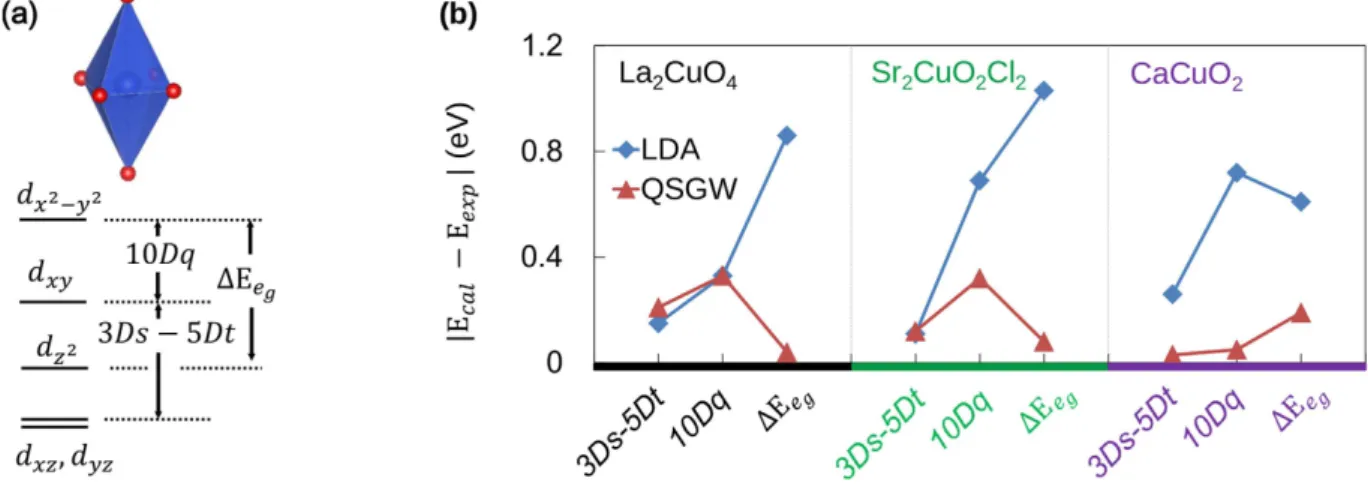
Our results are summarized in Table 1, Figs 4 and 5. The values of 10Dq, defined as the difference between two energy levels of dx y2−2 and dxy (see Fig. 4(a)), are larger in the QSGW calculation by ~62–
125% than the LDA values. While LDA underestimates 10Dq compared to the experiment, QSGW
-π
0
π
-π
0
π
k
y
k
x
(a)
-π
0
π
-π
0
π
k
y
k
x
d
x
2-y
2d
z
2(b)
-π
0
π
-π
0
π
k
y
k
x
(c)
-π
0
π
-π
0
π
k
y
k
x
d
x
2-y
2d
z
2(d)
Figure 3. The orbital-resolved Fermi surfaces (kz = 0 plane) at the reduced eg band filling by 0.15 (hole
doping): (a) La2CuO4 (LDA), (b) La2CuO4 (QSGW), (c) HgBa2CuO4 (LDA), and (d) HgBa2CuO4 (QSGW).
slightly overestimates, which is related to the tendency that Cu-t2g bands are pushed down relative to eg,
as was also observed in the previous QSGW calculations for other transition-metal oxides40,42,43. It is important to note that overall the QSGW result is in better agreement with experiment, as clearly seen in Fig. 4(b).
As noted in the above, according to the two-band theory by Sakakibara et al.26,27, the important parameter that governs Tc is ΔEeg (or 4Ds + 5Dt in Ref. 32). Figures 4(b) and 5 clearly show that the
calculated values of ΔEeg by QSGW are in excellent agreement with those from RIXS spectra; the
differ-ence is 2–8%. The LDA values are noticeably smaller than the experiments although the differdiffer-ence gets reduced in the higher Tc materials, CaCuO2 and HgBa2CuO4 (see Fig. 5). This can be taken as a strong support for the two-band theory in the sense that the LDA value of ΔEeg as an input for FLEX provides qualitative information of material dependence, while the ΔEeg by QSGW already contains the correla-tion effect beyond LDA, being consistent with RIXS.
Another parameter deduced from RIXS in Ref. 32 is 3Ds—5Dt, the energy level difference between
dxy and dyz,zx. In this case, the LDA results are not much different from QSGW and experiment (see
Fig. 4(b)).
The effect of epitaxial strain. An interesting aspect found in the Tc trend of the cuprates is its
significant enhancement in the thin film form. Locquet et al. reported44 that T
c can be controlled by
epi-taxial strain by about factor of two45. The underdoped La
2CuO4 with its bulk Tc of 25 K exhibits a higher
and lower Tc of ~49 K and 10 K when it is grown on SrLaAlO4 (SLAO) and SrTiO3 (STO) substrates,
Figure 4. (a) The three model parameters for the comparison to Ref. 32. Note that ΔEeg is denoted by
4Ds + 5Dt in Ref. 32. (b) The difference of the calculated model parameters (Ecal) from the experiments
(Eexp). 0 0.5 1 1.5 2 2.5 3
La2CuO4 Sr2CuO2Cl2 CaCuO2 HgBa2CuO4
∆ Eeg (eV) Compounds LDA QSGW Exp.
Figure 5. The values of ∆Eeg (or 4Ds + 5Dt in the notation of Ref. 32) estimated by LDA (blue squares), QSGW (red triangles), and RIXS data (green circles).
respectively44. It is therefore important to check whether the two-band theory is also consistent with this observation.
In order to simulate the tensile and compressive strain produced by STO and SLAO, we first opti-mized the c lattice parameter with two different in-plane lattice constants, aSTO = 3.905 and aSLAO = 3.755 Å, for La2CuO4, which originally has a0 = 3.782 Å and c0 = 13.25 Å. As expected, the optimized out-of-plane parameters get smaller and larger under the tensile and compressive strain, respectively; cSTOopt =12 96. and cSLAOopt =13 36 Å. . As a result, the ratio between the out-of-plane and in-plane Cu—O distance,
r = dapical/dinplane, is found to be 1.32, 1.28, and 1.24, for aSLAO, a0 and aSTO, respectively.
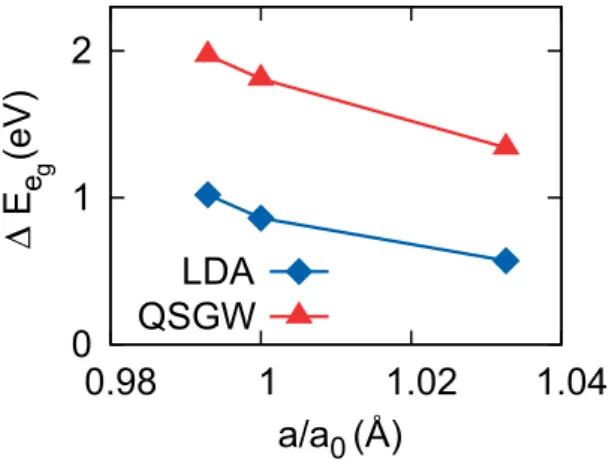
The calculated values of ΔEeg are plotted in Fig. 6. Both LDA and QSGW predict that ΔEeg gets enhanced and reduced under compressive and tensile strain, respectively, which is consistent with the experimental observation44. The reduction of ΔE
eg at a = aSTO is about 0.16 eV in both LDA and QSGW,
and the enhancement at a = aSLAO is 0.29 (LDA) and 0.47 eV (QSGW).
Summary and Conclusion
Using the QSGW method, we re-examined the electronic structure of copper oxide high temperature superconducting materials. Several important features were found to have been captured by the GW procedure, such as effective mass enhancement. The shape and orbital character of the Fermi surface were also notably changed, especially for the case of La2CuO4, and they are in good agreement with the ARPES data41. Important model parameters including the key quantity for the two-band theory of T
c, ΔEeg, were
examined, and the QSGW results were in excellent agreement with RIXS data.
The present study shows that the first-principles band calculation can quantitatively reproduce the experimental observation by taking into account the correlation effects beyond LDA. We emphasize that it is not inconsistent with the previous study by Sakakibara et al. which takes the LDA result as an input for the many-body calculation of superconductivity. While the QSGW result cannot be used as a direct input for the FLEX-type calculation because of the partial double-counting of the many-body correla-tion, the “best” non-interacting Hamiltonian, that can serve as an input, may lie somewhere in between the LDA and QSGW. Obtaining a well-defined non-interacting Hamiltonian is, therefore, an important future direction for the first-principles-based description of high-temperature superconductivity, and it may quantitatively resolve the problem of low Tc in La2CuO4 produced by the LDA input33.
Methods
Quasiparticle self-consistent GW. The QSGW42,43,46 calculates H
0 (non-interacting Hamiltonian describing quasiparticles or band structures) and W (dynamically-screened Coulomb interactions between the quasiparticles within the random phase approximation) in a self-consistent manner. While the ‘one-shot’ GW is a perturbative calculation starting from a given H0 (usually from LDA/GGA), QSGW is a self-consistent perturbation method that can determine the one-body Hamiltonian within itself. The GW approximation gives the one-particle effective Hamiltonian whose energy dependence comes from the self-energy term Σ (ω) (here we omit index of space and spin for simplicity), and in QSGW, the static one-particle potential Vxc is generated as
0
1
2
0.98
1
1.02
1.04
∆
E
eg(eV)
a/a
0(Å)
LDA
QSGW
Figure 6. The calculated ∆Eeg as a function of epitaxial strain. The a0 = 3.782 Å is the experimental value for bulk La2CuO4. The compressive and tensile strain are simulated with a = 3.755 and 3.905 Å
∑
ψ ε ε ψ = Σ( ) + Σ( ) , ( ){
}
V 1 2 ij i Re[ i ij] Re j ij j 1 xcwhere εi and |ψi〉 refer to the eigenvalues and eigenfunctions of H0, respectively, and Re[Σ (ε)] is the Hermitian part of the self-energy42,43,46. With this Vxc, one can define a new static one-body Hamiltonian H0, and continue to apply GW approximation until converged. In principle, the final result of QSGW does not depend on the initial conditions. Previous QSGW studies, ranging from semiconductors42,43 to the various 3d transition metal oxides42,43,47 and 4f-electron systems48, have demonstrated its capability in the description of weakly and strongly correlated electron materials.
Computation details. We used our new implementation of QSGW49 by adopting the ‘augmented plane wave (APW) + muffin-tin orbital (MTO)’ , designated by ‘PMT’ 50,51, for the one-body solver. The accuracy of this full potential PMT method is proven to be satisfactory in the supercell calculations of homo-nuclear dimers from H2 through Kr2 with the significantly low APW energy cutoff of ~4 Ry, by including localized MTOs51. A key feature of this scheme for QSGW is that the expansion of Vxc can be made with MTOs, not APWs, which enables us to make the real space representation of Vxc at any k point.
We performed the calculations with the experimental crystal structures52–55, and used 10 × 10 × 10, 12 × 12 × 12, 12 × 12 × 8, and 14 × 14 × 14 k points for LDA calculations of Sr2CuO2Cl2, La2CuO4, HgBa2CuO4, and CaCuO2, respectively. As for QSGW calculations, in order to reduce the computation cost, the number of k points were reduced to be 5 × 5 × 5, 7 × 7 × 7, 8 × 8 × 4, and 8 × 8 × 8 for the first Brillouin zone of Sr2CuO2Cl2, La2CuO4, HgBa2CuO4, and CaCuO2, respectively. The MTO radii used in our calculations were as follows: (i) 1.58, 1.04, 0.89, and 1.38 Å for Sr, Cu, O, and Cl in Sr2CuO2Cl2, (ii) 1.43, 0.97, and 0.86 Å for La, Cu, and O in La2CuO4, (iii) 1.10, 1.59, 1.05, and 0.83 Å for Hg, Ba, Cu, and O in HgBa2CuO4, and (iv) 1.54, 1.01, and 0.86 for Ca, Cu, and O in CaCuO2.
Many of the key parameters in this study are defined in terms of the energy levels of each orbital, such as Ex y2− 2 and E3z r2−2. To quantify them we simply take the center of mass position of PDOS:
∫
∫
= ( ) ( ) , ( ) α α α E E g E dE g E dE 2 E E E E min max min maxwhere gα(E) is PDOS for a given orbital α. An ambiguity is inevitably introduced in determining Emin,max, and we set the range to cover the whole antibonding band complex for Cu-eg states. (Eeming , Eemaxg ) for La2CuO4 is (−1.95 eV, 2.05 eV) in LDA and (−2.20, 1.55) in QSGW. For HgBa2CuO4, the band dispersion changes and the values of Eeming and Eemaxg are redefined accordingly: (Eeming , Eemaxg ) = (−2.40, 2.50) in LDA and (−2.55, 1.65) in QSGW. If we choose two different ranges for two eg orbitals to include only the main
peak of each orbital PDOS, we can actually produce the better agreement with the numbers in the pre-vious study by Sakakibara et al. where the levels are defined using maximally localized Wannier function method26,27. Even if the ranges are set to cover the whole window of Cu-e
g bands including bonding parts,
the trend reported in this work does not change. The same is true for O-2p and Cu-t2g levels. In other words, none of the reasonably defined energy ranges change our conclusion, and the values are well compared with those reported in the previous study using a maximally localized Wannier function26,27.
References
1. Bednorz, J. G. & Müller, K. A. Possible high Tc superconductivity in the Ba-La-Cu-O system. Z. Phys. B: Condens. Matter 64,
189–193 (1986).
2. Norman, M. R., Pines, D. & Kallin, C. The pseudogap: friend or foe of high Tc? Adv. Phys. 54, 715–733 (2005).
3. Lee, P. A., Nagaosa, N. & Wen, X.-G. Doping a Mott insulator: Physics of high-temperature superconductivity. Rev. Mod. Phys.
78, 17–85 (2006).
4. Lee, P. A. From high temperature superconductivity to quantum spin liquid: progress in strong correlation physics. Rep. Prog.
Phys. 71, 012501 (2008).
5. Ogata, M. & Fukuyama, H. The t-J model for the oxide high-Tc superconductors. Rep. Prog. Phys. 71, 036501 (2008).
6. Hüfner, S., Hossain, M. A., Damascelli, A. & Sawatzky, G. A. Two gaps make a high-temperature superconductor? Rep. Prog.
Phys. 71, 062501 (2008).
7. Barzykin, V. & Pines, D. Universal behaviour and the two-component character of magnetically underdoped cuprate superconductors. Adv. Phys. 58, 1–65 (2009).
8. Vojta, M. Lattice symmetry breaking in cuprate superconductors: stripes, nematics, and superconductivity. Adv. Phys. 58, 699– 820 (2009).
9. Alloul, H., Bobroff, J., Gabay, M. & Hirschfeld, P. J. Defects in correlated metals and superconductors. Rev. Mod. Phys. 81, 45–108 (2009).
10. Armitage, N. P., Fournier, P. & Greene, R. L. Progress and perspectives on electron-doped cuprates. Rev. Mod. Phys. 82, 2421– 2487 (2010).
11. Scalapino, D. J. A common thread: The pairing interaction for unconventional superconductors. Rev. Mod. Phys. 84, 1383–1417 (2012).
12. Fradkin, E., Kivelson, S. A. & Tranquada, J. M., Theory of intertwined orders in high temperature superconductors. arxiv:1407.4480 (2014).
13. Weber, C., Haule, K. & Kotliar, G. Apical oxygens and correlation strength in electron- and hole-doped copper oxides. Phys. Rev.
B 82, 125107 (2010).
14. Weber, C., Yee, C., Haule, K. & Kotliar, G. Scaling of the transition temperature of hole-doped cuprate superconductors with the charge-transfer energy. Eur. Phys. Lett. 100, 37001 (2012).
15. Takimoto, T., Hotta, T. & Ueda, K. Strong-coupling theory of superconductivity in a degenerate Hubbard model. Phys. Rev. B 69, 104504 (2004).
16. Wang, X., Dang, H. T. & Millis, A. J. d3 2 2z−r orbital in high-Tc cuprates: Excitonic spectrum, metal-insulator phase diagram,
optical conductivity, and orbital character of doped holes. Phys. Rev. B 84, 014530 (2011).
17. Hozoi, L., Siurakshina, L., Fulde, P. & van den Brink, J. Ab Initio determination of Cu 3d orbital energies in layered copper oxides.
Sci. Rep. 1, 65 (2011).
18. Uebelacker, S. & Honerkamp, C. Multiband effects on superconducting instabilities driven by electron-electron interactions.
Phys. Rev. B 85, 155122 (2012).
19. Mori, M., Khaliullin, G., Tohyama, T. & Maekawa, S. Origin of the spatial variation of the pairing gap in Bi-based high temperature cuprate superconductors. Phys. Rev. Lett. 101, 247003 (2008).
20. Ohta, Y., Tohyama, T. & Maekawa, S. Apex oxygen and critical temperature in copper oxide superconductors: Universal correlation with the stability of local singlets. Phys. Rev. B 43, 2968–2982 (1991).
21. Maekawa, S., Inoue, J. & Tohyama, T. The Physics and Chemistry of Oxide Superconductors [Iye, Y. & Yasuoka, H. (ed.)] [105–115] (Springer-Verlag, Berlin, 1992).
22. Feiner, L. F., Jefferson, J. H. & Raimondi, R. Intrasublattice hopping in the extended t-J model and Tcmax in the cuprates. Phys.
Rev. Lett. 76, 4939–4942 (1996).
23. Hozoi, L. & Laad, M. S. Quasiparticle bands in cuprates by quantum-chemical methods: towards an Ab initio description of strong electron correlations Phys. Rev. Lett. 99, 256404 (2007).
24. Pavarini, E., Dasgupta, I., Saha-Dasgupta, T., Jepsen, O. & Anderson, O. K. Band-Structure Trend in Hole-Doped Cuprates and Correlation with Tc max. Phys. Rev. Lett. 87, 047003 (2001).
25. Andersen, O. K., Liechtenstein, A. I., Jepsen, O. & Paulsen, F. LDA energy bands, low-energy Hamiltonians t′ , t′ ′ , t⊥(k), and J⊥.
J. Phys. Chem. Solids 56, 1573–1591 (1995).
26. Sakakibara, H., Usui, H., Kuroki, K., Arita, R. & Aoki, H. Two-orbital model explains the higher transition temperature of the single-layer Hg-cuprate superconductor compared to that of the La-cuprate superconductor. Phys. Rev. Lett. 105, 057003 (2010). 27. Sakakibara, H., Usui, H., Kuroki, K., Arita, R. & Aoki, H. Origin of the material dependence of Tc in the single-layered cuprates.
Phys. Rev. B 85, 064501 (2012).
28. Sakakibara, H. et al. Multiorbital analysis of the effects of uniaxial and hydrostatic pressure on Tc in the single-layered cuprate
superconductors. Phys. Rev. B 86, 134520 (2012).
29. Sakakibara, H. et al. Orbital mixture effect on the Fermi-surface-Tc correlation in the cuprate superconductors: Bilayer vs. single
layer. Phys. Rev. B 89, 224505 (2014).
30. Bickers, N. E., Scalapino, D. J. & White, S. R. Conserving approximations for strongly correlated electron systems: Bethe-Salpeter equation and dynamics for the two-dimensional Hubbard model. Phys. Rev. Lett. 62, 961–964 (1989).
31. Dahm, T. & Tewordt, L. Quasiparticle and spin excitation spectra in the normal and d-wave superconducting of the two-dimensional Hubbard model. Phys. Rev. Lett. 74, 793–796 (1995).
32. Moretti Sala, M. et al. Energy and symmetry of dd excitations in undoped layered cuprates measured by Cu L3 resonant inelastic
x-ray scattering. New Jour. Phys. 13, 043026 (2011).
33. Miyahara, H., Arita, R. & Ikeda, H. Development of a two-particle self-consistent method for multiorbital systems and its application to unconventional superconductors. Phys. Rev. B 87, 045113 (2013).
34. Biermann, S., Aryasetiawan, F. & Georges, A. First-principles approach to the electronic structure of strongly correlated systems: combining the GW approximation and dynamical mean-field theory. Phys. Rev. Lett. 90, 086402 (2003).
35. Sun, P. & Kotliar, G. Many-body approximation scheme beyond GW. Phys. Rev. Lett. 92, 196402 (2004).
36. Ayral, T., Werner, P. & Biermann, S. Spectral properties of correlated materials: Local vertex and nonlocal two-particle correlations from combined GW and dynamical mean field theory. Phys. Rev. Lett. 109, 226401 (2012).
37. Ayral, T., Biermann, S. & Werner, P. Screening and nonlocal correlations in the extended Hubbard model from self-consistent combined GW and dynamical mean field theory. Phys. Rev. B 87, 125149 (2013).
38. Das, T., Markiewicz, R. S. & Bansil, A. Intermediate coupling model of the cuprates. Adv. Phys. 63, 151 (2014).
39. Wang, X. et al. Covalency, double-counting, and the metal-insulator phase diagram in transition metal oxides. Phys. Rev. B 86, 195136 (2012).
40. Han, M. J., Kino, H. & Kotani, T. Quasiparticle self-consistent GW study of LaNiO3 and LaNiO3/LaAlO3 superlattice. Phys. Rev.
B 90, 035127 (2014).
41. Ino, A. et al. Doping-dependent evolution of the electronic structure of La2−xSrxCuO4 in the superconducting and metallic
phases. Phys. Rev. B 65, 094504 (2002).
42. van Schilfgaarde, M., Kotani, T. & Faleev, S. Quasiparticle self-consistent GW theory. Phys. Rev. Lett. 96, 226402 (2006). 43. Kotani, T., van Schilfgaarde, M. & Faleev, S. V. Quasiparticle self-consistent GW method: A basis for the independent-particle
approximation. Phys. Rev. B 76, 165106 (2007).
44. Locquet, J.-P. et al. Doubling the critical temperature of La1.9Sr0.1CuO4 using epitaxial strain. Nature 394, 453–456 (1998).
45. See also, Bozovic, I., Logvenov, G., Belca, I., Narimbetov, B. & Sveklo, I. Epitaxial strain and superconductivity in La2−xSrxCuO4
thin films. Phys. Rev. Lett. 89, 107001 (2002).
46. Faleev, S. V., van Schilfgaarde, M. & Kotani, T. All-electron self-consistent GW approximation: Application to Si, MnO, and NiO.
Phys. Rev. Lett. 93, 126406 (2004).
47. Kotani, T. & van Schilfgaarde, M. Spin wave dispersion based on the quasiparticle self-consistent GW method: NiO, MnO and
α-MnAs. J. Phys.: Condens. Matter 20, 295214 (2008).
48. Chantis, A. N., van Schilfgaarde, M. & Kotani, T. Quasiparticle self-consistent GW method applied to localized 4f electron systems. Phys. Rev. B 76, 165126 (2007).
49. Kotani, T. Quasiparticle self-consistent GW method based on the augmented plane-wave and muffin-tin orbital method. J. Phys.
Soc. Jpn. 83, 094711 (2014).
50. Kotani, T. & van Schilfgaarde, M. Fusion of the LAPW and LMTO methods: The augmented plane wave plus muffin-tin orbital method. Phys. Rev. B 81, 125117 (2010).
51. Kotani, T. & Kino, H. L.inearized augmented plane-wave and muffin-tin orbital method with the PBE exchange-correlation: Applied to molecules from H2 through Kr2. J. Phys. Soc. Jpn. 82, 124714 (2013).
52. Miller, L. L., Wang, X. L., Wang, S. X., Stassis, C. & Johnston, D. C. Synthesis, structure, and properties of Sr2CuO2Cl2. Phys. Rev.
B 41, 1921–1925 (1990).
53. Jorgensen, J. D. et al. Lattice instability and high-Tc, superconductivity in La2−xBaxCuO4. Phys. Rev. Lett. 58, 1024–1027 (1987).
54. Wagner, J. L. et al. Structure and superconductivity of HgBa2CuO4+δ. Physica C 210, 447–454 (1993).
Acknowledgments
We thank Ryotaro Arita for helpful comment and Prof. Hiroshi Katayama-Yoshida for hosting the helpful discussion. S.W.J. and M.J.H. were supported by Basic Science Research Program through the National Research Foundation of Korea(NRF) funded by the Ministry of Education(2014R1A1A2057202). The computing resource is supported by National Institute of Supercomputing and Networking/Korea Institute of Science and Technology Information with supercomputing resources including technical support (KSC-2014-C3-050) and by Computing System for Research in Kyushu University. T. K. was supported by the Advanced Low Carbon Technology Research and Development Program (ALCA), the “High-efficiency Energy Conversion by Spinodal Nano-decomposition” program of the Japan Science and Technology Agency (JST), and by the JSPS Core-to-Core Program (A) Advanced Research Networks (Computational Nano-materials Design on Green Energy).
Author Contributions
S.W.J., T.K. and H.K. performed the calculations. All authors contributed in analyzing the results and writing the paper.
Additional Information
Competing financial interests: The authors declare no competing financial interests.
How to cite this article: Jang, S. W. et al. Quasiparticle self-consistent GW study of cuprates: electronic
structure, model parameters, and the two-band theory for Tc. Sci. Rep. 5, 12050;
doi: 10.1038/srep12050 (2015).
This work is licensed under a Creative Commons Attribution 4.0 International License. The images or other third party material in this article are included in the article’s Creative Com-mons license, unless indicated otherwise in the credit line; if the material is not included under the Creative Commons license, users will need to obtain permission from the license holder to reproduce the material. To view a copy of this license, visit http://creativecommons.org/licenses/by/4.0/