978-1-5090-5124-3/17/$31.00 ©2017 IEEE
Domain-based Identifier-Locator Mapping
Management for Distributed Mobility Control
Nak-Jung Choi
School of Computer Science andEngineering
Kyungpook National University Daegu, Korea
Ji-In Kim
Silla System Inc.Daegu, Korea
Seok-Joo Koh
School of Computer Science and Engineering, SW Research Center
Kyungpook National University Daegu, Korea
Abstract—Mobility management is one of the crucial requirements for IP-based future mobile networks. Some works have recently been made on identifier-locator mapping management for mobility control with the identifier-locator separation principle. However, the existing management schemes are still subject to scalability problem and performance degradation. In this paper, we propose a domain-based identifier-locator mapping management for distributed mobility control, in which a identifier of mobile node represents the domain that a mobile node belongs to, and the mapping information of identifiers and locators will be managed in the distributed way at each domain gateway by using the domain information contained in the identifier. From the numerical analysis, we can see that the proposed domain-based mapping management scheme can provide better performance than the existing centralized and hash-based mapping management schemes in terms of total delays including registration delay and data delivery delays.
Keywords— mobility network, ID-LOC separation, domain-based, distributed mapping management, performance analysis
I. INTRODUCTION
In future IP-based mobile networks, the mobility management is one of the key requirements. For effective mobility support, some works on identifier-locator (ID-LOC) mapping management have recently been made with the identifier-locator separation principle, as shown in the examples of Host Identity Protocol (HIP) [1] and Locator-Identifier Separation Protocol (LISP) [2].
The HIP and LISP-LOC schemes can be viewed as centralized schemes, since a central server, such as rendezvous or map server, is employed for ID-LOC management. For more effective ID-LOC mapping management, some distributed mapping management (DMM) schemes have been studied [3-5], which include the hash-based scheme using the distributed hash table (DHT). However, the existing DMM schemes may still suffer from the performance degradation in the ID-LOC resolution using the DHTs.
In this paper, we propose a new domain-based distributed mapping management scheme, in which the ID of mobile node represents the domain that the mobile node belongs to, and the
ID-LOC mapping management is managed in the distributed way at each domain gateway by using the domain information contained in the identifier.
This paper is organized as follows. Section 2 describes the existing centralized and hash-based mapping schemes. Section 3 describes the proposed domain-based mapping management scheme. In Section 4, we compare the proposed scheme with the existing schemes by numerical analysis. Section 5 concludes this paper.
II. EXISTING MAPPING MANAGEMENT SCHEMES The existing mapping management schemes with ID-LOC separation can be classified into Centralized Mapping Management (CMM) and Hash-based Distributed Mapping Management (H-DMM) schemes.
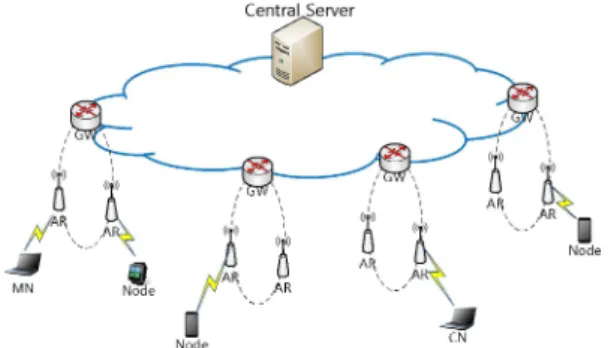
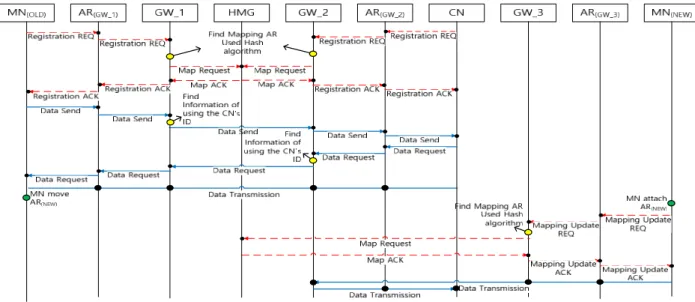
In CMM [1-2], both the data delivery and control functions are performed based on central server, such as rendezvous or map server. Initially, the mobile node (MN) will be registered with the central mapping server (CMS) by way of a gateway (GW). When a correspondent node (CN) wants to send data packet, it should first identify the location of MN by contacting with CMS. After that, the data communication between MN and CN will be performed. In case that the distance between CMS and MN/CN gets larger, the total delays associated with registration and data delivery may increase. Figure 1 shows a networks model for CMM. Figure 2 shows the CMM operation.
Fig. 2. Operation for centralized ID-LOC mapping management
In H-DMM [3-5], the data delivery and control functions are performed by each GW, rather than CMS, in the distributed way. Each GW performs the mapping control function, instead of CMS. The ID-LOC mapping management is performed based on the DHT hash function with the ID of the concerned host. That is, the GW that is responsible for ID-LOC mapping management for MN will be determined by applying a DHT hash function to the ID of the concerned host. When MN is attached to the network, GW will determine which GW in the network shall be responsible for ID-LOC mapping management for MN. Then, the attached GW sends a map update message to the hashed gateway (HGW). When CN sends a data packet to MN, GW of CN will first look up its DHT table so as to find which GW has the ID-LOC mapping information of MN. After that, GW of CN sends a map query message to the HGW. In turn, HGW will respond with a map query ACK message to GW. Then, the data packet can be delivered from CN to MN over an optimized path. This
hash-based mapping scheme tends to provide large delay, depending on the employed hashing mechanism and network environment, since a lot of hops between GW and HGW may be involved in the ID-LOC mapping resolution operations. Figure 3 and 4 show the networks model and operations for H-DMM.
Fig. 3. Network model for hash-based mapping management
III. PROPOSED DOMAIN-BASED MAPPING MANAGEMENT In this section, we describe a domain-based distributed ID-LOC mapping management (D-DMM) scheme, in which we assume that the ID of MN represents the domain information of MN.
A. Network Model
In the proposed scheme, we consider the 128-bit ID structure that contains the information of a home domain of MN. Figure 5 shows an example format of ID of MN. From this ID, we can identify the home-domain gateway (H-DGW) that manages the location of MN in the network.
Fig. 5. Example ID format of MN for domain-based DMM
Figure 6 shows the network model and operations for the proposed D-DMM scheme. For inter-domain ID-LOC mapping management, it is assumed that all DGWs are inter-connected. When MN moves into another domain, the network can easily identify the H-DGW of the MN from the ID.
Fig. 6. Network model for domain-based mapping management
B. Distributed Mapping Management Operations
Figure 7 shows an example operation of domain-based DMM. In the figure, there are three hosts, two MNs and a CN. When each host is attached to its nearest AR (Step 1), its ID and LOC will be registered or updated to the H-DGW which is known by ID information. In the figure, the H-DGW of MN1 and MN2 is DGW1, and the H-DGW of CN is DGW2. Each AR will send the map update message to each DGW (Step 2). DGW2 and DGW3 are not the H-DGW of MN2 and CN. So, they will send the map update message to MN2 and the H-DGW of CN (Step 3). When CN sends a data packet to MN1, DGW3 will send the map query message to DGW1. In this case, DGW3 can know the H-DGW of MN1 by investigating the domain information contained in the ID (Step 4). Now, the data transmission is made between CN and MN1 (Step 5).
Fig. 7. Exmaple of domain-based DMM operation
Figure 8 shows the domain-based DMM operations. When MN is attached to an access router in the visiting domain (DGW), it will send a registration message to DGW, and V-DGW will forward this message to the home domain gateway (H-DGW) of MN. Then H-DGW updates the ID-LOC mapping information of MN, and then it replies with the registration ACK message to V-DGW, AR (V-DGW), and further to MN.
IV. PERFORMANCE ANALYSIS
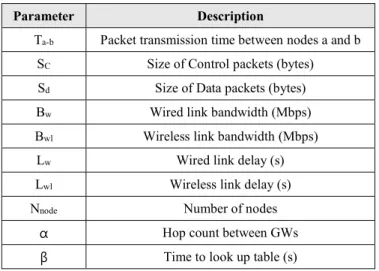
In this section, we analyze the total delays associated with registration and data delivery. For this purpose, we define the parameters used for analysis in Table 2.
TABLE I. PARAMETER USED FOR NUMERICAL ANALYSIS
Parameter Description
Ta-b Packet transmission time between nodes a and b
SC Size of Control packets (bytes)
Sd Size of Data packets (bytes)
Bw Wired link bandwidth (Mbps)
Bwl Wireless link bandwidth (Mbps)
Lw Wired link delay (s)
Lwl Wireless link delay (s)
Nnode Number of nodes
α Hop count between GWs β Time to look up table (s)
We denote Ta-b(S) by the transmission delay of a message with size S sent from a to b. So Ta-b(S) is expressed as follows. Ta-b(S) = (S/B + L) * α (1) The lookup delay for ID-LOC mapping table is set as β = log2(number of node). In the analysis, total delay (TD) for each candidate scheme consists of the registration delay (RD) and data delivery (DD). That is TD = RD + DD.
A. Numerical Analysis
In CMM, when MN is attached to a new AR, the AR will perform the registration with CMS. The CMS updates its mapping table. Then the data packet is first delivered to CMS, and CMS will forward the data packet to MN.
So, the total delay of CMM is given as follows.
RDCMM = (TMN-AR + TAR-GW + TGW-CMS) * 2 (2) DDCMM = TMN-AR + TAR-GW + TGW-CMS + β + TCMS-GW
+ TGW-AR + TAR-CN (3) TDCMM = RDCMM + DDCMM (4) In H-DMM, the AR will perform the registration with the distributed GW. GW finds the HGW that manages the mapping information of MN. The HGW updates its mapping table. When a data packet is delivered to GW of CN, and the GW finds the LOC of MN by contacting with HGW. Now, the data packet will be delivered over the optimized path.
So, the total delay of H-DMM is obtained as follows: RDH-DMM = (TMN-AP + TAP-AR + TAR-HMG) * 2 (5) DDH-DMM = TMN-AR + TAR-GW + TGW-HMG + β + THMG-GW
+ TGW-GW + TGW-AR + TAR-CN (6)
TDH-DMM = RDH-DMM + DDH-DMM (7) In D-DMM, when MN is attached to a new AR, the AR will perform the registration with the H-DGW, possibly via V-DGW. The H-DGW updates its mapping table. When a data packet is delivered to DGW of CN, the DGW finds the LOC of MN by contacting with the H-DMG of MN. Now, the data packet will be delivered over the optimized path.
So, the total delay of D-DMM is given as follows.
RDD-DMM = (TMN-AR + TAR-H-DGW) * 2 (8) DDD-DMM = TMN-AR + TAR-H-DGW + TH-DGW-DMG + β +
TDMG-H-DMG + TH-DGW-GW + TGW-AR + TAR-CN (9) TDD-DMM = RDD-DMM + DDD-DMM (10) B. Numerical Results and Discussion
Based on the analysis given so far, we now compare the performances of the existing and proposed schemes. For numerical analysis, the default values of parameter are configured as give in Table 3 by referring to [6].
TABLE II. PARAMETER VALUES USED FOR ANALYSIS
Parameter Default Minimum Maximum SC 200 bytes Sd 10000 bytes Bw 12500 Mbps Bwl 1250 Mbps Lwl 0.008 s Nnode 10000 Lw 0.004 s 0.001 s 0.01 s α(CMM) 5, 10 1 10
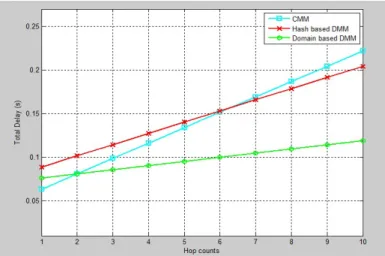
Figure 9 compares the total delays of the candidate schemes for different hop counts between CMS and GW or between GWs in the network. From the figure, we see that the CMM scheme provides better performance for small hop count (e.g., 1 or 2). However, as the hop count increases, the proposed D-DMM scheme gives the best performance. This is because the proposed scheme can reduce the ID-LOC mapping processing delay by using the domain-based identifier.
Figure 10 shows the impacts of wired link delays on total delay. The two DMM schemes provides better performance than the CMM scheme, and the proposed D-DMM scheme gives the best performance. It is noted that the gaps of performance between the existing and proposed schemes gets larger, as the link delay increases.
Figure 11 shows the impacts of wired link bandwidth on total delay. We can also see that the two DMM schemes provide better performance than the CMM scheme, and the proposed D-DMM scheme gives the best performance.
Fig. 9. Impact of hop count on total delay
Fig. 10. Impact of link delay on total delay
Fig. 11. Impact of bandwidth on total delay
V. CONCLUSIONS
In this paper we proposed a domain-based identifier-locator mapping management for distributed mobility management. In the proposed scheme, the identifier contains the domain information of MN for distributed mapping control. From the numerical analysis, we see the proposed domain-based scheme provides better performance than the existing schemes in terms of the registration and data delivery delays.
ACKNOWLEDGMENT
This study was supported by the BK21 Plus project (SW Human Resource Development Program for Supporting Smart Life) funded by the Ministry of Education, School of Computer Science and Engineering, Kyungpook National University, Korea (21A20131600005).
REFERENCES
[1] R. Moskowitz, et al., Host Identity Protocol (HIP) Architecture, IETF RFC 4423, Oct. 2015.
[2] D. Farinacci, et al., Locator Identifier Separation Protocol (LISP), IETF RFC 6830, Oct. 2015.
[3] H. Chan, et al., Requirements for Distributed Mobility Management, IETF RFC 7333, Aug. 2014.
[4] D. Liu, et al., Distributed Mobility Management: Current Practices and Gap Analysis, IETF RFC 7429, Jan. 2015.
[5] F. Qiu, et al., ''A Distributed Mobility Management Scheme in Networks with the Locator/Identifier Separation,'' International Journal of Communications Systems,'' Vol. 27, Oct. 2014, pp. 1874-1893. [6] M. Gohar, et al., ''Distributed Mapping Management of Identifiers and
Locators in LISP-based Mobile Networks'', Wireless Personal Communications, Vol. 72. No. 1, Sep. 2013, pp. 565-579.