Q-PMIP: Query-based Proxy Mobile IPv6
Jae Wan Park*, Ji In Kim*, Seok Joo Koh*
*School of Computer Science and Engineering, Kyungpook National University, Korea [email protected], [email protected], [email protected]
Abstract—This paper proposes the two extensive data delivery
schemes of Query-based PMIPv6 (Q-PMIPv6) and Signalling Query-based PMIPv6 (SQ-PMIPv6) in wireless networks. In the proposed Q-PMIPv6 scheme, when a correspond node (CN) sends the data packet to mobile node (MN), the Mobile Access Gateway (MAG), which CN is attached to, will send the binding query messages to Local Mobility Anchor (LMA) to get the Proxy-CoA of mobile node. After that, the CN can deliver all the subsequent data packets over the optimized routing path. The proposed SQ-PMIPv6 scheme is similar to the Q-PMIPv6. However, in SQ-PMIPv6, the CN will use a prior signalling with its attached MAG, before data transmission, to get the Proxy CoA of the mobile node. By using the SQ-PMIPv6, we can reduce the overhead of MAG of CN required for buffering the data packets during the Proxy Binding Query operation. The two proposed schemes are compared with the existing scheme of PMIPv6 by ns-2 simulations. From the performance analysis, we can see that the proposed two schemes can reduce the overhead of packet processing at LMA and throughput of data transmission, compared to the existing PMIPv6 scheme.
Keywords
—
Proxy MIPv6, Binding Query, Q-PMIP, SQ-PMIPI. INTRODUCTION
To support the IPv6 mobility, the Mobile IPv6 (MIPv6) was designed in the Internet Engineering Task Force (IETF) [1]. The MIPv6 protocol can be used to maintain IP connectivity for MN. To perform the mobility management signaling, each MN should have the modules to exchange the signals related to mobility management. Such a protocol is referred to ‘host-based mobility management’ protocol.
In the wireless network environment, the PMIPv6 was designed to support the ‘network-based mobility management’ for MN in IPv6 network [2]. The network-based mobility means that MN does not participate in exchanging signaling messages to process the mobility management unlike the host-based mobility scheme.
In PMIPv6, the mobile agents called MAG and LMA in the network will perform the mobility signaling instead of MN, and will keep track of movement of MN. However, in the routing optimization and LMA scalability issue, the PMIPv6 still needs to be for further study.
When the MN communicates with CN in PMIPv6, all the data packets should be delivered from source node to destination node via LMA, so those data packets will be delivered over the non-optimized path inefficiently.
This paper proposes the two extensive packet delivery schemes of PMIPv6, called QPMIPv6 and Signalling SQ-PMIPv6. It is assumed that both CN and MN are located in the same mobile network domain. In the proposed schemes, the MAG of CN (CN-MAG) will send the binding query to LMA to get the CoA of MN. After getting the Proxy-CoA, the CN-MAG will deliver all the subsequent data packets over the optimized packet delivery path to the MAG of MN (MN-MAG).
This paper is organized as follows. Section II describes the related work on the data transmission operation of PMIPv6. In Section III, we present the two proposed schemes: Q-PMIPv6 and SQ-PMIPv6. In Section IV, we compare the performances of candidate schemes by ns-2 simulation. Section V concludes this paper.
II. RELATED WORKS
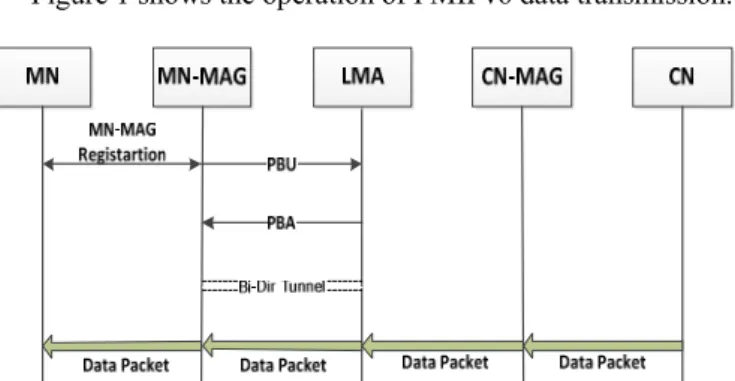
Figure 1 shows the operation of PMIPv6 data transmission.
Figure 1. PMIPv6 data transmission operations
When MN enters the MN-MAG’s area and the MN-MAG detects the MN’s attachment. The MN gets a link-up trigger of the link, it establishes a link connection with the MN-MAG, and then to update the LMA about the current location of MN. Then, the MN-MAG sends Proxy Binding Update (PBU) message to the LMA. Upon accepting this PBU message, the LMA sends a Proxy Binding Acknowledgement (PBA) message to the MN and creates the Binding Cache Entry (BCE). After these registration procedures, the LMA sets up its endpoint of the bi-directional tunnel to MN-MAG, the MN is ready to communicate with the CN by sending or receiving data packets.
In the figure, CN sends the data packets to the MN. The all data packets toward the MN should be transmitted via the
LMA. It may make the overhead of packet processing at the LMA. It incurs much more overhead when the number of data packets from CN to MN increases. Moreover, the path from CN-MAG to MN-MAG is not optimized path because it is via LMA. So, it may increase the data packet transmission time.
III.QUERY-BASED PMIPV6
In this paper, we propose the extensive schemes for data transmission, in which we will extend the PMIPv6 scheme. The proposed schemes can be used to reduce the overhead of packet processing at LMA and the throughput of data transmission in the PMIPv6 network.
Figure 2 shows the reference network configuration for Q-PMIP and SQ-Q-PMIP.
Figure 2. Q-PMIPv6 Overview
In the figure, the CN sends the data packets to MN. On receiving the data packets from CN, the CN-MAG exchanges the Proxy Binding Query (PBQ) and Proxy Binding Query Acknowledgement (PBQA) messages with LMA so as to get the Proxy-CoA. Then, the bi-directional tunnel is established between MAGs. The data packets are transmitted over the tunnel. This optimized path can reduce the overhead of the LMA and packet transmission delay between the MN and the CN.
A. Query-based PMIPv6
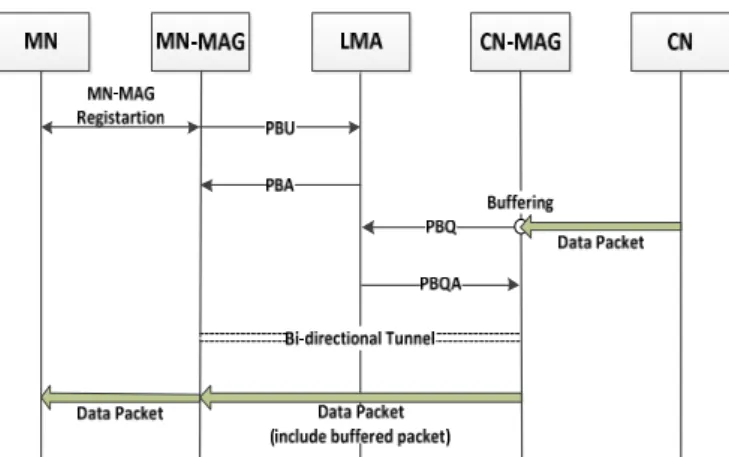
Figure 3 shows the operation of the Q-PMIPv6. First, the MN register to MN-MAG, it performs the link-layer signaling. The MN-MAG sends the PBU message to with the LMA to register the binding and routing state of MN. On receiving the PBU request, the LMA will create the BCE and send the PBA to respond to the MN-MAG.
After the PBU operations to register the MN to the LMA, the CN sends the data packets to the MN. When the CN-MAG receives the first packet from the CN, and then the CN-MAG sends PBQ message to the LMA to get the Proxy-CoA of MN. On the reception of PBQ, the LMA sends PBQA including the information that includes Proxy-CoA of MN. During these procedures, the CN-MAG has been received the data packets
from the CN. To prevent the packet losses, the MAGs perform the buffering until that CN-MAG receives PBQA from LMA and sets up the bi-directional tunnel between the MN-MAG and the CN-MAG.
Figure 3. Query-based PMIPv6 data transmission operations After establish the tunnel, the CN-MAG sends the data packets buffered in the MAG first. After that, the CN-MAG sends the data packets received from CN. Basically, the MAG in PMIPv6 network delivers all data packets to LMA. But the Q-PMIPv6 can use the optimized path without LMA to transmit the data packet by using the Query. With the data transport over the optimized path, Q-PMIPv6 can reduce the transmission delays of data packets, compared to PMIPv6. In addition, Q-PMIPv6 can avoid the problem of the data traffic processing load at LMA, since the data transmission to MN will be performed by the concerned MAG, instead of LMA, in the distributed manner.
B. Signalling Query-based PMIPv6
The proposed SPMIPv6 scheme is based on the PMIPv6 which is described in the above section. The Q-PMIPv6 has a problem. That is, the number of the buffered data packets in CN-MAG may increase during the processing the PBQ operation with the LMA. For example, if the PBQ or PBQA message delivery time increases, a significant amount of data packets should be buffered in the buffer of CN-MAG.
Figure 4. Signaling Query-based PMIPv6 data transmission operations To solve this problem of the Q-PMIPv6, we suggest the additional signaling procedure for the Q-PMIPv6, before data
transmissions from the CN to the CN-MAG, which is called the SQ-PMIPv6 and described in Figure 4.
In Figure 4, before the CN sends data packets, it must send the Data Transmission-Request (DT-Req) message to the CN-MAG. After receiving the DT-Req message, the CN-MAG will perform the PBQ operation with LMA, as done in the Q-PMIPv6. After that, the CN-MAG will send the Data Transmission-Acknowledgement (DT-Ack) message to the CN. Then, CN can transmit its data packets to MN.
With the help of these additional signaling procedures, the SQ-PMIP does not need to buffer the data packets, so it can reduce the overhead in the CN-MAG.
IV.PERFORMANCE ANALYSIS
A. Test Network
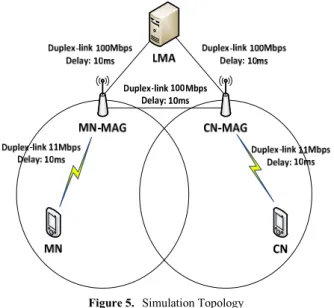
To analyze the performance of the two proposed Q-PMIPv6 and SQ-Q-PMIPv6 schemes, we configure a test network using the Network Simulator-2 [3], as shown in Figure 5.
Figure 5. Simulation Topology
In simulations, it is assumed that the MN and the CN are in same PMIPv6 domain. The wired links between the LMA and the MAGs have a network bandwidth of 100Mbps and link delay of 10ms, respectively. On the other hand, the wireless links between MAGs and MN/CN have a network bandwidth of 11Mbps and link delay of 10ms. During simulation, the CN transmits CBR data packets with the UDP packet size of 1,000 bytes at a transmission rate of 200 packets per second to the MN.
B. Experimental Results
Figure 6 shows the simulation results, which plots the packet sequence number for each scheme to compare the throughput performance over simulation time.
0 5 10 15 20 25 30 35 0.5 0.55 0.6 0.65 0.7 0.75 0.8 PMIPv6 Q-PMIPv6 SQ-PMIPv6 P a ck et Se que nc e N umbe r Simulation Time(s)
Figure 6. Trace of data packets transmitted during simulation From the figure, we can see that proposed two schemes which are both Q-PMIPv6 and SQ-PMIPv6 provide better performance than the existing PMIPv6 scheme. Above all, SQ-PMIPv6 shows the best performance among the three candidate schemes. This is because the proposed Q-PMIPv6 and SQ-PMIPv6 use the optimized path to MN. In the mean time, in comparison of Q-PMIPv6 and PMIPv6, the SQ-PMIPv6 gives better performance, since the SQ-SQ-PMIPv6 uses the optimized path from the first data packet, whereas the Q-PMIPv6 needs the buffering of initial data packets during the PBQ operations.
Figure 7 shows the packet delivery times of the candidate schemes for different CN-MAG-LMA link delay.
0.03 0.035 0.04 0.045 0.05 0.055 0.06 0.065 0.07 0.075 1ms 3ms 5ms 7ms 9ms 11ms 13ms 15ms Pa ck et Deli very T im e (s ) PMIPv6 Q-PMIPv6 SQ-PMIPv6
CN-MAG to LMA Delay time(ms)
Figure 7. Comparison of packet delivery time between CN-MAG and LMA In the figure, it is shown that the proposed Q-PMIPv6 and SQ-PMIPv6 schemes have smaller packet delivery time than the existing PMIPv6 scheme for all the cases. In addition, the gap of packet delivery time gets larger, as the CN-MAG-LMA delay increases. This is because the existing PMIPv6 is quite influenced by the MAG-LMA link delay, compared to the proposed two schemes. In other word, the PMIPv6 scheme tends to use a longer path of CN-MAG-LMA and MN-MAG-LMA, compared to the two proposed Q-PMIPv6 and PMIPv6 schemes. On the other hand, the Q-PMIPv6 and SQ-PMIPv6 are rarely affected by the concerned delay. That is,
after the PBQ procedures, the proposed two schemes will send data packets by using the optimized path.
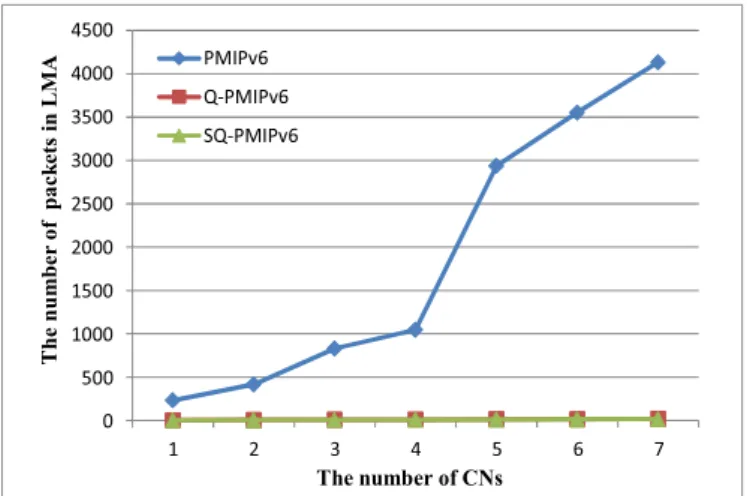
Figure 8 shows the number of packets that are processed at LMA during simulation. In the figure, we can see that the number of packets processed at LMA for PMIPv6 is greater than those of Q-PMIPv6 and SQ-PMIPv6. In particular, the number of packets processed at LMA for PMIPv6 gets larger, as the number of CN increases. This is because all of the packets from the CN to the MN should be passed via the MAG-LMA link. On the other hand, the proposed Q-PMIPv6 and SQ-PMIPv6 schemes will send the data packets using the optimized MN-MAG-CN-MAG link. As a result, both the two schemes show better performances than the existing PMIPv6.
0 500 1000 1500 2000 2500 3000 3500 4000 4500 1 2 3 4 5 6 7 PMIPv6 Q-PMIPv6 SQ-PMIPv6 The number of CNs The num ber o f pa ck ets i n LM A
Figure 8. Comparison of overhead of processing packet at LMA Figure 9 shows the comparison the Q-PMIPv6 scheme with the SQ-PMIPv6 scheme in terms of the deviation of packet delivery time.
In Q-PMIPv6, the CN-MAG should buffer the data packets until the PBQA message arrives from LMA to CN-MAG. After receiving the PBQA message, CN-MAG forwards the data packets to MN-MAG over the optimized path. At a result, it induces a large deviation of packet delivery time in Q-PMIPv6, compared to SQ-PMIPv6.
0 0.001 0.002 0.003 0.004 0.005 0.006 0.007 1ms 3ms 5ms 7ms 9ms 11ms 13ms 15ms Q-PMIPv6 SQ-PMIPv6 M e an De vi at io n of Pac k et D el iv er y Ti m e (s )
CN-MAG to LMA Delay time(ms)
V. CONCLUSIONS
In this paper, we present the Query-based PMIPv6 and Signaling Query-based PMIPv6 schemes that use the binding query to LMA so as to get the optimized data path. In the proposed Q-PMIPv6 scheme, we can achieve much smaller transmission delay of data packets than the existing PMIPv6. However, the Q-PMIPv6 tends to hold the data packets in the buffer of CN-MAG, until the PBQ and PBQA operation has finished. SO, if the PBQ operation takes a long delay, the overhead of the CN-MAG gets more severe in the Q-PMIPv6.
To overcome this drawback of the Q-PMIPv6, we proposed the SQ-PMIPv6, which doesn’t need to buffer the data packets. In the SQ-PMIPv6 scheme, it is required that the PBQ & PBQA operation will be done using a pre-signalling procedure, before the CN transmit the data packets to MN.
For performance analysis, we compared the existing PMIPv6 scheme with the proposed two schemes, Q-PMIPv6 and SQ-PMIP. In the PMIPv6, all data packets should be delivered via LMA. So, the overhead of LMA gets larger and the packet delivery cost is greater than the proposed two schemes. On the other hand, the Q-PMIPv6 and SQ-PMIPv6 induce a lower packet delivery cost than the PMIPv6, since they use an optimized path. In the meantime, the SQ-PMIPv6 can overcome the buffering problem of Q-PMIPv6 by using the pre-signalling with CN-MAG before data transmission of CN.
ACKNOWLEDGMENT
This research was supported by the IT R&D program of MKE/KEIT (10035245: Study on Architecture of Future Internet to Support Mobile Environments and Network Diversity) and the ITRC program of MKE/NIPA (NIPA-2010-C1090-1021-0002).
REFERENCES
[1] D. Johnson, C. Perkins, and K. Arkko, ''Mobility support in IPv6'', RFC 3775, June 2004.
[2] S. Gundavelli, K. Leung, V. Decarapalli, K. Chowdhury, and B. Patil, ‘Proxy Mobile IPv6’, RFC 5213, August 2008.
[3] Network simulator NS-2, http://www.isi.edu/nsnam/ns.
[4] M.Liebsch, L. Le and J. Abeille, ‘Route Optimization for Proxy Mobile IPv6’, Internet-Draft, November 13, 2007.
[5] S. Krishnan, Ed, R. Koodli, P. Loureiro, Q. Wu and A. Dutta, "Localized Routing for Proxy Mobile IPv6", Internet-Draft, September 1, 2010.