High Temperature Oxidation of a Zirconium Base Alloy in Steam
Seongwoo Yang,a Kwangheon Park,a Taegeun Yoo,b Seungjae Lee,c Sundoo Kim,c a Department of Nuclear Engineering, Kyung-Hee University, Suwon, , 449-701, Korea.
b FNC Co., LTD., Kwanak, Seoul, 151-742, Korea
c Korea Nuclear Fuel Co., LTD., Yuseong, Daejeon, 305-353, Korea
1. Introduction
Zr-base alloys are used as cladding materials for nuclear fuel in light and heavy water reactors. Zircaloy-4 (Zry-Zircaloy-4) has been used satisfactorily as a cladding material in pressurized water reactors. Nowadays, light water reactors tend to extend their fuel cycle length with high burn-up of nuclear fuel to get the improved economy. Zry-4 may not satisfy the required safety margin for the high burn-up fuel, and more corrosion-resistant Zr-base cladding materials are being developed. One direction for the development of new Zr-base alloys is addition of Nb in alloying elements.
At high temperatures, the exothermic reaction of Zr-base alloys with steam is always a concern for the safety of nuclear power plants during accidents like a loss-of-coolant accident. The Nuclear Regulatory Commission still uses the same criteria, which are applied to conventional Sn-added Zr claddings, for the safety analysis of newly developed Nb-added Zr base alloys. So, it is needed to check the difference in the kinetics of high-temperature oxidation in between Nb-added and Sn-Nb-added Zr alloys. In the present paper, we compare the characteristics of Sn-added Zr-alloy (Zry-4) and those of Nb-added alloy (Zr-1%Nb alloy), especially at high temperature oxidation
.
2. Experimentals
We selected two types of specimens, i.e., Zry-4 as a Sn-added alloy and Zr-1%Nb alloy as a Nb-added alloy in the experiments. Zry-4 tubes are the commercial tubes of Westinghouse, and used in the as-supply state. The tubes were cut to specimens of the height of about 15mm. Each specimen was degreased and pickled in
aqueous HF/HNO3 solution, then cleansed in hot and
cold water. The main alloying elements of Zry-4 are Sn, Fe and Cr, while those of Zr-1%Nb alloy are Nb, Sn, and Fe.
High temperature oxidation tests were done under 1 atm steam in a vertical heater, where a specimen is hung by a Pt-wire. When the goal temperature is obtained and the steam flow through the alumina tube inside heater becomes stabilized, the specimen is inserted into the center of the tube and pulled out of the tube after the desired oxidation is reached. The
temperature range is in between 700 and 1200oC. The
steam flow rate is about 10g/min.
The steam flow rate is about 10g/min. The steam-pressure dependency of Zr-alloys on the oxidation at high temperatures was also observed. The dependency
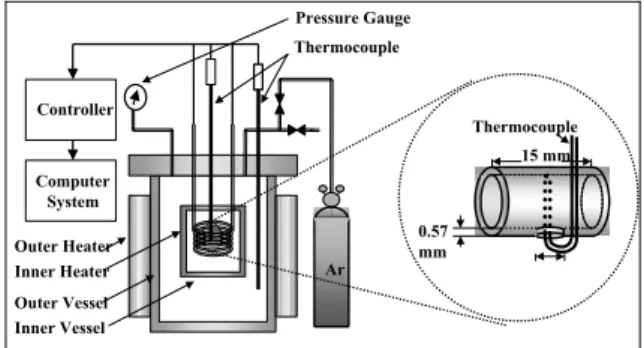
was obtained by an experimental setup that consists of two vessels and two resistance heaters (Fig.1). The outer vessel is used for maintaining high-pressure steam during the experiment. The vessel is heated up to 400oC,
and the steam pressure is controlled by the amount of water inside the vessel up to 150bar steam. Once the steam pressure is stabilized, the resistance heater surrounding the specimen inside the inner vessel is on. The specimen is heated up to the set-up temperature
(700-900 oC) rapidly by the resistance heater. The heat
up rate of the specimen is about 3 oC/sec, and oxidation
time was set to 1500sec.
Ar Controller Computer System Inner Heater Outer Heater Outer Vessel Pressure Gauge Thermocouple 0.57 mm 15 mm Thermocouple Inner Vessel
Figure 1. Experimental setup for high-pressure steam oxidation
After oxidation test, the specimen is molded, grounded and polished for the optical microscopic observation. For the micro-structural evaluation, sometimes the polished section was wipe-polished by etchant. The thickness of oxide and that of alpha-layer are determined by the photos from optical microscope.
3. Results and Discussion
The oxidation test at 1 atm steam is shown in Fig.2. The symbols (solid lines) indicate the weight gains of Zr-1%Nb alloy specimens with time and the dashed lines are those of Zry-4. Below 900oC, transition points
are observed in both alloys. Parabolic rate law is always applicable before transition in Zr-1%Nb alloy. The weight gain of Zr-1%Nb alloy at atmospheric steam can be formulated by the following equations.
Before transition, the weight gain (∆W) becomes; t K W = p ∆ where ⎟⎟ ⎠ ⎞ ⎜⎜ ⎝ ⎛ − × = ) ( 7 . 665 , 10 exp 10 139 . 7 4 K T Kp and ∆W : mg/dm2, t : sec.
Transactions of the Korean Nuclear Society Autumn Meeting Busan, Korea, October 27-28, 2005
After the transition point (below 900oC), the weight gain becomes; ∆W =Wt+K1(t−tT) where ⎟⎟ ⎠ ⎞ ⎜⎜ ⎝ ⎛ − × = ) ( 964 , 11 exp 10 286 . 1 7 K T Wt ⎟⎟ ⎠ ⎞ ⎜⎜ ⎝ ⎛ − × = ) ( 303 , 8 exp 10 51 . 1 2 1 T K K ⎟⎟ ⎠ ⎞ ⎜⎜ ⎝ ⎛ − × = ) ( 579 , 2 exp 10 23 . 3 4 K T tT
The above kinetic equation is denoted as solid lines in Fig.2. The oxidation kinetics of Zr-1%Nb alloy is somewhat different from those of Zry-4.[1-2]
1 10 100 10 100 1000 1200oC 1100oC 1000oC 900oC 800oC 700oC W e ight ga in ( m g/ dm 2)
Oxidation T ime (min)
Figure 2. Weight gain of Zr-1%Nb alloy in Steam. (dashed lines:Zry-4)
The results of oxidation enhancement by high-pressure steam are shown in Fig.3 and 4. The oxidation time is set 1500sec. The oxidation enhancement depends exponentially on the steam pressure. The dependency of Zr-1%Nb alloy is much smaller than that of Zry-4 (Fig.4).[3-4] 0 20 40 60 80 100 120 140 160 2 3 4 5 6 7 8 9 10 10 20 30 40 50 60 70 80 90 0o C 85 0o C 80 0oC 75 0o C 70 0o C O xi de T hi ck nes s ( µ m) Pressure (bar)
Figure 3. Steam pressure effects on the oxidation of Zry-4.
0 20 40 60 80 100 120 140 160 2 3 4 5 6 7 8 9 10 10 20 30 40 50 60 70 80 900o C 850oC 800oC 750oC 700oC O xi de T hic kn es s ( µ m) P re ssu re (ba r)
Figure 4. Steam pressure effects on the oxidation of Zr-1%Nb alloy.
4. Conclusion
High temperature steam oxidation behaviors of Zr-1%Nb alloy and Zry-4 were compared. Oxidation kinetics of Zr-1%Nb alloy at atmospheric steam pressure, follows parabolic-rate law, instead of
cubic-rate as was observed in Zry-4 below 900 oC. The
oxidation rate of the Zr-alloy is comparable to that of
Zry-4 below 900 oC , however, is slightly lower than
Zry-4 above 1000 oC.
Steam pressure effects on high temperature oxidation of both Zr-1%Nb alloy and Zry-4 were measured. Zry-4 was very sensitive to the steam pressure, and the oxidation rate increases exponentially with applied steam pressure. Contrary to Zry-4, Zr-1%Nb alloy was less sensitive to the high-pressure steam.
Acknowledgment
We would like to express their appreciation to Korea Nuclear Fuel Company (KNFC) for the financial support of this study. Also this work was financially supported by MOCIE through EIRC program..
REFERENCES
[1] V.F.Urbanic and T.R.Heidrick, High-temperature oxidation of zircaloy-2 and zircaloy-4 in steam, J. Nucl. Mater., vol.75, p.251, 1978
[2] S.Leistikow and G.Schanz, Oxidation kinetics and related phenomena of zircaloy-4 fuel cladding exposed to high temperature steam and hydrogen-steam mixtures under PWR accident conditions, Nucl. Eng. Design, vol.103, p.65, 1987 [3] R.E.Pawel, J.V.Cathcart and J.J.Campbell, The oxidation of zircaloy-4 at 900 and 1100°c in high pressure steam, J. Nucl. Mater., vol.82, p.129, 1979
[4] A.F.Brown, M.O.Tucker, T.Healey and C.J.Simpson, Oxide/α and α/β phase interface advance kinetics in steam oxidised zircaloy-2, J. Nucl. Mater., vol.105, p.93, 1982