17
ISSN: 2288-2766 © 2021 KODISA & EABEA. http://eajbe.jams.or.kr
doi: http://dx.doi.org/10.20498/eajbe.2021.9.1.17
The Effect of SMEs’ Slack Resource on Internationalization:
Focusing on SMEs’ Subcontracting Relationship*
11Jae-Jin KIM
Associate Professor, Department of Business Administration, Hoseo University, Cheonan, Korea
E-mail: [email protected]
Received: February 01, 2021. Revised: February 10, 2021. Accepted: February 19, 2021.
Abstract
Purpose—This study examines how financial slack resources and subcontracting of small and medium-sized enterprises (SMEs) affect their internationalization. To identify slack resources, subcontracting, and internationalization of SMEs, 1,062 SME samples in the electronics industry are used in the logistic regression analysis to analyze their relationship with SMEs’ export.
Research design, data, and methodology—This study conducted the empirical analysis on 1,062 SMEs in the electronics industry using the sample survey method. The samples were based on data selected and distributed by the Ministry SMEs and Startups. The data analysis methods were descriptive, correlation analysis, and logistics regression analysis.
Result—The analysis shows that only available resources are negatively related to SMEs’ internationalization. It can be interpreted as a high tendency for SMEs to avoid relatively risky choices such as entering overseas markets if they have enough financial resources. Moreover, subcontracting has a negative relationship with internationalization.
Conclusion—This study broadened the scope of SME research by analyzing subcontracting and slack resources together and provides practical implications for policymakers and managers.
Keywords: SMEs, Slack resource, Internationalization, Subcontracting
JEL Classification Code: L1. F2. F40
* This research was supported by the Academic Research fund of Hoseo University in 2018 (2018-0136). ⓒ Copyright: The Author(s)
This is an Open Access article distributed under the terms of the Creative Commons Attribution Non-Commercial License (http://Creativecommons.org/licenses/by-nc/4.0/) which permits unrestricted noncommercial use, distribution, and reproduction in any medium, provided the original work is properly cited.
18
1. Introduction
Research on the internationalization of small and medium-sized enterprises (SMEs) is of high importance to corporate managers and policymakers, as well as researchers in international business (Kim & Lim, 2011; PlaBarber & Alegre, 2007; Sapienza, Autio, George, & Zahra, 2006). This is because the Korean economy has faced limitations in the aftermath of global low growth after the global financial crisis, and the economic growth paradigm centered on SMEs is being highlighted as an alternative (Cho et al., 2017).
SMEs account for a large portion of the Korean economy. The number of SMEs is 99% of all businesses in Korea, and they are responsible for more than 85% of employment. It also plays a critical role in the industrial value chain, performing various lower functions in the manufacturing sector. Due to the nature of SMEs, they mainly have limited geographical activities in Korea. However, the domestic market is relatively small with existing overproduction, and it is characterized by a small number of large companies (Ok & Baek, 2015; Park, Sung & Lee, 2014). Therefore, expanding the scope of activities overseas is a good opportunity for SMEs to promote their growth and improve their competitiveness, as they can increase their growth potential through economies of scale and scope, learning effects, and so on in the process of internationalization (Nam et al., 2015). As a result, the government is making various efforts to expand economic growth and employment potential by fostering global SMEs (Lee, 2007). The international expansion of SMEs is an important policy decision (Jeong et al., 2014).
However, companies need sufficient internal resources to expand their overseas markets. Tseng et al. (2007) argued an entity’s high level of internal resources influences its multi-nationalization. The concept of sufficient internal resources held by an entity is mainly described as spare resources. Free resources can be arranged as holding resources beyond the number of resources required for an entity to gain a competitive advantage (Noria & Gulati, 1996). Cyert and March (1963) defined spare resources as the difference between all resources held by the entity and all necessary inputs. Many scholars have conducted several studies about these resources until recently.
However, most studies have focused on analyzing only the impact of spare resources on corporate performance or firm value, and not much has been done on how spare resources themselves become leading variables and directly affect internationalization (Nam, 2015). In addition, even in studies on the internationalization of spare resources and companies, most of the analysis subjects are large companies or listed companies with information that can be easily collected. Research on ordinary SMEs is scarce. Furthermore, few studies have identified the relationship between spare resources and internationalization with subcontracting, the primary business model for SMEs.
Korea intensively fostered the heavy chemical industry in the 1970s. Since then, Korea's economy has been growing by establishing a subcontracting structure. Among manufacturing SMEs, the percentage of consigned firms only outsourcing to other companies is 3.7%, but that of subcontracted firms that received outsourcing transactions from other firms is about 42% (SME Survey, 2017). Subcontracting structures have both merits and demerits to SMEs. Amsden (1989) argued that the subcontracting relationship not only secures a stable market for SMEs, but also it has positive effects such as mitigating bipolarization of the economic structure by transferring and spreading advanced technologies and management skills to latecomers or smellers. However, some scholars argued that the structure of subcontracting creates unfair trading practices in which the contractor exploits and steals subcontractors based on the bigger bargaining power (Park et al., 2011). Recently, this phenomenon, which is represented by “Gap-Eul relations” (and “Gap-jil” issue) in Korean society, is blamed for the technological and economic bipolarization between large and small firms. Because subcontracting is a key factor that has a significant impact on the business and performance of SMEs, analyzing them without considering the subcontracting situation may create an insufficient analysis that does not accurately reflect reality.
Therefore, this study analyzes the impact of subcontracting, which is a major business of SMEs, on the internationalization of SMEs by using slack resources together and provides implications for SMEs’ specific situations. Finally, this study also provides practical contributions for promoting SMEs’ entry into overseas markets to economic policymakers.
2. Literature Review
2.1. Slack resource
To be a going concern of a firm, resources should be greater than the business’ needs at the current level. New product launches and market expansion require several resources. Especially when slack resources are lacking, making
19 investments with high uncertainties such as technology and market development is impossible (Bourgeous, 1981; Cheng & Kesner, 1997).
According to Cyert and March (1963), a “slack resource” (or organizational slack) is an extra resource minus the minimum resources needed to maintain an organization’s allied system. These resources can be used to solve political issues within the organization, such as goal conflicts between subordinate organizations and problems with decision-making inconsistencies. Since then, the concept of slack resources has been explained by various researchers. For instance, Bourgeois (1981) defined slack resources as a practical or potential cushion needed to adapt to strategic changes in the organization. Meanwhile, Nohria and Gulati (1996) defined slack resources as a set of resources that exceed the minimum resources required for an organization to produce a certain level of output. Moreover, according to George (2005), slack resource is a resource that can be converted or relocated and potentially available to achieve organizational goals. Several researchers provided other definitions of this term, but most of them interpreted slack resources as resources to mitigate the impact of organizations on environmental changes outside the company and to take advantage of new opportunities through the flexible resource deployment (Kim & Kim, 2016).
Existing literature about slack resources is mainly studied to analyze their relationship with firm’s performance in various ways. It looked at the relationship with firm’s performance by distinguishing the types of slack resources or studied how slack resources were differently affected by each type of performance. Other studies include finding various moderators that affect the relationship between slack resources and firm’s performance and identifying moderating effects. However, these studies are scant. A further look at the research on slack resources is as follows.
First, the slack resources are divided into different types and how they have a different impact on firm’s performance. Typically, slack resources are classified into absorbed and unabsorbed resources (Bourgeous, 1981; Singh, 1986). The absorbed and unabsorbed slack are divided into the scope and ease of use. For example, the case of absorbed slack is like labor costs above the appropriate level, excess personnel, and dedicated mechanical facilities, where the scope of use of the resources is relatively narrow. Such absorbed slack is difficult to be used for specific activities as soon as there is a demand for slack, and they can be converted to unabsorbed slack resources through organizational efficiency such as restructuring, which requires a considerable amount of time and effort.
Meanwhile, unabsorbed slack is representative of cash or securities, which are relatively wide in scope of use and highly available. Such slack resources may be allocated to shareholders or invested in new strategies and innovative activities. Similarly, other studies have divided it into high-discretionary and low-discretionary slack (Sharfman, Wolf, Chase, & Tansik, 1988), depending on whether it can be recovered.
Other researchers divided slack resources into three dimensions (Geiger & Cashen, 2002; Herold et al., 2006): available slack, recoverable slack, and potential slack. The available and recoverable slack can be understood as the same concept as the unabsorbed and absorbed slack, respectively. Meanwhile, potential slack can be classified as low-discretionary slack because resources can be delivered or secured in the future through environmental changes such as additional liabilities or in stock price change (George, 2005). Table 1 summarizes the slack resource classification.
Table 1: Comparison of the types of slack resource
Cheng and Kesner (1997) Singh (1986) Sharfman et al. (1998) Similar
concept on slack
Available slack Unabsorbed slack High-discretion Slack
Recoverable slack Absorbed slack -
Potential slack - Low-discretion slack
Source: Kim and Lim (2011)
Meanwhile, some studies consider slack resources in terms of resource rarity and resource absorption, which categorize them into financial, operational, customer relational, and human resource slacks. Voss et al. (2008) argued that financial slack is both low in rarity and absorbance, whereas operational slack is low in rarity but highly absorbent. In addition, customer relationship slack has high rarity but low absorbance, whereas human resource slack has both rarity and absorbance characteristics. Moreover, Voss et al. (2008) categorized slack resources into four categories, empirically analyzing that each type has a different impact on exploratory and exploitation innovation.
Second, the relationship between slack resources and firm’s performance has been identified by various measures of organizational or firm’s performance. To identify this relationship, most studies use financial performance as a measure of gross profit, ROA, ROI, and ROE (Henderson & Fredrickson, 1996; Greenley & Oktemgil, 1998; George, 2005). Recently, empirical studies on whether slack resources enhance firm innovation have been published; these
20 studies capture and challenge new opportunities, that is, create new products or enter different markets with new strategies (Cyert & March, 1963; Greve, 2003).
Various factors have been used to measure firms’ innovation. For instance, the number of patents and the intensity of R&D are commonly used (Geiger & Cashen, 2002). Moreover, Voss et al. (2008) measured the level of innovation by dividing the types of innovation into exploratory and exploitational innovations. In addition to these variables associated with firm’s performance, environmental responses or risk-seeking are used by Cheng and Kesner (1997) as dependent variables in identifying the relationship between slack resources and firm’s performance
2.2. Slack resource and the internationalization of SMEs
Looking at the business environment faced by firms today, the trend of international integration of the markets and business activities continues. Therefore, transferring certain parts of the value chain to areas that can produce the most efficiency or generate the most value is becoming common. This regional redistribution of value chain results in the promotion of international movement of resources with suppliers or customers. In other words, corporate efforts to expand internationally require more resources.
The viewpoint that slack resources are surplus resources available to organizations includes the perspective that various constraints in firm’s global activities can be overcome. Having slack resources enables the firm to make various attempts, such as entering new overseas markets and exploring opportunities (Bourgeois, 1981). In other words, slack resources allow firms to explore or exploit new opportunities in overseas markets, while helping them pursue new and bold goals that have not been attempted in the domestic market (Bourgeois, 1981; Greenley & Oktemgil, 1998).
However, a different viewpoint that the firm’s slack resources are interpreted as agent problems also exists. According to the organization economic theory, scholars who advocate resource constraints argued that companies with fewer resources are likely to make better use of resources (Lin et al., 2009). Moreover, firms with low levels of slack resources, even in terms of economic rationality norm, perceive slack resource as higher opportunity costs for resources used in internationalization (Rhee & Cheng, 2002). Hence, the firm with low organizational slack resources could carefully pursue internationalization to reduce uncertainty and avoid risks. In addition, agent theory argues that extra resources can encourage self-aggrandizing managerial activities (Bourgeois, 1981).
For example, managers in a firm with more than enough resources are likely to be reluctant or hesitant to hire professional managers with extensive global experience because of their reluctance to lose control (Tourigny, 2006). Additionally, if managers perceive a much higher level of slack resources than that of their competitors, they tend to be optimistic about global management and strategic positioning (George, 2005) and idle in efforts to expand overseas markets. Thus, slack resources allow managers to remain passive about expansion without actively pursuing it (Hamel & Prahalad, 1994). In other words, slack resources are inefficient resources that unintentionally lead to actions that hinder firms from expanding overseas.
Recently, Ryu and Kim (2020) analyzed slack resources and internationalization of SMEs using 214 samples of SMEs. They conducted an empirical analysis assuming that slack resources serve as a modulator in the relationship between the firm’s dynamic capability and internationalization performance. Results of their study reveal that slack resources provide flexibility to respond to rapidly changing environments, especially to strengthen dynamic capabilities, as SMEs in overseas markets can have psychological relaxation, maintain more stable conditions, and accumulate new knowledge by coping with the expense.
Meanwhile, Ok and Back (2015) analyzed how firm’s slack resources affect internationalization by evaluating 507 KOSDAQ-listed venture firms in terms of overseas sales. They found that the liquidity ratio, which is viewed as a high-discretionary resource, has a positive impact on the level of internationalization. In addition, these effects increase the effectiveness of the relationship in industrial environments with low growth potential and high dynamics. However, it is difficult to say that a venture company listed on KOSDAQ purely represents SMEs. This is because the KOSDAQ listing requires a firm to have more than three billion won in equity capital or nine billion won in market capitalization. Moreover, by being listed on the exchange, the financing capacity is far superior to unlisted companies. Nam et al. (2015) analyzed the effect of slack resources on internationalization after the global financial crisis. They also analyzed the nonlinear relationship between slack resources and internationalization. They found that an increase in slack resources has a positive effect on internationalization by accelerating internationalization. However, they argued an inverted U-shaped relationship between excessive slack resources and internationalization due to the managerial discretion; the excessive slack resources negatively affects internationalization. However, the sample of this study is KOSPI-listed companies, and thus, applying the same meaning to the SMEs is limited.
21 The advantage of SMEs is that they can make quick decisions because their hierarchy is simple compared with large enterprises. However, poor risk tolerance and lack of separation of management and ownership, which means that external governance or shareholder discipline does not work, and low awareness of information disclosure are operational disadvantages. Large companies have been systemized with internal control along with checks by the board of directors, but SMEs often lack the management resources necessary to build their systems. Thus, rather than agent theory, a resource-based perspective and organizational behavior theory may be a better explanation for the effect of SMEs on slack resources and internationalization.
Hypothesis 1: The slack resources (available, recoverable, and potential) have a positive relationship with the internationalization of SMEs
2.3. Subcontracting and internationalization
Subcontract transactions in Korea are defined by the “Act on Fair Trade in Subcontracts.” Under this Act, subcontracts are defined as cases where non-SMEs entrust manufacturing and repair arrangements to SMEs. Park et al. (2011) argued that subcontracting is a form of production in which large companies outsource part or all of their production to small firms, and that subcontracting occurs because the market and cooperative factors complement each other in subcontract transaction.
In transaction cost economics, firms cannot expand all production facilities, so they create subcontracting structures such as vertical integration to maintain the firm’s production stability. If this subcontracting relationship persists in the long term, production efficiency can be achieved by reducing transaction costs. Eventually, both contractor and subcontractor firms have the advantage of laying the foundation for growth, thereby advancing the subcontracting relationships.
As aforementioned, subcontracting structures have both merits and demerits. Many transactions with large firms may provide more information and opportunities for SMEs. A broad network of large firms can influence SMEs to acquire a greater capacity to adapt to market changes and innovations (Laursen & Salther, 2006). SMEs can also combine internal resources with their counterpart’s resources, absorb new knowledge, and develop it into new capabilities available to overseas customers (Dyer & Hatch, 2006; Furlan, Grandinetti, & Camuffo, 2007).
However, according to Ahn et al. (2007), subcontracting is a structure where differences in bargaining power occur. A contractor has the greater bargaining power; therefore, an unfair transaction such as seizing the resources of the subcontracting firm is highly possible. After all, this unfair behavior intensifies the bipolarization of technology between firms. In addition, Porter (1979) stated that weakening bargaining power over buyers decreases profits or returns. In particular, large firms have strong bargaining power and unilateral price cuts (pressure on the unit price reduction of the delivery item) in transactions between large and small firms. Chang (2020) analyzed the differences in the financial performance between the subcontracting SMEs and similar non-subcontracting SMEs. He showed that the subcontracting SMEs, on average, had a higher level of improvement in sales and gross assets, but it did not lead to better profit and return significantly. Therefore, if the subcontracting transition is not positive for the financial performance of SMEs, the subcontracting situation will inevitably put a burden on entry into overseas markets that require significant investment. Therefore, the following hypothesis is proposed.
Hypothesis 2: The subcontracting of SMEs has a negative relationship with internationalization.
3. Methodology
3.1. Data and Samples
To analyze the relationship between slack resources and the degree of internationalization of SMEs, this study collected data from manufacturing firms with less than 300 employees in the electronics industry and conducted an empirical analysis. The research targets were restricted to manufacturing because prior research has been conducted mainly in consideration of the difference between manufacturing and service industries. Moreover, the
22 internationalization of the service industry is significantly lower than that of manufacturing industry, and real restrictions exist on data collection.
The data used for this study’s empirical analysis are 1,062 samples of SMEs engaged in the electronics industry based on the 2011 data released by the Ministry of SMEs and Startups. The Small and Medium Business Survey is conducted annually based on Article 21 (1) of the fundamental law of SMEs for the provision of basic data necessary for supporting and improving the structure of the small- and medium-sized manufacturing industry. In this study, the sample data from this survey were used for the analysis; especially financial data from SMEs were used to increase the reliability of measurements. In particular, these data are the official statistic obtained by the Ministry of SMEs and Startups; hence, SMEs must indicate the actual figures in their financial statements. Therefore, we were able to secure a relatively higher accuracy and confidence with these data than the data collected through the general survey.
3.2. Measurements
3.2.1. Dependent variable
Generally, previous studies measured internationalization based on the proportion of overseas sales to firm’s total sales. Although recent international business studies have argued that using a complex index is desirable to measure the degree of internationalization more accurately; some argue that a single reliable indicator is preferable because each has a different effect (Ramaswamy et al., 1996). Tseng et al. (2007) also used the proportion of overseas sales rather than the total sales as a measure of internationalization; however, this study considered exporting behavior of SMEs as part of internationalization. Actually, SME export is about 2%: of the total 3.54 million SMEs, only 95,000 have been exporting to overseas. Therefore, the export status was measured using the dummy variable as 1 if export, and 0 otherwise.
3.2.2. Independent and control variables
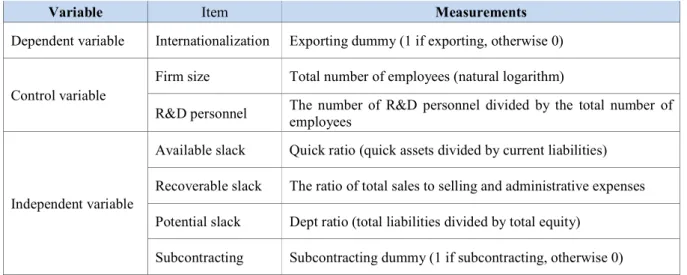
In this study, independent variables were the three slack resources (available, recoverable, and potential) and whether they are subcontracted. First, available slack measures the cash availability of the firm. Generally, financial slack resource measures firms’ current asset ratio, that is, the current assets divided by their current liabilities. However, such a current ratio includes the inventory amount; therefore, the available slack of SMEs is appropriately measured at better checking liquidity than at the current ratio. Consequently, the available slack resources in this study are used to measure the quick ratio (quick assets divided by current liability). Meanwhile, recoverable slack resources were measured in the ratio of sales and management costs to sales, whereas potential spare resources were measured using the debt ratio. The subcontracting was measured using a dummy variable. Table 2 presents the measurement methods of the variables used in this study.
Table 2: Measurement by variables
Variable Item Measurements
Dependent variable Internationalization Exporting dummy (1 if exporting, otherwise 0)
Control variable
Firm size Total number of employees (natural logarithm)
R&D personnel The number of R&D personnel divided by the total number of employees
Independent variable
Available slack Quick ratio (quick assets divided by current liabilities)
Recoverable slack The ratio of total sales to selling and administrative expenses
Potential slack Dept ratio (total liabilities divided by total equity)
23
4. Results and discussion
Table 3 summarizes the mean, standard deviation, and correlation among the variables used in the analysis. The average internationalization of 1,062 SMEs in the electronics industry was about 34.2%. R&D personnel accounted for 8% of the total employees. The proportion of available and potential slack is similar. The correlation between subcontracting and internationalization is statistically significant in the positive direction (r = 0.063, p < .05), enabling positive prediction of the hypothesis. Meanwhile, the correlation between available slack and internationalization is statistically significant, but the direction is negative (−).
Table 3: Descriptive and correlation
Mean S.D. 1 2 3 4 5 6 7 1. Internationalization .342 .474 1.000 2. Firm size 3.19 .997 .300*** 1.000 3. R&D personnel .080 .143 0.198*** 0.057* 1.000 4. Available 2.150 2.812 −.128*** −0.171*** −0.024 1.000 5. Recoverable .159 .130 0.025 −0.234*** 0.277*** 0.008 1.000 6. Potential 2.276 3.48 −0.009 −0.021 −0.065** −0.149*** 0.027 1.000 7. Subcontracting .511 .500 −0.063** 0.053* −0.052* −0.062** −0.081*** 0.102*** 1.000 * P 〈 .10, ** P 〈 .05, *** P 〈 .01.
Table 4: Logistics regression Model
Variables Model 1 Model 2
Constant −3.1212*** −2.8856*** Control variables Firm size 0.6734*** 0.0765*** R&D personnel 2.9216*** 0.5054*** Independent variable Available slack −0.0906*** Recoverable slack 0.7712 Potential slack 0.0010 Subcontracting −0.3492** Num. of obs 1064 1064 LR chi2 135.71 152.60 Pseudo R2 0.099 0.112 * P 〈 .10, ** P 〈 .05, *** P 〈 .01.
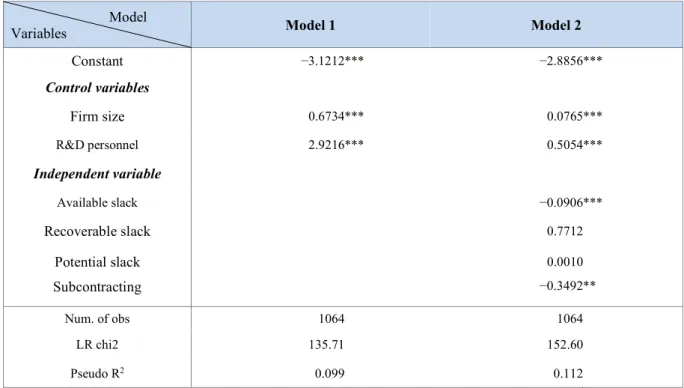
Table 4 presents the result of a logistics regression analysis on the internationalization of SMEs. Model 1 is the result of analyzing control variables, and Model 2 is the result of including all independent variables. First, Model 1
24 shows that both the firm size and R&D personnel were significant at the 0.01 level. The firm’s overseas expansion is related to the level of resources held by companies. Therefore, both the firm size and the R&D personnel, which represented firm’s important ability and resources, were expected to be significant in statistics.
Model 2 shows the result for independent variables. First, regarding slack resources analysis, only available slack out of the three slack resources showed statistically significant results, whereas recoverable and potential slack resources did not show significant values. Available slack resources have a negative relationship with internationalization, which can be interpreted as the shrink of SMEs’ overseas expansion as cashable assets increase. Thus, Hypothesis 1 was not supported.
Second, for the analysis of subcontracting and internationalization, results also showed a negative relationship between subcontracts and the internationalization of SMEs. This means that more subcontracting SMEs focus more on the domestic market than overseas, implying that the subcontracting transaction is not helpful to the financial benefits of SMEs and that it is difficult to lead to internationalization. Thus, hypothesis 2 was supported.
5. Conclusion and Limitation
This study empirically analyzes the effect of SMEs’ slack resources and subcontracting situations on internationalization. Results of the analysis reveal the opposite results of previous studies that showed that available resources with high cashable assets play a complementary role in SMEs, ultimately positively affecting internationalization. Further research is needed to determine whether this is caused by the characteristics of SMEs. Supposedly, compared to large firms, SMEs lack essential resources, and thus, strategies such as entering overseas markets with relatively high risks are a difficult choice. This can be interpreted as the more affordable financial resources of SMEs, the more stable the situation is pursued, and the more conservative the strategy is chosen. In addition, subcontracting transaction has shown a negative relationship with internationalization. This means that if SMEs with insufficient resources have a stable financial pipeline, then they are seeking stability-oriented choices, or the subcontracting transaction itself may not be positive for financial returns. In other words, depending on the subcontracting transaction, its effects on SMEs’ internationalization progress are probably negative or at least not positive.
Noting that SMEs are doing many subcontracting transactions, this study empirically examined how subcontracting itself affects the internationalization of SMEs along with the financial slack resources. These attempts can first extend the scope of existing slack resources mainly focusing on large enterprises to SMEs and then provide practical implications to managers and policymakers by analyzing subcontracting. Finally, the relationship between the financial slack and internationalization of SMEs is analyzed.
This study provides suggestions in both academic and industrial areas. Academic research on the slack resources and internationalization of SMEs has not been much conducted due to difficulties in collecting SME data. Previous studies mainly verified the effect of slack resources on the firm’s performance or value and mainly targeted large firm and listed companies in the stock market. However, these findings are difficult to apply well to SMEs, unlike the large firm, which is not in the principal–agent structure. Therefore, analyzing how slack resources affect internationalization only for SMEs is an important attempt to expand the academic horizon.
Industrially, subcontracting transaction reflects the reality of SMEs well. Empirically analyzing how subcontracting transactions relate to the SMEs slack resources and how they affect internationalization will provide implications and ideas to managers and policymakers of SMEs.
However, the following limitations also exist in this study. First, this study used only one-year financial data. Due to the nature of financial data of SMEs, it is difficult to obtain long-term panel data. Further studies must secure annual pooling data and attempt a more detailed analysis. Second, the differences in subcontracting levels should also be included in further analysis. That is, the effect of subcontracting stage in the subcontracting hierarchy on the performance or internationalization must be verified. Third, the measurement of overseas expansion as the ratio of exports to total sales, not dummy variable, must be specified. Finally, industries must be diversified, and the moderating effect of other key variables must be analyzed.
25
References
Ahn, H. H., Hwang, S. U., & Nam, K. G. (2007). Polarization of firms as the cause of hollowing-out of Korean manufacturing Industry. Korean Journal of Labor Studies, 13(2), 27-64.
Amsden, A. H. (1989). Asia’s next giant: South Korea and late industrialization, New York: Oxford University Press. Bourgeois, L. J. (1981), On the measurement of organizational slack. Academy of Management Review, 6(1), 29-39. Chang, W. (2020). Empirical analysis and policy implications of SMEs considering subcontracting relationship
between large and small enterprises. Public Finance Forum, 292(1), 6-31.
Cheng, J., & Kesner, I. (1997). Organizational slack and response to environmental shifts: the impact of resource allocation patterns. Journal of Management, 23(1), 1–18.
Cho, Y., Ji, M., Shin, J., Park, S., Kang, M., & Park, J. (2017). Limitations of the conglomerate-dependent growth systems and SMEs’ role as new growth engine. Korea Institute for Industrial Economics and Trade, 2(1), 801-829.
Cyert, R., & March, J. (1963). The behavioral theory of the firm. Englewood Cliffs. Prentice-Hall.
Dyer, J., & Hatch, N. (2006). Relation-specific capabilities and barriers to knowledge transfers: creating advantage through network relationships. Strategic Management Journal, 27(8), 701-719
Furlan, A., Grandinetti, R., & Camuffo, A. (2007). How do subcontractors evolve? International Journal of Operations and Production Management, 27(1), 69-80.
Geiger, S. W., & Cashen, L. H. (2002). A multidimensional examination of slack and its impact on innovation. Journal of Managerial Issues, 14(1), 68-84.
George, G. (2005). Slack resources and the performance of privately held firms. Academy of Management Journal, 48(4), 661-676.
Greenley, G. E., & Oktemgil, M. (1998). A Comparison of Slack Resources in High and Low Performing British Companies. Journal of Management Studies, 35(3), 377-398.
Greve, H. (2003). A behavioral theory of R&D expenditures and innovations: Evidence from shipbuilding. Academy of Management Journal, 46(6), 685-702.
Hamel, G., & Prahalad, C. K. (1994). Competing for the future. Boston, Massachusetts: Harvard Business School Press.
Henderson, A. D., & Fredrickson, J. W. (1996). Information-processing demands as a determinants of CEO compensation. Academy of Management Journal, 39(3), 575-606.
Herold, D. M., Jayaraman, N., & Narayanaswamy, C. R. (2006). What is the relationship between organizational slack and innovation. Journal of Managerial Issues, 18(3), 372-392.
Jung, M. J., Yang, H. S., & Chung, J.-E. (2014). Analysis of research streams on Korean SMEs’ internationalization: Based on the review of KCI listed journals from. Korea Trade Review, 39(3), 145-183.
Kim, B. J., & Lim, J. (2011), Slack resources and firm’s internationalization: a longitudinal study. Korean International Business Review, 15(4), 1-23.
Kim, B. G., & Kim, G. B. (2016). Slack resources and subsidiary performance in emerging market: focus on moderating effect of local experience and competition intensity. Industrial Economics and Business, 29(2), 723-751.
Laursen, K., & A. Salter, A. (2006). Open for innovation the role of openness in explaining innovation performance among UK manufacturing firms. Strategic Management Journal, 27(2), 131-150.
Lee, S. B. (2007). The Korean government export promotion for manufacturing SMEs: a gap analysis. International Business Journal, 18(3), 1-26.
Levinthal, D. A. (1997). Adaptation on rugged landscapes. Management Science, 43(7), 934–950.
Lin, W. T., Cheng, K. Y., & Liu, Y. (2009). Organizational slack and firm’s internationalization: A longitudinal study of high-technology firms. Journal of World Business, 44(4), 397-406.
Nam, H. J. (2015). A study on R&D capabilities relative to organizational slack and firm internationalization based on granger causality test. Industrial Economics and Business, 28(3), 1151-1176.
Nam, H. J., Park, C. G., & An, Y. H. (2015). Test of non-linearity for slack resources: global financial crisis as the center. Journal of Industrial Economics and Business, 28(4), 1639-1662.
Nohria, N., & Gulati, R. (1996). Is slack good or bad for innovation. Academy of Management Journal, 39(5), 1245-1264.
Ok, C. H., & Back, Y. (2015). The relationship between slack resources of venture firms and internationalization: moderating effects of domestic industry characteristics. International Business Journal, 26(4), 1-35.
26 Park, J. H., Sung, Y. D., & Lee, D. H. (2014). CEO experience and firm internationalization: the moderating effect of
CEO power. International Business Journal. 25(1), 29-58.
Park, M. S., Son, H. J., & Lee, H. H. (2011). Classification of the subcontracting companies accompanied by R&D capabilities compare and research. Journal of Information Technology and Architecture, 8(2), 121-135.
Pla-Barber, J., & Alegre, J. (2007). Analysing the link between export intensity, innovation and firm size in a science-based industry. International Business Review, 16(3), 275-293.
Porter, M. (1979). How competitive forces shape strategy. Harvard Business Review, 57(2), 137-145.
Ramaswamy, K., Kroeck, K. G., & Renforth, W. (1996). Measuring the degree of internationalization of a firm: a comment. Journal of International Business Studies, 27(1), 167–177.
Rhee, J. H., & Cheng, J. L. C. (2002). Foreign market uncertainly and incremental international expansion: the moderating effect of firm, industry, and host country factors. Management International Review, 42(4), 419-439. Ryu, D. W., & Kim, K. K. (2020). The effect of entrepreneurial orientation, learning orientation and dynamic capability on international performance: moderating effects of slack resource. Korea Trade Review, 45(5), 161-179.
Sapienza, H. J., Autio, E., George, G., & Zahra, S. A. (2006). A capabilities perspective on the effects of early internationalization on firm survival and growth. Academy of Management Review, 31(4), 917-933.
Sharfman, M., Wolf, G., Chase, R., & Tansik, D. (1988). Antecedents of organizational slack. Academy of Management Review, 13(4), 601-614.
Singh, J. (1986). Performance, slack, and risk taking in organizational decision making. Academy of Management Journal, 29(3), 562-585.
Tourigny, L. (2006). Delegating decision making in health care organizations. Health Care Manager, 25(2), 101–113. Tseng, C. H., Tansuhaj, P., Hallagan, W., & McCullough, J. (2007). Effects of firm resources on growth in
multinationality. Journal of International Business Studies, 38(6), 61-974.
Voss, G. B., Sirdeshmukh, D., & Voss, Z. G. (2008). The effects of slack resources and environmental threat on product exploration and exploitation. Academy of Management Journal, 51(1), 147–164.