The Effect of Learning Support Leadership on Learning Agility and Job
Satisfaction of Organizational Members
Moon Jun Kim*, Su Hee Kim**
*Research Professor, KNU Corporate Management Institute, Kongju National University,
**Assistant Professor, Sungkyul University Department of Early Childhood Education,
[email protected]*, [email protected]**
Abstract
We study is to confirm the influence of the manager's learning support leadership perceived by the organizational members of small and medium-sized ICT companies on the learning agility and job
satisfaction of the organizational members. In addition, this study was to confirm the relationship between learning agility and job satisfaction and the mediating effect of learning agility. To this end, the statistical package program SPSS 24.0 and SPSS PROCESS Macro Model were used for 352 copies. In other words, the results of analysis through frequency analysis, reliability analysis, factor analysis, regression analysis, and bootstrapping method to verify the established research hypothesis are as follows. First, the leadership of the manager's learning support showed a positive effect on job satisfaction. Second, the leadership of the manager's learning support showed a positive effect on learning agility. Third, learning agility was
statistically significant in job satisfaction. Fourth, learning agility showed a mediating effect between learning support leadership and job satisfaction. As shown in the results of this study, it was shown that in order to improve the job satisfaction of organizational members, the learning support leadership of the manager and the learning agility of the members can be systematically improved. In other words, in terms of strategic human resource management and strategic human resource development, the organization was required to establish systematic systems and continue to implement them. In particular, there was a need for the development and operation of programs that could develop and improve competency for learning support leadership and learning agility.
Keywords: learning support leadership, learning agility, job satisfaction, risk sensibility, organization members,
positive effect
1. INTRODUCTION
In the recent advent of the 4th Industrial Revolution based on ICT (Information and Communications Technology: ICT) and a global pandemic, organizations are demanding new leadership forms for survival and growth, such as learning immersion · support leadership and learning agility [1]. Advancement of an organization's sustainability management system can be determined by how independent members of the organization improve learning agility and job satisfaction. Managers need leadership in learning support that
IJACT 21-3-21
Manuscript received: February 15, 2021 / revised: February 24, 2021 / accepted: March 3, 2021 Corresponding Author: [email protected]
supports organizational members to realize the importance of their job values and to demonstrate their competencies. The learning support leadership of the organization manager removes the negative factors of organizational members and contributes the learning results to organizational performance through psychological stability and achievement motivation [2]. Leaders' Learning Support Leadership is a mentor, coach, and transformative leader who motivates members of the organization to acquire new knowledge and skills required for differentiated competitiveness and to strengthen job satisfaction through use [3]. On the other hand, learning agility can be said to be a factor that improves organizational performance and job satisfaction by utilizing various knowledge, information, and technologies acquired through various job experiences subjectively by members of the organization in accordance with changes in the business environment [1]. Learning agility serves as a key factor that promotes the improvement of individual and organizational performance and organizational effectiveness for members of the organization based on the know-how learned through quick understanding of changes in the management environment, situation judgment, and direct and indirect job experience [4]. Organizational satisfaction is a subjective and multidimensional concept recognized by members of the organization. In other words, it is the sentiment of the members of the organization on the job performance, which directly affects the job performance result. Job satisfaction is the degree to which the members of the organization agree with their expectations for emotional and psychological well-being for their job performance and is affected not only by the job itself but also by various factors surrounding the job [5]. The organization was desperately required for a new action plan to improve the job satisfaction of its members in order to advance the sustainability management system after the post-coronavirus. Therefore, this study aimed to provide the importance of managers' learning support leadership and learning agility as factors to improve job satisfaction of organization members.
2. THEORETICAL CONSIDERATION
2.1. The Relationship between Learning Support Leadership and Job Satisfaction
Leadership is the process of setting organizational goals and establishing and implementing specific plans to induce direct participation of members of the organization to achieve the goals [3]. Learning support leadership is the same concept as learning commitment leadership and learning management leadership. In other words, it is a comprehensive process for the activities of presenting a post-learning behavioral model and the support necessary to achieve the set learning goal so that members of the organization can acquire new knowledge and skills with a positive attitude [6]. Job satisfaction is a subjective and multidimensional concept of organizational members' job performance results, and is a positive attitude toward job performance [7]. Job satisfaction is not only a job, but also various environmental factors such as compensation, promotion, relationship, responsibility, and self-realization surrounding the job, and the result can be called job satisfaction [5]. On the other hand, the direct study between the supervisor's learning support leadership and job satisfaction is absolutely insufficient, and the results of similar studies are as follows. The leadership of the leader's learning support perceived by the members of the organization showed a positive (+) effect on organizational effectiveness [3]. In companies, job support from supervisors was a positive factor in job enthusiasm, a form of job satisfaction [8]. Learning support leadership was analyzed as a positive factor in organizational effectiveness in the learning organization at the bank branch office [9]. In a study of police officers, the supervisor's learning support showed a positive (+) effect on the work commitment and job performance of the members of the organization [10]. Therefore, in this study, the following hypothesis was established based on the results of similar preceding studies, although the study between the direct influence between learning support leadership and job satisfaction was insufficient.
Hypothesis 1. Learning support leadership will have a positive (+) effect on organizational satisfaction.
2.2. The Relationship between Learning support Leadership and Learning Agility
The learning support leadership of the manager is the leadership implemented by the organizational leader to the organizational members for the purpose of reinforcing the learning necessary to improve the job competency of the organizational members [6]. Learning agility means that the members of the organization create positive organizational outcomes through systematic change induction for continuous growth and development [4]. In other words, it means the will and ability to learn and use it in a timely manner in order to improve the sensitivity of new knowledge, technology and information in a changing business environment [11]. Learning agility is an individual's ability and capacity to successfully perform new and difficult job roles from various experiences of an organizational member [1]. Although direct and indirect studies on the influence relationship between learning support leadership and learning agility were insufficient, the hypothesis was established through similar studies as follows. The self-leadership of nursing students showed a positive effect on learning agility [12]. On the other hand, learning support leadership had a positive effect on learning agility and a similar concept, learning orientation [3]. Therefore, in this study, although direct and indirect research on learning support leadership and learning agility is absolutely insufficient, the hypothesis was established as follows based on similar preceding studies.
Hypothesis 2. Learning support leadership will have a positive (+) effect on learning agility. 2.3. The Relationship between learning agility and job satisfaction
Learning agility is an activity in which members of an organization achieve their goals through positive actions and initiatives from a new perspective without being bound by existing knowledge, skills and procedures to improve their job competency [13]. Job satisfaction is the sum of emotions experienced by members of the organization in relation to their job, and can be said to be a key factor leading to the achievement of organizational goals [14]. The higher the job satisfaction of an organization member, the more job-related learning becomes possible. It is also determined by multidimensional factors that act as positive factors for improving organizational performance through an active and cooperative attitude [15]. Although direct research on the influence relationship between learning agility and job satisfaction is insufficient, a research hypothesis was established through the following preceding studies. In a study on secondary school teachers, learning agility had a direct positive (+) effect on job satisfaction and an indirect effect on job satisfaction through positive psychological capital [16]. In a study of childcare teachers in the Jeonnam region, learning agility was statistically significant in job satisfaction [17]. In a study of K companies, learning agility showed a positive (+) effect on employees' work commitment [18]. The learning agility perceived by the organizational members of the social economic organization showed a positive influence on organizationality [1]. Therefore, this study set up a hypothesis as follows based on previous studies to confirm the relationship between learning agility and job satisfaction.
Hypothesis 3. The Learning agility of organization members will have a positive (+) effect on job satisfaction.
2.4. Mediating effect of learning agility
Learning agility is learning experience, which is an informal individual ability for successful performance of new and difficult job roles from various experiences that organization members have acquired from learning phenomena occurring in the workplace [3]. In other words, learning agility is the ability to apply to successfully perform a job in a new and challenging environment [4]. Although there is no direct study on the mediating effect of learning agility between learning support leadership and job satisfaction, similar preceding studies are as follows. In the relationship between the S insurance company leader-member
behavior increases as learning agility increases was verified [19]. In addition, learning agility showed a partial mediating effect in the relationship between the job characteristics of military officers and organizational commitment[20]. As a result of verifying the mediating effect of learning agility and career adaptation in the influence of hotel members' informal learning on leading career behavior, learning agility showed a positive (+) mediating role [21]. Therefore, this study established the hypothesis as follows based on previous studies on the mediating effect of learning agility between learning agility and job satisfaction.
Hypothesis 4. The learning agility of organization members will have a mediating effect between learning support leadership and job satisfaction.
3. RESEARCH METHOD
3.1. Research ModelThe purpose of this study is to confirm the relationship between the manager's learning support leadership perceived by the organization member on the learning agility and job satisfaction of the organization member. In addition, this study was to confirm the relationship between learning agility and job satisfaction and the mediating effect of learning agility. In other words, a research model is presented as shown in Figure 1 to improve the learning support leadership and learning agility, which are newly emerging in the improvement of job satisfaction of organization members.
Figure 1. Research model
3.2. Analysis Method
In this study, 387 of 410 questionnaires were collected from November 9, 2019 to December 10, 2019 for about 5 weeks, targeting organization members. Among them, 352 copies were used, excluding 35 copies that could not be processed statistically, and the statistical package programs SPSS 24.0 and SPSS PROCESS Macro Model were used. That is, frequency analysis, reliability analysis, factor analysis, regression analysis, and bootstrapping method were conducted.
3.3. Operational Definition
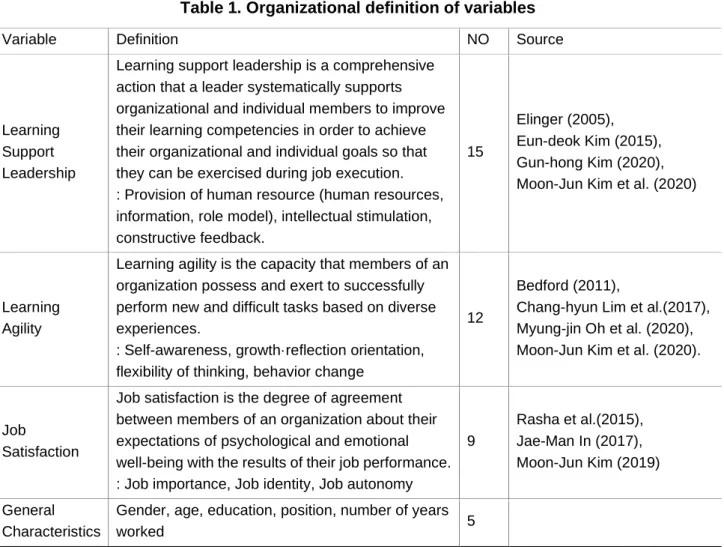
The main variables of this study, such as learning support leadership, learning agility, and job satisfaction, were measured in the Likert 5-point scale method by modifying and supplementing the items verified in previous studies to suit the research purpose. In other words, the purpose of this study was to confirm the relationship between the manager's learning support leadership perceived by the organization members on the learning agility and organizational satisfaction of the organization members. The operational definition of the variables for this study model is shown in Table 1.
Table 1. Organizational definition of variables
Variable Definition NO Source
Learning Support Leadership
Learning support leadership is a comprehensive action that a leader systematically supports organizational and individual members to improve their learning competencies in order to achieve their organizational and individual goals so that they can be exercised during job execution. : Provision of human resource (human resources, information, role model), intellectual stimulation, constructive feedback.
15
Elinger (2005), Eun-deok Kim (2015), Gun-hong Kim (2020), Moon-Jun Kim et al. (2020)
Learning Agility
Learning agility is the capacity that members of an organization possess and exert to successfully perform new and difficult tasks based on diverse experiences.
: Self-awareness, growth·reflection orientation, flexibility of thinking, behavior change
12
Bedford (2011),
Chang-hyun Lim et al.(2017), Myung-jin Oh et al. (2020), Moon-Jun Kim et al. (2020).
Job
Satisfaction
Job satisfaction is the degree of agreement between members of an organization about their expectations of psychological and emotional well-being with the results of their job performance. : Job importance, Job identity, Job autonomy
9 Rasha et al.(2015), Jae-Man In (2017), Moon-Jun Kim (2019) General Characteristics
Gender, age, education, position, number of years
worked 5
4. EMPIRICAL ANALYSIS RESULT
4.1. Demographic CharacteristicsTo achieve the purpose of this study, the results of frequency analysis for general characteristics (352 persons) are as follows. The gender was 227 (64.4%) for males and 125 (35.6%) for females. The age distribution was 158 people in their 30s (44.9%), 142 people in their 40s (40.4%), and 52 people in their 50s or older (14.7%). The academic background was 171 people college graduates (48.6%), vocational college graduates 120 people (34.1%), high school graduates 35 people (9.9%), and graduate school graduates 26 people (7.4%). By position, 118 people (33.5%) deputies, 95 people managers (27.0%), 74 people employees (21.0%), 58 people vice-managers (16.5%), and 7 people executives or above (2.0%) were analyzed. The number of years worked is 141 people (40.1%) under 7 years, 87 people (24.7%) under 5 years, 68 people (19.3%) under 10 years, 38 people (10.8%) poor in 3 years, 18people (5.1%) over 10 years.
4.2. Feasibility and Reliability Analysis
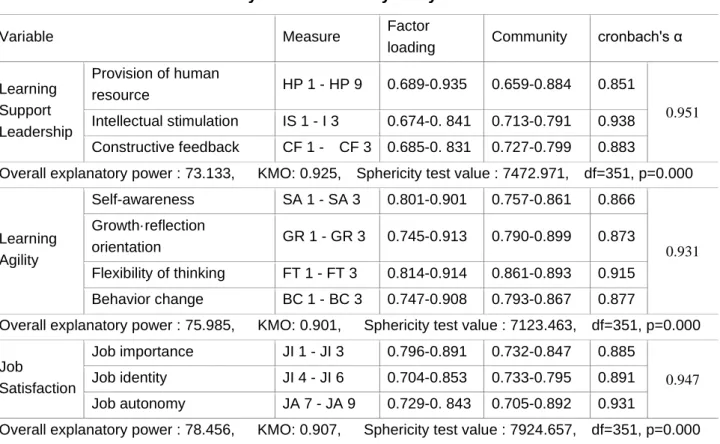
The validity of the variables in this study is the principal component extraction method that extracts factors based on the total variance, and the factor analysis results are shown in Table 2.
Table 2. Factor analysis and reliability analysis results of variables
Variable Measure Factor
loading Community cronbach's α
Learning Support Leadership Provision of human resource HP 1 - HP 9 0.689-0.935 0.659-0.884 0.851 0.951 Intellectual stimulation IS 1 - I 3 0.674-0. 841 0.713-0.791 0.938 Constructive feedback CF 1 - CF 3 0.685-0. 831 0.727-0.799 0.883
Overall explanatory power : 73.133, KMO: 0.925, Sphericity test value : 7472.971, df=351, p=0.000
Learning Agility Self-awareness SA 1 - SA 3 0.801-0.901 0.757-0.861 0.866 0.931 Growth·reflection orientation GR 1 - GR 3 0.745-0.913 0.790-0.899 0.873 Flexibility of thinking FT 1 - FT 3 0.814-0.914 0.861-0.893 0.915 Behavior change BC 1 - BC 3 0.747-0.908 0.793-0.867 0.877
Overall explanatory power : 75.985, KMO: 0.901, Sphericity test value : 7123.463, df=351, p=0.000 Job Satisfaction Job importance JI 1 - JI 3 0.796-0.891 0.732-0.847 0.885 0.947 Job identity JI 4 - JI 6 0.704-0.853 0.733-0.795 0.891 Job autonomy JA 7 - JA 9 0.729-0. 843 0.705-0.892 0.931
Overall explanatory power : 78.456, KMO: 0.907, Sphericity test value : 7924.657, df=351, p=0.000 Overall explanatory power: The percentage of cumulative variance in the total sample that explains the entire variable,
KMO: sample suitability indicator (Kaiser-Meyer-Olkin: KMO),
Sphericality test value: Bartlett sphericity test (chi-square distribution): Approximated-X², df=351, The significance probability is Bartlett's p-value.
In other words, the number of factors is determined by extracting only factors having an eigen value of 1 or more that describe one or more variances. Meanwhile, the sample suitability measurement index (Kaiser-Mayer-Olkin: KMO), an index indicating whether the entire correlation matrix is suitable by factor analysis, is as follows. Learning support leadership (0.925), learning agility (0.901), and job satisfaction (0.907) exceeded the standard of 0.8. Therefore, it was indicated that the use of factor analysis was appropriate and that common factors existed. In addition, the Bartlett sphericity test, which determines whether the correlation coefficient matrix is a diagonal matrix by calculating the value of the correlation coefficient determinant of the sample extracted from the population, used a chi-square distribution. As a result, Approximated-χ² is as follows. That is, learning support leadership (7472.971), learning agility (7123.463), and job satisfaction (7924.657) were expressed, and the analysis data and measurement items were analyzed to be suitable for performing factor analysis with df=351 and p=0.000. On the other hand, the correlation of this study model was analyzed based on the result of factor analysis of the Pearson correlation.
In other words, the multicollinearity measured by the variance inflation factor (VIF) looks at the correlation between predictive models for the dependent variable. Therefore, the VIF value for verifying the multicollinearity of this study was found to have no problem in the range of 2.339 to 2.591. Therefore, it can be judged that the β value of the regression model in this study has stability and reliability, and the introduced variable is suitable for verification, indicating that regression analysis is possible.
4.3. Hypothesis Verification
4.3.1. Analysis of Mediating Effects of Learning Agility on Job Satisfaction of Learning Support Leadership
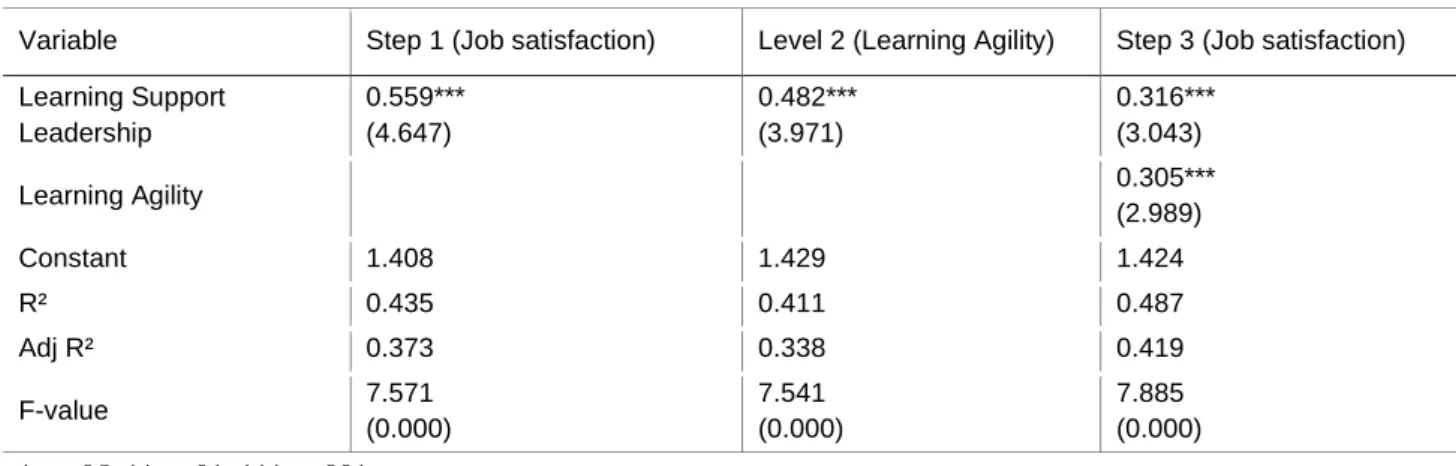
This study was aimed at organizational members who are employed by small and medium-sized ICT companies. To this end, the results of the survey conducted a hierarchical regression analysis of to analyze the mediating effect of learning agility in the effect of learning support leadership on job satisfaction [22]. On the other hand, the results of verifying the hypotheses set to achieve the research purpose are shown in Table 3. Regression analysis was performed over three stages for hypotheses (hypothesis 1-4) set according to the research model. Therefore, as a result of regression analysis over the first stage (hypothesis 1), second stage (hypothesis 2), and three stages (hypothesis 3 and hypothesis 4), all regression coefficients were found to be significant at the 1% level (p<0.001).
First, hypothesis 1 showed that the independent variable, learning support leadership, had a significant positive (+) effect on the dependent variable, organizational satisfaction, in the first-stage regression equation. Therefore, the hypothesis 1, “Leadership support for learning will have a positive effect on organizational satisfaction” was adopted. In other words, the results of previous studies [3, 8-10] supported the results of this study. Therefore, in order to improve the job satisfaction of organization members, the need to systematically and further improve the learning support leadership of managers emerged.
Second, for Hypothesis 2, it was found that the independent variable, learning support leadership, had a significant positive (+) effect on the parameter, learning agility, in the two-stage regression equation. Therefore, the hypothesis of two learning support leadership was adopted as it would have a positive effect on learning agility. The results of this study show that, as in previous studies [3, 12], learning support leadership is a major factor in improving the learning agility of members of the organization. In other words, in order to improve learning agility, the development and execution of programs to improve learning support leadership was required.
Third, to test hypothesis 3, the effect of learning agility on job satisfaction was analyzed while controlling the effect of learning support leadership on job satisfaction by applying learning support leadership and learning agility in a three-stage regression equation. As a result, it was found that the regression coefficient had a significant positive (+) effect at the 1% level (p<0.01). Therefore, the hypothesis 3, learning agility, was adopted as statistically significant in job satisfaction. This is shown in the results of previous studies [1, 16-18]. In other words, it was shown that the improvement of job satisfaction through the advancement of the organization's sustainability management system is improved by learning agility.
Fourth, in Table 3, the effect of learning support leadership on job satisfaction and the magnitude of the effect of learning support leadership through learning agility as a parameter on job satisfaction were compared. As a result, when looking at the regression coefficient (β), the third step (β=0.316) was smaller than the first step (β=0.559). This means that when learning support leadership affects job satisfaction, learning agility plays a part as a mediator. Therefore, the hypothesis that learning agility has a mediating effect was adopted in the influence of the hypothesis 4-member learning support leadership on job satisfaction. This indicated the importance of the mediating effect of learning agility, as in previous studies [19-21].
Table 3. Analysis of mediating effect of learning agility on job satisfaction of learning support leadership
Variable Step 1 (Job satisfaction) Level 2 (Learning Agility) Step 3 (Job satisfaction) Learning Support Leadership 0.559*** (4.647) 0.482*** (3.971) 0.316*** (3.043) Learning Agility 0.305*** (2.989) Constant 1.408 1.429 1.424 R² 0.435 0.411 0.487 Adj R² 0.373 0.338 0.419 F-value 7.571 (0.000) 7.541 (0.000) 7.885 (0.000) * p<.05, **p<.01, ***p<.001
4.3.2. Verification of the Mediating Effect of Learning Agility
This study analyzed the significance of the mediating effect size using the Bootstrapping method [23] to verify the mediating effect on learning agility. This is a verification method for mediating effects that complements the existing methods, and does not require the assumption of a normal distribution of estimates. In this study, in order to verify the magnitude of the mediating effect of learning agility in the influence of learning support leadership on job satisfaction, the value was extracted by repeating boost-trapping as SPSS PROCESS Macro Model 4 [23]. The results were analyzed as shown in Table 4. That is, the 95% confidence interval lower limit of 0.109 and upper limit of 0.385 did not contain 0 in the interval between the lower and upper limits, indicating a significant mediating effect of learning agility. Therefore, it was verified that learning agility would have a mediating effect in the influence of the hypothesis 4-member learning support leadership on job satisfaction.
Table 4. Booststrapping to verify the mediating effect of learning agility
Variable Bootstrapping
Mediating effect factor
Bootstrapping
standard error 95% confidence interval
Variable Bootstrapping
Mediating effect factor
Bootstrapping standard error Lower Bootstrapping Limit Bootstrapping upper limit Learning Agility 0.214 0.061 0.109 0.385
5. CONCLUSION
This study was to confirm the mediating effect of learning agility in the effect of learning support leadership on job satisfaction for the organizational members of small and medium-sized ICT companies. For this purpose, the main verification results for the research hypothesis established according to the research model through the final 352 part are as follows. First, the hypothetical one-man learning support leadership showed a positive (+) effect on job satisfaction. Second, it was found that the hypothetical 2-person learning support leadership had a positive (+) effect on learning agility. Third, the hypothesis of 3 learning agility showed a positive effect on job satisfaction. Fourth, when the hypothetical 4-member learning support leadership has a positive effect on job satisfaction, learning agility has a partial mediating
effect. In addition, the results of verifying the mediating effect of learning agility through the SPSS PROCESS Macro Model 4 are shown as follows. In other words, it was shown that the mediating effect of learning agility was significant because 0 was not included between the lower and upper limits in the 95% confidence interval. Meanwhile, the main theoretical implications presented through this study are as follows.
First, this study is an additional empirical analysis on the mediation of learning agility in the influence of learning support leadership on job satisfaction. Second, the theoretical discussion on learning support leadership, learning agility, and organizational satisfaction is presented. Third, in order to advance the organization's sustainability management system with the advent of the 4th Industrial Revolution, the importance of the mediating role of learning agility as well as the influence of the manager's learning support leadership on learning agility and job satisfaction was theoretically reaffirmed. In addition, the practical implications expressed through the results of this study are as follows. First, it is possible to derive the need for learning support leadership and learning agility as a new alternative for improving the job satisfaction of organization members in the era of the 4th industrial revolution. Second, in order to improve the job satisfaction of members of the organization, the need to enhance job satisfaction through leadership in learning support based on the principle of mutual benefit and a sense of responsibility for learning agility was required. Third, in order to systematize and enhance individual job satisfaction, the importance of strategic human resource development to improve the learning support leadership capability and learning agility of managers was required. Despite these major results, this study has a limitation of the study that it targets the organizational members of a specific company. Therefore, in future studies, it is necessary to apply various variables for improving job satisfaction through various sample numbers.
REFERENCES
[1] Kim Moon Jun (2020), “The Influence of Learning Agility Perceived by Organization Members on Organizational Performance: Focused on Social Economy Organization”, Technology Management, 5(3), 173-191. DOI : 10.33443/tm.2020.5.3.173
[2] Tracey J. B. and M. J. Tews (2002), “Construct validity of a general training climate scale”, Organizational research methods, 8(4), 353-374. https://doi.org/10.1177/1094428105280055
[3] Moon-jun Kim, Su-hee Kim (2020), “The Effect of Leader Learning Support Leadership on Learning Orientation and Organizational Effectiveness”, Korean Review of Corporation Management, 11(4), 209-232. http://dx.doi.org/10.20434/KRICM.2020.11.11.4.209.
[4] De Meuse K. P. (2017), “Learning Agility: Its evolution as a psychological construct and its empirical relationship to leader success”, Consulting Psychology Journal: Practice and Research, 69(4), 267-295. DOI: 10.1037/cpb0000100
[5] Moon Jun Kim (2020), “The Effect of Organizational Culture and Job Environment Characteristics Perceived by Organization Members on Job Satisfaction”, International journal of internet, broadcasting and communication, 12(4), 156-165. https://doi.org/10.7236/IJIBC.2020.12.4.156
[6] Russ-Eft (2002), “A Typology of training design and work environment factors affecting workplace learning and transfer”, Human Resource Development Review, 1(1), 45-65.
[7] Netermeyer, R. G. & J. G. Maxham Ⅲ (2007), “Employee Versus Supervisor Ratings of Performance in the Retail Customer Service Sector: Differences in Predictive Validity for Customer Outcomes”, Journal of Retailing, 83(1), 131-145. DOI: 10.1016/j.jretai.2006.10.009
[8] Ah-ra Oh (2013), “An Empirical Study on the Job Engagement: Relationship between Antecedents, Organizational Citizenship Behavior and Innovation Behavior”, Sogang University Graduate School of Business Ph.D. Thesis
[9] Eun-Duk Kim (2015), “The Influence of Branch Manager's Learning Support Leadership on
Organizational Effectiveness in Learning Organizations at Bank Branch Units”, Korea Educational Engineering Association, 2015(1), 29.
[10] Kim Geun-ho, Jang Won-seop & Son Jeong-eun, Choi Gyu-il(2019), “A Study on Managerial Learning Support, Knowledge Sharing and Work Engagement Affecting Task Performance of Police Officers”, Research on Public Security Policy, 33(1), 39-72. DOI: 10.35147/knpsi.2019.33.1.39
[11] Bedford, C. L. (2011), “The role of learning agility in workplace performance and career advancement”, Unpublished doctoral dissertation. University of Minnesota.
[12] Lim Kyung-hee, Lee In-suk (2020), “The Influence of Nursing Students' Self Leadership and
Achievement Motivation on Learning Agility”, Korean Society of Nursing Science, Korean Academy of Nursing Science Conference, 2020(10),106-106.
http://www.dbpia.co.kr/journal/articleDetail?nodeId=NODE10477993
[13] Grant A. M. and S. J. Ashford (2008), “The dynamics of pro-activity at work”, Research in Organizational Behavior, 28,3-34. http://dx.doi.org/10.1016/j.riob.2008.04.002
[14] Kaliski, B.S. (2007). Encyclopedia of Business and Finance, Second edition, Thompson Gale, Detroit, 446. https://doi.org/10.1111/j.1532-5415.1984.tb02265.x
[15] Moon Jun Kim (2020), “The Effect of Leadership Types of Managers Perceived by ICT Organization Members on Leadership Trust and Job Satisfaction”, International Journal of Advanced Smart
Convergence, 9(2), 212-223. http://dx.doi.org/10.7236/IJASC.2020.9.2.212
[16] Youn gil Kim, Kiung Ryu (2020), “The Structural Relationships Between Self-directed Learning Ability, Learning Agility, Positive Psychological Capital, and Job Satisfaction of Secondary School Teachers ”, The Journal of Humanities and Social science, 11(2), 1225-1240.
DOI http://dx.doi.org/10.22143/HSS21.11.2.85
[17] Jin-Sook Choi, Jung-Youn Ha & Dae-Myung Kim and Jiyeon Kang (2020), “The Effects of Child Care Teachers' Professionalism, Learning Agility and Positive Psychological Capital on Their Job
Satisfaction”, The Korea Contents Society, 20(3), 116-130. DOI: 10.5392/JKCA.2020.20.03.116 [18] Kwon, Se-Hyun, Lee Jin Gu (1980), “Structural Relationships among Job Challenge, Learning Agility,
Work Engagement and Innovative Work Behavior: Focusing on K Enterprise”, Agricultural education and human resource development, 52(2), 83-107. DOI: 10.23840/agehrd.2020.52.2.83
[19] Jong min Han (2018), “Mediating effect of learning agility in the relationship between S insurance company leader-member exchange relationship (LMX) and employee innovation behavior”, Korea University Graduate School of Education Master's Thesis
[20] Jeon Ki Seok, Choi Soon won (2020), “Relationship between Military Non-Commissioned Officer’s Job Characteristics and Organizational Commitment : The Mediating Effect of Learning Agility”, Korean Military Journal, 76(2), 99-126. DOI: 10.31066/kjmas.2020.76.2.005
[21] Suyeon Kim, LEE HEE SU (2020), “The Effect of Hotel Employee’s Informal Learning on Proactive Career Behavior: Mediating Effects of Learning Agility and Career Adaptability”, Journal of Tourism Management Research, 97, 481-508. http://dx.doi.org/10.18604/tmro.2020.24.4.23
[22] Baron, R. M., & Kenny, D. A. (1986), “The moderator- mediator variable distinction in social
psychological research: Conceptual, strategic, and statistical considerations”, Journal of Personality and Social Psychology, 51(6), 1173-1182.
[23] Hayes, A. F. (2013), “Introduction to mediation, moderation, and conditional process analysis: A regression-based approach”, New York, NY: Guilford.