- 30 -
The Application of Laser Doppler Flowmetry for
Allergic Rhinitis and Rhinitis Medicamentosa
Jeung-Gweon Lee, M.D.1, Joo -Heon Yoon, M.D.1 , 2, Hyun Jun Kim, M.D.1,In Suk Moon, M.D.1, Jae -Yol Lim, M.D.1 and Jong Bum Yoo, M.D.1
ABSTRACT
Background and Objectives:Allergic rhinitis (A R) and rhinitis medicamentosa (RM ) have different mucosal color and
pathophysiology. To investigate whether the mucosal color and nasal blood flow are different between the diseases in spite of same symptoms, we designed this study. Materials and Methods:20 patients with allergic rhinitis and 21 patients with rhinitis medicamentosa were compared with 20 normal volunteers using mucosal color grading and Laser Doppler flowmetry. The Laser Doppler flowmetry was performed with a Periflux 4001 (Perimed, Jrtlla, Sweden) and perfusion unit (PU), velocity unit (VU), and concentration Unit (CU) were measured. The Laser Doppler flowmetry data in AR and RM were compared with those of the normal subjects, and between A R and RM. Results:The perfusion score of AR and RM were lower than the control (p<0.05) and it was statistically significant that the mucosal color of AR were pale and of RM were reddish, comparing to the control group (p<0.05). Conclusion:The nasal blood flow was decreased with AR and RM compared to control but the mucosal color of AR and RM were different because of the difference of pathophysiology of diseases. When diagnosing RM, observation of mucosal color and measurement of nasal blood flow will be helpful besides the history of long-term use of nasal decongestant.
KEY WORDS:Laser Doppler flowmetry ・Nasal blood flow・Mucosal color・Rhinitis medicamentosa・Allergic rhinitis.
INTRODUCTION
The interrelationship between mucosal findings and mucosal perfusion in inflammatory nasal diseases have been very helpful in the clinical diagnosis and treatm-ent of this disorder. Allergic rhinitis is an inflammatory disease of the nasal mucosa that has main symptoms such as itching, sneezing, watery rhinorrhea and nasal obstruction. It shows pale and bluish mucosal findings. Within minutes of exposure to an allergen, mediators such as histamine, tryptase, prostaglandin D2, leuco-triene C4, kinin and so forth are secreted and an early response occurs which is followed by findings such as
vasodilation, increase of vascular permeability and mucosal edema. Thereafter 3-11 hours, eosinophil, neutrophil and histamine, TAME esterase, kinin and so forth increase followed by a late response that causes nasal obstruction, sneezing and rhinorrhea.1)2)
Differently, Fox3) first stated the possibility of rhi-nitis medicamentosa in 1931 and in 1946 Lake4) for the first time named it rhinitis medicamentosa. This is a disorder where nasal obstruction is complained after longterm use of sympathomimetics. It shows reddish mucosal findings that cause rebound vasodilatation and mucosal congestion. The clinical expressions may vary by the type of medication or the patient.5) About the pathophysiology of this disorder, Baldwin6) et al., reported that the stimulating effec t of the β-receptors of symapthomimetics exceeds the stimulating effect of α-receptors which causes noradrenaline depletion in the nerve endings that cause tolerance. However, other possibilities such as rebound vasodilation caused by ischemia and edema,7) over-stimulaiton of α-2 recep-tors8) and over-acceleration of parasympathetic nerves9) are mentioned as well.
1
Department of Otorhinolaryngology, 2the BK21 Project for Me-dical Science, Yonsei University College of Medicine, Seoul, Korea
Address correspondences and reprint requests to Jong Bum Yoo, M.D., Department of Otorhinolaryngology, Yonsei University College of Medicine, 134 Shinchon-dong, Seodaemun-gu, Seoul 120-752, Korea
Tel:82-2-361-8489, Fax:82-2-393-0580 E-mail:[email protected] Accepted for publication on October 5, 2002
Until now, methods such as Hydrogen clearance method10) or Xenon washout method11) have been used to measure nasal mucosal perfusion, however, they are all invasive and have a limit in measuring physiologic nasal mucosal perfusion. Thereafter, Stern12) first intro-duced a noninvasive method where the dopper theory is used to measure the micro-circulating perfusion. Olsson13) et al., introduced Laser Doppler blood fl-owmetry for mucosal perfusion measurement. Laser Doppler blood flowmetry has excellent reproducibility and is noninvasive and because it shows mucosal perfusion precisely, it has been actively used in the research of the pathophysiology of the nasal mucosa.14) It has also been valuably used in the evaluation of the nasal mucosa state in our country as well.15)
Therefore in this study we wish to compare the ab-normal mucosal color and mucosal perfusion findings in allergic rhinitis and rhinitis medicamentosa patients using laser Doppler flowmetry and to assist in clinically adopting it.
MATERIAL AND METHOD
Experimental Group
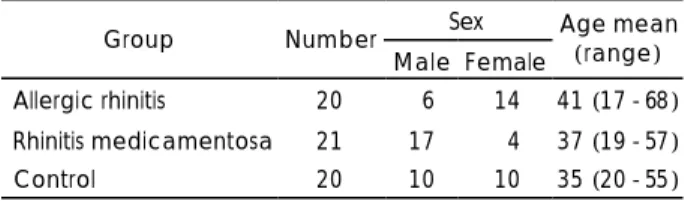
This study was based on 20 patients that visited our OPD from November through December 2001 that were diagnosed with perennial allergic rhinitis through an intradermal skin test and whose chief complaint was nasal obstruction. The age distribution ranged from 17 through 68 years old (average age 41 years old). The sex distribution was 6 male and 14 female. Also, based on 21 rhinitis medicamentosa patients that visited our OPD from January 2000 through June 2002 that had accompanying nasal septal deviation and nasal obstruction caused by topical nasal decongestant used for over 6 months. The age distribution ranged from 19 through 57 years old (average age 37 years old) and the sex distribution was 17 male and 4 female. The control group consisted of 20 healthy people in a similar age group with the experimental group that had normal findings on anterior nasal inspection and had no past history of allergic rhinitis or rhinitis medicame-ntosa. The sex distribution was 10 male and 10 female and the age distribution ranged from 20 through 55 years old (average age 35 years old)(Table 1).
Experimental method
The mucosal finding was measured through obser -vation of the anterior portion of the inferior turbinate with no specific treatment before using the laser Do-ppler flowmetry. Severe pale was regarded as grade 0, pale as grade 1, severely hyperemic as grade 4, hyperemic as grade 3 and normal as grade 2. One tester carried out scoring by comparing a picture of a patient showing distinct pale or hyperemic mucosal findings. To inquire measurement of nasal perfusion using laser Doppler flowmetry, patients rested 1-2 hours before testing. Foreign bodies or crust, mucoid secretion and so forth of the nasal cavity were all removed. To measure nasal mucosal perfusion, a laser dopper flowmetry (Periflux 4001 laser doppler perfu-sion meter, Perimed, Jrtlla, Sweden) that uses 780 nm of laser beam was applied.16)
Analysis of results
The results were analyzed by an analytical program known as the Perisoft program (Perimed, Jrtlla, Sw-eden) and mucosal perfusion, velocity and RBC con-centration was measured. Measuring units used in this study were perfusion unit (PU), concentration unit (CU) and velocity unit (VU) each voluntarily named by perisoft program. Throughout the entire research period a well experienced tester of the nose function laboratory carried out all tests.
Statistical method
As a statistical method, the ANOVA test was used to compare the perfusion and RBC concentration and velocity between the allergic rhinitis and rhinitis medi-camentos group with the control group. The student T-test was applied for mucosal color comparison (p<0.05).
Table 1. Age and sex distribution of allergic rhinitis, rhinitis me-dicamentosa and control group
Sex Group Number Male Female Age mean (range) Allergic rhinitis 20 06 14 41 (17-68) Rhinitis medicamentosa 21 17 04 37 (19-57) Control 20 10 10 35 (20-55)
RESULT
Comparison of mucosal color between the alle-rgic rhinitis and rhinitis medicamentosa group with the control group.
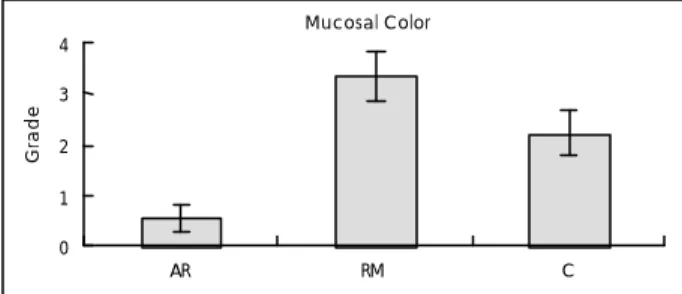
The mucosal color in allergic rhinitis was 0.55± 0.51 (mean±SD), 3.35±0.75 in rhinitis medicamen-tosa and 2.20±0.41 in the control group. Based on a multiple analysis using the ANOVA test all three group showed a significant difference among one another (p<0.05). On the other hand, an analysis based the interrelationship between the mucosal color and per-fusion using the T-test shows that when the mucosal color is 2 the perfusion is 157.43±49.10 PU, when 3, 107.63±21.47 PU and when 4, 105.91±24.55 PU. The perfusion was significantly higher when the mu-cosal color was 2, compared to when it was 3 or 4 (p< 0.05)(Fig. 1).
Comparison of perfusion between the allergic rhinitis and rhinitis medicamentosa group with the control group
The perfusion was 117.34±10.85 PU (mean±SD) in allergic rhinitis, 114.23±32.16 PU in rhinitis medi-camentosa and 154.12±21.88 PU in the control group. Based on a multiple analysis using the ANOVA test, perfusion in allergic rhinitis and rhinitis medicamen-tosa was significantly lower (p<0.05) compared to the control group, however, there was no statistical meaning between the allergic rhinitis and rhinitis medicamentosa group. Velocity and RBC concentration compared in the allergic rhinitis and rhinitis medicamentosa with the control group showed that the velocity was 158.33 ±80.27 VU (mean±SD) and the RBC concentration was 83.77±23.49 CU in allergic rhinitis, and 240.79 ±87.98 VU and 55.65±23.11 CU, relatively, in rhi-nitis medicamentosa. Based on a comparison multiple analysis using the ANOVA test of the control group where the velocity was 281.68±77.74 VU and RBC concentration was 58.77±17.15 CU, the velocity in allergic rhinitis compared to rhinitis medicamentosa and the control group, was significantly lower (p<0.05), however, there was no statistical meaning between rhinitis mediccamentosa and the control group. The RBC concentration was significantly higher (p<0.05) in allergic rhinitis compared to rhinitis medicamentosa
and the control group, however, there was no statistical meaning between rhinitis medicamentosa and the con-trol group (Table 2).
DISCUSSION
History and symptoms, nasal cavity examination all play an important role in the diagnosis and treatment of patients suspected of any rhinologic disorder. An attempt to clinically adapt an objective observation of mucosal congestion and perfusion has been executed. In such researches, rhinomanometry was mostly used for mucosal congestion evaluation, however, due its limitations as an indirect method it has been reported, on the other hand, that using laser Dopper flowmetry together has been more useful in measuring mucosal congestion and perfusion.14)
Laser Doppler flowmetry operates based on the theory of irradiating laser beam to the tissue through laser fiber where a portion is reflected back out from moving materials (usually RBC) in the tissue which causes a frequency change according to the Doppler effect. The reflected laser beam is absorbed by a photodetector where the frequency change is recorded and by a signal processor, the power is output as an electrical sign.13) Perfusion, RBC concentration and velocity are measured through this process and the tissue perfusion is proportionate to RBC concentration and velocity.
Table 2. Laser Doppler flowmetry score of allergic rhinitis. rhini-tis medicamentosa and control
Perfusion Concentration Velocity Allergic rhinitis 117.84* 83.78*† 158.33*†
Rhinitis medicamentosa 114.23* 55.65† 240.79†
Control 154.12 58.77 281.68
*:Statistically different from control, †:Statistically different between allergic rhinitis and rhinitis medicamentosa
Mucosal Color 0 1 2 3 4 AR RM C Grade
Fig. 1. Mucosal color of allergic rhinitis (AR), rhinitis medicame-ntosa (RM) and control (C).
Based on a comparison between mucosal color and perfusion between rhinitis medicamentosa and allergic rhinitis with the control group, decrease of perfusion and hyperemic mucosa findings in rhinitis medica-mentosa showed a significant difference compared to the control group, however, RBC concentration and velocity did not show any statistical difference com-pared to the control group and is, therefore, considered that despite submucosal vasodilation, perfusion was not increased. Hyperemic nasal mucosa finding is considered clinically meaningful, however, because hy-peremic findings of the nasal mucosa occurred despite no increase of RBC concentration in the rhinitis medi-camentosa, the relationship between RBC concentration and mucosal color has not been established in this study. It is estimated that there probably are other factors that affect mucosal color other than RBC con-centration, which will require further research. Also, decrease of perfusion and pale mucosal color in allergic rhinitis showed a significant difference compared to the control group. RBC concentration was high and velocity was low compared to the control group. Such decrease of perfusion is considered to be caused by RBC concentration increase due to mucosal edema and decrease of velocity. It is considered that the mucosal vasoc onstriction17) of histamine is also involved in pale mucosal color, along with mucosal edema. When compared, mucosal color is pale in allergic rhinitis and hyperemic in rhinitis medicamentosa and perfusion was significantly low in both groups compared to the control group. As such, there was a difference in mucosal color even though perfusion has decreased identically in both groups and this is regarded to have originated from the pathophysiological difference of mucosal edema and vasoconstriction in allergic rhinitis and rebound vasodilation in rhinitis medicamentosa. Along with this, among mucosal color and perfusion, perfusion showed a statistically significant increase compared to hyperemic or pale findings of normal mucosa. Therefore it is considered that continuous laser Doppler flowmetry measurement could be useful in the evaluation of the patient’s improvement during treatment. However, because the diagnostic standard of rhinitis medicamentosa is still obscure, we depended mostly on past history and physical examination. It is also regarded that there were probably patients that have already been somewhat treated at a different
hos-pital before coming to our hoshos-pital and the possibility that an underlying disease may have affected the results cannot be excluded. Also, it is considered that it would have been more clinically useful if research on the interrelationship between clinical symptoms and ex-amination findings and laser Doppler flowmetry have been executed.
CONCLUSION
In this study, based on allergic rhinitis and rhinitis medicamentosa patients that admitted with nasal ob-struction, there was a difference in mucosal color in both cases while nasal perfusion, on the other hand, decreased identically in both cases. To take notice of this fact, we studied the clinical use of laser Dopper flowmetry and the difference of symptom expression. As a result, it is considered that past history use of nasal decongestant along with hyperemic mucosal co-lor and decrease of nasal perfusion will be very useful in the future diagnosis of rhinitis medicamentosa and can also, possibly be useful in the judgment of treat-ment process.
REFERENCES
1) Wang DW, Clement P. Pathologic mechanism underlying the
clini-cal symptoms of allergic rhinitis. Am J Rhinol 2000;14:325-33.
2) Noble S, Forbes R, Woodbridge H. Allergic rhinitis. Am Fam
Phy-sician 1995;51(4):837-47.
3) Fox N. Chronic effect of epinephrine and ephedrine on the nasal
mucosa. Arch Otol 1931;13:73-6.
4) Lake C. Rhinitis medicamentosa. Staff Mayo Clinic 1946;21:367-71.
5) Scadding GK. Rhinitis medicamentosa. Clin Exp Allergy 1995;25:
391-94.
6) Baldwin R. Rhinitis medicamentosa (An approach to treatment). J
Med Assoc State Ala 1977;47:33-5.
7) Debernardis J, Winn M, Kerkman D, Kyncl J, Buckner S, Horrom
B. A new nasal decongestant, A-57219: a comparison with oxy-metazoline. J Pharm Phamacol 1987;39:760-3.
8) Lacroix J. Adrenergic and non-adrenergic mechanisms in
sympa-thetic vascular control of nasal Mucosa. Acta Physiol Scand 1989; 136:1-63.
9) Elwany S,Stephanos W. Rhinitis medicamentosa. An experimental
histopathological and histochemical Study. ORL J Otorhinolaryn-gol Relat Spec 1983;45:187-94.
10) Aukland K, Bower BF, Berliner RW. Measurement of local blood
flow with hydrogen gas. Cir Res 1964;14:164-87.
11) Bende M, Fisberg K, Larsson I, Ohkin P. A method for
determi-nation of blood flow with 133 Xenon In human nasal mucosa. Acta Otolaryngol 1983;96:277-85.
12) Stern MD. In vivo evaluation of microcirculation by coherent light
scattering. Nature 1975;254:56-8.
13) Olsson P,Bende M,Ohlin P. The laser doppler flowmeter for
1985;99:133-9.
14) Grudemo H, Juto JE. Rhinostereometry and laser-doppler
flow-metry in human nasal mucosa ORL J Otorhinolaryngol Relat Spec 997;59:50-6.
15) Kim HU, Kim SS, Park HJ, Yoon JH, Lee JG. Effect of hot steam
inhalation on microcirculation of nasal mucosa. J Rhinol 2000;7 (2):137-41.
16) Moon HJ, Kim CH, Han SJ, Lee JG, Choi EC, Yoon JH. The
change of nasal blood flow after a total laryngectomy determined by lasser do ppler blood flowmetry. Korean J Otolaryngol 2001;44: 925-9.
17) Lee JG, Ohyama M. Pharmacological studies of histamine effect
on contractile response in canine nasal mucosa. Korean J Otolary-ngol 1998;31(2):300-9.