Research Article
Optimal Condition to Create Femoral Tunnel Considering
Combined Influence of Knee Flexion and Transverse Drill Angle
in Anatomical Single-Bundle ACL Reconstruction Using Medial
Portal Technique: 3D Simulation Study
Sung-Hwan Kim
, Sung-Jae Kim
, Chong Hyuk Choi
, Dohyun Kim
, and Min Jung
The Arthroscopy and Joint Research Institute, The Department of Orthopaedic Surgery, Yonsei University College of Medicine, Seoul, Republic of Korea
Correspondence should be addressed to Min Jung; [email protected] Received 29 January 2018; Accepted 2 July 2018; Published 17 July 2018 Academic Editor: Konstantinos Anagnostakos
Copyright © 2018 Sung-Hwan Kim et al. This is an open access article distributed under the Creative Commons Attribution License, which permits unrestricted use, distribution, and reproduction in any medium, provided the original work is properly cited. There has been no previous study using three-dimensional (3D) measurement on femoral tunnel characteristics according to the combined influence of various flexion angles of knee and transverse drill angles in single-bundle ACL reconstruction with transportal technique. The purpose of this study was to determine optimal condition of knee flexion angle and transverse drill angle to create secure femoral tunnel in single-bundle ACL reconstruction with transportal technique considering tunnel length, tunnel wall breakage, and graft bending angle. This study was conducted using simulation of 3D computed tomography of thirty subjects. Three variables of femoral tunnel changed according to combined influence of four flexion angles of knee and three transverse drill angles were measured: tunnel length, wall breakage, and graft bending angle. There was no case of short femoral tunnel less than 25 mm at 120∘ and 130∘of flexion. There was no case of breakage of femoral tunnel at 120∘of flexion with maximum transverse drill angle (MTA) and MTA-10∘and at 130∘ of flexion. Considering effect on graft bending angle, decrease of flexion angle and transverse drill angle could be appropriate in creating femoral tunnel. Increased flexion angle and transverse drill angle secured femoral tunnel having sufficiently long length without wall breakage. However, avoiding excessive flexion angle and maximum transverse drill angle could be recommended because they tended to cause more acute graft bending angle.
1. Introduction
In performing ACL reconstruction, the placement of graft tunnel has been recognized as one of the most important factors to obtain satisfactory postoperative outcomes. In particular, femoral tunnel placement was turned out to be crucial because it has a great influence on knee kinematics [1, 2]. In the 80s and 90s, although considered to be less anatomic, femoral tunnel was created mostly using transtibial technique. However, in transtibial technique, there is a constraint in creating femoral tunnel by tibial tunnel and the femoral tunnel shows a tendency to be located at a higher position compared to native ACL footprint. Biomechanical studies revealed that this drawback of transtibial technique led to deficiency in restoring the normal knee joint kinemat-ics including rotational stability [3–5], and clinical studies
also showed poor outcomes with regard to rotational stability [6]. To compensate these shortcomings, efforts were made to position the femoral tunnel at the anatomical position of native ACL and anatomical ACL reconstruction using transportal technique [7, 8] or outside-in technique [9, 10] was presented as alternatives. Transportal technique has an advantage of no need for lateral femoral dissection using an additional incision necessary for outside-in technique. How-ever, the femoral tunnel created with transportal technique through medial portal has shortcomings such as short tunnel length [11–13], posterior wall blowout [12], and cartilage damage [14, 15]. In this respect, previous studies insisted that flexion angle should be increased more than 90∘ [16, 17], and medial portal should be made at lower position [18] to avoid unsatisfactory femoral tunnel. A lower flexion angle causes a shorter femoral tunnel, and transverse drill angle
Volume 2018, Article ID 2643247, 10 pages https://doi.org/10.1155/2018/2643247
these studies did not present the optimal condition in consideration of the femoral tunnel characteristics changing according to the combined effect of knee flexion angle and transverse drill angle. Additionally, the angular change of the graft at the femoral tunnel aperture depending on the condition to create tunnel was not taken into account. A previous study demonstrated that the increased acuity of the graft bending angle at the femoral tunnel aperture led to increased bending stress on the graft [20]. Repetitive motion of the reconstructed graft at the sharp edge due to the acute femoral tunnel angle could result in injury of graft and tunnel widening [20, 21]. It was noted that femoral graft bending angle in ACL reconstruction with transportal technique was more acute than angle in ACL reconstruction with transtibial technique [22]. Accordingly, it is necessary to take an integrated approach to the proper condition to create femoral tunnel, considering femoral tunnel length, tunnel wall breakage, and graft bending angle comprehensively. To the best of the authors’ knowledge, there has been no previous study using three-dimensional (3D) measurement on the femoral tunnel characteristics including tunnel length, tunnel wall breakage, and graft bending angle, which changed according to the combined influence of various flexion angles of knee and transverse drill angles in single-bundle ACL reconstruction with transportal technique. The purpose of the present study was to determine the optimal condition of the knee flexion angle and transverse drill angle to create femoral tunnel in single-bundle ACL reconstruction with use of transportal technique considering tunnel length, tunnel wall breakage, and graft bending angle. It was hypothesized that there would be an appropriate knee flexion angle and transverse drill angle for creation of optimal femoral tunnel. This study was conducted using 3D computed tomography (CT) simulation.
2. Materials and Methods
2.1. Reconstruction of 3D Computed Tomographic Model. CT images of knees of subjects who had a CT scan to evaluate trauma around the knee from August 2009 to March 2011 were retrospectively reviewed after approval by the institutional review board of our institution. The CT scanner Sensation 64 (Siemens Healthcare, Erlangen, Germany) was used for all examinations. The tube parameters were 120 kVp and 135∼253 mAs. The acquisition matrix was 512 x 512 pixels. The scan field of view was 134 ∼ 271 mm, and the slice thickness was 0.6∼1 mm. A CT scan was conducted in full extension. The subjects who met the following criteria were included in the present study: (1) no ligament injury, (2) no osseous deformity, (3) no fracture of femur and tibia, (4) no operation history, and (5) grade 0 or I according to the Kellgren-Lawrence grading scale [23]. CT images of thirty subjects were included. Digital Imaging and Communications in Medicine (DICOM) data were extracted from the picture archiving and communication system (Centricity PACS, GE Medical System Information
of knee including femur and tibia without soft tissue was reconstructed.
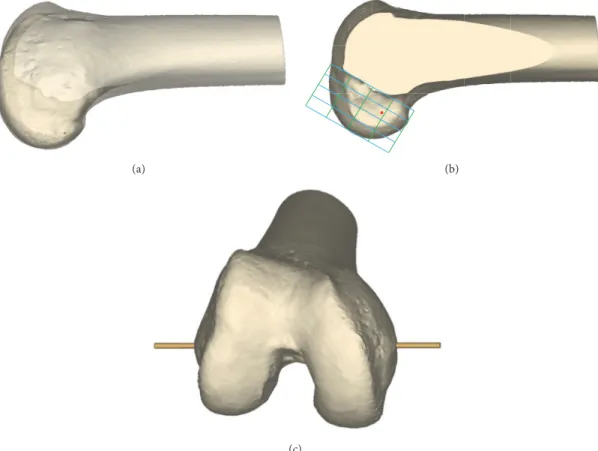
2.2. 3D Simulation of Femoral Tunnel Drilling. The femoral footprint center was determined using method described by Forsythe et al. using 3D-reconstructed model [24]. To establish femoral center of ACL footprint, 3D reconstructed model of femur was aligned in a true lateral position, where medial and lateral femoral condyles were superimposed as the position for the quadrant method developed by Bernard et al. (Figure 1(a)) [25]. And then the medial femoral condyle was virtually eliminated from the original 3D model at the most anterior aspect of the intercondylar notch to have a visual on the medial wall of the lateral femoral condyle (Figure 1(b)) [26]. A 4× 4 grid was drawn on the medial wall of the lateral femoral condyle from a true medial view of the femur established at 90∘of knee flexion, similar to the quadrant method for standard lateral radiograph previously described (Figure 1(b)) [25]. The most anterior edge of the intercondylar notch was used as the reference for the grid alignment in place of Blumensaat line on the standard lateral radiograph. The femoral footprint center was determined according to the coordinates of the reference point noted by the previous study [27] on the single-bundle anatomic reconstruction using the quadrant method. The coordinates were defined by the segments of the grid along the Blu-mensaat line and perpendicular to the BluBlu-mensaat line. The distance of the femoral center parallel to the Blumensaat line was 28.4% along the line measured from the posterior border. The distance perpendicular to the Blumensaat line was 35.7% along the line measured from the Blumensaat line. The point was displayed at the determined position as the femoral footprint center (Figure 1(b)). And then the original 3D femur model including both condyles was restored.
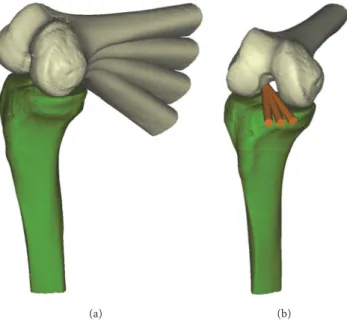
To make change of the flexion angle, transepicondylar axis was used as rotation axis of flexion [28, 29] (Figure 1(c)). On the transepicondylar axis, the knee flexion angles were changed at intervals of 10∘ from 100∘ to 130∘ (Figure 2(a)). 90∘ of flexion angle was excluded from the study because the femoral tunnel created at the 90∘ of flexion angle was reported to have a tendency to blow out the posterior cortex of the lateral femoral condyle [16]. The transverse drill angle was set in three positions. According to the previous study [19], the possible maximum transverse drill angle of rotation can be achieved without coming into contact with the cartilage of medial femoral condyle. The first drill angle was determined as the maximum transverse drill angle (MTA) and the other two drill angles were determined as MTA-10∘ and MTA-20∘ by moving drill laterally (Figure 2(b)). During the actual operation, femoral tunnel can be created through the far anteromedial portal while viewing through the anterolateral portal. This allows these two portals to be freely positioned and the far anteromedial portal to be positioned at MTA, MTA-10∘, and MTA-20∘. The drill bit was simplified to the virtual cylinder. The cylinder passed through the center of the virtual far anteromedial portal
(a) (b)
(c)
Figure 1: (a) 3D reconstructed model of femur was aligned in a true lateral position, where medial and lateral femoral condyles were superimposed. (b) The medial femoral condyle was virtually eliminated from the original 3D model at the most anterior aspect of the intercondylar notch, and A 4× 4 grid was drawn on the medial wall of the lateral femoral condyle from a true medial view of the femur established at 90∘of knee flexion. The femoral footprint center was determined according to the following coordinates: The distance parallel to the Blumensaat line was 28.4% along the line measured from the posterior border. The distance perpendicular to the Blumensaat line was 35.7% along the line measured from the Blumensaat line. (c) Transepicondylar axis was established as rotation axis of flexion to make change of the flexion angle.
and the determined femoral footprint center. During the actual operation of ACL reconstruction using medial portal technique, the position of far anteromedial portal should be as low as possible just above the medial meniscus without damaging the anterior horn of the medial meniscus. In the present study with 3D-reconstructed model, the center of the virtual far anteromedial portal was established at 10 mm above the tibial plateau in consideration of the radius of the femoral tunnel and the thickness of the medial meniscus. The diameter of drill bit was set to 8 mm.
2.3. Measurement of Variables of the Femoral Tunnel Char-acteristics. Three major variables changed according to the combined influence of four flexion angles of knee and three transverse drill angles were measured: (1) femoral tunnel length, (2) femoral tunnel wall breakage, and (3) graft bending angle at the femoral tunnel aperture. Each variable at the twelve conditions by combination of flexion angle and transverse drill angle was measured. Maximum femoral tunnel length was determined as the distance from the intra-articular center of femoral footprint to the center of the
external cortex of the lateral femoral condyle penetrated by the virtual cylinder. A minimum length of the femoral tunnel without wall breakage for the secure graft fixation was set as 25 mm based on previous research [16]. The tunnel with less than 25 mm of length was regarded as a short tunnel. Comparison of tunnel lengths between four different knee flexion angles in condition of fixed transverse drill angle and between three different transverse drill angles in condition of fixed knee flexion angle were performed. The femoral tunnel wall breakage was divided into two types of entrance breakage and mid-tunnel breakage. Entrance breakage meant the breakage of wall at the entrance of the tunnel, and mid-tunnel breakage meant the breakage of wall within 25 mm from the entrance of the tunnel without entrance breakage. The graft bending angle at the femoral tunnel aperture was measured as the angle between the femoral tunnel penetrated by virtual cylinder and the extended line that passed through the tibial footprint center and the femoral footprint center (Figure 3) [30]. The tibial footprint center was determined according to the coordinates of the reference point noted by the previous study [31] using 3D reconstructed model [24]. On a true proximal-to-distal view of the tibial plateau, the
(a) (b)
Figure 2: Variables at the twelve conditions by combination of flexion angle and transverse drill angle were measured. (a) The knee flexion angles were changed at intervals of 10∘from 100∘to 130∘on the transepicondylar axis. (b) The possible maximum transverse drill angle of rotation can be achieved without coming into contact with the cartilage of medial femoral condyle. The first drill angle was determined as the maximum transverse drill angle (MTA) and the other two drill angles were determined as MTA-10∘and MTA-20∘by moving drill laterally.
(a) (b) (c)
Figure 3: The graft bending angle at the femoral tunnel aperture was measured as the angle between the femoral tunnel penetrated by virtual cylinder and the extended line that passed through the tibial footprint center and the femoral footprint center with the knee in full extension. (a) The tibial footprint center was determined according to the following coordinates: the point located at 35.7% of the anterior-to-posterior depth of the tibia measured from the anterior border and at 51.5% of the medial-to-lateral width of the tibia measured from the medial border. (b) Anterior view. (c) Oblique view. Point A is the tibial footprint center, and point B is the femoral footprint center. Extended line that passed through these two centers is the line connecting points A, B, and C. Point D indicates the center of femoral tunnel at the external cortex. The graft bending angle is measured as the angle composed of points C, B, and D.
point that was located at 35.7% of the anterior-to posterior depth of the tibia measured from the anterior border and at 51.5% of the medial-to-lateral width of the tibia measured from the medial border was set as the tibial footprint center (Figure 3). According to a previous study [32], consistent
contact pressure occurred at the anterior aspect of the tunnel and anterior portion of the graft had maximum contact pressure with the knee in full extension. Therefore, in the present study, the graft bending angle at the femoral tunnel aperture was measured with the knee in full extension.
Table 1: Comparison of mean femoral tunnel lengths in each condition according to the flexion angle and transverse drill angle.
Flexion angle Transverse drill angle
MTA MTA-10∘ MTA-20∘ P-valuea
100∘(mm) 23.5±3.0 (16.1∼28.0) 19.9±4.1 (12.0∼28.1) 15.2±3.7 (8.6∼21.9) <.001 110∘(mm) 29.0±3.2 (22.7∼39.4) 31.5±5.2 (16.3∼45.1) 38.2±9.8 (11.4∼51.6) <.001 120∘(mm) 32.3±3.0 (27.0∼42.7) 36.2±3.9 (28.7∼46.5) 46.1±9.1 (32.4∼78.0) <.001 130∘(mm) 33.6±2.6 (28.2∼41.5) 37.0±3.2 (29.6∼47.2) 44.4±5.4 (34.0∼59.6) <.001
P-valueb <.001 <.001 <.001
MTA: maximum transverse drill angle without coming into contact with the medial condyle cartilage. The lengths of tunnels (mm) are given as mean± standard deviation (range).
aP-value for comparison of tunnel lengths between different transverse drill angles of MTA to MTA-20∘in condition of fixed flexion angle. bP-value for comparison of tunnel lengths between different flexion angles of 100∘to 130∘in condition of fixed transverse drill angle.
Table 2: Comparison of the proportions of short tunnel with less than 25 mm in each setting.
Flexion angle Transverse drill angle
MTA MTA-10∘ MTA-20∘ P-valuea
100∘ 19 (63.3%) 27 (90%) 30 (100%) <.001
110∘ 3 (10%) 2 (6.7%) 2 (6.7%) 0.779
120∘ 0 (0%) 0 (0%) 0 (0%)
-130∘ 0 (0%) 0 (0%) 0 (0%)
-P-valueb <.001 <.001 <.001
MTA: maximum transverse drill angle without coming into contact with the medial condyle cartilage. The values are given as cases with proportion in parentheses.
aP-value for comparison between different transverse drill angles of MTA to MTA-20∘in condition of fixed flexion angle. bP-value for comparison between different flexion angles of 100∘to 130∘in condition of fixed transverse drill angle.
2.4. Statistical Analysis. The repeated-measures Analysis of Variance (ANOVA) for continuous variables was performed to compare the tunnel lengths and the graft bending angles. The post hoc analysis with adjusted P-value obtained by Bonferroni correction was performed to make pairwise comparisons. Cochran's Q test for dichotomous variables was performed to compare the proportions of short tunnel and tunnel breakage between groups. The level of significance was set at P<0.05. Statistical analysis was conducted using the IBM SPSS Statistics for Windows software program (version 23.0; IBM, Armonk, New York).
3. Results
The demographic data of patients were listed in Table 5. Com-parison of tunnel lengths between different flexion angles of 100∘ to 130∘ showed statistically significant difference in condition of transverse drill angle fixed at MTA, MTA-10∘, or MTA-20∘ (P<0.001) (Table 1). Post hoc analysis showed that there were statistically significant differences (P<0.05) in all pairwise comparisons except a comparison between 120∘ and 130∘ of flexions at MTA-10∘ (P=0.158) and MTA-20∘(P=0.516) (Table 6). In condition of flexion angle fixed at 100∘, 110∘, 120∘, or 130∘, comparison of tunnel lengths between different transverse drill angles of MTA to MTA-20∘showed a statistically significant difference (P<0.001) (Table 1). Post hoc analysis showed that there were statistically significant differences in all pairwise comparisons (P<0.001) (Table 7).
In terms of short tunnel, at 100∘of flexion, the proportion of short tunnel with less than 25 mm was 63.3% (19 cases) at
MTA, 90.0% (27 cases) at MTA-10∘, and 100% (30 cases) at MTA-20∘. At 110∘of flexion, the proportion of short tunnel with less than 25 mm was 10.0% (3 cases) at MTA, 6.7% (2 cases) at MTA-10∘, and 6.7% (2 cases) at MTA-20∘. There was no short tunnel at 120∘and 130∘of flexion. The proportion of short tunnel according to the different transverse drill angle differed significantly at only 100∘ of flexion (P<0.001). The proportion of short tunnel according to the different flexion angle of knee differed significantly at all transverse drill angles (P<0.001) (Table 2).
Regarding femoral tunnel wall breakage, there were more than one case of breakage at 100∘and 110∘of flexion regardless of transverse drill angle and 120∘of flexion and MTA-20∘. The femoral tunnel created at 120∘ of flexion and MTA, MTA-10∘, and 130∘ of flexion had no breakage of wall (Table 8). The proportion of femoral tunnel wall breakage according to the different transverse drill angle differed significantly at 100∘, 110∘, and 120∘ of flexion (P≤0.001). The proportion of femoral tunnel wall breakage according to the different flexion angle of knee differed significantly at all transverse drill angles (P<0.001) (Table 3).
According to the results of comparison of graft bending angles at femoral tunnel aperture between each setting, in condition of transverse drill angle fixed at MTA, MTA-10∘, or MTA-20∘, graft bending angles between different flexion angles of 100∘ to 130∘ had significant difference (P<0.001) (Table 4). Post hoc analysis showed that there were sta-tistically significant differences in all pairwise comparisons (P<0.05) (Table 9). As knee flexion angle increased, graft bending angle also increased. In condition of flexion angle
100∘ 13 (43.3%) 20 (66.7%) 30 (100%) <.001
110∘ 4 (13.3%) 9 (30.0%) 26 (86.7%) <.001
120∘ 0 (0%) 0 (0%) 7 (23.3%) 0.001
130∘ 0 (0%) 0 (0%) 0 (0%)
-P-valueb <.001 <.001 <.001
MTA: maximum transverse drill angle without coming into contact with the medial condyle cartilage. The values are given as cases with proportion in parentheses.
aP-value for comparison between different transverse drill angles of MTA to MTA-20∘in condition of fixed flexion angle. bP-value for comparison between different flexion angles of 100∘to 130∘in condition of fixed transverse drill angle.
Table 4: Comparison of mean graft bending angles at femoral tunnel aperture in each condition according to the flexion angle and transverse drill angle.
Flexion angle Transverse drill angle
MTA MTA-10∘ MTA-20∘ P-valuea
100∘(degree) 65.4±4.5 (59.1∼71.3) 60.5±4.6 (53.9∼66.4) 56.4±4.5 (49.8∼62.1) <.001 110∘(degree) 72.5±4.8 (65.5∼77.7) 69.0±4.4 (62.3∼74.0) 66.2±4.0 (60.0∼70.8) <.001 120∘(degree) 79.5±3.2 (75.6∼83.5) 76.9±3.0 (72.9∼80.6) 74.7±2.9 (70.7∼78.2) <.001 130∘(degree) 84.8±4.7 (78.2∼90.5) 83.8±4.5 (77.2∼89.0) 83.0±4.2 (76.6∼87.5) 0.007
P-valueb <.001 <.001 <.001
MTA: maximum transverse drill angle without coming into contact with the medial condyle cartilage. The graft bending angles (mm) are given as mean± standard deviation (range).
aP-value for comparison of tunnel lengths between different transverse drill angles of MTA to MTA-20∘in condition of fixed flexion angle. bP-value for comparison of tunnel lengths between different flexion angles of 100∘to 130∘in condition of fixed transverse drill angle.
Table 5: Demographic data for patients.
Variable (𝑛 = 30) Sexb Male 17 (56.7%) Female 13 (43.3%) Age(years)a 40.3±16.8 Sideb Right 13 (43.3%) Left 17 (56.7%) Transepicondylar distance(cm)a 82.1±5.7 Height(cm)a 168±8.6 Weight(kg)a 62.8±15.4
aThe values are given as mean ± standard deviation. bThe values are given as 𝑛 (%).
fixed at 100∘, 110∘, 120∘, or 130∘, comparison of graft bending angles between different transverse drill angles of MTA to MTA-20∘ showed a statistically significant difference (P<0.05) (Table 4). Post hoc analysis showed that there were statistically significant differences in all pairwise comparisons (P<0.05) (Table 10). As transverse drill angle increased by moving the drill medially in close proximity to the carti-lage of medial femoral condyle, graft bending angle also increased.
4. Discussion
The technical difficulties of creating femoral tunnel in ACL reconstruction with use of transportal technique through medial portal are attributed to the occurrence risk for short tunnel length [11–13], posterior wall blowout [12], and car-tilage damage [14, 15]. The characteristics of femoral tunnel were influenced by flexion angle of knee [16, 17, 19] and transverse drill angle [19]. Therefore, combined effect of flexion angle of knee and transverse drill angle on creation of femoral tunnel has an important clinical relevance, and these two factors should be considered comprehensively not individually. The present study focused on the optimal condition of the knee flexion angle and transverse drill angle to create femoral tunnel considering tunnel length, tunnel wall breakage, and graft bending angle in single-bundle ACL reconstruction using transportal technique.
According to the results of present study, both flexion angle of knee and transverse drill angle had significant effects on the length of femoral tunnel. In condition of each fixed transverse drill angle, as flexion angle increased, most of tunnel lengths tended to increase with statistical significance. To attain a high flexion angle up to 130∘ was beneficial to achieve a longer femoral tunnel. Basdekis et al. [16] also reported that the femoral tunnel length was longer at 110∘ and 130∘of flexion than at 90∘ of flexion in their cadaveric study on ACL reconstruction using transportal technique. In condition of each fixed flexion angle of knee, as transverse
Table 6: Post hoc analysis of tunnel lengths between different flexion angles of 100∘to 130∘in condition of fixed transverse drill angle.
Pairwise comparison MTA MTA-10∘ MTA-20∘
100∘versus 110∘ <.001 <.001 <.001 100∘versus 120∘ <.001 <.001 <.001 100∘versus 130∘ <.001 <.001 <.001 110∘versus 120∘ <.001 <.001 0.015 110∘versus 130∘ <.001 <.001 0.013 120∘versus 130∘ <.001 0.158 0.516
MTA: maximum transverse drill angle without coming into contact with the medial condyle cartilage. The values are given as adjusted P-value with use of Bonferroni correction.
Table 7: Post hoc analysis of tunnel lengths between different transverse drill angles of MTA to MTA-20∘in condition of fixed flexion angle.
Pairwise comparison 100∘ 110∘ 120∘ 130∘
MTA versus MTA-10∘ <.001 <.001 <.001 <.001
MTA versus MTA-20∘ <.001 <.001 <.001 <.001
MTA-10∘versus MTA-20∘ <.001 <.001 <.001 <.001
MTA: maximum transverse drill angle without coming into contact with the medial condyle cartilage. The values are given as adjusted P-value with use of Bonferroni correction.
Table 8: The proportion of femoral tunnel wall breakage including entrance breakage and mid-tunnel breakage in each setting.
Flexion angle
Transverse drill angle
MTA MTA-10∘ MTA-20∘
EB MB TB EB MB TB EB MB TB
100∘ 11 (36.7%) 2 (6.7%) 13 (43.3%) 9 (30%) 11 (36.7%) 20 (66.7%) 11 (36.7%) 19 (63.3%) 30 (100%) 110∘ 4 (13.3%) 0 (0%) 4 (13.3%) 7 (23.3%) 2 (6.7%) 9 (30.0%) 11 (36.7%) 15 (50%) 26 (86.7%)
120∘ 0 (0%) 0 (0%) 0 (0%) 0 (0%) 0 (0%) 0 (0%) 5 (16.7%) 2 (6.7%) 7 (23.3%)
130∘ 0 (0%) 0 (0%) 0 (0%) 0 (0%) 0 (0%) 0 (0%) 0 (0%) 0 (0%) 0 (0%)
MTA: maximum transverse drill angle without coming into contact with the medial condyle cartilage.
EB: entrance breakage, MB: mid-tunnel breakage, TB: total of femoral tunnel wall breakage including both entrance and mid-tunnel breakage. The values are given as cases with proportion in parentheses.
Table 9: Post hoc analysis of graft bending angles at femoral tunnel aperture between different flexion angles of 100∘to 130∘in condition of fixed transverse drill angle.
Pairwise comparison MTA MTA-10∘ MTA-20∘
100∘versus 110∘ 0.003 0.001 <.001 100∘versus 120∘ 0.001 0.001 0.001 100∘versus 130∘ <.001 <.001 <.001 110∘versus 120∘ 0.014 0.008 0.004 110∘versus 130∘ 0.001 <.001 <.001 120∘versus 130∘ 0.012 0.004 0002
MTA: maximum transverse drill angle without coming into contact with the medial condyle cartilage. The values are given as adjusted P-value with use of Bonferroni correction.
Table 10: Post hoc analysis of graft bending angles at femoral tunnel aperture between different transverse drill angles of MTA to MTA-20∘ in condition of fixed flexion angle.
Pairwise comparison 100∘ 110∘ 120∘ 130∘
MTA versus MTA-10∘ <.001 <.001 <.001 0.010
MTA versus MTA-20∘ <.001 0.001 <.001 0.023
MTA-10∘versus MTA-20∘ <.001 0.001 <.001 0.049
MTA: maximum transverse drill angle without coming into contact with the medial condyle cartilage. The values are given as adjusted P-value with use of Bonferroni correction.
flexion angle, femoral tunnel tended to pass through the low position of femoral condyle. Therefore, transverse drill angle by the more lateral position tended to break the posterior condyle, leading to short tunnel length. When the tunnel less than 25 mm in length was regarded as a short tunnel, there was no case of a short tunnel in creating at 120∘ and 130∘ of flexion. Only considering the tunnel length, high flexion angle of 120∘and 130∘could be optimal condition, and longer tunnel could be achieved by decreased transverse drill angle moving the drill medially.
In terms of tunnel wall breakage, there was no case of entrance breakage and mid-tunnel breakage at 120∘of flexion with MTA and MTA-10∘ and 130∘ of flexion. There were one or more cases of tunnel wall breakage at 100∘, 110∘, and 120∘of flexion with MTA-20∘. As flexion angle increased and transverse drill angle increased by moving drill medially, the proportion of tunnel wall breakage tended to decrease. A previous study [16] measured the closest distance between guide pin for femoral tunnel and the posterior cortex. The distance was -0.5±2.1 mm at 90∘ of flexion, 5.1±1.1 mm at
110∘ of flexion, and 9.9±2.5 mm at 130∘ of flexion. Both this previous study [16] and the present study showed that as flexion angle increased, the risk of tunnel wall breakage decreased. There was no case of breakage at 130∘of flexion regardless of transverse drill angle. However, at 120∘ of flexion, there was not a case of breakage at MTA and MTA-10∘ but seven cases of breakage at MTA-20∘. As transverse drill angle decreased, the femoral tunnel length increased, but the problem was that the risk of wall breakage also increased. Accordingly, it requires the attention and effort to increase the transverse drill angle by moving drill medially at less than 130∘ of flexion. Considering two factors of length and wall breakage of femoral tunnel, it could be recommended to create femoral tunnel at increased flexion angle and increased transverse drill angle for a secure femoral tunnel having sufficiently long length without wall breakage.
However, if the influence of the femoral graft bending angle was applied, the optimal condition in creating femoral tunnel changed. There has been no study on change of graft bending angle according to the combined effect of flexion angle and transverse drill angle in single-bundle ACL reconstruction using transportal technique. As knee flexion angle increased, graft bending angle also increased. The increased acuity of the graft bending angle at the femoral tunnel aperture was reported to cause increased bending stress on the graft, leading to injury of the graft and tunnel widening [20, 21]. A previous study [16] dealing with effect of only flexion angle presented the results of two-dimensional measurement on X-ray using eight cadaveric specimens. It proposed that 110∘ of flexion angle was more optimum condition compared to 90∘ and 130∘ of flexion angle [16]. The present study also demonstrated that it would be better to avoid too high flexion angle and less than 130∘of flexion could be more appropriate. In addition to the flexion angle of knee, transverse drill was also considered in the present study. Increase of transverse drill angle caused graft bending angle
creating femoral tunnel. All factors considered, 120 of flexion angle of knee provided sufficient tunnel length without tunnel wall breakage, and MTA-10∘led to the more decreased graft bending angle compared to MTA. Consequently, 120∘ of flexion angle and MTA-10∘ could be recommended as the optimal condition in creating femoral tunnel with sufficient tunnel length, no breakage of tunnel wall, and decreased graft bending angle at femoral tunnel aperture.
There were several limitations that warrant review before definitive conclusions can be drawn. First, the present study was conducted by simulation using 3D reconstructed CT model. Biomechanics of knee joint during flexion such as femoral roll back and screw home movement were not considered. Simplified cylinder created virtually replaced femoral tunnel. The data were obtained from virtual mea-surements. Further actual clinical study on real patients is needed to add the clinical significance to the present study. Second, only 3D bone model of knee including femur and tibia was reconstructed with CT images. When positioning a virtual far anteromedial portal, the thickness of the medial meniscus was considered. However, soft tissues around knee joint such as collateral ligament, cruciate ligament, and meniscus were not reconstructed. Third, the femoral and tibial centers of ACL footprint were determined according to previous studies [27, 31]. However, there are considerable variations of the ACL footprint anatomy between individuals. There is an avoidable limitation in applying the results of the current study uniformly to all patients. Fourth, mea-sured variables of the present study were tunnel length, tunnel wall breakage, and graft bending angle. However, there are more significant variables related to the charac-teristics of femoral tunnel including aperture morphology [19, 33]. An integrated study including various factors not addressed in this study is needed to reach a solid conclu-sion.
5. Conclusions
In creating femoral tunnel in ACL reconstruction with transportal technique, characteristic factors including tunnel length, tunnel wall breakage, and graft bending angle should be considered comprehensively. Increased flexion angle and transverse drill angle secured femoral tunnel having suffi-ciently long length without wall breakage. However, avoid-ing excessive flexion angle and maximum transverse drill angle could be recommended because they tended to cause more acute graft bending angle. The present study helps to understand the combined effect of influential factors on the characteristics of femoral tunnel in ACL reconstruc-tion.
Data Availability
The data used to support the findings of this study are available from the corresponding author upon request.
Ethical Approval
This study was conducted following the approval of Institu-tional Review Board of Severance Hospital, Yonsei University College of Medicine (IRB number 4-2017-0138).
Disclosure
Investigation was performed at the Arthroscopy and Joint Research Institute, Department of Orthopaedic Surgery, Yon-sei University College of Medicine, Seoul, Republic of Korea.
Conflicts of Interest
Each author certifies that he or she has no commercial asso-ciations (e.g., consultancies, stock ownership, equity interest, or patent/licensing arrangements) that might pose conflicts of interest in connection with the submitted article.
Acknowledgments
This study was supported by a faculty research grant of Yonsei University College of Medicine (6-2017-0097) and Basic Science Research Program through the National Research Foundation of Korea (NRF) funded by the Ministry of Science and ICT (no. 2017R1C1B5017548).
References
[1] J. C. Loh, Y. Fukuda, E. Tsuda, R. J. Steadman, F. H. Fu, and S. L.-Y. Woo, “Knee stability and graft function following ante-rior cruciate ligament reconstruction: Comparison between 11 o’clock and 10 o’clock femoral tunnel placement. 2002 Richard O’Connor Award paper,” Arthroscopy, vol. 19, no. 3, pp. 297–304, 2003.
[2] J. M. Scopp, L. E. Jasper, S. M. Belkoff, and C. T. Moorman III, “The effect of oblique femoral tunnel placement on rotational constraint of the knee reconstructed using patellar tendon autografts,” Arthroscopy, vol. 20, no. 3, pp. 294–299, 2004. [3] S. Ristanis, G. Giakas, C. D. Papageorgiou, T. Moraiti, N.
Stergiou, and A. D. Georgoulis, “The effects of anterior cruciate ligament reconstruction on tibial rotation during pivoting after descending stairs,” Knee Surgery, Sports Traumatology, Arthroscopy, vol. 11, no. 6, pp. 360–365, 2003.
[4] A. D. Georgoulis, S. Ristanis, V. Chouliaras, C. Moraiti, and N. Stergiou, “Tibial rotation is not restored after ACL reconstruc-tion with a hamstring graft,” Clinical Orthopaedics and Related Research, no. 454, pp. 89–94, 2007.
[5] S. Tashman, D. Collon, K. Anderson, P. Kolowich, and W. Anderst, “Abnormal rotational knee motion during running after anterior cruciate ligament reconstruction,” The American Journal of Sports Medicine, vol. 32, no. 4, pp. 975–983, 2004. [6] L. S. Lohmander, P. M. Englund, L. L. Dahl, and E. M. Roos,
“The long-term consequence of anterior cruciate ligament and meniscus injuries: osteoarthritis,” The American Journal of Sports Medicine, vol. 35, no. 10, pp. 1756–1769, 2007.
[7] M. E. Steiner, “Independent drilling of tibial and femoral tun-nels in anterior cruciate ligament reconstruction.,” The Journal of Knee Surgery, vol. 22, no. 2, pp. 171–176, 2009.
[8] J. H. Lubowitz, “Anteromedial portal technique for the ante-rior cruciate ligament femoral socket: pitfalls and solutions,” Arthroscopy: The Journal of Arthroscopic and Related Surgery, vol. 25, no. 1, pp. 95–101, 2009.
[9] R. Garofalo, E. Mouhsine, P. Chambat, and O. Siegrist, “Anatomic anterior cruciate ligament reconstruction: The two-incision technique,” Knee Surgery, Sports Traumatology, Arthroscopy, vol. 14, no. 6, pp. 510–516, 2006.
[10] P. A. Smith, R. S. Schwartzberg, and J. H. Lubowitz, “No tunnel 2-socket technique: all-inside anterior cruciate ligament double-bundle retroconstruction,” Arthroscopy - Journal of Arthroscopic and Related Surgery, vol. 24, no. 10, pp. 1184–1189, 2008.
[11] S. R. Golish, J. A. Baumfeld, R. J. Schoderbek, and M. D. Miller, “The effect of femoral tunnel starting position on tunnel length in anterior cruciate ligament reconstruction: a cadaveric study,” Arthroscopy - Journal of Arthroscopic and Related Surgery, vol. 23, no. 11, pp. 1187–1192, 2007.
[12] A. Bedi, B. Raphael, A. Maderazo, H. Pavlov, and R. J. Williams III, “Transtibial versus anteromedial portal drilling for anterior cruciate ligament reconstruction: a cadaveric study of femoral tunnel length and obliquity,” Arthroscopy - Journal of Arthro-scopic and Related Surgery, vol. 26, no. 3, pp. 342–350, 2010. [13] C. B. Chang, J.-Y. Choi, I. J. Koh, K. J. Lee, K.-H. Lee, and T.
K. Kim, “Comparisons of femoral tunnel position and length in anterior cruciate ligament reconstruction: Modified transtibial versus anteromedial portal techniques,” Arthroscopy - Journal of Arthroscopic and Related Surgery, vol. 27, no. 10, pp. 1389–1394, 2011.
[14] M. Nakamura, M. Deie, H. Shibuya et al., “Potential risks of femoral tunnel drilling through the far anteromedial portal: a cadaveric study,” Arthroscopy - Journal of Arthroscopic and Related Surgery, vol. 25, no. 5, pp. 481–487, 2009.
[15] T. Zantop, A.-K. Haase, F. H. Fu, and W. Petersen, “Potential risk of cartilage damage in double bundle ACL reconstruction: Impact of knee flexion angle and portal location on the femoral PL bundle tunnel,” Archives of Orthopaedic and Trauma Surgery, vol. 128, no. 5, pp. 509–513, 2008.
[16] G. Basdekis, C. Abisafi, and P. Christel, “Influence of knee flexion angle on femoral tunnel characteristics when drilled through the anteromedial portal during anterior cruciate liga-ment reconstruction,” Arthroscopy - Journal of Arthroscopic and Related Surgery, vol. 24, no. 4, pp. 459–464, 2008.
[17] G. Basdekis, C. Abisafi, and P. Christel, “Effect of knee flexion angle on length and orientation of posterolateral femoral tunnel drilled through anteromedial portal during anatomic double-bundle anterior cruciate ligament reconstruction,” Arthroscopy - Journal of Arthroscopic and Related Surgery, vol. 25, no. 10, pp. 1108–1114, 2009.
[18] T. Zantop, M. Herbort, M. J. Raschke, F. H. Fu, and W. Petersen, “The role of the anteromedial and posterolateral bundles of the anterior cruciate ligament in anterior tibial translation and internal rotation,” The American Journal of Sports Medicine, vol. 35, no. 2, pp. 223–227, 2007.
[19] D. Hensler, Z. M. Working, K. D. Illingworth, E. D. Thorhauer, S. Tashman, and F. H. Fu, “Medial portal drilling: Effects on the femoral tunnel aperture morphology during anterior cruciate ligament reconstruction,” The Journal of Bone & Joint Surgery, vol. 93, no. 22, pp. 2063–2071, 2011.
[20] Y. Tashiro, T. Gale, V. Sundaram et al., “The graft bending angle can affect early graft healing after anterior cruciate ligament reconstruction: In vivo analysis with 2 years’ follow-up,” The
T. S. Ko, “Graft bending angle is correlated with femoral intraosseous graft signal intensity in anterior cruciate ligament reconstruction using the outside-in technique,” The Knee, vol. 23, no. 4, pp. 666–673, 2016.
[22] J. H. Wang, J. G. Kim, D. K. Lee, H. C. Lim, and J. H. Ahn, “Comparison of femoral graft bending angle and tunnel length between transtibial technique and transportal technique in anterior cruciate ligament reconstruction,” Knee Surgery, Sports Traumatology, Arthroscopy, vol. 20, no. 8, pp. 1584–1593, 2012. [23] J. H. Kellgren and J. S. Lawrence, “Radiological assessment of
osteo-arthrosis,” Annals of the Rheumatic Diseases, vol. 16, no. 4, pp. 494–502, 1957.
[24] B. Forsythe, S. Kopf, A. K. Wong et al., “The location of femoral and tibial tunnels in anatomic double-bundle anterior cruciate ligament reconstruction analyzed by three-dimensional com-puted tomography models,” The Journal of Bone & Joint Surgery, vol. 92, no. 6, pp. 1418–1426, 2010.
[25] M. Bernard, P. Hertel, H. Hornung, and T. Cierpinski, “Femoral insertion of the ACL. Radiographic quadrant method,” Ameri-can Journal of Knee Surgery, vol. 10, no. 1, pp. 14–21; discussion 21-12, 1997.
[26] T. Mochizuki, T. Muneta, T. Nagase, S.-I. Shirasawa, K.-I. Akita, and I. Sekiya, “Cadaveric knee observation study for describing anatomic femoral tunnel placement for two-bundle anterior cruciate ligament reconstruction,” Arthroscopy: The Journal of Arthroscopic and Related Surgery, vol. 22, no. 4, pp. 356–361, 2006.
[27] H. Xu, C. Zhang, Q. Zhang et al., “A systematic review of anterior cruciate ligament femoral footprint location evaluated by quadrant method for single-bundle and double-bundle anatomic reconstruction,” Arthroscopy - Journal of Arthroscopic and Related Surgery, vol. 32, no. 8, pp. 1724–1734, 2016. [28] D. L. Churchill, S. J. Incavo, C. C. Johnson, and B. D. Beynnon,
“The transepicondylar axis approximates the optimal flexion axis of the knee,” Clinical Orthopaedics and Related Research, no. 356, pp. 111–118, 1998.
[29] E. Most, J. Axe, H. Rubash, and G. Li, “Sensitivity of the knee joint kinematics calculation to selection of flexion axes,” Journal of Biomechanics, vol. 37, no. 11, pp. 1743–1748, 2004.
[30] K. Nishimoto, R. Kuroda, K. Mizuno et al., “Analysis of the graft bending angle at the femoral tunnel aperture in anatomic double bundle anterior cruciate ligament reconstruction: A comparison of the transtibial and the far anteromedial portal technique,” Knee Surgery, Sports Traumatology, Arthroscopy, vol. 17, no. 3, pp. 270–276, 2009.
[31] J. H. Ahn, H. J. Jeong, C.-S. Ko, T. S. Ko, and J. H. Kim, “Three-dimensional reconstruction computed tomogra-phy evaluation of tunnel location during single-bundle anterior cruciate ligament reconstruction: A comparison of transtibial and 2-incision tibial tunnel-independent techniques,” Clinics in Orthopedic Surgery, vol. 5, no. 1, pp. 26–35, 2013.
[32] H. Segawa, Y. Koga, G. Omori, M. Sakamoto, and T. Hara, “Influence of the femoral tunnel location and angle on the con-tact pressure in the femoral tunnel in anterior cruciate ligament reconstruction,” The American Journal of Sports Medicine, vol. 31, no. 3, pp. 444–448, 2003.
[33] J. G. Kim, M. H. Chang, H. C. Lim, J. H. Bae, J. H. Ahn, and J. H. Wang, “Computed tomography analysis of the femoral