위상최적화를 이용한 수중음향렌즈의 설계
Underwater Acoustic Lens Design Using Topology Optimization
장강원
†·
Tran Quang Dat‡
·
조완호*
·
권휴상*
·
조승현*
Gang-Won Jang, Tran Quang Dat, Wan-Ho Cho, Hyu-Sang Kwon and Seung Hyun
Cho
Key Words : Topology Optimization, Phase Field Method, Allen-Cahn equation, Helmholtz equation, Acoustic Lens
ABSTRACT
In this paper, topology optimization of two-dimensional acoustic lenses is presented by using the phase field method. The objective of the optimization is to maximize the acoustic pressure at a specified domain inside the acoustic domain for a given frequency, and the constraint is imposed on the amount of the material of the acoustic lens. Topology optimization of two-dimensional acoustic lenses are obtained as the steady state of the phase transition described by the Allen-Cahn equation. The Helmholtz equation modeling the wave propagation is solved by using a finite element method. The effectiveness of the proposed method is verified by applying it for several two-dimensional acoustic lens system design problems.
Nomenclature
p
: pressure in the analysis domaina
: density of the acoustic mediuma
c
: local speed of sound
: design variable1. Introduction
An acoustic camera is an imaging device used to locate sound sources and characterize them. An acoustic lens camera creates an image by using acoustic lenses analogous to photography. Ultrasound reflected and scattered by the object is received by acoustic lenses that form a 2D image, which is directly converted into a corresponding visual image by the sensor in real time.
The problem of optimizing an acoustic lens has been studied by using gradient-based optimizations in Wadbro and Berggren [1], and Tran et al. [2]. In [1], an acoustic horn was optimized by using topology optimization with the aim of radiating sound as efficiently as possible. In [2], acoustic lens surfaces for an acoustic imaging device were optimized to maximize pressure at focal point by using shape optimization.
The phase field method was developed to represent surface dynamics of phase transition phenomena such as solid-liquid transitions [3]. In this paper, the phase field method is used to represent the motion of optimized shape boundaries for the lens optimization. The phase field function defined on the design domain is updated to obtain the optimal configuration of lenses.
The advantages of the phase field method compared to other existing optimization methods when it comes to the lens design problem are that the creative lens layouts such as multiple lenses or small lens groups can be obtained through the optimization without carefully selecting the initial layout.
2. Topology optimization of acoustic lens
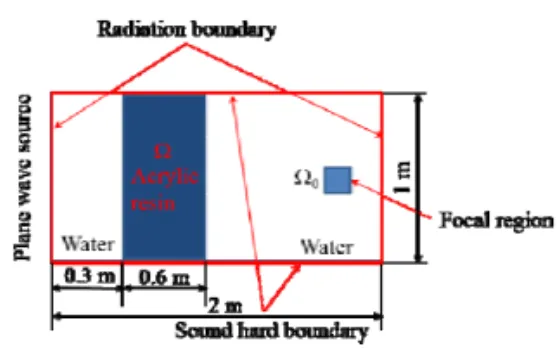
Fig. 1: A design domain
† 발표자, 교신저자; 정회원, 세종대 기계공학과 E-mail : [email protected] Tel : 02-3408-3771, Fax : 02-3408-4333 ‡ 세종대 대학원 * 표준과학연구원 한국소음진동공학회 2014년 추계학술대회 555
2.1 Design variables and material interpolation
Fig. 1 illustrates the problem definition for present topology optimization of the acoustic lens. In order to optimize material properties of discretized elements in the design domain , the phase field function
which characterizes the phase of the system at each nodal values are used as design variables; elements with =0 correspond to water, and elements with =1 to the lens material. For material interpolation, the simple interpolation scheme in [4] is employed:
1
1
s w s wc
c
c
,
(1)
where s, cs and w, cw are the density and sound
speed of solid material, the density and sound speed of water, respectively.
2.2 Optimization formulation
The objective of the topology optimization is to maximize the average pressure at the focal region while the volume of the lens material is constrained:
Maximize N R x
0,
J p
p d
,
(2a) Subject to:
,
00
DG p
d
V
, (2b) where the phase filed function is bounded as0 , and V 1 0 is the allowed lens volume.
3. Design example
The plane wave source in Fig. 1 is operated with the frequency of 10 kHz in water (cw = 1500 m/s, w
= 1000 kg/m3), and the design domain is made of acrylic resin (cs = 2727 m/s, s = 1200 kg/m3). The
left edge of the domain is under the pressure boundary condition for the wave source. To prevent reflection of the outgoing wave into the analysis domain, all the edges are under plane wave radiation condition.
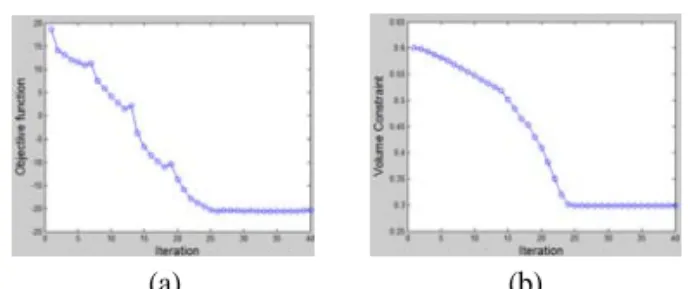
The result of topology optimization of the acoustic lens and the acoustic pressure distribution are shown in Fig. 2 (a) and (b), respectively. Through the optimization, the pressure at the focal region is significantly increased while the volume constraint in Eqs. 2(b) is satisfied. The convergence plots for the objective and constraint are plotted in Fig. 3.
(a) (b)
Fig. 2: Topology optimization of the acoustic lens: (a) optimized topology and (b) acoustic pressure field.
(a) (b)
Fig. 3: Optimization history for the lens problem: (a) objective and (b) constraint
4. Conclusions
The phase field method was applied for topology optimization of the acoustic lens system. The advantages of the phase field method simple in computation, and the creative lens layouts such as multiple lenses or small lens groups can be obtained through the optimization without carefully selecting the initial layout. The optimization problem was formulated to achieve maximum sound pressure at the focal region and to increase the resolution of the acoustic image by making the beam pattern larger and narrower on the focal plane. The validity and utility of the phase field method were verified in the numerical example.
References
(1) Wadbro, E., Berggren, M., 2006, Topology optimization of an acoustic horn. Computer Methods in Applied Mechanics and Engineering.
(2) Tran, Q. D., Jang G. W., Kwon, H. S., Cho, W, H., Cho, S. H., Cho, Y. H., Seo, H. S., 2013, "Optimal Design of Acoustic Lens System for Underwater Acoustic Beamformning and Imaging," ISSN 1225-441x, The Acoustical Society of Korea, Volume 32, Issue 1, pp 75.
(3) Allen, S. M., Cahn, J. W., 1979, A microscopic theory for antiphase boundary motion and its application to antiphase domain coarseningtions, Acta Metall. 27, pp. 1085~1095.
(4) Bendsøe, M. P., Sigmund, O., 2003, Topology optimization. Theory, methods and applications. Springer, Berlin Heidelberg.