Introduction to Wolsong Tritium Removal Facility (WTRF)
K. M. Songa, S. H. Sohna, D. W. Kanga, H. S. Chungba
KEPRI, 103-16 Munji-dong, Yusong-gu, Daejon, 305-380, [email protected] b
KHNP, 167 Samsung-dong, Kangnam-gu, Seoul, 135-791
1. Introduction
Four CANDU 6 reactors have been operated at Wolsong site. Tritium is primarily produced in heavy-water-moderated-power reactors by neutron capture of deuterium nuclei in the heavy water moderator and coolant. The concentration of tritium in the reactor moderator and coolant systems increases with time of reactor operation. For CANDU 6 reactors, the estimated equilibrium values are ~3 TBq/kg-D2O in the moderator
and ~74 GBq/kg-D2O in the coolant, where the
production rate is balanced by tritium decay and water makeup and loss process [1]. The tritium level in the moderator heavy water of Wolsong Unit-1 is getting higher for about 20-year operation and is over 2.22x10¹² Bq/kg at the end of 2003. It was known that the tritium levels in the moderators of the other units would be also steadily increased. In order to reduce the tritium activity, KHNP has committed to construct a Tritium Removal Facility (TRF) at the Wolsong site.
2. Features of WTRF
2.1 Location and Building
The WTRF (Wolsong TRF) is located between the Wolsong Unit-2 and Unit-3. The WTRF facility is a six-level building based on a design typical for industrial buildings, and is designed to have a 40-year lifespan. Figure 1 shows the front view of the WTRF building, which is divided into three major work areas: (1) service area, (2) operations area and (3) process area including hydrogen zone. The process area is organized into separate ventilation environments, to define and isolate the area containing equipment with hydrogen from the rest of the building.
Figure 1. The front view of the WTRF.
2.2 Design Requirement
The general design and performance specification of the WTRF is given in Table 1. The capacity of the WTRF is 100 kg/hr, and its detritiation factor per pass is 35. This design specification allows the WTRF to maintain the tritium activities in the moderators of four CANDU 6 reactors below 370 GBq/kg.
Table 1. The general parameters for the WTRF.
D2O feed isotopic > 99.9 mol% D2O
D2O feed tritium concentration 370 ~ 2,220 GBq/kg
D2O processing rate 100 kg/hr
Minimum tritium extraction
efficiency per pass 97%
Tritium by-product > 99.0% T2
Design service life 40 years
Design availability factor 80%
ASME SA-312, Section II-A, Section III, CAN/CSA N285 and CSA Z299 are applied to the WTRF as codes, standards and regulatory requirements.
2.3 Main Processes
The tritium removal process of the WTRF is made up of three parts. The front-end process of the first part is LPCE process. Using wet proofed catalyst, this process is termed Liquid Phase Catalytic Exchange (LPCE). In this process, the tritium is extracted from the heavy water through catalytic reaction. The catalyst and column for the WTRF LPCE process had been developed by collaboration between KEPRI and KAERI.
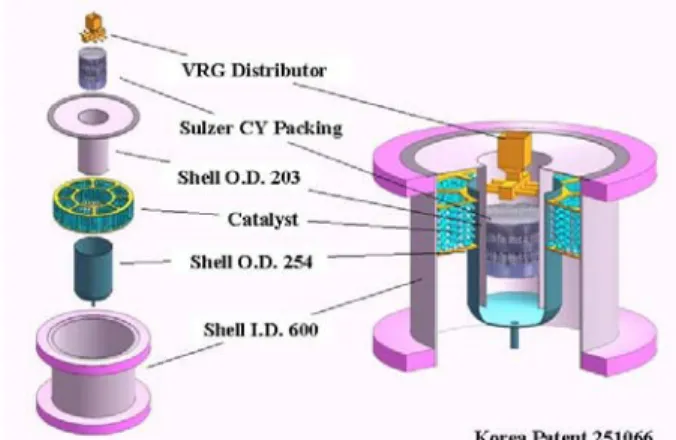
Figure 2. The internals of a catalyst section.
The main components of the LPCE columns are 55 catalyst sections, 1 humidifier and 2 sumps. Figure 2
Transactions of the Korean Nuclear Society Autumn Meeting Busan, Korea, October 27-28, 2005
shows internals of a catalyst section. Sulzer CY packing installed in the inner shell is used for the vapor-liquid mass transfer and the wet proofed catalyst packed in the outer shell is used for the vapor-gas reaction.
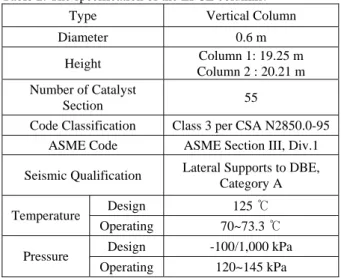
The specification of the LPCE columns is given in Table 2.
Table 2. The specification of the LPCE columns.
Type Vertical Column
Diameter 0.6 m
Height Column 1: 19.25 m
Column 2 : 20.21 m Number of Catalyst
Section 55
Code Classification Class 3 per CSA N2850.0-95
ASME Code ASME Section III, Div.1
Seismic Qualification Lateral Supports to DBE,
Category A Design 125 ℃ Temperature Operating 70~73.3 ℃ Design -100/1,000 kPa Pressure Operating 120~145 kPa
The back-end process of the second part is Cryogenic Distillation (CD) process. This process concentrates the tritium by low temperature distillation of the D2/DT
mixture, to produce streams of essentially pure D2 and
T2. The CD system operates at liquid hydrogen
temperature (24~26K), with compressed cold helium supplied from the helium refrigerator. In the Darlington Tritium Removal Facility (DTRF), the hydrogen refrigerator has been used for the CD.
The third part of the process is the measurement and packaging of the concentrated T2 for secure, long-term
storage. Titanium metal has been selected for the immobilization and long-term storage of tritium because of the low equilibrium pressure of tritium at normal storage temperatures. In the WTRF, the T2
removed from the detritiation process is reacted with titanium metal at room temperature, to form a stable metal tritide.
2.4 Comparison with DTRF
The DTRF has been in operation at the Darlington Nuclear Generating Station in Canada since 1990. Design feed capacity of the DTRF is 360 kg/hr, almost 4 times that of the WTRF. The DTRF uses VPCE (vapor phase catalytic exchange) process as a front-end one. The VPCE process requires that the tritiated heavy water feed be superheated to 200 ℃, in a number of stages, to avoid liquid condensation in the catalyst. Since the LPCE process of the WTRF uses a wet proofed catalyst unlikely the DTRF VPCE process, the heavy water can be fed directly to the LPCE columns and the WTRF is operational in easier conditions than the DTRF.
4. Expectations
Following the start of operation of the WTRF, a reduction in the total annual tritium release from the Wolsong site is expected. The tritium activities in the moderators will be maintained ultimately below 370 GBq/kg. The primary function of the WTRF is to reduce the amount of tritium contained in the heat transport and moderator systems. This should lead to a reduction in the gaseous and liquid tritium releases from the site. This may also reduce public and occupational exposures from tritium.
2.27E+04 1.22E+04 1.09E+04 3.81E+03 9.76E+03 0.00E+00 1.00E+04 2.00E+04 3.00E+04 4.00E+04 5.00E+04 6.00E+04 '82 '84 '86 '88 '90 '92 '94 '96 '98 '00 '02 '04 '06 '08 '10 '12 '14 '16 '18 '20 '22 '24 '26 '28 '30 년도 방출량(Ci/yr)
Unit1 Unit2 Unit3 Unit4
Year Release (Ci/yr)
Figure 3. Annual tritium release after WTRF operation.
Figure 3 shows the annual tritium release from Wolsong site before and after WTRF operation. Before WTRF operation, the total tritium release from 4 reactors is 655.5 TBq/yr. After WTRF operation, however, it will be decreased below 202.3 TBq/yr. During the WTRF operation, the effective exposure dose is estimated below 2.56 x 10⁻² mSv/yr. This value shows that 69% of the population dose is reduced after WTRF operation.
REFERENCES
[1] K.M.Song, et al., “The Prediction of Tritium Level Reduction of Wolsong NPPs by Heavy Water Detritiation with WTRF”, Fusion Sci. Techn., 48, p290-293 (2005). [2] “Safety Analysis Report for Wolsong Tritium Removal Facility”, 8609-01320-SAR-001, KHNP (2004).