A Preliminary Neutral Framework for the Accident Sequence Evaluation for a Hydrogen
Conversion Reactor
Seok-Jung Han & Joon-Eon Yang
Korea Atomic Energy Research Institute, P.O. Box 105, Yuseong, Daejeon, South Korea, [email protected]
1. Introduction
A framework for an early stage PSA for a hydrogen conversion reactor has been proposed in this paper. The approach is based on a functional and top-down approach. A main concerning point of this approach is to use a design neutral framework. A design neutral framework of PSA can provide a flexibility to apply to several candidate design concepts or options. This neutral-framework idea was borrowed from a proposed regulatory framework in US NRC [1]. The feasibility of our proposed approach has been assessed to be applied in an accident sequence analysis for a hydrogen conversion reactor.
2. A neutral framework for PSA
The proposed neutral framework for PSA consists of two steps approach: Main logic modeling by functional description and supporting logic modeling.
A feature of the neutral framework is to build a PSA frame to cover diverse candidate design concepts or options. A neutral framework for the PSA of a new designed reactor is based on the functional approach. Systems that have a similar function can be described using a single model by the system function. The functional model can minimize the system dependency. The functional approach is a useful approach for a neutral framework.
The neutral framework, however, is not a complete neutral form. It is necessary a premise assumption for functional similarity. For this reason, the neutral framework is applicable in a similar reactor type design. Top-down approach is usually adopted in some areas of PSA. It can allow us to apply our neutral approach, because it can submit to start from functional definition of failure mode based on conceptual or preliminary design criteria. A combined approach can develop a PSA’s model that minimizes a concrete system feature as a starting point of the PSA.
The final form of an assessment has not yet a complete neutral form. It should include detailed descriptions for each system or component. According to progression of the system or component design, the assessment has a concrete form of the assessed reactor system.
An advantage of the approach is that the functional description can minimize an effort to re-assess the risk due to design changes or design candidates. The neutral
framework can be achieved by a minimized effort in a design stage’s PSA.
3. An Application Example
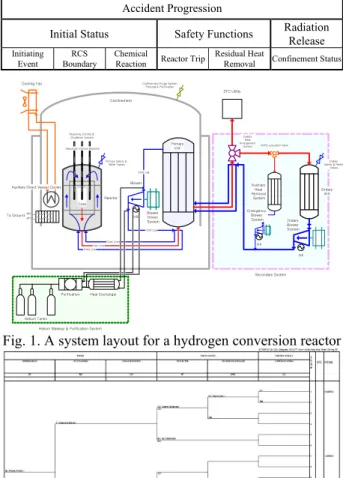
An application example has been prepared. A detailed system layout for the current developing hydrogen conversion reactor was not determined yet, so a system layout was assumed as shown in Fig. 1.We tried that this layout can consider the current proposed design features if possible. Our assumed system layout approximately consists of three parts:
(1) Reactor system layout (primary and secondary coolant loops)
(2) Engineered system layout (3) Confinement system layout
It is noted that the related structure is assumed well-worked. Several necessary systems such as instrument & control systems, support systems, balance of plan (BOP), & electric power supply systems do not considered at this time. Other options also are not considered. As above mentioned, because each candidate has a similar function, our proposed functional approach has a useful in this situation.
Fundamental safety functions of high temperature gas-cooled reactors (HTGR) consist of three parts [2]:
(1) Reactivity control (2) Residual heat removal
(3) Control of radiation material release
An accident progression event tree for an example system layout has been prepared as shown in Table 1. It consists of following parts:
(1) Initial status, (2) Safety functions, and (3) Radiation release.
Initial status includes three headings: initiating event type, RCS boundary state and chemical reaction state. Safety functions include the failure of reactivity control and the failure of residual heat removal. Radiation release was described as a confinement status. These headings in the event tree are modeled by functional description, so each design feature indirectly was incorporated.
An event tree diagram for a hydrogen conversion reactor was developed as shown in Fig. 2. For the quantification, each heading should be modeled by a supporting logic tree or a fault tree. It can be depended on a designed system layout. Each heading can be described as a detailed supporting logic tree.
Transactions of the Korean Nuclear Society Autumn Meeting Busan, Korea, October 27-28, 2005
A choice between a supporting logic tree and a fault tree depends on the degree of detail of system layout. In an early design stage, a supporting logic tree model is more adequate than a fault tree model. In the present paper, a supporting logic tree for the failure of reactivity control has been modeled as an example.
In the failure of reactivity control, the cause of the failure is due to several influences. Reactivity control of a HGTR is achieved by control rods and shutdown rods. In PSA, the failure of reactivity control on demand like a reactor trip signal is expected due to trip signal failure or mechanical system failure like a mechanical failure on control rod driving system. A signal failure is due to instrument and actuation System (I&C) failure. The other failure is originated from physical characteristics as a reactivity insertion by specific transient behavior. The physical behavior is unknown to us at this time, but the effect on accident sequence analysis should be considered until it is identified. Figure 3 shows a supporting logic tree for the failure of reactivity control.
4. Concluding Remark
A framework for an early stage PSA for a hydrogen conversion reactor has been proposed in this paper. The approach is based on a functional and top-down approach. A design neutral framework for a PSA can provide a flexibility to apply to several candidate design concepts or options. The feasibility of our proposed approach has been assessed to be applied in an accident sequence analysis for an example system layout.
To develop a complete form of a neutral framework for the PSA for a new reactor design, several parts of PSA techniques should be prepared. In this paper, a framework for the accident sequence and the system analysis has been proposed for a new reactor design. To make a more applicable framework, an additional technique for quantification should be prepared. A database of reliability for quantification should be prepared. We expect that the proposed approach as a part of an integrated framework can be useful tool for the PSA for a hydrogen conversion reactor.
ACKNOWLEDGEMENT
This study has been done under the nuclear hydrogen project supported by the Ministry of Science and Technology, Republic of Korea.
REFERENCES
[1] Working Draft Report in SECY-05-0006, "Regulatory structure in new plant licensing, Part 1: Technology-Neutral Framework," US NRC, NUREG-XXXX, SECY-05-006, 2005
[2] Kazuhiko Kunitomi & Shusaku Shiozawa, “Safety Design,” Nuclear Engineering and Design, Vol. 233, pp. 45-58, 2004
Table 1. A description of an accident progression event tree for an example system layout
Accident Progression
Initial Status Safety Functions Radiation Release
Initiating Event
RCS Boundary
Chemical
Reaction Reactor Trip
Residual Heat
Removal Confinement Status
Secondary System Confinement
Helium Makeup & Purification System
Primary IHX Blower Reactor Core Cold Leg Cold Leg Cooling Fan To Ground Auxiliary Direct Vessel Cooler
Purification Heat Exchanger
Helium Tanks ... Blower Driven System Cold Line Hot Line Cold Line
Confinement Purge System Filtering & Purification
Primary Safety & Relief Valves Reactivity Control &
Shutdown System
Reactivity Control Machine
2ndary Blower System Auxiliary Heat Removal System 2ndary Heat Arrangement System 2ndary IHX
AHRS actuation Valve
Emergency Blower System ETC Utility
2ndary Safety & Relief
Valves
HX
HX HX
Fig. 1. A system layout for a hydrogen conversion reactor
Fig. 2. An event tree example for an example system layout
Fig. 3. A supporting logic tree for the failure of reactivity control