ISSN 2288-1069 (Online)
http://dx.doi.org/10.12925/jkocs.2021.38.2.465
A Study on the Skin Stress Recognition and
Beauty Care Status due to Wearing Masks
Hyeon-Suk Kim
✝Lecturer, Division of Beauty Design, Wonkwang University
(Received April 4, 2021; Revised April 21, 2021; Accepted April 26, 2021)
안면 마스크 착용에 따른 피부 스트레스 인식도와
뷰티 케어 현황에 관한 연구
김현숙✝
✝원광대학교 피부미용학과, 강사
(2021년 4월 4일 접수: 2021년 4월 21일 수정: 2021년 4월 26일 채택)
Abstract : This study conducted an online and offline survey of 210 people from March 11 to 27, 2021 for the purpose of investigating and analyzing the current status of skin stress recognition and beauty care behavior due to wearing masks. The collected data were analyzed using SPSS 25.0 with Cronbach's α, Frequency Analysis, Chi-square test, and One way Anova. The average daily mask wearing time of more than 7 hours during the Covid-19 period was 43.8%, and skin stress recognition by wearing masks was highest among those in their 30s (M=4.27) and service workers (M=4.64), and those with acne and skin troubles (M=4.47) perceived high stress. The most important factor for home care treatment was cleansing(67.6%) and for beauty care was skin care(36.7%). Considerations factors on beauty care were 54.3% for service and customer care capabilities, and on body shape management method 45.7% for exercise. According to this study, respondents are recognizing skin stress due to the long-term use of masks, and home care treatment has been increasing as the esthetic salon has become unstable to visit due to the Covid-19 epidemic.
Keywords : Face mask, Skin stress, Beauty care, Skin care, Home care
요 약 : 본 연구는 안면 마스크 착용에 따른 피부 스트레스 인식도와 뷰티 케어 현황조사를 목적으로 2021년 3월 11일-3월 27일 까지 210명을 대상으로 온라인과 오프라인을 이용하여 설문조사를 실시하였 다. 수집된 자료는 SPSS 25.0을 이용하여 Cronbach's α, Frequency Analysis, chi-square test, One way Anova로 분석하였다. 코로나19 기간 중 일일 평균 마스크 착용 시간은 43.8%가 7시간 이상이며, 마스크
✝Corresponding author
착용에 의한 피부 스트레스 인식도는 30대(M=4.27)와 서비스직(M=4.64)이 가장 높고 여드름, 피부 트러 블(M=4.47) 고민이 있는 사람이 스트레스를 높게 인식하였다. 홈 케어 시 중요 요소는 클렌징(67.6%)이, 뷰티 케어 현황에서는 피부 관리(36.7%)가 가장 높았다. 뷰티 케어 선택 시 고려 사항은 서비스 및 고객관 리 능력이 54.3%, 체형관리를 위한 방법은 운동이 45.7%로 가장 높게 나타났다. 본 연구 결과 안면 마스 크의 장시간 사용으로 인해 피부 스트레스가 많이 인식되고 있으며 코로나 상황에 의해 피부 관리실 이용 이 불안해짐에 따라 홈 케어 관리가 늘어난 것으로 나타났다. 주제어 : 안면 마스크, 피부 스트레스, 뷰티 케어, 피부 미용, 홈 케어
1. Introduction
Recently, there have been many social restrictions due to the risk of transmission of the Covid-19 virus such as social distancing from others and wearing masks to prevent infection and personal hygiene. As a result, there are reports of increased mental fatigue as well as physical skin damage caused by mask contact and skin stress in the mask wearing area. Coronavirus is a virus that can infect people and various animals, spread between humans with RNA viruses measuring 27 to 32 kb of gene size, and most infections cause close contact (mainly within 2m) that occurs when an infected person coughs, sneezes, speaks, sings, etc[1]. It also causes more patients and deaths than SARS and MERS, and countries around the world are developing treatments and vaccines[2] to slow the rate of transmission, and it is mandatory to wear a mask by setting a range of social distancing steps for prevention[3].
The number and degree of make up is decreasing due to frequent skin troubles caused by wearing masks[4], along with fewer cosmetic purchases and fewer makeup for cosmetic purposes, resulting in lower interest in makeup and satisfaction with appearance after the Covid-19 outbreak[5].
The results of the preceding study show that wearing a mask for a long time is causing various skin problems with itching, tingle and sensitive skin. The study also found that physical contact, inflow of pollutants and
bacteria caused by high temperature and humidity can cause skin problems, and that the participants have a hygienic concept that contact with used masks can cause skin infection or disease[6].
In particular, research has shown that skin troubles such as acne, pores, wrinkles, and skin elasticity reduction, and capillary extension have increased due to wearing face masks after Covid-19[7], and these skin troubles on the area of face masks account for a significant portion of skin stress.
In the midst of the Covid-19 epidemic, there are many multi-use facilities that need to be contacted by people in the field of beauty industry, so it is necessary to find various countermeasures to prevent the spread of the virus. In particular, since most of the beauty industry is a special service that cannot be serviced online, various studies should be conducted to complement the hygienic aspects[8].
The beauty service industry is rapidly developing due to women's social advancement and interest in beauty care, along with other industries, it is developing into an industry that can increase creative added value. And franchise beauty shops, total beauty shops, and small specialty shops are spreading throughout the country due to these customers' demands[9]. The purpose of this study is to provide basic data of the beauty industry by investigating and analyzing not only the skin stress awareness from the face masks but also the beauty care status from the skin care behavior during the
Covid-19 epidemic.
2. Research method
2.1. Research ObjectFor the study of skin stress recognition, beauty management behavior, and skin care status due to wearing face masks, men and women aged 20 or older living in Korea were surveyed online and offline from March 11 to March 27, 2021 without deciding on a specific area. Naver office form and questionnaire were prepared and distributed, and 210 data were used in the study, excluding seven inappropriate questionnaires, among the 217 retrieved questionnaires.
2.2. Research Method
This study used a questionnaire to identify not only the skin stress recognition level due to wearing face masks but the resulting beauty care status focused on the skin care behavior during the Covid-19 epidemic. The questionnaires used in this study were modified and supplemented for the purpose of this study based on prior research such as M. J. Kim[10], J. Y. Park[11], I. O. Kim[12], S. K. Jeong[13]), D. YU[14]. Including 6 questions of general characteristics, 5 questions of beauty care behavior, 7 questions of skin beauty management, 6 questions of skin stress recognition due to the use of face masks, 7 questions of skin care behavior status during Covid-19 epidemic.
In addition, Cronbach's α was used to verify the accuracy of the measurement tool as a method of measuring whether the items in the question have similar values. In general, it can be determined in case the Cronbach's α value is more than 0.6[15]. In this study, the Cronbach's α value of the questions on ‘skin stress recognition due to the use of face masks’ is 0.882, and the value with respect to ‘skin care behavior status during Covid-19’ is 0.871
which was measured on a Likert 5-point scale using the answers ‘Not at all(1 point)’, ‘Not(2 point)’, ‘Normal(3 point)’, ‘Yes(4 point)’, and ‘Very Yes(5 point)’. and internal consistency was obtained.
2.3. Data Analysis
The data used in this study was analyzed using the Statistical Package for the Social Science (SPSS) 25.0 program. Frequency Analysis, which yields frequency and percentages for general characteristics investigation of subjects, obtained mean and standard deviation, and chi-square test was conducted to verify the significance of differences between measurement variables on stress recognition by wearing face masks. In addition, the data were analyzed through One way Anova and significance was verified at the significance level p<.05.
3. Results and Considerations
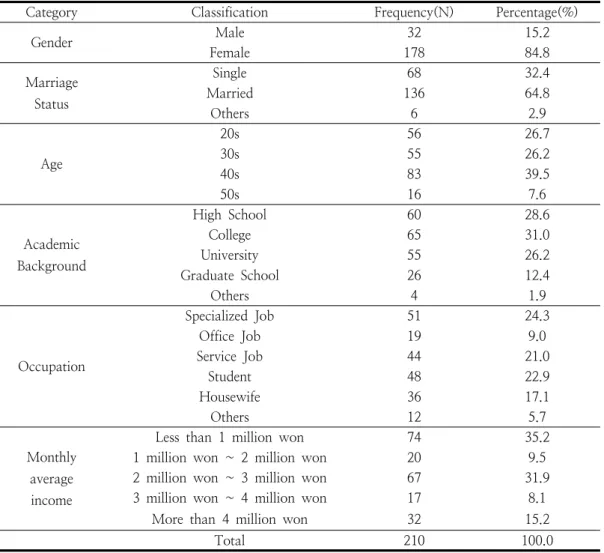
3.1. General CharacteristicsThe general characteristic results of the subjects in this study were shown in <Table 1>. In terms of gender, 32 males (15.2%), 178 females (84.8%), in marital status, 68 unmarried (32.4%), 136 married (64.8%), and 6 others (2.9%), and in ages, 56 people in their 20s (26.7%), 55 in their 30s (26.2%), 83 in their 40s (39.5%), and 16 in their 50s (7.6%). In terms of academic backgrounds, the number of high school graduates was 60 (28.6%), college 65 (31.0%), university 55 (26.2%), graduate school 26 (12.4%), and 4 others (1.9%), and in occupation status, it shows that 51 specialized job (24.3%), 19 office job (9%), 44 service job (21.0%), 48 students (22.9%), 36 housewives (17.1%) and 12 others (5.7%). And in terms of monthly average incomes, 74 people (35.2%) under 1 million won, 20 (9.5%) 1~2 million, 67 (31.9%) 2~3 million, 17 (8.1 %) 3~4 million, and 32 (15.2%) more than 4 million won.
Table 1. General characteristics of respondents
(N=210) Category Classification Frequency(N) Percentage(%)
Gender Male 32 15.2 Female 178 84.8 Marriage Status Single 68 32.4 Married 136 64.8 Others 6 2.9 Age 20s 56 26.7 30s 55 26.2 40s 83 39.5 50s 16 7.6 Academic Background High School 60 28.6 College 65 31.0 University 55 26.2 Graduate School 26 12.4 Others 4 1.9 Occupation Specialized Job 51 24.3 Office Job 19 9.0 Service Job 44 21.0 Student 48 22.9 Housewife 36 17.1 Others 12 5.7 Monthly average income
Less than 1 million won 74 35.2 1 million won ~ 2 million won 20 9.5 2 million won ~ 3 million won 67 31.9 3 million won ~ 4 million won 17 8.1
More than 4 million won 32 15.2
Total 210 100.0
3.2. Skin Stress Recognition by Wearing Face Masks
3.2.1. Average daily mask wear time during Covid-19
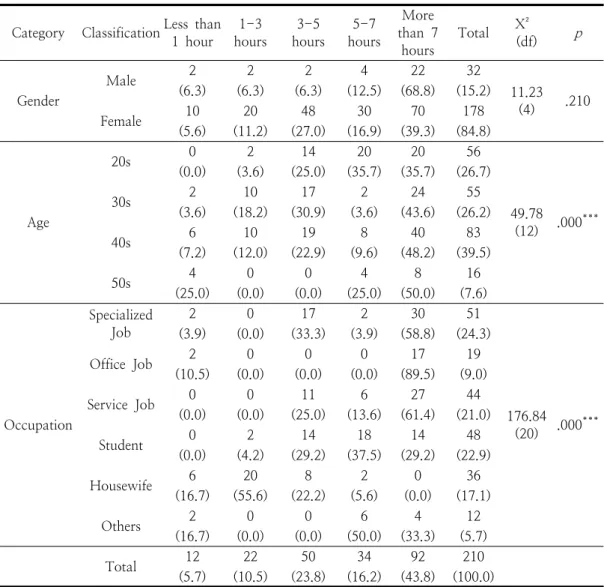
The World Health Organization recommends covering the nose, mouth and chin using masks as part of a comprehensive action strategy to contain transmission and save lives[16]. The results of the study's average daily mask wear time during the Covid-19 period were shown in
<Table 2> according to gender, age, and occupation. 43.8% of the total wore masks for more than 7 hours, followed by 23.8% for 3 to 5 hours. By gender, 68.8% for men and 39.3% for women, 35.7% for those in their 20s, 43.6% for those in their 30s, 48.2% for 40s, 50.0% for those in their 50s. Office Job 89.5%, 61.4% for services and 58.8% for professionals, Gender was found to have no significant differences, but it was shown to have significant results depending on age and occupation. (p<.000).
Table 2. Average daily mask wearing time during Covid-19
(N=210)
Category ClassificationLess than 1 hour 1-3 hours 3-5 hours 5-7 hours More than 7 hours Total X² (df) p Gender Male 2 2 2 4 22 32 11.23 (4) .210 (6.3) (6.3) (6.3) (12.5) (68.8) (15.2) Female 10 20 48 30 70 178 (5.6) (11.2) (27.0) (16.9) (39.3) (84.8) Age 20s 0 2 14 20 20 56 49.78 (12) .000 *** (0.0) (3.6) (25.0) (35.7) (35.7) (26.7) 30s 2 10 17 2 24 55 (3.6) (18.2) (30.9) (3.6) (43.6) (26.2) 40s 6 10 19 8 40 83 (7.2) (12.0) (22.9) (9.6) (48.2) (39.5) 50s 4 0 0 4 8 16 (25.0) (0.0) (0.0) (25.0) (50.0) (7.6) Occupation Specialized Job 2 0 17 2 30 51 176.84 (20) .000 *** (3.9) (0.0) (33.3) (3.9) (58.8) (24.3) Office Job 2 0 0 0 17 19 (10.5) (0.0) (0.0) (0.0) (89.5) (9.0) Service Job 0 0 11 6 27 44 (0.0) (0.0) (25.0) (13.6) (61.4) (21.0) Student 0 2 14 18 14 48 (0.0) (4.2) (29.2) (37.5) (29.2) (22.9) Housewife 6 20 8 2 0 36 (16.7) (55.6) (22.2) (5.6) (0.0) (17.1) Others 2 0 0 6 4 12 (16.7) (0.0) (0.0) (50.0) (33.3) (5.7) Total 12 22 50 34 92 210 (5.7) (10.5) (23.8) (16.2) (43.8) (100.0) *p<.05, **p<.01, ***p<.001
3.2.2. Skin Stress Recognition by Wearing Face Masks
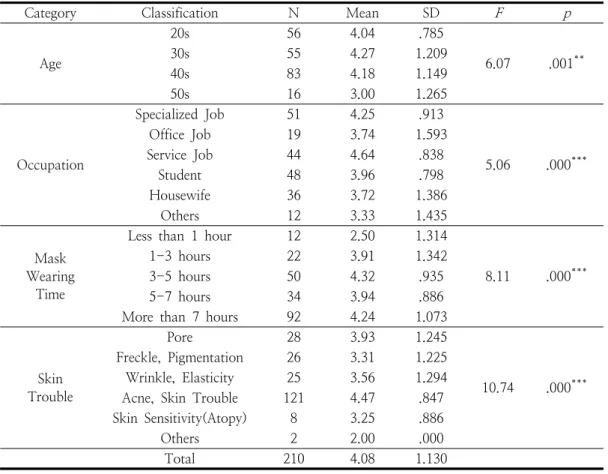
The results of the survey on skin stress recognition by wearing masks were summarized and shown in <Table 3>. According to age, people in their 30s(M=4.27) have the highest skin stress recognition level and those in their 50s(M=3.00) have the lowest level. By occupation, service workers(M=4.64) have the highest stress recognition, the lowest others
(M=3.33), and higher if they wear masks for more than 3-5 hours(M=4.32). It was also found that people with concerns such as acne and skin trouble(M=4.47) perceive stress the most. Skin stress recognition and age (F=6.07,
p<.001), occupation (F=5.06, p<.000), mask wear time (F=8.11, p<.000), and skin concern (F=10.74 and p<.000) all showed significant differences.
Table 3. Recognition of Skin Stress by Wearing Face Masks
(N=210) Category Classification N Mean SD F p
Age 20s 56 4.04 .785 6.07 .001** 30s 55 4.27 1.209 40s 83 4.18 1.149 50s 16 3.00 1.265 Occupation Specialized Job 51 4.25 .913 5.06 .000*** Office Job 19 3.74 1.593 Service Job 44 4.64 .838 Student 48 3.96 .798 Housewife 36 3.72 1.386 Others 12 3.33 1.435 Mask Wearing Time
Less than 1 hour 12 2.50 1.314
8.11 .000***
1-3 hours 22 3.91 1.342 3-5 hours 50 4.32 .935 5-7 hours 34 3.94 .886 More than 7 hours 92 4.24 1.073
Skin Trouble Pore 28 3.93 1.245 10.74 .000*** Freckle, Pigmentation 26 3.31 1.225 Wrinkle, Elasticity 25 3.56 1.294 Acne, Skin Trouble 121 4.47 .847 Skin Sensitivity(Atopy) 8 3.25 .886
Others 2 2.00 .000
Total 210 4.08 1.130 *p<.05, **p<.01, ***p<.001
3.3 Skin Concern with Face Masks
3.3.1. Skin Concerns in Wearing Area of Face Masks
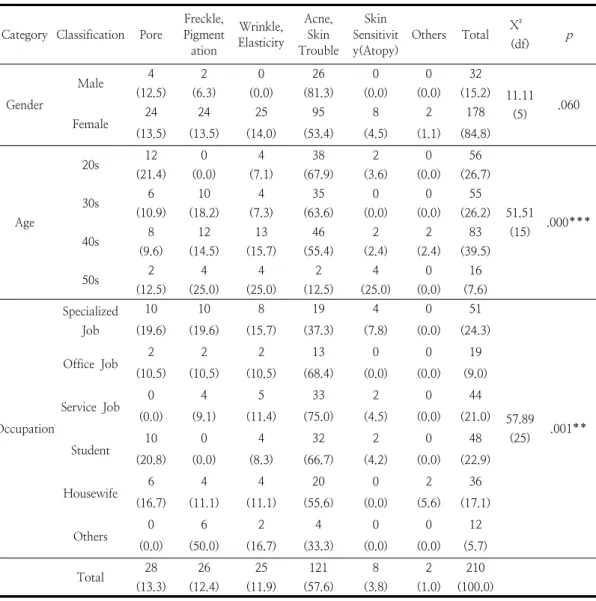
The analysis of skin concerns in the area of wearing face masks, according to gender, age, and occupation, was shown in <Table 4>. The largest skin concerns found in the area of wearing face masks were acne and skin trouble at 57.6%, followed by Pore 13.3%, Freakle and Pigmentation 12.4%, Wrinkle and Elasticity 11.9%, Skin Sensitivity 3.8%, and Others 1.0%. 57.6% of the respondents answered that they had acne and skin troubles, 82.3% for men and 53.4% for women, and there was no significant
difference(X²=11.11, p<.060). By age (X²= 51.51, p<.000), 67.9% in their 20s who are worried about acne and skin trouble, 63.6% in their 30s, 55.4% in their 40s, and 12.5% in their 50s. In addition, 75.0% of service workers, Office Job 68.4% and 66.7% of students showed significant results by occupation (X²=57.89, p<.001).
In a previous study, respondents thought that professional care for skin problems was the most ideal skin care practice, but in the Covid-19 situation, many forms of service had changed to a non-face-to-face society, which limited individual lifestyles and made it difficult to get face-to-face service.[17].
Table 4. Skin Concerns of Mask Wearing Area
(N=210)
Category Classification Pore
Freckle, Pigment ation Wrinkle, Elasticity Acne, Skin Trouble Skin Sensitivit y(Atopy) Others Total X² (df) p Gender Male 4 2 0 26 0 0 32 11.11 (5) .060 (12.5) (6.3) (0.0) (81.3) (0.0) (0.0) (15.2) Female 24 24 25 95 8 2 178 (13.5) (13.5) (14.0) (53.4) (4.5) (1.1) (84.8) Age 20s 12 0 4 38 2 0 56 51.51 (15) .000*** (21.4) (0.0) (7.1) (67.9) (3.6) (0.0) (26.7) 30s 6 10 4 35 0 0 55 (10.9) (18.2) (7.3) (63.6) (0.0) (0.0) (26.2) 40s 8 12 13 46 2 2 83 (9.6) (14.5) (15.7) (55.4) (2.4) (2.4) (39.5) 50s 2 4 4 2 4 0 16 (12.5) (25.0) (25.0) (12.5) (25.0) (0.0) (7.6) Occupation Specialized Job 10 10 8 19 4 0 51 57.89 (25) .001** (19.6) (19.6) (15.7) (37.3) (7.8) (0.0) (24.3) Office Job 2 2 2 13 0 0 19 (10.5) (10.5) (10.5) (68.4) (0.0) (0.0) (9.0) Service Job 0 4 5 33 2 0 44 (0.0) (9.1) (11.4) (75.0) (4.5) (0.0) (21.0) Student 10 0 4 32 2 0 48 (20.8) (0.0) (8.3) (66.7) (4.2) (0.0) (22.9) Housewife 6 4 4 20 0 2 36 (16.7) (11.1) (11.1) (55.6) (0.0) (5.6) (17.1) Others 0 6 2 4 0 0 12 (0.0) (50.0) (16.7) (33.3) (0.0) (0.0) (5.7) Total 28 26 25 121 8 2 210 (13.3) (12.4) (11.9) (57.6) (3.8) (1.0) (100.0) *p<.05, **p<.01, ***p<.001
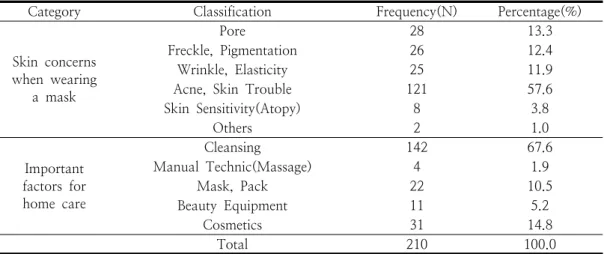
3.3.2. Skin Concern and Home Care in the Period of Wearing Face Masks
The results of the survey on skin concern and the status of home care were summarized and shown in <Table 5>. 57.6% of people answered skin concerns with acne and skin troubles, 13.3% of pores, 12.4% of freckle and pigmentation, 11.9% wrinkle and elasticity, 3.8% of skin sensitivity (atopy) and 1% of
others.
In addition, a survey on important factors for home care showed that cleansing was the most important with 67.6%, followed by cosmetics with 14.8%, masks and packs with 10.5%. This result shows the same results of a prior study that consumers want not only basic cleaning functions but also skin moisturizing and skin care functions just by using cleansing
Category Classification Frequency(N) Percentage(%) Skin concerns when wearing a mask Pore 28 13.3 Freckle, Pigmentation 26 12.4 Wrinkle, Elasticity 25 11.9 Acne, Skin Trouble 121 57.6 Skin Sensitivity(Atopy) 8 3.8 Others 2 1.0 Important factors for home care Cleansing 142 67.6 Manual Technic(Massage) 4 1.9 Mask, Pack 22 10.5 Beauty Equipment 11 5.2 Cosmetics 31 14.8 Total 210 100.0
Table 5. Skin Concerns and Home Care Status when Wearing Face Masks
(N=210)
products[18]. These results also support the findings of previous studies showing that more acne care cosmetics are used after Covid-19 comparing to the data before Covid-19[19]. 3.4 Status of beauty care during Covid-19 The data on the status of beauty care during Covid-19 was shown in <Table 6>. Among the factors of interest in beauty care, skin care was the highest with 36.7%, body shape management was 33.3%, and hair care was 15.7%. As for the monthly cost of beauty care, 62.4% of the cost was less than 100,000 won, and 28.1% of the cost 100,000 ~ 200,000 won. Consideration factors when choosing beauty care, 54.3% of service and customer care followed by 19.5% of treatment programs. For body shape management method, 45.7% of the respondents said exercise, 27.6% of the diet, and 17.6% of the respondents said they have professional esthetic salons for it. This is the same as the results of previous studies suggesting that people who exercise mainly use home training without any time or place limitations and that it is a good help to the quality of life[20].
3.5 Skin Care Behavior during Covid-19 The results of analyzing the skin care
behavior of the subjects during the Covid-19 period were summarized as shown in <Table 7>. When asked about the experience of using the skin care salon before(M=3.18) and after Covid-19(M=1.69), the experience of using the skin care salon afterwards has decreased compared to the previous one.
In addition, when asked about changes in skin type, home care and use of beauty devices after Covid-19, many respondents answered that there were changes(M=3.70), especially various troubles in their skin caused by long-term use of the face masks(M=3.95) and increased in number of home care(M=3.41), Mask Packs for skin beauty(M=3.50) and use of home care equipments(M=3.19) after Covid-19 epidemic.
4. Conclusion
In this study, the level of skin stress recognition and beauty care status caused by wearing face masks during the Covid-19 epidemic were investigated through a survey focusing on skin care behavior, and the results are summarized as follows.
Table 6. Status of beauty care during Covid-19
(N=210) Category Classification Frequency(N) Percentage(%)
Interest Factor of Beauty Care
Skin care 77 36.7
Body shape management 70 33.3
Hair care 33 15.7
Make up 24 11.4
Medical and Cosmetic surgery 6 2.9 Cost of
monthly use for Beauty Care
Less than 100,000 won 131 62.4 100,000 ~ 200,000 won 59 28.1 200,000 ~ 300,000 won 14 6.7 300,000 ~ 400,000 won 4 1.9 More than 400,000 won 2 1.0
Consideration Factor for Beauty Care
Price 28 13.3
Service and Customer Care
Capabilities 114 54.3
Level of Beauty Products and
Equipments 25 11.9 Indoor Environment 2 1.0 Treatment Programs 41 19.5 Body Shape Management Method Exercise 96 45.7 Diet 58 27.6 Diet Medication 2 1.0 Diet Supplements 17 8.1 Esthetic Salon 37 17.6 Total 210 100.0
Table 7. Skin Care Behavior during Covid-19
(N=210)
Questions N Mean SD
1. Experience of using the Skin Care Salon before
Covid-19 210 3.18 1.558
2. Experience of using the Skin Care Salon after
Covid-19 210 1.69 1.168
3. Changes in Skin Types since Covid-19 210 3.70 1.062 4. Skin trouble caused by long-term use of Face
Masks 210 3.95 1.066
5. Increase in number of Home Care for skin beauty
due to Covid-19 210 3.41 1.281 6. Increase in number of Home Care Equipments for
skin beauty due to Covid-19 210 3.19 1.398 7. Increase in number of Mask Packs for skin beauty
First, a survey of the average daily mask wearing time during the Covid-19 period showed that nearly half of the people wore masks for more than seven hours, and it increased as the age increased, and by occupation, office and service workers showed high value. Skin stress recognition by wearing a mask is the highest in 30s and service workers, and people with acne and skin trouble perceive stress as high.
Second, the biggest skin problem in the area of wearing a face mask was acne and skin trouble, followed by Pore. People in their 20s are most worried about acne and skin troubles, and by profession, service workers are the highest. In a survey on the important factors for home care in terms of the skin troubles, cleansing was the most.
Third, after looking at the status of beauty care during Covid-19, skin care was the highest as a factor of interest in beauty care, followed by body shape management. Consideration factors in selecting beauty care were shown as service and customer management skills, and exercise was the highest as a method for body shape management.
Fourth, looking at the skin care behavior during the Covid-19 period, it was found that the use of the esthetic shops has decreased a lot after Covid-19. Many of the respondents recognized that skin types had changed since Covid-19, and that skin problems had been caused by wearing masks for a long time. In addition, the number of home care, mask packs and use of beauty devices for skin beauty were found to be above average.
After conducting this study, suggestions for future research are as follows.
First, the long-term use of face masks during the Covid-19 period showed significant skin stress, but the wearing of masks for personal hygiene is expected to continue for a while in the future, so research should continue to improve the environment of the area of wearing face masks.
Second, since acne and skin troubles are
found to be high in areas where masks are worn, the development of cosmetics and programs for esthetic shops to improve these skin problems are needed.
Third, in situations like Covid-19, it is necessary to develop a new program that combines the professional esthetic shops and home care efficiently.
Based on the results of this study, it is predicted that understanding the skin stress recognition and beauty care status of wearing face masks and using them as data for the beauty industry will help develop skin care programs suitable for the Covid-19 situation.
References
1. Korea Centers for Disease Control and Prevention, "Coronavirus Infections-19 Information”, http://ncov.mohw.go.kr/, (accessed Apr., 3, 2021)
2. S. E. Park, “Epidemiology, Virology, and Clinical Features of Severe Acute Respiratory Syndrome Coronavirus 2 (SARS-CoV-2;Coronavirus Disease-19)”,
Pediatr Infect Vaccine, Vol.27, No.1, p. 7, (2020).
3. Ministry of Health and Welfare, "The scope of mandatory wearing of masks at the stage of social distancing", (2020). 4. S. Y. Kim , S. H. Li . “Correlation among
wearing masks because of Covid-19, makeup Satisfaction and goal-oriented attitude”, Journal of Convergence for Information Technology, Vol.10, No.12, p. 163, (2020).
5. Y. M. Park, H. Y. Kim, “A Study on Changes in Women's Makeup Interest and Use Patterns Before and After the Outbreak of Covid-19“, Asian Journal of Beauty and Cosmetology, Vol.19, No.1, p. 135, (2021).
6. M. J. Kim, C. M. Yu, “The Effects of Long-term Mask Wearing on Aesthetic Behavior: Focusing on the Covid-19
pandemic", Journal of the Korean Society of Beauty and Art, Vol.21, No.3, p. 19, (2020).
7. S. E. Bae, “The effect of wearing a mask due to Covid-19 on the skin condition and skin care behavior of adults”, Master's thesis, Daegu Haany University, p. 66, (2020).
8. D. J. Park, “Effects of Social Risks due to Covid-19 on the Beauty Consumption Psychology and Shopping Patterns as well as Response Measures”, Master's thesis, Hannam University, pp. 104-105, (2021). 9. T. Y. Kim, S. N. Lee, “The Mediating
Effect of Job Satisfaction on the Relationship between Internal Marketing and the Customer Orientation of Employees in the Beauty Service Industry”,
Asian Journal of Beauty and Cosmetology, Vol.16, No.4, p. 555, (2018).
10. M. J. Kim, C. M. Yu, “The Effects of Long-term Mask Wearing on Aesthetic Behavior: Focusing on the Covid-19 pandemic", Journal of the Korean Society of Beauty and Art, Vol.21, No.3, p. 19, (2020).
11. J. Y. Park, E. S. Jeong,. “A Study of the Evaluation on Selection Attributes of Skincare Salons Using Importance- Performance Analysis (IPA) -Focusing on the Difference between Sole Proprietor and Franchise Salons-”, Korean Journal of Aesthetics and Cosmetology, Vol.7, No.3, pp. 225-238. (2009).
12. I. O. Kim, “The Effect of Female Body Image and Beauty Interest on Beauty Management Behavior”, Master's thesis, Hansung University, pp. 91-92, (2019).
13. S. K. Jeong, “Customer Satisfaction Analysis According To The Women's Skin Care Realities”, Master's thesis, Chung- Ang University, p. 21, (2008).
14. D. Yu,, “A Study on the Effect on Customer Satisfaction of Characteristics of the Members of Franchise: Focusing on Beauty Center”, Master's thesis, Gachon University, pp. 101-107, (2014).
15. H. P. Lee, “Basic Statistics Using IBM SPSS 25”, Book publication Hwasumoc, p. 353-354, (2019).
16. M. J. Kim, C. M. Yu, “The Effects of Long-term Mask Wearing on Aesthetic Behavior: Focusing on the Covid-19 pandemic", Journal of the Korean Society of Beauty and Art, Vol.21, No.3, p. 22, (2020).
17. WHO(World Health Organization), h t t p s : / / w w w . w h o . i n t / e m e r g e n c i e s / , (accessed Apr., 3, 2021).
18. M. H. Shin, “A Study on the Use of Cleansing Products and the Relationship between Skin Care and Skin Type”, Master's thesis, Hansung University, pp. 70-71, (2017).
19. S. E. Bae, “The effect of wearing a mask due to Covid-19 on the skin condition and skin care behavior of adults”, Master's thesis, Daegu Haany University, p. 68, (2020).
20. Q. Y. CHEN , “The Effect of Beauty Health Care Behaviors on Perceived Interactions and Quality of Life“, Master's thesis, Chonnam National University, p. 48, (2020).