© Korean Powder Metallurgy Institute 973
-Mechanical alloying (MA) is a solid-state powder processing method which has the ability to synthesize a variety of new alloy phases including supersaturated solid solutions, nanocrystalline structures, amorphous phases and intermetallic compounds. In this investigation, the interaction between aluminum and iron caused by MA of Fe-XAl (where X ranged between 30 to 90%) has studied as a function of milling time and post heat-treating temperatures. The sequences of structural and/or phase transformation and the behavior of mechanically alloyed powders have been assessed using XRD, hardness and magnetometer. It was found that, during mechanical milling of elemental powder Al and Fe, five milling stages were categorized, namely, particle flattening, welding predominance, equiaxed formation, random welding orientation and steady state composite particles. All milled powders showed nano-sized powder mixtures after milling for 20hrs. When Fe-30%Al powder was milled for 150hrs, partially ordered AlFe phase was obtained. However, when these saturated solid solutions were heat treated at 5000C, AlFe intermetallic was precipitated in fully ordered. When the Al increasing up to 40% was milled for 50 hr, the XRD pattern showed a broad halo, spectrum which mast formation of an amorphous phase. When Fe-60%Al powder mixture was mechanically milled for 50 hr, Al5Fe2 intermetallic formed associated with an amorphous phase, which transformed into Al3Fe intermetallic by heat treating at 5000C. In case Fe-75% and Fe-90% Al milled for 150 hrs only Al peaks appeared and were shifted to higher angles, suggesting that Fe atoms diffused into Al, leading to the formation of a solid solution.
Raw materials used were high pure powders of Fe and Al at least 99.9% purity. The powder sizes were smaller than 45µm. These powders were blended to form composition of (Fe-XAl) alloys, where X is ranging [30, 40, 60, 75 and 90] in order to cover almost all main compositions of the binary systems of (Fe-Al). A home-made shaker-type mill was used for mechanical milling. The mechanical alloying process was carried out at room temperature and in argon atmosphere. Hardness tests were performed for as milled powders. The powders were mounted in a cold epoxy resin cured at room temperature and were successively polished by diamoned paste down to 0.25µm. Microharness data of the milled powders were measured by an indentation technique, using Vickers Hardness Tester type (Shimadzu Microhardness), at a load of 25gm. About eight to ten measurements were made on each sample.
A philips X-Ray diffractometer (XRD), type PW1370 was used to examine the structure variation during milling, at 30kV potential and 25mA current at scanning speed of one (cm) 2θ per minute. From XRD patterns, the average grain size of the formed phases was calculated from the fullwidth at half-maximum of main peak measurments, using the Scherrer`s equation [10]. The lattice parameter (a0) was determined for the milled powder by XRD using internal standerd as mentioned by Klug and Alexander [11]. The magnetic measurements are realized using a hystereimeter LDJ Electronics, Inc Troy, MT U.S.A 9600-1 VSM.
The XRD was used to follow the structural changes during mechanical alloying of (Fe-XAl) powder mixtures, and to measure the changes in crystallite size, lattice parameter and strain as a function of milling time.
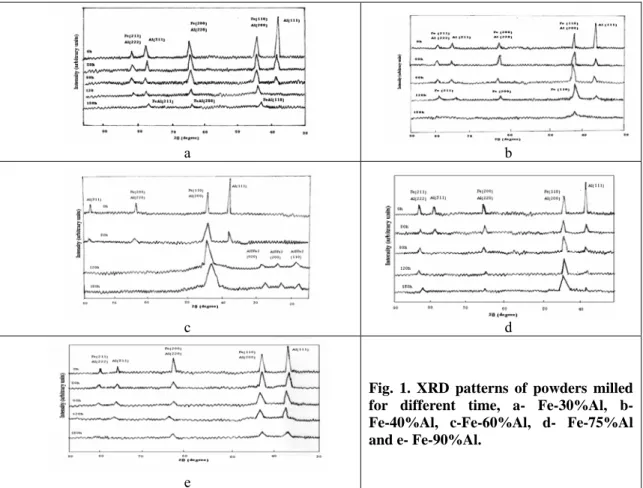
Fig.1 (a) shows XRD patterns of Fe-30% Al alloy as a function of milling time. The as powder mixture, showed all the expected peaks from both Fe and Al, with the Fe (110), Fe (200) and Fe (211) peaks overlapping with the Al (200), Al (200) and Al (222) peaks, respectively. As milling time increased, the extent of diffusion of elemental Al into Fe during milling leading to the formation of FeAl, where the disappearance of the Al peak is evident after about 120 hr milling. Longer milling times up to 150 hr leave the alloyed powders in a partially ordered state. The lattice parameter of FeAl, calculated from Fe (110), had increased from the initial value of 0.2866nm, in the blended stat, to 0.2885nm, after milling time of 120hr, which remained constant with increasing milling time up to 150hr, indicating that the maximum solubility level had been reached, as indicated. The crystallite size was calculated for each alloy from the broadening of X-ray peaks at half of main peak using the Scherrer formula [16]. Fig. 2 shows the variation of crystalline size with milling time, from which it can notice that nanometer- sized crystals were formed after long milling. Also, the average root mean square rms - strain of Fe-30%Al increased with the increase of milling time, see Fig.3. This might be due to the introduction of excessive cold working into the powder particles due to milling effect, which resulted in the generation of high saturation of defects producing high strains.
When Fe-40%Al powder mixture was mechanically milled, it was founded that the resultant structure up to 120hr was similar to that of Fe-30%Al. However, with increased milling time to 150hr, the XRD pattern showed a broad halo, suggesting the formation of an amorphous phase, as indicated in Fig. 1 (b). If the Fe content was increased such that the initial composition of the powder mixture was Fe-60%Al, Al5Fe2 intermetallic started to form after 120hr milling time, with presence of amorphous phase at 2θ 400 to
2006 POWDER METALLURGY World Congress
PA02-W-15
Solid-state Reaction in Al-Fe Binary System Induced by Mechanical Alloying
S. H. Kaytbay, S.F. Moustafa and W.M. Daoush© Korean Powder Metallurgy Institute 974 -450, as indicated in Fig.1 (c).
Fig. 1(d) shows the XRD patterns of Fe-75%Al powder mixture as a function of milling time. No evidence of formation of Al3Fe phase can be detected even after 150hr of mechanical milling, and only Al solid solution was observed.
There are two possibilities for this lack of formation: 1. no formation of Al3Fe phase with this composition after 150hr of mechanical alloying, or 2. formation of Al3Fe phase but in the nanocrystalline form. The XRD patterns of Fe-90%Al powder as a function of milling time is shown in Fig. 1 (e). With increasing milling time, the Al peaks shifted to higher angles, suggesting alloying of Fe into Al, leading to the formation of a solid solution. Again there is no evidence
for the presence of Al3Fe can be detected even after mechanical alloying for 150hr. The two possibilities that have been mentioned above are also applied for this case. Nano-meter crystal size can be obtained by mechanical alloying in all investigated (Fe-Al) powder mixture compositions. The partially ordered FeAl phase could be obtained directly by mechanical alloying in Fe- 30 and 40 wt%Al. The Al5Fe2 phase could be synthesized directly by milling Fe-60 wt% Al powders. Heat treatment of milled powders is necessary to synthesize the Al3Fe intermetallics and the formation of fully ordered FeAl phase. The coercivity of par0ticles increase for smaller particles. The saturation magnetization of sample decrease after milling due to change in crystal structure.
a b
c d
e
Fig. 1. XRD patterns of powders milled for different time, a- Fe-30%Al, b- Fe-40%Al, c-Fe-60%Al, d- Fe-75%Al and e- Fe-90%Al.