© Korean Powder Metallurgy Institute 1251
-1. Introduction
Bi-2223/Ag tapes fabricated by PIT(Powder In Tube) process can relatively well maintain superconducting properties under bending and tension stress since fine superconducting cores are embedded in the pure silver or silver alloy matrix. On the other hand, superconducting devices using Bi-2223/Ag tapes are almost all used at cryogenic temperature under 77 K after they had been made at room temperature. Therefore, the differences of thermal expansion between superconductor, matrix and magnet former can cause the degradation of superconducting property such as critical current. Especially, Bi-2223/Ag tapes are subject to complex stress-strain conditions that consist of bending, tension and thermal stress-strain when they are used to make the electric applications. Complex stress-strain compared to single stress or strain causes more serious degradation of superconducting property of Bi-2223/Ag tapes. Osamura group and Shin et al have intensively worked to investigate the degradation mechanism of Bi-2223/Ag tapes to the tension and bending stress-strain conditions[1,2]. Ten Kate group have also reported about mechanical properties of Bi-2223/Ag tapes using the U-shape apparatus[3].
In this study, the relationship of complex stress-strain and critical current property has been investigated using the bending and tension apparatus.
2. Experimental and Results
First of all, Bi-223/Ag tapes were fabricated by PIT process using Bi1.8Pb0.4Sr2Ca2Cu3Ox precursor powder
and Ag tube. The final tapes dimensions were 0.16 mm thick and 4.05 mm width. To investigate the stress-strain characteristics of Bi-2223/Ag tapes, we have deviced the apparatus that can apply the tension and bending stress-strain to the tapes simultaneously or individually. Fig. 1 shows the apparatus and crosssection of 55 filamentary Bi-2223/Ag tapes. Tension and bending test was carried out to know the effect of deformation temperature and stress-strain on the critical current of superconducting tapes. Complex stress-strain test was proceeded to compare to the results of the single stress-strain tests.
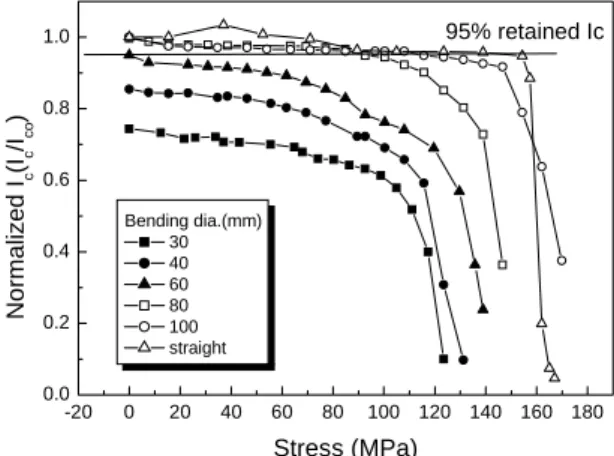
Based on the results of single bending and tension stress-strain, complex stress-strain deformation that is more similar to the real condition for magnet winding was applied to the tapes. We have varied the bending diameter from 30 to 100 mm including only straight and tension stress from 0 to 180MPa. Bi-2223/Ag tapes were already bended along the bending former at room temperature before cooling down to 77K. Therefore, each critical current at 0 MPa was degraded with inverse proportional to the each bending diameter.
Fig. 2 shows the relationship of complex stress-strain and normalized critical current of Bi-2223/Ag tapes. Critical current behavior of complex bended tape with 100 mm diameter is similar to that of the only tension defrormed tapes. In this case, complex stress-strain is not different from single stress-strain. But, complerx stress-strain has degraded critical current more seriously than that of single stress-strain when the tape was bended below 100 mm diameter. And also, critical current of the tape was drastically decreased due to smaller bending diameter below 80 mm without tension stress.
2006 POWDER METALLURGY World Congress
PC14-W-09
The Effect of Deformation Stress-strain and Temperature on the I
cDegradation of
Bi-2223/Ag Tapes
Hong Soo Ha1,2,a, Sang Cheol Kim3,b, Dong Woo Ha1,c, Sang Soo Oh1,d, and Jin Ho Joo2,e 1
Superconducting Materials Group, KERI, 28-1, Seongju-dong, Changwon, Gyeongnam, 641-120, Korea
2
School of Advanced Materials Science and Engineering, Sungkyunkwan University, 300, Cheoncheon-dong, Jangan-ku, Suwon, Gyeonggi, 440-746, Korea
3
Nexans Korea Ltd., 165, Sadongri, Namemyun, Cheongwongun, Chungbuk, 363-812, Korea
a
[email protected], [email protected], [email protected], [email protected], [email protected] Abstract
In order to investigate 95% retained critical current of Bi-2223/Ag tapes under various stress-strain conditions, load cell attached tension and bending apparatus was used. The critical current of stress-strained tape was degraded below 95% retained critical current when tension and bending was simultaneously applied together. But only one of this tension or bending did not degrade the tape below 95% retained critical current. Deformation temperature was important to maintain the 95% retained Ic of Bi-2223/Ag tapes after bending or tension deformation because mechanical strength of tapes can be changed drastically between room temperature and 77 K.
© Korean Powder Metallurgy Institute 1252 -(a)
(b)
Fig. 1. Photos of (a) bending and tension apparatus (b)cross-section of Bi-2223/Ag tapes
Critical current of Bi-2223/Ag tapes that have lower than 95% retained Ic at 0 MPa was decreased easily at low stress condition below yield strength stress. Yield strength was reduced in prpoportional to the bending diameter in which critical current was abruptly decreased near the yield strength. It could be explained that crack was generated at ceramic core and just propagates to the neighbor grains by elongation of Ag. In spite of the fact that yield strength of Bi-2223/Ag tapes are about 150 MPa at 77K, the tape deformed with complex stress-strain at 30 mm diameter shows that yield strength was as low as that of room temperature deformed tape.
-20 0 20 40 60 80 100 120 140 160 180 0.0 0.2 0.4 0.6 0.8 1.0 95% retained Ic No rm a lized Ic (Ic /Ico ) Stress (MPa) Bending dia.(mm) 30 40 60 80 100 straight
Fig. 2. Tension stress dependence of critical current for Bi-2223/Ag tapes deformed with various bending diameter.
3. Summary
We have used successfully bending and tension apparatus to apply the complex stress-strain to the Bi-2223/Ag tapes. Bending and tension characteristics of the tapes deformed at 77K are superior to that of deformed at room temperature. The critical current of complerx stress-strained tape was degraded more seriously than that of simple stress-strained tape at bending diameter of below 100 mm. Yield strength and 95% retained critical current of complex stress-strained tapes were reduced in proportion to the bending diameter.
4. Acknowledgements
This research was supported by a grant from Electric Power Industry Technology Evaluation & Planning of the Electric Power Industry R&D Program funded by the Ministry of Commerce, Industry and Energy, Republic of Korea
5. References
1. M.Hojo, M.Nakamura, M.Tanaka, T.Adachi, M.Sugano, S.Ochiai and K.Osamura: Supercond. Sci. Technol. Vol.18(2005), p.S356.
2. H.S.Shin, K.Katagiri: Supercond. Sci. Technol. Vol.16(2003), p.1012.
3. H.J.N. van Eck, L. Vargas, B. ten Haken, H.H.J. ten Kate: Supercond. Sci. Technol. Vol.15(2002), p.1213